Transmogrification

Transmogrification, though it carries a slightly literary, almost mythic tone, suggests not just change but a deep and strange transformation into something fundamentally different.

For much of its recorded history, the Mojave Desert was primarily understood as a physical region. Its identity arose from terrain and climate. Dense or permanent human occupation played little role. Early travelers, surveyors, geologists, and writers described it using the language of the landform. They noted broad basins, isolated mountain ranges, dry lakes, volcanic fields, alluvial fans, dunes, washes, and the intermittent course of the Mojave River. The desert was seen as a geographical system. Uplift, erosion, aridity, and distance formed it. Its boundaries were often indistinct. The Mojave was not yet a tightly organized human landscape. It was seen as open country, with character shaped by the land’s form.

In that earlier conception, geography imposed limits upon people. Travel followed springs, canyon mouths, and natural passes through the mountains. Camps and settlements clustered where water permitted survival. Roads bent around lava flows, crossed playas, or traced older Indigenous routes refined over generations of movement through the desert. Human activity existed within conditions dictated by climate and terrain. The desert remained the dominant force, and people adapted themselves to it.
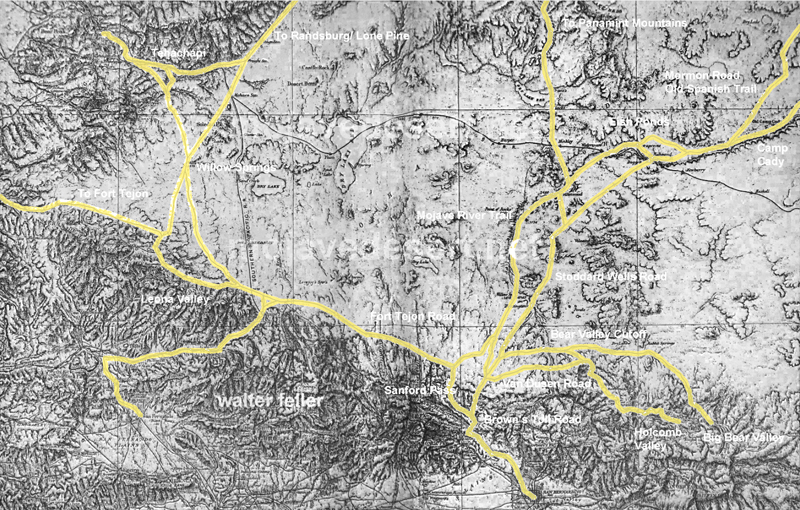
Even with these earliest permanent intrusions, the long-standing dynamic between people and landscape was not immediately overturned. Mining camps rose and disappeared as ore deposits and water supplies fluctuated. Wagon roads faded when springs failed. Small railroad towns appeared abruptly but often remained fragile in the face of the scale and hostility of the surrounding landscape. Much of the Mojave still retained the appearance of a place shaped principally by geology rather than by civilization.
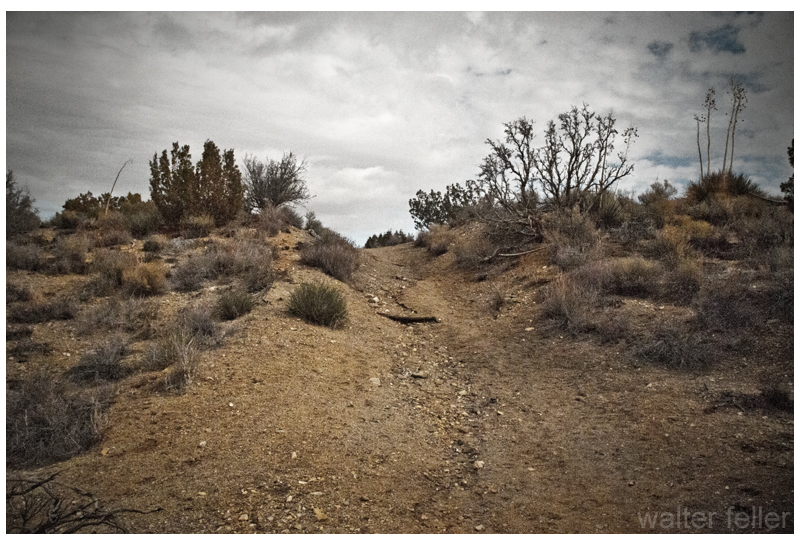
Over time, a shift occurred: the Mojave, once defined by natural systems, increasingly came to be structured around human needs. The first key shift came with railroads, which established artificial centers in previously insignificant locations—places that had mattered only as crossings or water stops. Afterward, elements like highways, aqueducts, transmission corridors, military reservations, utility infrastructure, suburban expansion, recreational development, industrial agriculture along the margins, and large-scale energy production continued this trend. These forces did not simply occupy the desert; they actively reorganized it.
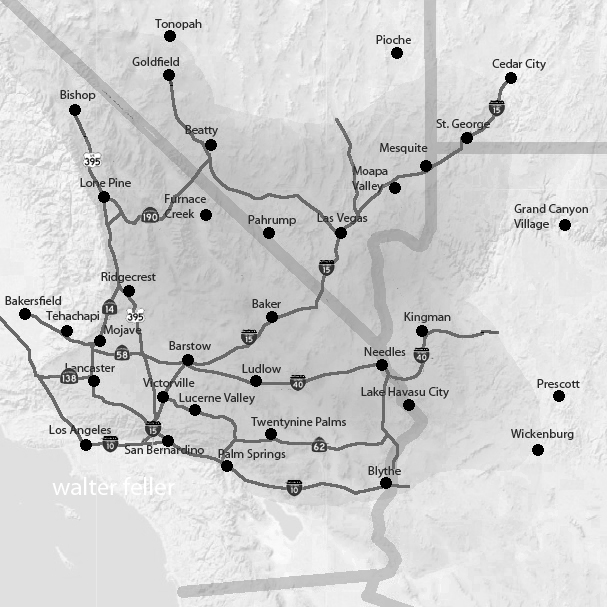
A modern map of the Mojave clearly reveals this shift: vast military boundaries now dominate entire valleys and mountain ranges. Meanwhile, interstate highways create strong directional corridors across what were once diffuse travel landscapes. Utility-scale solar developments, visible for miles, convert open basins into industrial energy fields. Transmission towers march across dry lakes and bajadas. Off-road recreation networks carve repeating tracks into fragile terrain. Finally, conservation areas and national preserves add another layer of organization by establishing access restrictions, managing habitats, providing tourism infrastructure, and developing preservation policies.

Increasingly, the Mojave is understood less through watersheds and landforms than through jurisdiction and use. One valley becomes associated with military training, another with renewable energy, others with recreation, habitat protection, logistics, or suburban expansion. This shift is reflected in the language used to describe the desert. Whereas earlier generations emphasized playas, volcanic mesas, spring systems, or mountain passes, modern discussions focus on renewable energy zones, conservation plans, transportation corridors, protected acreage, groundwater management, housing pressure, and recreational access.

Yet the older desert has not disappeared beneath these overlays. The geology remains the controlling framework beneath every human system. Basin-and-range topography still governs drainage and movement. Mountain ranges still create rain shadows and isolate valleys. Heat still limits settlement density. Water scarcity still defines possibility. Dry lakes still gather runoff after storms, just as they did centuries ago. In many places, the desert resists permanent transformation. Every generation is reminded that the underlying landscape remains older and more powerful than any system laid upon it.

Building on these evolving layers of meaning, what has changed most is not simply the Mojave’s physical appearance but its significance. The desert has shifted in its conceptual role: initially perceived as a natural form, then as a landscape of use, and now increasingly as a landscape of negotiation.

The central question is no longer merely “What is the Mojave?” but “What is the Mojave for?” Different groups now approach the same landscape with competing visions: energy developers see open basins suitable for solar fields and transmission infrastructure; conservationists see fragile ecosystems, migration corridors, and biological continuity; tribes see ancestral homelands, sacred sites, and cultural memory in the terrain itself. The military sees strategic training space, defined by isolation and open airspace, while residents see communities and livelihoods. Recreationists seek freedom, mobility, solitude, and escape, while cities beyond the desert offer land, water, transportation routes, and energy supplies.

As these pressures intensify, nearly every part of the Mojave acquires overlapping claims—emptiness itself becomes contestable. Open land is no longer simply open; instead, it becomes designated, managed, leased, protected, restricted, industrialized, or defended. Consequently, the future Mojave is likely to be shaped not by a single activity, but by tensions among many competing systems, all operating simultaneously across the same terrain.

In this evolving context, the Mojave is entering a third historical phase. Initially, it was defined by its physical landforms. Next, human activities and uses became the defining factors. Now, the Mojave’s identity may increasingly depend on negotiations and conflicts over its meaning, access, and purpose.

The old desert will still remain beneath these arguments. The playas will still whiten under summer heat. Winds will still sweep across creosote flats. Mountain ranges will still rise abruptly from broad basins at dusk. Seasonal floods will still cut across washes after sudden storms. The geological skeleton of the Mojave will endure. However, as human systems become more extensive and entangled, the experience and interpretation of the desert will continue to change.

The future Mojave will be governed as a layered landscape. No single authority will determine its fate: federal agencies will control vast public lands; counties will regulate roads, zoning, and development pressure; tribes will press claims rooted in sovereignty, memory, and sacred geography; energy and mining companies will seek permits, leases, and corridors; conservation groups will defend habitat and species; recreationists will demand access; and residents will argue for the right to live within the desert, not just be managed from outside. In light of these overlapping interests, governance will become less about drawing boundaries and more about arbitrating between claims. The desert will be administered through plans, lawsuits, permits, consultations, closures, leases, and exceptions. Its future will not be decided all at once; instead, it will be determined valley by valley, corridor by corridor, and project by project.

The Mojave functions as both an ancient physical landscape and a modern human one. While it is no longer shaped solely by tectonics, erosion, and climate, it is no longer defined solely by railroads, highways, military reservations, and energy development. Increasingly, the desert is formed by negotiations over how such a landscape should exist. Thus, what once was defined by its form is now shaped by the competing meanings people assign to it.
The Desert Character of Its People

1) Foundation: People shaped by limits

The earliest desert people were not simply residents; they were formed by the land itself. Groups such as the Mojave people and Southern Paiute lived within a system defined by scarcity, timing, and precision.

Water determined everything. Springs, washes, and seasonal flows organized movement. Knowledge was practical and inherited, not optional. A person needed to know where to go, when to move, and how to use what was available.

This produced a distinct human type:

  • Memory-based knowledge of place
  • Endurance and adaptability
  • Careful use of limited resources
  • Cultural continuity is tied directly to the landscape

The desert was not something to overcome. It was something to understand.


2) Transitional figure: The crosser and builder

In the 19th century, a different kind of person entered the desert: traders, soldiers, freighters, miners, ranchers, and surveyors. Routes like the Old Spanish Trail carried people across the region rather than within it.

These individuals did not have generations of accumulated knowledge, but they still had to respect the desert’s limits. Many adapted quickly; others did not last.

Their traits were different:

  • Practical, experience-driven learning
  • Willingness to take risks
  • Dependence on known routes and water points
  • Early shift toward ownership, extraction, and control

They began reshaping the desert, but they had not yet escaped its authority.


3) Industrial desert people: Workers of the corridor

With the arrival of large-scale infrastructure, the desert produced a different kind of person. Railroads such as the Atchison, Topeka, and Santa Fe Railway and the Southern Pacific Railroad, followed by highways like Route 66, transformed the region into a corridor.

The people of this phase were workers tied to systems: railroad crews, station agents, mechanics, miners, motel owners, and military personnel.

Their relationship to the desert shifted:

  • Less reliance on natural water and terrain knowledge
  • Greater reliance on infrastructure
  • Identity tied to function (rail hub, highway stop, base town)
  • Continued toughness, but within organized systems

The desert still mattered, but it mattered indirectly. The system stood between the person and the land.


4) Contemporary condition: Layered and divided identities

Today, desert populations are not uniform. In places like Victorville and Apple Valley, people of many types coexist, often with very different relationships to the land.

These include:

  • Long-time residents with inherited knowledge
  • Commuters tied to outside economies
  • Logistics and warehouse workers are connected to national systems
  • Retirees seeking space and climate
  • Recreational users (off-roaders, hikers, tourists)
  • Preservation-focused individuals
  • Developers and energy interests

These groups do not share a single understanding of what the desert is.

Modern traits tend to include:

  • Reduced dependence on local ecological knowledge
  • High mobility and population turnover
  • Identity is shaped by lifestyle rather than landscape
  • Fragmented sense of place

The desert person is no longer one type. It is a mix of overlapping roles.


5) Structural shift: From land-taught to system-supported

The core change can be stated clearly:

Desert people moved from being shaped by the land to being supported by systems that buffer them from it.

Earlier conditions:

  • Knowledge was necessary for survival
  • Mistakes had immediate consequences

Modern conditions:

  • Infrastructure absorbs risk (water systems, roads, services)
  • Direct knowledge of the land is no longer required for daily life

This shift did not remove the desert’s influence, but it reduced its direct control over behavior.


6) Continuities: What has not disappeared

Some traits persist where the desert still exerts pressure:

  • Toughness and endurance
  • Independence and skepticism of outside control
  • Improvisation under constraint
  • Strong attachment to space and openness

These qualities remain evidence of the older desert character, still present beneath modern conditions.


7) Cultural consequence: A divided meaning of the desert

The modern desert holds multiple meanings at once:

  • Home
  • Opportunity
  • Hardship
  • Scenery
  • Memory
  • Resource

Because people no longer depend on the land in the same way, they no longer share a single desert identity.


Bottom line

Desert people evolved through three broad stages:

  • Land-taught inhabitants shaped by necessity and knowledge
  • Transitional builders and workers balancing constraint and control
  • Modern system-supported populations living within a layered infrastructure

The deeper shift is this:

from direct dependence on the land
to mediate life within systems built across it

But the underlying desert remains unchanged, and it still quietly determines what is possible

Mojave Desert Human (Historical) Geography

Mojave Desert Geography

A long interaction history between people and the challenging desert environment marks the human (historical) geography of the Mojave Desert. Here are key aspects of the human history and settlement patterns in the Mojave Desert:

  1. Indigenous Peoples:
    • Before European contact, various indigenous groups inhabited the Mojave Desert, including the Mojave, Chemehuevi, and Serrano peoples.
    • These groups adapted to the arid environment, relying on hunting, gathering, and seasonal migrations to exploit available resources.
  2. Spanish Exploration and Missionaries:
    • Spanish explorers and missionaries, including Francisco Garces and Juan Bautista de Anza, ventured into the Mojave Desert in the 18th century.
    • These explorers sought routes to link Spanish missions in California and establish trade connections.
  3. Old Spanish Trail:
    • The Old Spanish Trail, a trade route connecting Santa Fe, New Mexico, to California, passed through the Mojave Desert in the early 19th century.
    • This trail facilitated the exchange of goods and cultural interactions between Spanish settlers and indigenous groups.
  4. American Pioneers and Westward Expansion:
    • During the 19th century, American pioneers and settlers ventured into the Mojave Desert as part of westward expansion.
    • The discovery of gold and other minerals in the region, such as the Calico Mountains, led to mining booms and the establishment of mining towns.
  5. 19th Century Military:
  6. Railroads and Transportation:
    • The construction of railroads, such as the Southern Pacific Railroad, was crucial in connecting the Mojave Desert to the broader transportation network.
    • Railroad towns, including Barstow, developed as important transportation hubs.
  7. Mining and Boomtowns:
    • Mining activities, particularly for silver and borax, flourished in the late 19th and early 20th centuries.
    • Boomtowns like Calico, once a significant silver mining town, experienced periods of rapid growth and decline.
  8. Military Presence:
    • The Mojave Desert has been home to various military installations, including Edwards Air Force Base and the Naval Air Weapons Station China Lake.
    • These installations have played roles in aviation testing, research, and training.
  9. Route 66:
    • The historic Route 66, a major U.S. highway, passed through the Mojave Desert during the mid-20th century, bringing increased traffic, commerce, and tourism to the region.
  10. National Parks and Conservation Efforts:
    • Establishing national parks and preserves, such as Joshua Tree National Park and the Mojave National Preserve, reflects efforts to conserve the desert’s unique ecosystems and landscapes.
  11. Modern Urbanization and Recreation:
    • Urban areas on the periphery of the Mojave Desert, such as Las Vegas, have experienced rapid growth.
    • The desert attracts tourists and outdoor enthusiasts interested in hiking, rock climbing, and stargazing.

Understanding the human history of the Mojave Desert involves recognizing the diverse ways different groups have interacted with the desert environment over time, from indigenous peoples adapting to the harsh conditions to the various waves of exploration, settlement, and economic activities that have shaped the region.