Transmogrification

Transmogrification, though it carries a slightly literary, almost mythic tone, suggests not just change but a deep and strange transformation into something fundamentally different.

For much of its recorded history, the Mojave Desert was primarily understood as a physical region. Its identity arose from terrain and climate. Dense or permanent human occupation played little role. Early travelers, surveyors, geologists, and writers described it using the language of the landform. They noted broad basins, isolated mountain ranges, dry lakes, volcanic fields, alluvial fans, dunes, washes, and the intermittent course of the Mojave River. The desert was seen as a geographical system. Uplift, erosion, aridity, and distance formed it. Its boundaries were often indistinct. The Mojave was not yet a tightly organized human landscape. It was seen as open country, with character shaped by the land’s form.

In that earlier conception, geography imposed limits upon people. Travel followed springs, canyon mouths, and natural passes through the mountains. Camps and settlements clustered where water permitted survival. Roads bent around lava flows, crossed playas, or traced older Indigenous routes refined over generations of movement through the desert. Human activity existed within conditions dictated by climate and terrain. The desert remained the dominant force, and people adapted themselves to it.
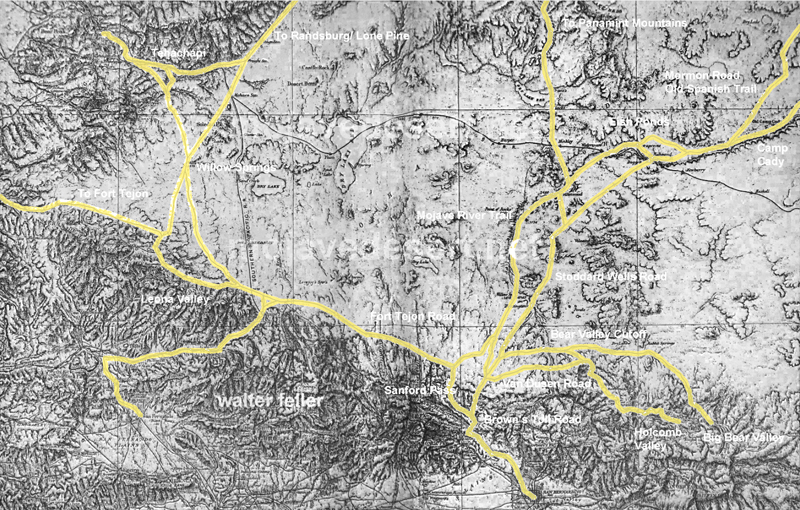
Even with these earliest permanent intrusions, the long-standing dynamic between people and landscape was not immediately overturned. Mining camps rose and disappeared as ore deposits and water supplies fluctuated. Wagon roads faded when springs failed. Small railroad towns appeared abruptly but often remained fragile in the face of the scale and hostility of the surrounding landscape. Much of the Mojave still retained the appearance of a place shaped principally by geology rather than by civilization.
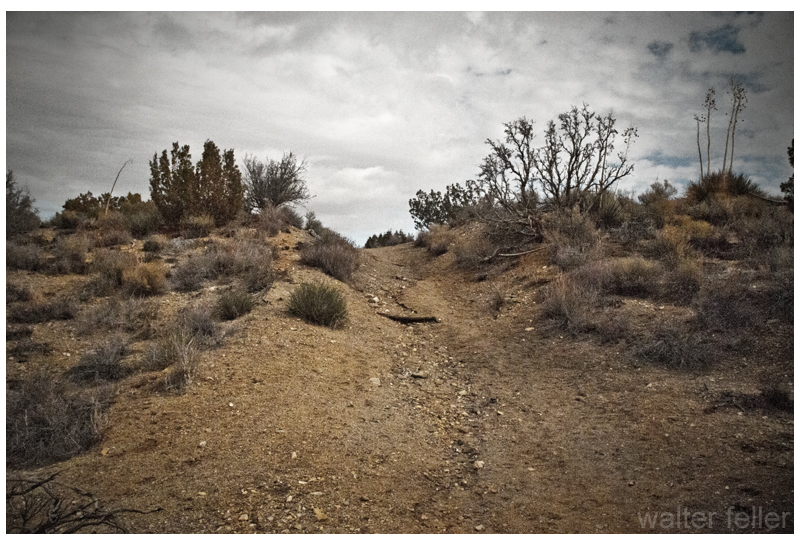
Over time, a shift occurred: the Mojave, once defined by natural systems, increasingly came to be structured around human needs. The first key shift came with railroads, which established artificial centers in previously insignificant locations—places that had mattered only as crossings or water stops. Afterward, elements like highways, aqueducts, transmission corridors, military reservations, utility infrastructure, suburban expansion, recreational development, industrial agriculture along the margins, and large-scale energy production continued this trend. These forces did not simply occupy the desert; they actively reorganized it.
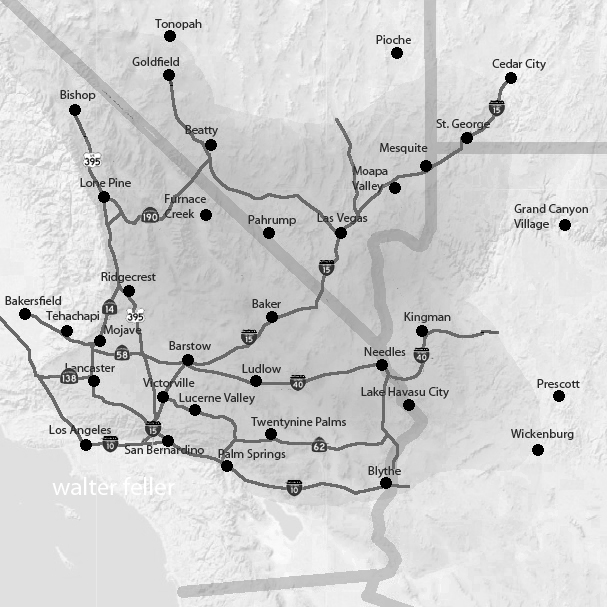
A modern map of the Mojave clearly reveals this shift: vast military boundaries now dominate entire valleys and mountain ranges. Meanwhile, interstate highways create strong directional corridors across what were once diffuse travel landscapes. Utility-scale solar developments, visible for miles, convert open basins into industrial energy fields. Transmission towers march across dry lakes and bajadas. Off-road recreation networks carve repeating tracks into fragile terrain. Finally, conservation areas and national preserves add another layer of organization by establishing access restrictions, managing habitats, providing tourism infrastructure, and developing preservation policies.

Increasingly, the Mojave is understood less through watersheds and landforms than through jurisdiction and use. One valley becomes associated with military training, another with renewable energy, others with recreation, habitat protection, logistics, or suburban expansion. This shift is reflected in the language used to describe the desert. Whereas earlier generations emphasized playas, volcanic mesas, spring systems, or mountain passes, modern discussions focus on renewable energy zones, conservation plans, transportation corridors, protected acreage, groundwater management, housing pressure, and recreational access.

Yet the older desert has not disappeared beneath these overlays. The geology remains the controlling framework beneath every human system. Basin-and-range topography still governs drainage and movement. Mountain ranges still create rain shadows and isolate valleys. Heat still limits settlement density. Water scarcity still defines possibility. Dry lakes still gather runoff after storms, just as they did centuries ago. In many places, the desert resists permanent transformation. Every generation is reminded that the underlying landscape remains older and more powerful than any system laid upon it.

Building on these evolving layers of meaning, what has changed most is not simply the Mojave’s physical appearance but its significance. The desert has shifted in its conceptual role: initially perceived as a natural form, then as a landscape of use, and now increasingly as a landscape of negotiation.

The central question is no longer merely “What is the Mojave?” but “What is the Mojave for?” Different groups now approach the same landscape with competing visions: energy developers see open basins suitable for solar fields and transmission infrastructure; conservationists see fragile ecosystems, migration corridors, and biological continuity; tribes see ancestral homelands, sacred sites, and cultural memory in the terrain itself. The military sees strategic training space, defined by isolation and open airspace, while residents see communities and livelihoods. Recreationists seek freedom, mobility, solitude, and escape, while cities beyond the desert offer land, water, transportation routes, and energy supplies.

As these pressures intensify, nearly every part of the Mojave acquires overlapping claims—emptiness itself becomes contestable. Open land is no longer simply open; instead, it becomes designated, managed, leased, protected, restricted, industrialized, or defended. Consequently, the future Mojave is likely to be shaped not by a single activity, but by tensions among many competing systems, all operating simultaneously across the same terrain.

In this evolving context, the Mojave is entering a third historical phase. Initially, it was defined by its physical landforms. Next, human activities and uses became the defining factors. Now, the Mojave’s identity may increasingly depend on negotiations and conflicts over its meaning, access, and purpose.

The old desert will still remain beneath these arguments. The playas will still whiten under summer heat. Winds will still sweep across creosote flats. Mountain ranges will still rise abruptly from broad basins at dusk. Seasonal floods will still cut across washes after sudden storms. The geological skeleton of the Mojave will endure. However, as human systems become more extensive and entangled, the experience and interpretation of the desert will continue to change.

The future Mojave will be governed as a layered landscape. No single authority will determine its fate: federal agencies will control vast public lands; counties will regulate roads, zoning, and development pressure; tribes will press claims rooted in sovereignty, memory, and sacred geography; energy and mining companies will seek permits, leases, and corridors; conservation groups will defend habitat and species; recreationists will demand access; and residents will argue for the right to live within the desert, not just be managed from outside. In light of these overlapping interests, governance will become less about drawing boundaries and more about arbitrating between claims. The desert will be administered through plans, lawsuits, permits, consultations, closures, leases, and exceptions. Its future will not be decided all at once; instead, it will be determined valley by valley, corridor by corridor, and project by project.

The Mojave functions as both an ancient physical landscape and a modern human one. While it is no longer shaped solely by tectonics, erosion, and climate, it is no longer defined solely by railroads, highways, military reservations, and energy development. Increasingly, the desert is formed by negotiations over how such a landscape should exist. Thus, what once was defined by its form is now shaped by the competing meanings people assign to it.
The Butterfield Overland Mail and Its Impact on California

The Butterfield Overland Mail was a pioneering mail and passenger service that operated from 1858 to 1861. It was established by John Butterfield, who won a federal contract to transport mail twice a week between St. Louis, Missouri, and San Francisco, California, in 25 days or less. This service, known as the Butterfield Overland Trail, was crucial in connecting the eastern United States with the burgeoning populations on the West Coast. The route’s significance to California, in particular, cannot be overstated, as it facilitated communication, commerce, and the integration of the state into the broader national framework.

The Establishment of the Route

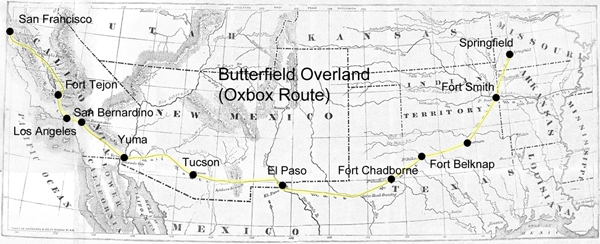
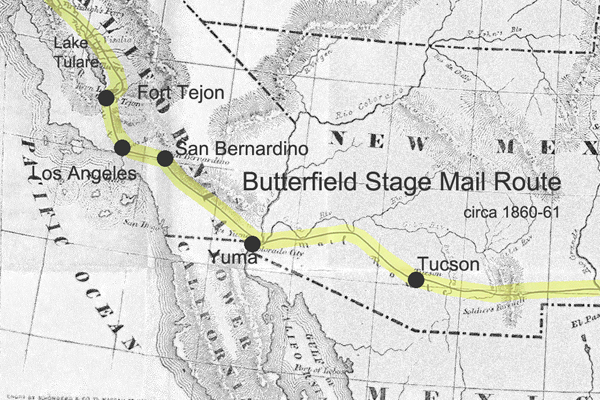
In 1857, the U.S. Congress awarded Butterfield a $600,000-a-year contract to establish an overland mail route. This contract was the largest land-mail contract ever awarded in the United States at the time. The route began from two eastern termini on the Mississippi River at St. Louis, Missouri, and Memphis, Tennessee. It converged and followed a southerly course through Missouri, Arkansas, Texas, New Mexico, and Arizona before heading north through California to its western terminus in San Francisco. The southern path, known as the Oxbow Route, was chosen to avoid the harsh winter conditions of the Rocky Mountains.

Challenges and Operations

The undertaking was enormous. In association with the principals of Wells Fargo & Co., Butterfield invested over a million dollars to organize the stage line. This investment covered building or repairing roads and bridges, establishing and staffing about 150 stations, and purchasing stagecoaches, wagons, horses, mules, and feed. Additionally, water wells had to be dug, and mountain passes had to be cleared. The route’s operation required the coordination of 800 employees, from drivers and station keepers to blacksmiths and cooks.

Travel along the Oxbow Route was by stagecoach, which left twice a week carrying passengers, freight, and mail. The stagecoaches averaged 100 miles daily, ensuring that mail could be delivered to San Francisco within 25 days. Despite the logistical challenges, including the lack of water and conflicts with Native American tribes, the Butterfield Overland Mail managed to operate remarkably efficiently.

California’s Segment of the Route

The California segment of the Butterfield Overland Trail was particularly significant. After crossing the Colorado River near Fort Yuma, the route entered California and proceeded through the desert and mountain landscapes. Key stops included Los Angeles, where the stagecoaches resupplied and passengers rested, and San Francisco, the final terminus. The route’s passage through California was essential for integrating the state’s economy and population with the rest of the country.

Impact on California

The Butterfield Overland Mail significantly impacted California’s development. Providing a reliable and relatively fast mail service helped integrate California’s economy with the rest of the nation. The route facilitated commerce, allowing businesses to send and receive correspondence and goods more efficiently. It also enabled more effective governmental communication, which was crucial for the governance and development of the rapidly growing state.

Moreover, the Butterfield Overland Mail played a vital role in shaping California’s social and cultural landscape. The service brought many people, including settlers, businesspeople, and adventurers, who contributed to the state’s diverse population. The stagecoach route also supported infrastructure development, such as roads and stations, which continued to benefit the state long after the service ended.

Challenges and Legacy

Despite its success, the Butterfield Overland Mail faced numerous challenges. The harsh desert and mountain environments, the threat of Indian attacks, and the logistical difficulties of maintaining such an extensive route were significant obstacles. The onset of the Civil War in 1861 led to the suspension of the Butterfield Overland Mail as the route was deemed vulnerable to Confederate attacks. The U.S. government rerouted mail delivery to the Central Overland Trail, which was shorter and considered safer.

The legacy of the Butterfield Overland Mail endures as a symbol of American enterprise and determination. It demonstrated the feasibility of a transcontinental mail service and paved the way for future developments in communication and transportation. The route’s influence on California’s integration into the United States and its contribution to its economic and social development are lasting testaments to its significance.

In conclusion, the Butterfield Overland Mail was a monumental achievement in American history. Its establishment and operation represented a significant advancement in communication and transportation, particularly for California. Despite its relatively short operation, the service profoundly impacted the state’s development and integration into the broader national framework. The Butterfield Overland Mail symbolizes the pioneering spirit and the relentless pursuit of progress that characterized the era.

Butterfield Overland Trail National Historic Trail Special Resource Study (May 2018)

Butterfield Overland National Historic Trail Special Resource Study/Environmental Assessment Trail Study News (January 2012)

Butterfield Overland Trail Special Resource Study/Environmental Assessment Scoping Report (September 2012)

Butterfield Overland Trail Special Resource Study Press Release — Termination of Environmental Assessment (December 7, 2016)

Butterfield Overland National Historic Trail Map (c2012)

Committee Report: Butterfield Overland Mail (extract from The Chronicles of Oklahoma, Vol. 36 No. 4, Winter 1958-1959)

Designation of the Butterfield Overland National Historic Trail Public Law 117-345 136 Stat. 6196 (January 5, 2023)

Maps: Arizona • Arkansas • California-North • California-Central • California-South • Missouri • New Mexico • Texas-East • Texas-West • Texas & Oklahoma (c2012)

Marking the Butterfield: Retracing the Indian Territory Segment of the 1858-61 Butterfield Overland Mail Stagecoach Road (Susan Penn Dragoo, extract from The Chronicles of Oklahoma, Vol. 97 No. 1, Spring 2019)

Potts’ Inn (Jack E. Porter, January 11, 1970)

Significance Statement: Butterfield Overland Trail (proposed National Historic Trail) (April 9, 2013)

The Butterfield Overland Mail Company (Mary A. Helmich, 2008)

The Butterfield Overland Mail One Hundred Years Ago (Muriel H. Wright, extract from The Chronicles of Oklahoma, Vol. 35 No. 1, Spring 1957)

The Overland Mail 1849-1869 (Le Roy R. Hafen, 1926)

Butterfield Overland Stage Mail Route

The Butterfield Overland Mail Route was a historic transportation route in the mid-19th century that played a crucial role in connecting the eastern and western parts of the United States.

Butterfield Overland Stage Route
(Oxbow Route)

Here are some key points about the Butterfield Overland Mail Route:

  1. Establishment: The Butterfield Overland Mail Company was awarded a government contract in 1857 to establish and operate a stagecoach and mail route between St. Louis, Missouri, and San Francisco, California. The purpose of the route was to improve communication and transportation between the two coasts, especially in light of the California Gold Rush.
  2. Route: The route covered approximately 2,800 miles and passed through eight present-day states: Missouri, Arkansas, Oklahoma, Texas, New Mexico, Arizona, California, and Oregon. It traversed various terrains, including deserts, mountains, and plains.
  3. Frequency and Duration: The Butterfield Overland Mail Company operated its stagecoaches twice a week in each direction, and the journey took about 25 days to complete. This significantly improved travel time compared to other methods available at the time.
  4. Stations and Stops: The company established a series of stations along the route to facilitate the long and arduous journey, spaced about 20-30 miles apart. These stations provided fresh horses, food, and accommodations for passengers and drivers. Some of these stations eventually became important settlements in their own right.
  5. Challenges: The route faced numerous challenges, including harsh weather conditions, difficult terrain, and the threat of attacks from Native American tribes. The company had to implement security measures to protect passengers and mail.
  6. End of Operations: The Butterfield Overland Mail Route faced financial difficulties exacerbated by the onset of the Civil War. 1861, the service was suspended, and the stagecoaches and stations were abandoned. The route became less relevant as the transcontinental railroad was completed after the Civil War, offering faster and more reliable transportation.
  7. Legacy: While the Butterfield Overland Mail Route was relatively short-lived, its legacy persists. The route contributed to the United States’s westward expansion and shaped the development of communities along its path. Some old stations have been preserved as historic sites, and portions of the route have been designated the “Butterfield Overland Mail Route.”

The Butterfield Overland Mail Route remains an important chapter in the history of westward expansion and transportation in the United States during the mid-19th century.

https://mojavedesert.net/stagecoaches/

https://mojavedesert.net/mojave-desert-indians/

https://digital-desert.com/historic-roads/

  1. Butterfield Overland Mail (or Oxbow Route):
    • The Butterfield Overland Mail was a stagecoach and mail delivery service that operated from 1857 to 1861. It was a vital communication and transportation link between the eastern and western United States.
    • The route covered approximately 2,800 miles, connecting St. Louis, Missouri, and San Francisco, California. It passed through several states, including Missouri, Arkansas, Texas, New Mexico, Arizona, and California.
    • The term “Oxbow” might not be directly associated with the Butterfield Overland Mail but could be a local or regional name for a section of the route or a specific location along the way.
  2. Overland Stage Route:
    • The Overland Stage Route, on the other hand, generally refers to the network of stagecoach routes that existed in the western United States during the 19th century. These routes were crucial for mail delivery, transportation of passengers, and freight.
    • The most famous of these stagecoach lines was the Butterfield Overland Mail, but there were other stage lines as well, such as the Central Overland California and Pikes Peak Express Company (C.O.C. & P.P.), which operated a route known as the “Pony Express.”