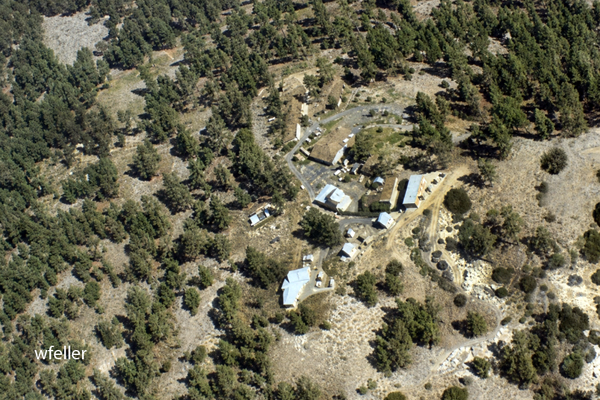
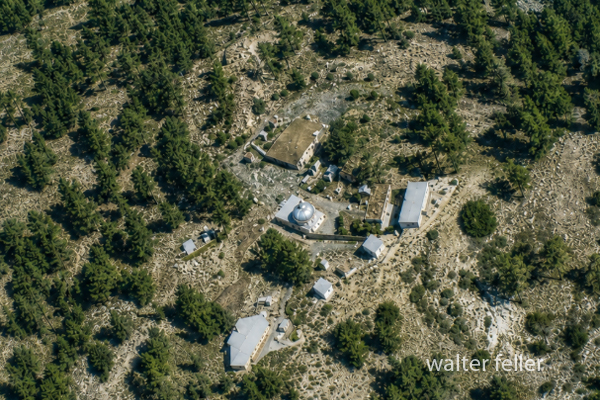
Table Mountain Observatory, usually called TMO, is the astronomical part of NASA JPL’s Table Mountain Facility above Wrightwood in the San Gabriel Mountains. The facility overlooks the Mojave Desert about 60 miles northeast of JPL’s Pasadena campus, at roughly 7,500 feet in elevation. Its altitude, mountain setting, and distance from Los Angeles air pollution make it well suited to observing and atmospheric research. [1]
The scientific history of the site reaches back to 1926, when the Smithsonian Institution established an observatory there for solar irradiance studies. JPL began using the mountain for spacecraft solar-panel testing in the late 1950s and early 1960s. In 1962, JPL acquired the U.S. Forest Service lease, built TM-1, installed a 16-inch optical telescope, and achieved first light on August 1. [2]
Table Mountain Facility has never been only an astronomy site. Its work has included solar testing, spacecraft calibration, atmospheric lidar, ozone and water-vapor measurement, and instrument-comparison campaigns. Long-term lidar research has measured stratospheric ozone, temperature, aerosols, tropospheric ozone, and water vapor. [1][3][4]
A major modern instrument is Pomona College’s 1-meter, 40-inch telescope, shared with JPL. The telescope has a 40.5-inch mirror and supports CCD imaging, filter wheels, polarimetry, near-infrared work, and adaptive optics. Built between 1982 and 1985, and improved with new optics in 1996, it has served both student observing and research. [5]
Table Mountain Observatory is a mountain-edge science station where the San Gabriels meet the desert sky. It belongs to the same regional landscape as Cajon Pass, Big Pines, Angeles Crest, Wrightwood, and the Mojave overlook country, though its purpose is scientific rather than recreational.
Table Mountain Observatory (TMO) is part of NASA JPL’s Table Mountain Facility, located above Wrightwood in the San Gabriel Mountains. The 37-acre site is situated at an elevation of 7,300 feet and overlooks the Mojave Desert, approximately 60 miles northeast of JPL’s Pasadena campus. Its high elevation, mountain setting, and distance from Los Angeles air pollution make it a prime location for astronomical and atmospheric research.
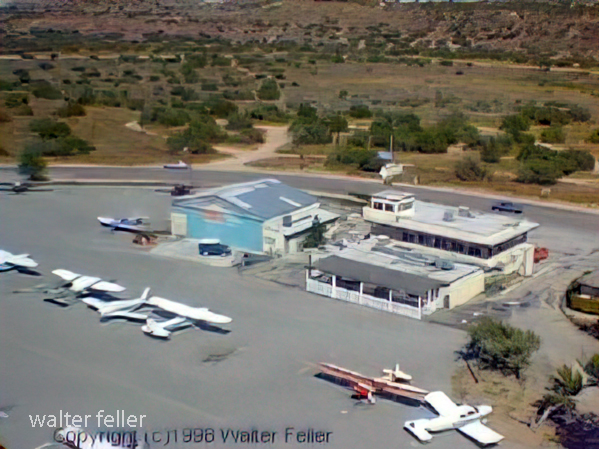
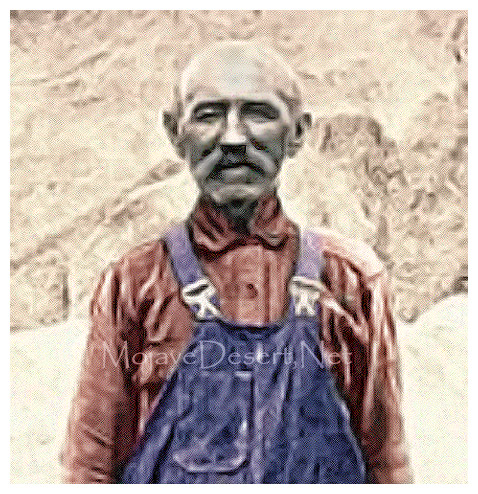
TMO – 1998 – pilot, Willy Williams
Building on this foundation, the site’s scientific history goes back further than most people think. The Smithsonian Institution started the observatory in 1926 to study solar radiation. In the late 1950s, JPL began using it to test solar panels for space vehicles and took over the U.S. Forest Service lease in 1962. That same year, JPL built TM-1, set up a 16-inch telescope, and saw its first light on August 1, 1962.
Beyond its original astronomical purpose, TMO’s primary focus is scientific research. In addition to astronomy, the Table Mountain Facility enables solar testing, spacecraft calibration, atmospheric lidar, and ozone and water vapor measurements. JPL’s lidar group values the site’s remote location, high altitude, favorable climate, and dark skies, which support research on stratospheric ozone, temperature, aerosols, tropospheric ozone, and water vapor.
In terms of significant equipment, a key modern telescope at TMO is Pomona College’s 1-meter (40-inch) telescope, which is shared with JPL. It has CCD imaging, filter wheels, polarimetry, near-infrared tools, and advanced adaptive optics. Built from 1982 to 1985, it got new optics in the 1990s and is now used for both student and research observations.
From a broader perspective, and from the viewpoint of someone in the Mojave or Wrightwood, Table Mountain Observatory stands out as a dedicated scientific station where the San Gabriel Mountains meet the desert sky. While places like Cajon Pass, Big Pines, and Angeles Crest are known for recreation, TMO’s main purpose is to support scientific research in the area.
Table Mountain – 1998 – Ultralight pilot, George Chabot
Further reading: JPL Table Mountain Facility history, JPL Table Mountain lidar site, NDACC Table Mountain Facility station page, and Pomona College’s Table Mountain Observatory page.
The arroyo toad is a small, stocky toad of sandy washes, shallow streams, and open riparian terraces. It is not a general desert toad. It depends on a very particular kind of stream: low-gradient water, sandy or fine-gravel bars, shallow pools, and nearby upland soils soft enough for burrowing. The young develop in quiet, shallow water, while adults spend much of the dry season underground.
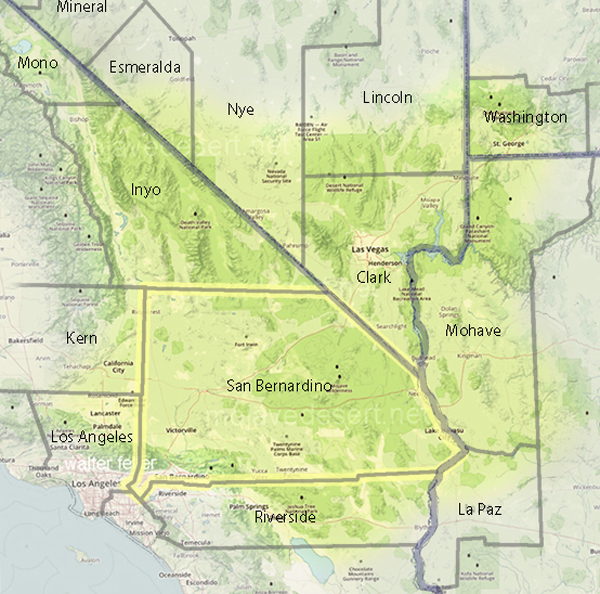
In the Mojave region, the arroyo toad belongs to the old drainage system of the San Gabriel and San Bernardino mountains rather than the open desert floor. The U.S. Fish and Wildlife Service recognizes a Desert Recovery Unit in northeastern Los Angeles County and southwestern San Bernardino County.
Breeding usually occurs from winter into summer when shallow pools are available. Eggs hatch quickly, tadpoles develop in slow water, and young toads remain near drying pools before moving into nearby sandy uplands. During hot, dry months, toads estivate in burrows, emerging in response to moisture or disturbance.
The arroyo toad remains federally endangered. Its main problems are loss and fragmentation of stream habitat, dams and water diversions, altered flows, non-native predators such as bullfrogs and crayfish, drought, wildfire, and climate change.
Simple description:
The arroyo toad is a rare, federally endangered toad found along sandy, shallow streams in parts of central and southern California and northern Baja California. It needs both water and sand: quiet pools for breeding and soft upland soils for burrowing during the dry season. In the desert region, it is tied to mountain-fed washes and riparian corridors, not open dry flats.
Notes & Additional Reading
The arroyo toad, Anaxyrus californicus, was federally listed as endangered on December 16, 1994. U.S. Fish and Wildlife Service describes it as a species of shallow, slow-moving stream and riparian habitat with nearby sandy or fine-gravel uplands, and lists threats including non-native predators, disease, water withdrawals, urban and agricultural development, pollution, drought, and climate change.
For desert-region wording, be careful. The species is mainly tied to coastal and mountain drainages of central and southern California and northwestern Baja California, but it also occurs in some desert-associated drainages, including the Mojave River. The San Diego Natural History Museum atlas specifically notes “more prominent desert drainages, such as the Mojave River.”
For accuracy on old desert records, use Ervin, Beaman, and Fisher. They found that four reported Sonoran Desert populations from Riverside, San Diego, and Imperial counties were erroneous, which is important when discussing the arroyo toad’s desert range.
For current conservation and population discussion, use Hitchcock et al. The 2017-2020 range-wide surveys found arroyo toads at 61 of 88 surveyed historical sites and in 20 of 25 historically occupied watersheds, but no detections occurred at nearly one-third of surveyed sites. The paper also emphasizes drought, invasive aquatic species, altered flows, and other human effects as major management concerns.
For upland habitat, stream terraces, and management, use Gallegos et al. Their radio-telemetry study found that adult toads used open, sandy flats with sparse vegetation and remained on stream terraces during and after breeding; they also warned that assuming toads are absent from floodplain habitat outside the breeding season may leave them vulnerable to disturbance.
Additional reading:
U.S. Fish and Wildlife Service. “Arroyo Toad (Anaxyrus californicus).” Best general source for status, description, habitat, life cycle, range, threats, and recovery context.
U.S. Fish and Wildlife Service. “Arroyo Toad (Anaxyrus californicus) 5-Year Review.” Best source for the current federal review status and conservation assessment.
Hitchcock, C. J., et al. 2022. “Range-wide persistence of the endangered arroyo toad (Anaxyrus californicus) for 20+ years following a prolonged drought.” Ecology and Evolution. Best recent scientific paper for persistence, drought, and broad survey results.
Gallegos, E., L. M. Lyren, R. E. Lovich, M. J. Mitrovich, and R. N. Fisher. 2011. “Habitat use and movement of the endangered Arroyo Toad (Anaxyrus californicus) in coastal southern California.” Journal of Herpetology. Best paper for adult movement, stream terraces, upland use, and management timing.
Ervin, E. L., K. R. Beaman, and R. N. Fisher. 2013. “Correction of locality records for the endangered arroyo toad (Anaxyrus californicus) from the desert region of southern California.” Bulletin of the Southern California Academy of Sciences. Best paper for correcting desert-location errors.
California Department of Fish and Wildlife / UC Davis. California Amphibian and Reptile Species of Special Concern. Useful state-level conservation reference; the CDFW page includes the arroyo toad species account under its amphibian and reptile Species of Special Concern publication.
San Diego Natural History Museum. “Anaxyrus californicus — Arroyo Toad.” Good field-guide style source for identification, range notes, conservation status, and the Mojave River mention.
Experiencing solitude differs from just being alone. Being alone means having no one else present, while solitude is freedom from being watched, measured, interrupted, explained, or directed.
This is why it isn’t solitude if someone tells you so. When another names it, your experience transforms into performance. You’re no longer simply alone; you’re seen as alone, and that changes everything. True solitude can’t be certified; it has no witness.
Solitude arrives when the mind stops looking over its shoulder—no audience to impress, answer, or defend against. At first, it feels empty, but then honest. The usual noise from others fades, as well as the quiet inside you grows.
Because of this inward journey, solitude must be discovered, not assigned. Someone might point you to a trail, canyon, road, or quiet room, but can’t give you the experience. You must arrive inwardly and stay until silence feels present, not absent.
It is important to note that solitude is not loneliness, even though the two may seem alike at first. Loneliness longs for company; solitude accepts aloneness. Loneliness feels like exclusion; solitude feels like being reunited with yourself. Solitude is a private settlement between a person and the world.
In true solitude, the land does not explain itself. The wind does not ask to be understood. The stones, brush, sky, and distance do not perform for you. They simply exist. And if you remain still enough, you begin to exist in the same plain way. No announcement. No approval. No lesson forced upon you.
Once found, solitude is easier to visit. At first, it’s distant—a place with no road. You may mistake it for loneliness, boredom, or emptiness. But after that first encounter, you recognize the path back. You know what to set aside: noise, explaining, the need to be seen, and the habit of answering others. Then solitude is no longer a strange country; it becomes a place you can return to.
With practice, in solitude, you can sit still until the restlessness passes. At first, the mind seeks noise: a task, a voice, a screen, a reason to leave. Stay past that. Solitude works once the urge to be distracted fades.
In this space, you can walk without regarding it as exercise. Notice the ground, wind, tracks, shadows, slope, distance, heat, cold, bird calls, creosote, and how light changes on the rock. Let the place be, without turning it into a lesson.
During this attention, think honestly—not dramatically, not in circles. Ask simple questions: What burdens aren’t mine? What do I defend? What do I believe with no pressure? What matters without an audience?
Afterward, write a few plain sentences. Just field notes of the mind: I noticed. I remembered. I avoided it. I felt calmer when. No need to explain.
If writing settles your thoughts, read something steady: nature writing, scripture, philosophy, desert history, a field guide, or a map. Old books help because they don’t shout; they wait.
For example, I have read books in solitude. Land of Little Rain by Mary Hunter Austin is one. As time went on, I made photographs to illustrate her chapters. That kind of reading does not finish with the last page. It carries you back into the land itself. The words teach you how to look, and the camera becomes a quiet way of answering what the book first taught you to notice.
Study one plant, rock, wash, bird, or old road cut. Solitude pairs well with attention; the deeper you look at one thing, the less you crave many things.
Pray, meditate, or be silent. The name matters less than the act. The point is to stop performing and listen inwardly.
Above all, stop explaining yourself. That is solitude’s rarest gift: no defense, no audience, no argument. Quiet enough to be real again.
That is the value of being alone: it does not flatter or define you. It gives you space to find out.
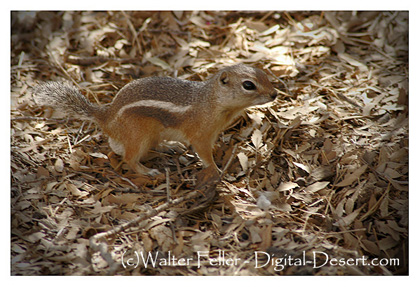
The Mojave Desert is home to many small rodents, including squirrels, rats, and mice. At first glance, they may seem alike, but each group has its own habits and place in the desert.
Antelope Squirrel
Squirrels are often the easiest to see because many are active during the day. White-tailed antelope squirrels, California ground squirrels, and Mojave ground squirrels may be seen running across open ground, sitting upright, or watching from near a burrow. Their alert behavior helps them survive in a land of hawks, snakes, coyotes, and foxes.
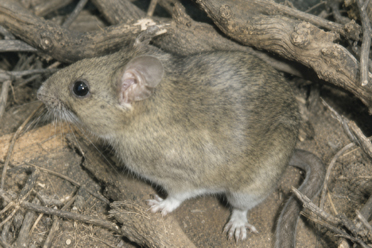
Packrat – Roger Barbour photo – USFWS
Rats and mice are more often active at night. Kangaroo rats are well-adapted to desert life, with long hind legs for hopping and cheek pouches for carrying seeds. Woodrats may build large stick nests under cactus, shrubs, or rocks. Mice are usually smaller, quicker, and harder to notice. Pocket mice, deer mice, and grasshopper mice often stay hidden in burrows, brush, or rocky cover.
Pocket mouse
All of these animals are rodents. They have front teeth that keep growing, and many feed on seeds, plants, insects, or a mix of foods. Though small, they are an important part of the Mojave ecosystem. They move seeds, loosen soil, and provide food for owls, snakes, bobcats, kit foxes, and other desert predators.
Squirrels are the daytime watchers. Kangaroo rats are the night jumpers. Mice are the hidden seed gatherers. Together, they help keep the desert alive.
I like geology because it transforms how I see the desert. Geology explains why the land looks the way it does, why water follows certain paths, why mountains rise, or basins sink, and why springs appear. It shows how natural forces shape human choices: trails, roads, mines, railroads, and settlements emerge from the land’s history. Geology turns the desert from empty space into a record that can be read.
To many people, the desert looks still and silent. They see rocks, dry washes, cliffs, playas, distant mountains, and open ground. However, geology reveals that the desert is not still at all. It is the result of movement, pressure, heat, erosion, faulting, volcanism, uplift, and time. Every ridge, canyon, lava flow, terrace, wash, spring, and fault scarp has a reason for being there. While the land may not speak plainly, it leaves evidence.
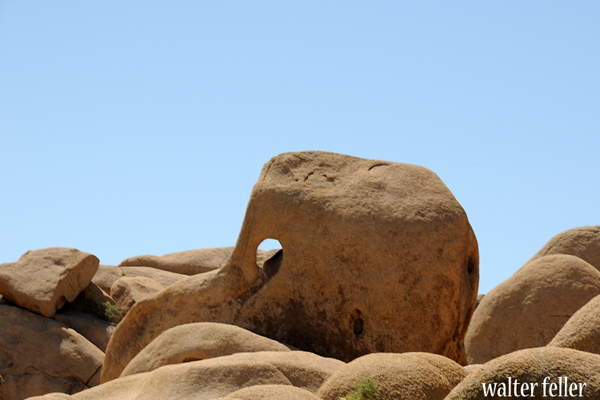
Jumbo Rock – Joshua Tree National Park
That is one reason geology appeals to me. It is based on visible proof. A geologist can look at a cliff face, a broken hillside, a tilted layer of rock, a dry lakebed, or a mine dump and begin to understand what happened. The evidence may be old, weathered, scattered, or partly hidden, but it is still there. Geology rewards careful observation. It asks a person to slow down, look closely, compare patterns, and respect what the land is showing.
For about nine years, I wandered and explored the desert simply by going out there. I moved from one point of interest to another, mostly staying to myself. Instead of following a formal course or guided route, I learned by looking, walking, comparing places, and remembering what I had seen. A canyon led to a spring. A spring led to a wash. A wash led to a road. A road led to a mine, a pass, a dry lake, or a faulted hillside. Over time, the separate places began to connect, further deepening my understanding.
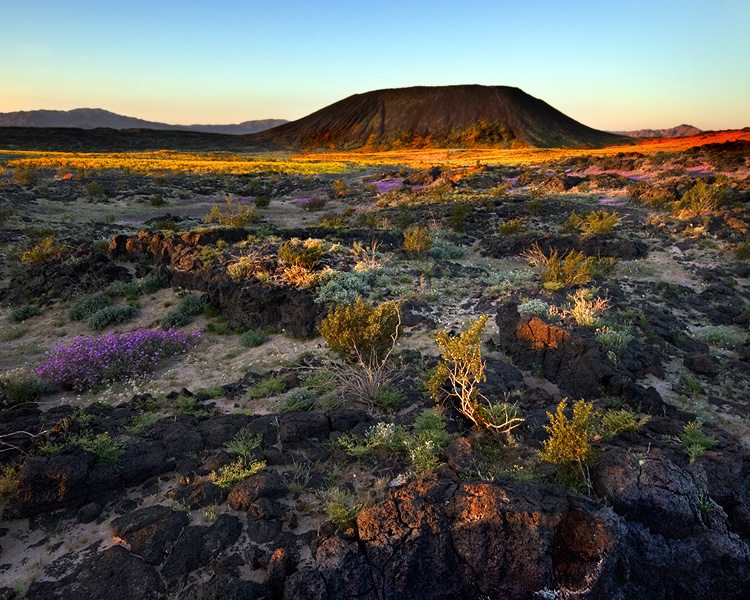
Amboy Crater
That kind of wandering gave the desert time to teach me. I was not trying to master it all at once. Some places made sense right away. Others stayed confusing until I saw another place that explained them. Over time, the desert became less like a collection of isolated sites and more like one connected landscape.
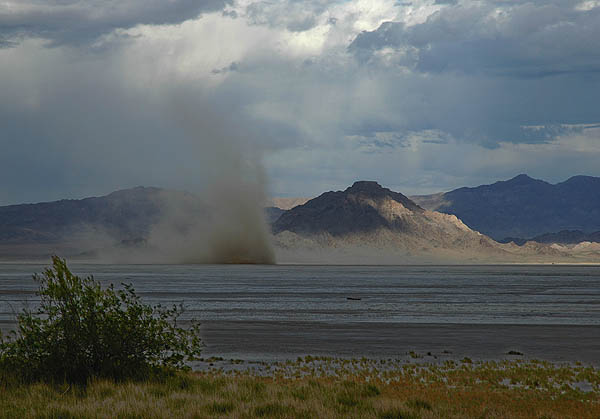
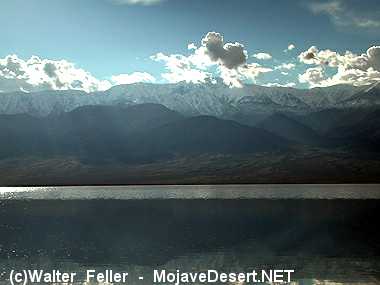
Lake Manly – Death Valley
In making these connections, I began to see that geology and history both seek to explain the past, but in different ways. History asks who came through a place, what they did, what they called it, and what they left behind. Geology, in contrast, asks deeper questions: Why is this pass here? Why did the river cut through at this place? Why did the lake disappear? Why was ore found in this mountain and not another? Why did a spring appear along one route and not another? Ultimately, human history depends on the shape and structure of the earth beneath it.
Blue Cut Fault – Joshua Tree National Park
This is especially true in the Mojave Desert. The Mojave is a land of corridors, barriers, basins, mountains, playas, springs, faults, and washes. People did not move across a blank map. They followed water, passes, dry lake margins, river channels, and openings between ranges. Trails, wagon roads, railroads, highways, mining camps, and towns were all influenced by geology. To understand the Mojave well, a person has to understand the ground.
Geology also explains why the desert can feel so old. Human history may reach back a few hundred or a few thousand years, but geology reaches into deep time. It deals with ancient seas, vanished lakes, old volcanoes, buried rivers, moving faults, and mountains worn down and raised again. It reminds us that the land existed long before us and will remain long after us. That perspective gives the desert dignity.
I admire geologists because they know how to read the earth without needing it to speak plainly. They can stand before a canyon wall, a fault zone, a lava field, or a dry lake and see more than scenery. They see time, force, sequence, and evidence. They understand that the land is not random. It has structure. It has a history. It has a record, even when that record is difficult to read.
I also admire the dedication and discipline geology requires. It is not casual work. It takes field study, maps, measurements, samples, notes, old reports, and comparison. A geologist must be willing to walk rough ground, endure heat and distance, and keep looking when the answer is not obvious. The earth does not reveal its story all at once. Understanding comes one observation at a time.
That kind of work requires humility. A good geologist cannot force the land to fit an easy explanation. The evidence has to lead. If the rocks say one thing and the theory says another, the theory must change. That respect for facts is one of the strongest parts of geology. It is disciplined curiosity. It combines imagination with restraint.
The Desert Studies Center at Zzyzx belongs in this story because it represents desert study put into practice. With this focus shifting from theory to place, it is a center where students, teachers, and researchers can go into the Mojave itself and learn directly from the land. Set near Soda Dry Lake, at the end of the Mojave River system, it stands in one of the best natural classrooms in the desert.
That setting matters. Around Zzyzx are dry lake beds, springs, salt flats, rocky slopes, volcanic features, desert plants, old shorelines, and evidence of water, heat, faulting, erosion, and long-term change. A person studying there is not learning geology only as an abstract subject. He is standing inside the evidence.
The Desert Studies Center also shows why geology requires discipline. Field science is not guessing from a distance. It means walking the ground, taking notes, checking maps, and comparing what is seen with what has been written. That is the kind of work I admire. It takes order and respect for facts.
In that sense, Zzyzx is more than a place on the map. It serves as a bridge between curiosity and discipline, and as a living example of how the Mojave Desert continues to be studied and interpreted. The Desert Studies Center turns admiration for geology into practical learning. Connecting students and researchers directly with the land shows that the desert itself remains the best teacher.
Geologists also help preserve meaning in places that might otherwise be overlooked. A dry wash is not just a wash. A playa is not just a flat place. A fault is not just a crack. A mine is not just a hole in the ground. Building on this, each one belongs to a larger story. Geology connects small details to big forces. It turns scattered features into a pattern.
That is why geology makes the desert understandable. Instead of seeing emptiness, geology reveals the bones and memory of the landscape. The Mojave is not barren, but layered with evidence of violence, patience, age, movement, and history. Geology’s explanation brings order and beauty to the surface, grounded in the evidence it preserves.
I like geology because it deepens every desert visit. Once you begin to see the land geologically, ordinary places become more interesting. A roadcut becomes a lesson. A wash becomes a process. A spring becomes a clue. A mountain front becomes evidence of movement. A dry lake becomes the trace of a vanished world.
Most of all, I like geology because it sharpens attention and deepens understanding. Geology rewards patience, discipline, and respect for the past. It reminds us that the earth has a story older than our own, and the Mojave Desert, far from being empty, vividly displays that story. With geology, the desert becomes readable and meaningful.
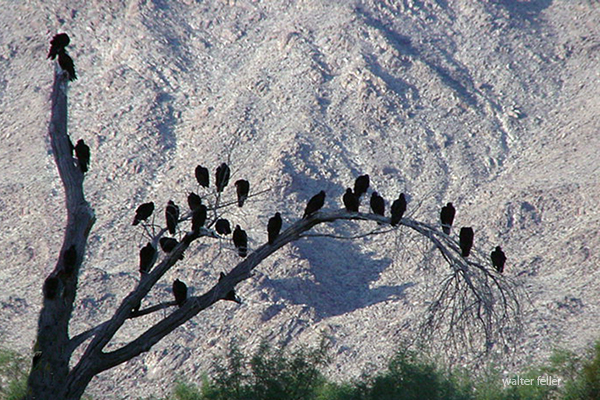
Once dusk approaches, vulture activity shifts noticeably. During the day, vultures ride thermals, travel, and search for carrion. While the sun drops lower, the warm rising air begins to weaken. The birds often stop traveling far and begin moving toward a regular night roost.
Just before sunset, vultures may circle near the roost in loose groups. This circling can look like they are gathering over something dead, but that is not always the case. In the evening, they often use the last lift of the day, sorting themselves into the roost and waiting for a safe place to settle. One bird may arrive, then several more. They may circle, drift, perch, shift position, and lift off again before finally settling.
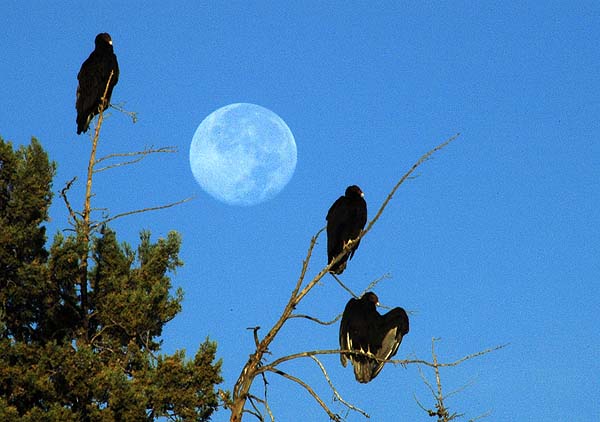
A roost may be in tall trees, cliffs, utility towers, old buildings, or other high open places. Vultures prefer places where they can see around them. In the morning, they launch easily. Roosting together provides some protection against danger. It may also help them keep track of where other vultures go to feed.
After dark, vultures are mostly quiet and inactive. They do not hunt at night. Their eyesight is good, but they need sunlight and warm air to soar. Without thermals, they conserve energy by perching. They may shift, preen, or shuffle along a branch, but mostly they rest at night.
Animals die at night. Their carcasses, if not swallowed whole, may be hastily shredded, abandoned, and left to rot as a meal for the buzzards or other scavengers.
Near sunrise, the roost stirs. Vultures stretch, preen, and spread their wings. Sunning in the morning is among their most noticeable behaviors. A vulture standing with open wings is usually warming after the cool nighttime, drying dew, and preparing for flight.
They usually wait for the sun to warm the ground and create rising air. When thermals form, vultures leave, circling upward and spreading out. The roost empties, and the search begins again.
The Scavengers
Fifty-seven buzzards, one on each of fifty-seven fence posts at the rancho El Tejon, on a mirage-breeding September morning, sat solemnly while the white tilted travelers’ vans lumbered down the Canada de los Uvas. After three hours they had only clapped their wings, or exchanged posts. The season’s end in the vast dim valley of the San Joaquin is palpitatingly hot, and the air breathes like cotton wool. Through it all the buzzards sit on the fences and low hummocks, with wings spread fanwise for air. There is no end to them, and they smell to heaven. Their heads droop, and all their communication is a rare, horrid croak.
Interesting! Haven’t been there, but it’s been described as gold mineralization localized in one of the low-angle (thrust) fault zones that extend south from (and relieve compression from) the San Andreas Fault along the north side of the San Gabriels. That compressional environment extends from where it bends more westerly, north of the Coachella Valley, to where it resumes its more northwesterly course at the west end of the San Gabriels. Could you see any visible geological evidence of that? Envious that you got there!
Interesting! I have not been there, but I have heard it described as gold mineralization localized in one of the low-angle thrust fault zones that extend south from the San Andreas Fault along the north side of the San Gabriels. Those faults help accommodate the compression created where the San Andreas bends more westerly north of the Coachella Valley, before resuming its more northwesterly course near the west end of the San Gabriels.
Could you see any visible geologic evidence of that on the ground? Fault gouge, sheared rock, quartz veining, altered zones, breccia, or repeated/tilted beds would all be interesting. Envious that you got there!
elucidate
Here is a more elucidated version:
Interesting. I have not been there, but the description makes geological sense. The gold mineralization has been described as localized within one of the low-angle thrust or reverse-fault zones that extend southward from the San Andreas Fault along the north side of the San Gabriel Mountains.
That setting is important because this part of the San Andreas is not a simple, straight strike-slip boundary. North of the Coachella Valley, the fault bends into a more westerly trend. That bend creates transpression: strike-slip motion combined with compression. The crust has to shorten and thicken, and some of that strain is taken up by reverse and thrust faults along the northern San Gabriels. Farther west, near the west end of the range, the San Andreas resumes its more typical northwest trend.
In such a compressional fault environment, mineralization can become focused along zones of weakness. Fault planes, fractured rock, breccia zones, and sheared contacts can all act as pathways for hydrothermal fluids. If those fluids carried silica, sulfides, and metals, they could deposit quartz veins and gold where pressure, temperature, chemistry, or permeability changed.
So I would be curious whether there was visible evidence of the structure on the ground: sheared or crushed rock, fault gouge, breccia, slickensides, repeated rock units, tilted beds, iron staining, quartz veining, altered zones, or a distinct contact where one rock package has been pushed over another. Even if the gold itself was not visible, the structural setting might be.
Envious that you got there. That is exactly the kind of place where the landscape may tell a larger tectonic story if you know what to look for.
expand all
Interesting. I have not been there, but the description makes geologic sense, and it opens up a much larger story than just “gold in a fault zone.”
The gold mineralization has been described as localized within one of the low-angle thrust or reverse-fault zones that extend southward from the San Andreas Fault along the north side of the San Gabriel Mountains. That is an important detail. A low-angle fault zone is not just a crack in the rock; it is a broad zone of broken, sheared, crushed, and chemically altered rock where movement has taken place over time. In a compressional setting, one block of crust is being driven up and over another. Those zones can become major pathways for mineral-bearing fluids.
This part of the San Andreas is not a simple, straight, clean strike-slip fault. Farther south and east, the San Andreas trends northwest-southeast in the classic right-lateral fashion. But north of the Coachella Valley, the fault bends into a more westerly orientation. That bend matters enormously. When a right-lateral strike-slip fault bends the “wrong” way, the two sides do not simply slide past each other smoothly. They jam, shorten, and thicken the crust. Geologists call that transpression: a combination of lateral shear and compression.
That compressional zone extends along the northern front of the San Gabriel Mountains. The mountains themselves are partly a product of that tectonic crowding. The crust is squeezed, folded, broken, and shoved upward. Some of the strain stays on the main trace of the San Andreas, but much of it is transferred into adjacent reverse faults, thrust faults, oblique-slip faults, folds, and fractured belts. In other words, the San Andreas does not act alone. It produces a whole structural neighborhood.
The low-angle thrust zones extending south from the San Andreas are part of that neighborhood. They help accommodate shortening across the range front. In plain terms, the crust cannot slide smoothly through the bend, so it stacks, uplifts, and fractures. That creates the conditions in which fault-related mineralization can occur.
Gold mineralization in such a setting is usually not random. Hydrothermal fluids move through the most permeable pathways available. A fault zone provides exactly that: broken rock, fractures, crushed breccia, shear planes, and repeated openings caused by movement. Fluids rising through these pathways may carry silica, iron, sulfur, carbonate, and small amounts of precious metals. When conditions change–pressure drops, temperature changes, chemistry shifts, fluids mix, or the pathway narrows–minerals precipitate. Quartz veins, iron oxides, sulfides, clay alteration, and sometimes gold may form in and near the fault zone.
That is why I would be especially interested in what was visible on the ground. The gold itself might not be obvious, and in many cases it would not be visible at all. But the structural and alteration evidence might be. I would look for a zone of rock that appears more shattered, softened, stained, or disrupted than the surrounding material. Fault gouge would be one clue: clay-rich, powdery, crushed material produced by grinding along the fault. Fault breccia would be another: angular fragments of older rock cemented or packed together within the fault zone. Sheared rock, where minerals or rock fabrics are smeared out into streaks or bands, would also be significant.
Quartz veining would be especially interesting. In a mineralized fault zone, quartz may occur as thin stringers, irregular veinlets, thicker veins, or stockwork networks. The veins might be white, gray, rusty, milky, or iron-stained. Rusty red, brown, orange, or yellow staining can indicate oxidation of iron-bearing minerals such as pyrite. That does not prove gold, but it is often associated with hydrothermal alteration. Greenish, whitish, or clay-rich alteration halos around fractures could also be meaningful.
A true thrust relationship might show itself in larger structural ways. You might see one rock type lying structurally above another in a way that does not match normal stratigraphic order. There may be repeated units, abrupt contacts, crushed zones along the contact, or beds and foliations tilted at unexpected angles. In metamorphic or plutonic terrain, the evidence may be less like neat layered beds and more like zones of mylonite, cataclasite, breccia, altered granitic rock, or sheared gneiss.
Slickensides would be another prize: polished or striated fault surfaces showing the direction of movement. On a thrust or reverse fault, the lineations may suggest upward movement of one block over another, though in this region movement could be oblique because the San Andreas system combines strike-slip and compression. That obliquity is part of what makes the San Gabriel block so structurally interesting.
The broader tectonic setting is the key. From the San Gorgonio Pass / Coachella Valley region westward along the northern San Gabriels, the San Andreas enters a restraining-bend geometry. The motion between the Pacific and North American plates is still dominantly right-lateral, but the bend forces compression into the system. That compression is relieved through uplift of the San Bernardino and San Gabriel Mountains, thrusting along range-front and internal faults, folding of sedimentary basins, and distributed deformation away from the main fault.
At the west end of the San Gabriels, where the San Andreas resumes a more northwesterly course, the geometry changes again. The compressional intensity and structural style are not uniform along the entire belt. Some areas are dominated by uplift and thrusting; others by oblique-slip deformation, strike-slip transfer, folding, or basin development. That variability could help explain why mineralization is localized in one fault zone rather than spread evenly everywhere. The right combination of structure, permeability, host rock chemistry, fluid source, and timing has to occur.
So the place you mention may be interesting for two reasons at once. Locally, it may preserve a mineralized fault zone where gold-bearing fluids used a low-angle thrust structure as a conduit. Regionally, it may be a small exposure of the larger tectonic machinery that built and continues to deform the northern San Gabriel Mountains. The mine or prospect is the local expression; the restraining bend of the San Andreas is the regional engine.
What I would want to know from someone who had been there is whether the mineralization looked structurally controlled in the field. Was the quartz confined to a shear zone? Did the veins parallel the fault fabric, or cut across it? Was the country rock pervasively altered, or only fractured locally? Was there a visible low-angle contact? Did the workings follow a seam, a vein, a breccia body, or a crushed zone? Were there iron-stained ribs or resistant quartz ledges standing out from softer fault gouge? Were the dumps full of milky quartz, rusty quartz, altered granite, schist, or breccia?
Those details would help distinguish several possibilities. It could be gold in discrete quartz veins occupying fractures related to thrusting. It could be disseminated or veinlet-controlled mineralization in a broader altered shear zone. It could be mineralization along a contact between contrasting rock units. Or it could be older mineralization later caught up in San Andreas-related deformation. The field relationships would matter.
In a place like that, the visible clues are often subtle. A casual visitor might see only broken rock, brush, mine dumps, and a scar in the hillside. But a geologist would ask: why here? Why did the miners follow this exact line? Why is the rock crushed here and not there? Why does the staining follow a zone? Why do the veins have this orientation? Why does the ridge or drainage line up with the structure? Those questions are often more revealing than the mine opening itself.
That is why I said I would be envious. It sounds like the kind of locality where a small mining feature might sit directly on top of a much larger tectonic story: the San Andreas bend, compression along the northern San Gabriels, low-angle faulting, fractured rock, hydrothermal fluid movement, and localized gold deposition all intersecting in one place.
outline
I. Main point
The locality is interesting because the gold occurrence may not be isolated or random. It may be tied to a larger structural system associated with compression along the San Andreas Fault and the north side of the San Gabriel Mountains.
II. Regional tectonic setting
A. The San Andreas Fault is not straight in this region.
B. North of the Coachella Valley, the fault bends into a more westerly trend.
C. This bend creates a restraining-bend geometry.
D. In a right-lateral fault system, that geometry produces compression as well as lateral slip.
E. The resulting deformation is called transpression: strike-slip motion plus shortening.
III. Effect on the San Gabriel Mountains
A. The northern San Gabriels occupy part of this compressional zone.
B. The crust is shortened, thickened, fractured, and uplifted.
C. The mountains are partly a result of this tectonic crowding.
D. The San Andreas does not carry all the deformation by itself.
E. Strain is distributed into nearby structures, including:
Reverse faults
Thrust faults
Oblique-slip faults
Folds
Shear zones
Fractured belts
IV. Low-angle thrust faults
A. Some fault zones extend southward from the San Andreas along the north side of the San Gabriels.
B. These may be low-angle thrust or reverse-fault zones.
C. In such structures, one block of crust is pushed up and over another.
D. These faults help relieve or accommodate compression from the San Andreas restraining bend.
E. They form broad zones of crushed, sheared, fractured, and altered rock.
V. Relationship to gold mineralization
A. Gold mineralization may be localized within one of these low-angle fault zones.
B. Fault zones are natural conduits for hydrothermal fluids.
C. Mineral-bearing fluids can move through:
Fractures
Breccia zones
Shear planes
Crushed rock
Reopened fault surfaces
D. Gold and associated minerals may precipitate where conditions change, including:
Pressure drops
Temperature changes
Chemical shifts
Fluid mixing
Changes in permeability
Narrowing or sealing of fluid pathways
VI. Possible mineral indicators
A. Visible gold may not be present.
B. More likely clues would include:
Quartz veins
Quartz stringers
Stockwork veinlets
Iron staining
Rusty red, brown, orange, or yellow oxidation
Sulfide remnants or boxwork textures
Clay alteration
Silicified rock
Altered granitic, metamorphic, or sedimentary host rock
VII. Structural evidence to look for
A. Fault gouge: soft, clay-rich, crushed material along a fault.
B. Fault breccia: angular broken rock fragments in a fault zone.
C. Sheared rock: stretched, smeared, or foliated material produced by movement.
D. Slickensides: polished or striated fault surfaces showing movement direction.
E. Repeated rock units: the same unit appearing more than once because of thrusting.
F. Abrupt contacts: sudden boundaries between rock types.
G. Low-angle contacts: shallowly dipping fault surfaces.
H. Tilted or disrupted bedding or foliation.
I. Linear ridges, saddles, gullies, or drainage alignments following the fault zone.
VIII. Field questions for someone who visited
A. Was the mineralization clearly confined to a shear or fault zone?
B. Did the workings follow a vein, seam, breccia body, or crushed zone?
C. Was there a visible low-angle fault contact?
D. Were quartz veins parallel to the fault fabric, or did they cut across it?
E. Was there iron-stained quartz on the dump?
F. Was the country rock altered broadly or only along fractures?
G. Were there slickensides, gouge, breccia, or sheared rock?
H. Did the mine follow a structurally obvious line?
IX. Alternative interpretations
A. Gold may have formed directly in the thrust-related hydrothermal system.
B. Gold may occupy fractures caused by compression.
C. Gold may be related to an older mineralizing event later deformed by San Andreas-related faulting.
D. Gold may be localized along a contact between contrasting rock units.
E. Gold may occur in discrete veins rather than a broad mineralized fault zone.
X. Larger significance
A. The site may be a local mining feature.
B. It may also expose part of the broader tectonic machinery of Southern California.
C. The mineralization, faulting, uplift, and San Andreas restraining bend may all be connected.
D. The key question is whether visible field evidence supports that structural interpretation.
XI. Closing sentiment
A. The locality sounds worth seeing because it may combine mine history, structural geology, mineralization, and regional tectonics in one place.
B. The most interesting question to ask on the ground is: why did mineralization happen there, along that exact zone?
if I were to return to the site (Big Horn Mine, Angeles National Forest) what would be the top three pieces of evidence to look for?
I will ground this in the Big Horn Mine setting rather than speak only in generalities, and I will separate geologic clues from mine-safety/access issues.Thought for 15s
For Big Horn Mine specifically, I would make the top three targets these:
The Vincent Thrust contact itself
The main thing to look for is not just “a vein,” but evidence that the mine sits in the Vincent Thrust zone. The published mine description places Big Horn along the trace of the Vincent Thrust, with mineralization in a northeast-striking, low-angle zone dipping roughly 15 to 30 degrees northwest. It also describes the thrust as the contact between upper-plate San Gabriel Gneiss and lower-plate Pelona Schist. That is your number-one field question: can you see the structural contact, or at least the contrast between the rocks on either side? USGS/MRDS summaries describe the gold as occurring in a structurally favorable position along the Vincent Thrust zone.
In practical terms, look for a low-angle, laterally persistent zone rather than a steep, narrow fissure. Look for a change from more massive gneissic or amphibolitic rock to more foliated schistose rock. The Pelona Schist near the mine is described as well-foliated, medium- to dark-gray or black schist; the host interval between thrust strands is described as dominated by crushed amphibolite, an important host for the gold mineralization.
Crushed, sheared, gougy, or brecciated rock in the fault zone
The second thing to look for is mechanical damage: the ground preparation that made the rock permeable. The deposit description says favorable preparation included crushing and increased permeability within the Vincent Thrust zone, with impermeable gouge along upper and lower thrust surfaces helping confine the fluids. That is a very useful clue because it tells you the ore was not merely “near” a fault; it depended on the fault zone’s internal architecture.
On the ground, I would look for angular breccia fragments, crumbly clay-rich gouge, slick or polished shear surfaces, smeared foliations, shattered amphibolite, and zones where the rock changes from competent to rotten over a short distance. A mine dump may be as useful as an outcrop: pieces of crushed amphibolite, gneiss, schist, gouge, or veined breccia would tell you what the miners were actually following underground.
Quartz-pyrite-gold and calcite-pyrite-gold veinlets, especially where they follow fractured rock
The third thing is the mineralization style. The USGS resource study summarizes the district’s gold as being associated with small amounts of sulfides and occurring in quartz in fracture zones. The Big Horn mine description is more specific: it describes quartz-pyrite-gold and calcite-pyrite-gold veinlets formed from hydrothermal fluids.
In the field, look for white to gray quartz veinlets, calcite veinlets, rusty iron staining after pyrite, boxwork textures where sulfides weathered out, and quartz or calcite concentrated along fractures rather than randomly distributed. The key observation is orientation: do the veinlets parallel the thrust fabric, occupy sheared fractures, or occur between strands of the fault zone? If the veins and alteration are confined to the crushed thrust interval, that supports the structural-control interpretation.
My field hierarchy would be: first find the structural zone, then the damaged rock, and then check whether quartz/calcite/sulfide alteration is localized within that damaged zone. That sequence would give you the strongest evidence that the gold mineralization is tied to the Vincent Thrust rather than merely occurring somewhere near an old mine.
One caution: observe from outside. Current hiking guidance warns against entering the mine and to be careful around old boards and metal; the route is also seasonal because CA-2 can close in winter.
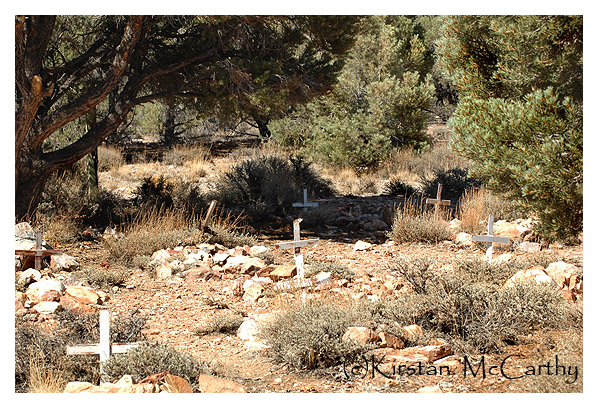
Beginning photographers are drawn to cemeteries because they offer strong subjects without needing access, models, money, or complicated logistics.
A cemetery gives a novice several useful things at once: quiet, stillness, interesting light, readable shapes, texture, inscriptions, age, symbolism, and emotion. The subject does not move, so the photographer can slow down and practice composition, focus, depth of field, close-ups, shadows, and framing. Headstones, fences, trees, paths, statues, flowers, flags, and weathered surfaces naturally create visual structure.
They also feel meaningful. A beginner often wants photographs to say something, not merely show something. Cemeteries come preloaded with themes: memory, loss, time, ancestry, mystery, abandonment, faith, and neglect. That can make the pictures feel more profound than the photographer’s technical skill can yet produce elsewhere.
There is also a long-standing romantic and gothic pull. Old cemeteries provide atmosphere: leaning stones, carved angels, iron gates, winter grass, late-afternoon light. They can look dramatic even when photographed simply.
But that is also the trap. Cemetery photography can become easy symbolism: a broken stone, a skull, an angel, a name, a sunset. The best work usually goes beyond mood. It notices evidence: who is buried there, how the graves are arranged, what materials were used, which names repeat, which markers are cared for, which are forgotten, and what the cemetery says about the community around it.
So beginners are drawn to cemeteries because cemeteries are accessible, patient, visually rich, emotionally charged, and historically layered. They make it easier to feel that a photograph has weight.
No single government, tribe, agency, or company controls the Mojave Desert. That is the first rule for understanding its history. The Mojave is not one jurisdiction. It is an area with many overlapping authorities. It is older than the borders now drawn. It is still managed piece by piece: by federal land agencies, tribal nations, state governments, county supervisors, city councils, military commands, water districts, railroads, utilities, conservation laws, mining claims, private property, and custom.
Before American maps and agencies, Native peoples held authority over the region. Their homelands, trails, springs, food-gathering areas, trade routes, and river crossings shaped the land. This was not “ownership” in the later courthouse sense; instead, it meant use, memory, obligation, defense, kinship, and sacred geography. The Mojave people controlled key parts of the Colorado River. Paiute, Chemehuevi, Serrano, Cahuilla, Kawaiisu, Timbisha Shoshone, and others were tied to desert and mountain margins. Authority followed water, trails, seasonal movement, and social ties.
Spanish and Mexican authority followed, coming lightly and unevenly. The Mojave was crossed, described, feared, and sometimes claimed. It was not closely governed. Missions, ranchos, military parties, and traders affected the edges and corridors more than the interior. The desert was difficult to occupy in the usual colonial way. Water was scarce. Distances were great. Native people still controlled much of the practical geography.
After the United States took California and the Southwest, authority became more formal but not necessarily more complete. Surveyors, soldiers, miners, freighters, railroad companies, and county officials imposed new systems of control. Military posts guarded roads and river crossings. Mining districts drafted local rules before the full government arrived. Stage and wagon roads made certain corridors important. Counties claimed jurisdiction, but their reach was often thin.
The arrival of the railroad changed the balance of power. The Atlantic and Pacific Railroad, later tied to the Santa Fe system, crossed the Mojave. Authority gathered around depots, water stops, sidings, land grants, and townsites. Places like Daggett, Barstow, Needles, Kelso, and Mojave developed. Transportation created order in a land that had previously resisted centralized control. The railroad did not govern the whole desert. However, it controlled movement, freight, settlement patterns, and economic opportunity.
Mining created another layer. Silver, gold, borax, copper, iron, salt, and other minerals brought camps, claims, mills, roads, and speculation. In many districts, authority came from miners’ meetings, claim notices, local custom, and whoever could pay for extraction and hauling. Over time, state and federal law provided the legal framework. On the ground, the desert was ruled by remoteness, money, water, and endurance.
Homesteading added another layer to authority. The government encouraged settlement through land laws. Much of the Mojave, however, was marginal for farming. Some settlers proved up claims. Some built cabins. Some failed. Some left behind the jackrabbit homestead landscape. Authority here was paper-based: legal descriptions, patents, assessment rolls, roads, school districts, and county maps. But the land itself often had the final word.
In the 20th century, the federal government became the main land authority. National parks, military bases, grazing districts, wildlife refuges, reclamation projects, and later BLM management made much of the Mojave public land. World War II and the Cold War expanded the military presence. Fort Irwin, China Lake, Edwards Air Force Base, Marine Corps bases, and training ranges made the desert a national defense site.
At the same time, water and power authorities became decisive. As a result, projects like the Hoover Dam, the Colorado River system, aqueducts, transmission lines, pipelines, and later solar and wind initiatives connected the Mojave to cities across the Southwest. In this phase, the desert was governed by both land ownership and infrastructure.
Later, the conservation era changed the question of authority again. Laws and designations like the 1964 Wilderness Act, the 1976 Federal Land Policy and Management Act, the California Desert Conservation Area, and the 1994 California Desert Protection Act redefined much of the Mojave as habitat, wilderness, cultural landscape, and public trust. Groups such as the National Park Service, BLM, Fish and Wildlife, state agencies, county governments, tribes, miners, ranchers, off-road users, utilities, conservation groups, and local residents all joined the debate.
Today, much of the California desert is managed by the Bureau of Land Management. Other major areas are under the National Park Service, such as Mojave National Preserve, Joshua Tree National Park, and Death Valley National Park. The military is also a major landholder and decision-maker. Tribal authority is increasingly recognized through consultation, co-stewardship, and co-management, though this is not always done equally or adequately. Counties regulate land use in private and unincorporated areas. Cities govern their own townsites. Water districts, utilities, mining companies, conservation groups, and private owners all hold some authority.
Also, who is in charge?
The best answer is: it depends on where you are, what resource is at issue, and what kind of authority you mean. A ranger can control a campground. A county may control the zoning. A sheriff can enforce local law. The BLM can manage grazing, recreation, mining access, or conservation on public land. The Park Service may regulate activity within a preserve or park. A tribe may exercise cultural, historical, legal, and, sometimes, land-management authority. The military can close an entire landscape. A water district can decide the fate of an aquifer. A railway or utility may control a corridor. A private owner may hold title to a desert square surrounded by public land.
That is the Mojave’s pattern: not centralized command, but layered jurisdiction. The desert has always been negotiated valley by valley, spring by spring, road by road. Its history is people trying to cross it, use it, protect it, extract from it, defend it, name it, and claim it—but never mastering it. Whoever controlled water, movement, maps, law, minerals, military access, or infrastructure controlled part of the desert. But no one controlled it all. The Mojave is best seen not as a single chain of command, but as a contest between landform, use, law, memory, and power.
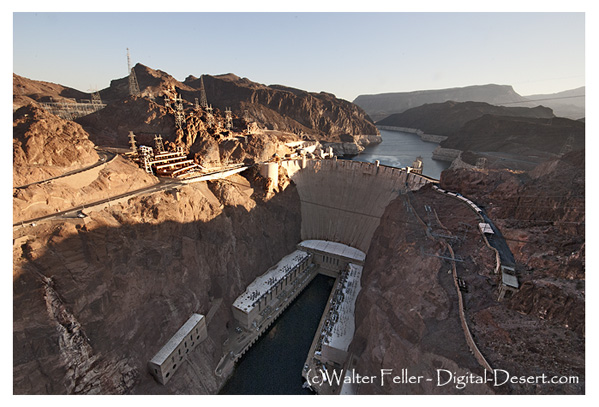
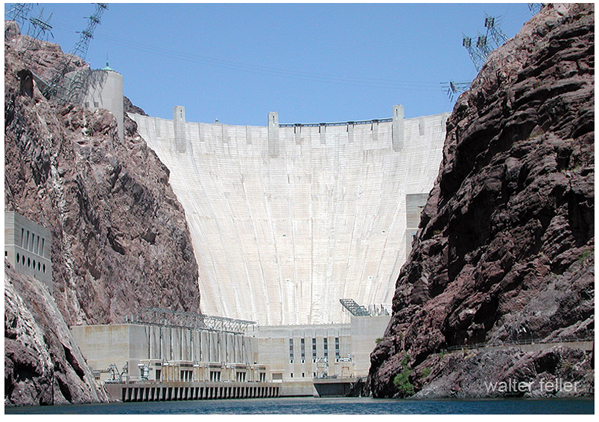
Hoover Dam and Boulder Dam refer to the same concrete structure that crosses the Colorado River between Nevada and Arizona. The distinction lies not in the dam, but in a story formed by planning, politics, and changing names. Early proposals to control the Colorado River focused on Boulder Canyon, upstream of the eventual construction site. As a result, the project became widely known as Boulder Dam, a name that remained familiar even after engineers selected Black Canyon, with its stronger rock walls and narrower gorge, as the better location for such a massive dam.
In 1930, Secretary of the Interior Ray Lyman Wilbur announced that the project would be named Hoover Dam, in honor of President Herbert Hoover, who had supported Colorado River development and played a role in negotiations among the basin states. Construction began during his administration, but the dam soon became associated with the Great Depression and the political changes that followed.
When Franklin D. Roosevelt became president in 1933, his administration returned to the older name Boulder Dam, which government publications and public references often used for years. Roosevelt dedicated the dam in 1935, even as major construction was still underway. During this period, “Boulder Dam” was not merely a casual nickname; it was the official name favored by many people and agencies.
In 1947, Congress formally restored the name Hoover Dam, which has since been the official designation. Boulder Dam remains an older historical term.
The two names, therefore, mark different moments in American history: “Boulder Dam” belongs to the era of early planning, Depression-era construction, and New Deal usage, while “Hoover Dam” is the modern official name. Together, the names reflect not only a landmark of engineering but also the politics of memory in the American West.
The Salt Lake Route, the Mojave River, and the Safer Passage of 1849
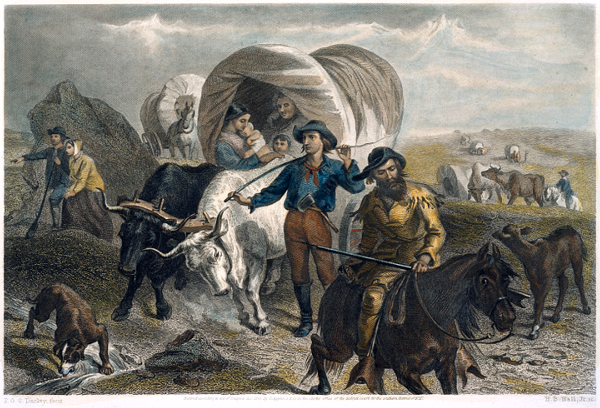
Emigrants crossing the plains / F.O.C. Darley, fecit ; H.B. Hall, Jr. sc.
Walter Van Dyke, a young Cleveland lawyer, joined the 1849 rush to California. Reaching Salt Lake too late to cross the Sierra safely, he turned south with a guided party under Captain Jefferson Hunt. His account records the successful Salt Lake-to-Los Angeles route via the Old Spanish Trail, Santa Clara, the Virgin River, Las Vegas, the Mojave River, and the Cajon Pass. It is valuable for showing the southern road that worked, not the Death Valley disaster.
The California Gold Rush is often remembered as a westward rush: across the plains, over the Sierra Nevada, or around the Horn and through Panama. These routes shaped the classic Forty-niner image: ox-team emigrant, sea passenger, red-shirted miner, speculator, and gold-seeker. Stewart Edward White divided the movement into three channels: the Cape Horn voyage, the overland road, and the Panama route. The overland road drew hardier emigrants, whose property was wagons, livestock, and farm equipment. White also highlighted the heavy price: cholera, failed animals, abandoned wagons, alkali deserts, and exhaustion from the Humboldt and Sierra crossings. The ordeal was a “trial by fire.” Reaching California, in the end, changed the emigrant.
Yet the overland story was a web of routes, decisions, delays, guides, mistakes, and improvisations. The best-known road led to the Humboldt and the Sierra. By 1849, however, lateness changed everything. Those late to Salt Lake faced a hard choice: attempt the Sierra and risk disaster, winter in Utah, or turn south toward Los Angeles on the Old Spanish Trail—a safer but longer route. At this juncture, Van Dyke’s “Overland to Los Angeles, by the Salt Lake Route in 1849” proves valuable, as his party avoided Death Valley by joining Captain Jefferson Hunt’s guided movement south and west toward the Mojave River and Cajon Pass.
Van Dyke started as an ordinary gold seeker. He was recently admitted to the bar in Cleveland. In spring 1849, he joined a company and left for California via Chicago, Iowa, Council Bluffs, the Platte, Fort Laramie, the Sweetwater, and Salt Lake City. His plain, late-life recollection preserves a useful chronology: leaving Chicago on June 6. Crossing the Mississippi on June 18. Leaving the Missouri on July 24. Reaching Salt Lake City on October 8. Then, waiting as the season closed, the Sierra route. Like many emigrants, they were late. However, unlike many, they accepted the consequences. The Donner disaster was a fresh warning that still shaped their choices.
In Salt Lake, Van Dyke’s party learned from Mormons returning from the mines that crossing the Sierra before winter was impossible. While they hesitated, the Pomeroy brothers, Missouri traders, prepared to take livestock and freight wagons to Southern California. Consequently, the emigrants joined them and hired Captain Jefferson Hunt as a guide. This decision put Van Dyke’s party on a different road from most Forty-niners, making their success reliant on guidance, water, forage, and discipline—not speed.
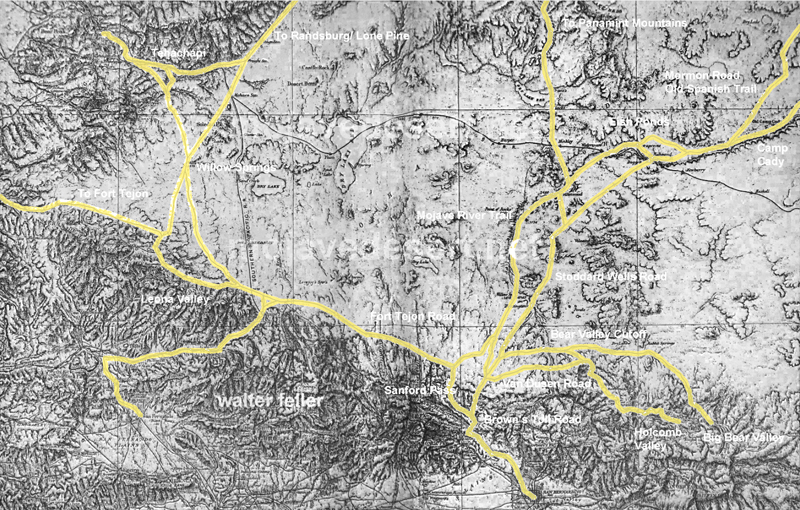
They left Salt Lake on 3 November 1849, heading south along the Wasatch. Near Utah Lake’s south end, they struck the Old Spanish Trail, which Van Dyke calls the northern route between Los Angeles and Santa Fe. This is important: the party did not create a new road, but entered an old corridor of travel, trade, and survival. They passed Spanish Fork, Sevier County, Mountain Meadows, Santa Clara, Virgin, Las Vegas, Mojave River, and Cajon Pass. The route was difficult but clear, with known camps, springs, river bottoms, and a familiar guide.
Van Dyke’s southern-route account should be read with the context provided by Will Bagley in Across the Plains, Mountains, and Deserts. Bagley’s bibliography demonstrates the scale of the overland documentary record: thousands of primary accounts, guidebooks, gazetteers, later wagon-travel sources, and secondary works. However, he warns that the California Trail’s southern route is less represented than the northern and central routes. This gap matters. Because of it, Bagley’s coverage is selective. He directs readers to Harlan Hague and Patricia Etter for more detail. This caution is important: Van Dyke is not just another emigrant reminiscence. For the Mojave and southern-route studies, he is a firsthand witness in a thin documentary field.
The contrast with White’s narrative is sharp. In his “Across the Plains” chapter, White spotlights catastrophic features: the Humboldt Sink, Sierra, broken wagons, dead animals, cholera graves, and emigrant trains collapsing under haste and poor preparation. Van Dyke’s account is different. There are hardships, hunger, snow, poor feed, and exhausted stock, but not disaster. The southern road remained challenging, not easy. The crucial distinction lay in route choice. By turning south, Van Dyke’s party exchanged the Sierra wall for a long desert road with intermittent water, warmer weather after Utah, and a descent through Cajon Pass into Southern California.
The Mojave River was the final desert threshold for Van Dyke’s party. Provisions nearly failed. About a dozen men went ahead for relief. They reached the Mojave River on the second day from the main camp, near present-day Barstow. They followed the Old Spanish Trail up the river to Cajon Pass. This short passage matters: it shows the Mojave River as the practical approach to Southern California. The river led emigrants to the pass and from the desert to the settlement.
The emotional climax is at Cajon Pass. Out of food and aided by moonlight, Van Dyke’s advance party went through the pass at night. They emerged in the valley around four o’clock on February 1. Van Dyke’s memory fixes on the contrast. The day before, they were in a harsh desert. Now, they walked through flowers and wild clover, with fragrant morning air. The passage is conventional–a classic arrival scene–, but its power lies in its geography.
Cajon Pass marked the divide between ordeal and relief.
At Cucamonga Rancho, the advance party found food, milk, and butter. A few days later, they reached Chino Ranch, linked to Colonel Isaac Williams, who had sent relief that season. Soon after, Van Dyke went to Los Angeles with a horse and guide, carrying letters and packages. The rest of the Cleveland party arrived with the train about a week later. The crossing took eight months. All arrived alive and healthy. Van Dyke knew this was rare. He had seen graves along the Platte and Black Hills and knew many had endured worse.
Van Dyke drew a larger lesson from their survival. That winter brought early rains and deep Sierra snow. No ordinary party could have crossed the Sierra. His group traveled from Salt Lake to Southern California with ox teams and heavy wagons, delayed primarily by weakened stock. He used this fact to argue that the Salt Lake-to-Los Angeles corridor was the natural railroad route to the Pacific—lighter grades, fewer snow sheds. This is retrospective route advocacy. However, it is grounded in their successful winter passage when the Sierra route was closed.
White frames what Van Dyke omits: the allure of the mines and San Francisco. White’s world rushes toward gold. It sorts into miners, merchants, teamsters, speculators, lawyers, gamblers, and citizens of a new commonwealth. The Gold Rush was a social furnace as well as a migration. Van Dyke confirms this from the south. In Los Angeles, he found a small Spanish pueblo with little business beyond stock raising. Even southern route emigrants kept moving north. The mines remained the magnet.
The three sources, therefore, work best together. Bagley supplies the research architecture: how to think about diaries, journals, recollections, reminiscences, guidebooks, and the uneven survival of trail records. White gives the broad synthetic frame. The Gold Rush was a migration, ordeal, social leveling, urban explosion, and civic improvisation. Van Dyke gives the local route witness. A Cleveland emigrant who reached Salt Lake too late. He turned south under guidance, followed the Old Spanish Trail, came by the Mojave River and Cajon Pass, and arrived safely in Los Angeles. Used together, these accounts show that the Forty-niner story was not simply a rush to California. It was a series of choices made under pressure. The right road, at the right season, could mean the difference between disaster and survival.
For Death Valley and Mojave work, that distinction is essential. The southern route is often remembered through the dramatic failure of the Death Valley parties. Van Dyke preserves the counterexample: the guided road that worked. His party suffered from hunger, snow, poor forage, and failing cattle. But it did not fall into catastrophe. It stayed with Hunt’s route. They kept to the Old Spanish Trail, used known water corridors, and entered Southern California through Cajon Pass. In that sense, Van Dyke’s account is not merely a reminiscence. It is evidence for the practical geography of survival in 1849.
The better historical question, then, is not simply why some Forty-niners suffered. All suffered in some measure. The sharper question is why some parties survived intact while others broke apart. Timing, leadership, route knowledge, livestock condition, water, forage, and the discipline to abandon the wrong ambition at the right moment–that made the difference. Van Dyke’s party wanted the gold fields. But at Salt Lake, they accepted winter’s terms.
The better historical question, then, is not simply why some Forty-niners suffered. All suffered in some measure. The sharper question is why some parties survived intact while others broke apart. Timing, leadership, route knowledge, livestock condition, water, forage, and the discipline to abandon the wrong ambition at the right moment—that made the difference. Van Dyke’s party wanted the gold fields. But at Salt Lake, they accepted winter’s terms. That decision sent them south, through the Mojave, and into Los Angeles alive.
References
Bagley, Will, ed. Across the Plains, Mountains, and Deserts: A Bibliography of the Oregon-California Trail, 1812-1912. Prepared for the National Park Service, National Trails Intermountain Region. Salt Lake City: Prairie Dog Press, 2015.
Van Dyke, Walter. “Overland to Los Angeles, by the Salt Lake Route in 1849.” Historical Society of Southern California.
White, Stewart Edward. The Forty-Niners: A Chronicle of the California Trail and El Dorado. New Haven: Yale University Press, 1918.
Caballeria, History of San Bernardino Valley: From the Padres to the Pioneers, 1810-1851 – mission-era foundation, Guachama, Politana, San Bernardino naming, La Placita, Agua Mansa, and transition to Mormon settlement.
Ingersoll, Century Annals of San Bernardino County, 1769 to 1904 – detailed San Bernardino County annals, Mormon colony, county formation, pioneer memory, illustrations, local biographies, railroad/citrus/irrigation development, and the 1904 historical frame.
Brown and Boyd, History of San Bernardino and Riverside Counties, Vol. I – broader county synthesis, San Bernardino and Riverside institutional history, towns, agriculture, irrigation, transportation, mining, education, courts, and later regional development.
Master timeline using all three files:
1542 – Cabrillo reaches San Diego Bay, beginning the Spanish coastal frame that Caballeria uses as background for San Bernardino Valley history. Caballeria’s table of contents begins with Cabrillo and Viscaino, then moves to the missions and San Bernardino Valley proper.
1602-1603 – Viscaino surveys the California coast and reinforces the Spanish naming pattern that later appears inland in mission-era place names.
1769 – Spanish occupation of Alta California begins under the Portola-Serra expedition. Ingersoll’s title frame begins San Bernardino County history at 1769, while Brown/Boyd and Caballeria both treat the mission system as the institutional background for the valley.
1770 – Mission San Carlos Borromeo is founded at Monterey, after which the Spanish occupation of California was considered complete in the mission narrative.
1771 – Mission San Gabriel Arcangel is founded. This becomes the parent mission for the San Bernardino Valley activity. Caballeria’s structure moves from San Gabriel directly toward Politana and the valley mission outposts.
1774-1776 – The inland Anza route makes the San Bernardino Valley part of the practical travel corridor between the Colorado River, the San Gabriel, and coastal California.
1810 – Politana is established at or near Guachama as the first Christian settlement in the San Bernardino Valley. Ingersoll places “Mission Settlements in San Bernardino County,” “Politana,” and “San Bernardino Mission Station” in his Spanish-era chapter.
1812 – Earthquakes and Native resistance disrupt the first Politana settlement. This marks the first failure of the San Gabriel mission foothold in the valley.
1820s – Mission activity resumes in the San Bernardino Valley, leading to the establishment of the San Bernardino mission station, agriculture, stock raising, and zanja irrigation works.
1830s – Secularization breaks the mission system and shifts land, labor, water, buildings, and herds toward Mexican civil and rancho control. Caballeria treats secularization, abandonment, land titles, and Mexican grants as the hinge between mission and rancho history.
1842 – Rancho San Bernardino is granted to Antonio Maria Lugo and his sons. Ingersoll also notes that the Lugos offered lands near Politana to New Mexican colonists.
July 4, 1842 – Daniel Sexton raises the American flag in San Gorgonio Pass, an early symbolic American act before formal U.S. control.
1843 – Lorenzo Trujillo and others settle at Agua Mansa, according to Ingersoll’s annals.
1845 – A second party of colonists under Jose Tomas Salazar removes from La Politana and founds Agua Mansa. Caballeria says Agua Mansa means “gentle water,” names Ignacio Moya as the first alcalde, and says Louis Rubidoux later succeeded him.
1846 – The Battle of Chino occurred during the Mexican-American War. Ingersoll places it in the Mexican-era chapter alongside Rancho Santa Ana del Chino, the San Bernardino Grant, Indian troubles, and the rancho order.
April 12, 1847 – A detachment of the Mormon Battalion is sent to establish a military post at Cajon Pass.
April 1848 – A Mormon Battalion party passes through Cajon Pass with a wagon; Ingersoll calls it the first wagon to cross that route.
1849 – Gold Rush-era movement passes through the inland route, but Caballeria notes that the San Bernardino Valley itself remained distant from the earliest gold excitement, with Mexican settlers continuing their pastoral life.
June 11, 1851 – The first Mormon party reaches Cajon Pass.
September 1851 – The Mormons purchase the San Bernardino grant. This is the hinge from Mexican rancho occupation to organized American colonization.
1852 – The Old Fort is erected; the Mormons build a grist mill and a road up Twin Creek Canyon.
1851-1852 – The Little Church of Agua Mansa is built and dedicated to San Salvador; Caballeria says its parish records preserved marriages, births, and deaths.
April 26, 1853 – San Bernardino County is separated from Los Angeles County. The townsite of San Bernardino was laid out the same year, and the Mormon Council House was erected.
April 13, 1854 – The City of San Bernardino is incorporated. The first stage of service between San Bernardino and Los Angeles began the same year.
1855 – Volunteers under Captain Andrew Lytle enter the desert in pursuit of Native raiders, highlighting continued frontier insecurity after county formation.
1856 – Conflict grows between Mormons and Independents.
1857 – The Mormon recall begins, effectively closing the Mormon colony phase. Ingersoll’s contents treat “The Recall” as part of the Mormon-era chapter.
1858 – The first Union Sunday School and first May Day picnic are recorded; the Butterfield stage route is established. Ingersoll marks this as the start of the “Between Period–1858-1875.”
1859 – The Ainsworth-Gentry fight occurs, one of the best-known local violence episodes of the post-Mormon years. Brown/Boyd describe this period as one in which Mormon-Gentile tensions, mining-camp lawlessness, Native raiding, and Civil War sentiment converged.
1860 – Gold is discovered in Bear and Holcomb valleys; the San Bernardino Herald appears as the first newspaper in the county.
1861 – A toll road through Cajon Pass is established; Camp Carleton is established on the Santa Ana River; C. W. Piercey is killed in a duel near San Rafael.
January 22, 1862 – The great flood destroys Agua Mansa. Caballeria says rain continued for fifteen days and nights, the Santa Ana became a raging torrent, and the village was washed away except for the church and Cornelius Jensen’s house. Ingersoll summarizes the event as “Agua Mansa swept away.”
1862 – The first county educational convention is held, and the first orange grove, four acres, is set out at Old San Bernardino.
1862-1868 – Flood memory becomes part of the region’s historical identity. Brown/Boyd preserve Mrs. Crafts’ account of the 1861-62 rains, describing families fleeing to higher ground, adobe houses melting, and neighbors sheltering one another.
1875-1890 – Ingersoll’s “Progression” period: agriculture, horticulture, city growth, transportation, and the boom era reshape the county.
1880s – Citrus, irrigation, railroad development, and new towns transform San Bernardino County from a former mission-rancho-frontier district into a modern agricultural and town-building region.
1890s – County consolidation continues through public buildings, horticultural organizations, transportation networks, electric power, and institutional development.
1904-1905 – Ingersoll’s Century Annals of San Bernardino County, 1769 to 1904, is prepared as a permanent county history and biographical record; one biographical note says Ingersoll began gathering data in 1898 and published after delays.
1922 – Brown and Boyd’s History of San Bernardino and Riverside Counties offers a later retrospective synthesis, folding Caballeria and Ingersoll into a broader county- and regional-history.
The combined structure is:
Spanish and mission foundation, 1542-1830s: coastal discovery, San Gabriel, Politana, San Bernardino mission station, zanja, stock, and agriculture.
Mexican rancho and New Mexican settlement, 1830s-1851: secularization, Lugo grant, La Politana, La Placita, Agua Mansa, stock protection, and Battle of Chino.
Mormon colony and county formation, 1851-1857: purchase of Rancho San Bernardino, Old Fort, townsite, county separation, incorporation, roads, mills, and the Mormon recall.
Between periods, 1858-1875: post-Mormon instability, flooding, mining, lawlessness, Civil War tensions, schools, stages, and slow recovery.
Progression and boom, 1875-1890: railroad, irrigation, citrus, Redlands, Ontario, Chino, Highland, and speculative expansion.
Modern county memory, 1890-1922: public institutions, electric power, forest reserve, county division, horticulture, biography, and the writing of formal local history.
Transmogrification, though it carries a slightly literary, almost mythic tone, suggests not just change but a deep and strange transformation into something fundamentally different.
For much of its recorded history, the Mojave Desert was primarily understood as a physical region. Its identity arose from terrain and climate. Dense or permanent human occupation played little role. Early travelers, surveyors, geologists, and writers described it using the language of the landform. They noted broad basins, isolated mountain ranges, dry lakes, volcanic fields, alluvial fans, dunes, washes, and the intermittent course of the Mojave River. The desert was seen as a geographical system. Uplift, erosion, aridity, and distance formed it. Its boundaries were often indistinct. The Mojave was not yet a tightly organized human landscape. It was seen as open country, with character shaped by the land’s form.
In that earlier conception, geography imposed limits upon people. Travel followed springs, canyon mouths, and natural passes through the mountains. Camps and settlements clustered where water permitted survival. Roads bent around lava flows, crossed playas, or traced older Indigenous routes refined over generations of movement through the desert. Human activity existed within conditions dictated by climate and terrain. The desert remained the dominant force, and people adapted themselves to it.
Even with these earliest permanent intrusions, the long-standing dynamic between people and landscape was not immediately overturned. Mining camps rose and disappeared as ore deposits and water supplies fluctuated. Wagon roads faded when springs failed. Small railroad towns appeared abruptly but often remained fragile in the face of the scale and hostility of the surrounding landscape. Much of the Mojave still retained the appearance of a place shaped principally by geology rather than by civilization.
Over time, a shift occurred: the Mojave, once defined by natural systems, increasingly came to be structured around human needs. The first key shift came with railroads, which established artificial centers in previously insignificant locations—places that had mattered only as crossings or water stops. Afterward, elements like highways, aqueducts, transmission corridors, military reservations, utility infrastructure, suburban expansion, recreational development, industrial agriculture along the margins, and large-scale energy production continued this trend. These forces did not simply occupy the desert; they actively reorganized it.
A modern map of the Mojave clearly reveals this shift: vast military boundaries now dominate entire valleys and mountain ranges. Meanwhile, interstate highways create strong directional corridors across what were once diffuse travel landscapes. Utility-scale solar developments, visible for miles, convert open basins into industrial energy fields. Transmission towers march across dry lakes and bajadas. Off-road recreation networks carve repeating tracks into fragile terrain. Finally, conservation areas and national preserves add another layer of organization by establishing access restrictions, managing habitats, providing tourism infrastructure, and developing preservation policies.
Increasingly, the Mojave is understood less through watersheds and landforms than through jurisdiction and use. One valley becomes associated with military training, another with renewable energy, others with recreation, habitat protection, logistics, or suburban expansion. This shift is reflected in the language used to describe the desert. Whereas earlier generations emphasized playas, volcanic mesas, spring systems, or mountain passes, modern discussions focus on renewable energy zones, conservation plans, transportation corridors, protected acreage, groundwater management, housing pressure, and recreational access.
Yet the older desert has not disappeared beneath these overlays. The geology remains the controlling framework beneath every human system. Basin-and-range topography still governs drainage and movement. Mountain ranges still create rain shadows and isolate valleys. Heat still limits settlement density. Water scarcity still defines possibility. Dry lakes still gather runoff after storms, just as they did centuries ago. In many places, the desert resists permanent transformation. Every generation is reminded that the underlying landscape remains older and more powerful than any system laid upon it.
Building on these evolving layers of meaning, what has changed most is not simply the Mojave’s physical appearance but its significance. The desert has shifted in its conceptual role: initially perceived as a natural form, then as a landscape of use, and now increasingly as a landscape of negotiation.
The central question is no longer merely “What is the Mojave?” but “What is the Mojave for?” Different groups now approach the same landscape with competing visions: energy developers see open basins suitable for solar fields and transmission infrastructure; conservationists see fragile ecosystems, migration corridors, and biological continuity; tribes see ancestral homelands, sacred sites, and cultural memory in the terrain itself. The military sees strategic training space, defined by isolation and open airspace, while residents see communities and livelihoods. Recreationists seek freedom, mobility, solitude, and escape, while cities beyond the desert offer land, water, transportation routes, and energy supplies.
As these pressures intensify, nearly every part of the Mojave acquires overlapping claims—emptiness itself becomes contestable. Open land is no longer simply open; instead, it becomes designated, managed, leased, protected, restricted, industrialized, or defended. Consequently, the future Mojave is likely to be shaped not by a single activity, but by tensions among many competing systems, all operating simultaneously across the same terrain.
In this evolving context, the Mojave is entering a third historical phase. Initially, it was defined by its physical landforms. Next, human activities and uses became the defining factors. Now, the Mojave’s identity may increasingly depend on negotiations and conflicts over its meaning, access, and purpose.
The old desert will still remain beneath these arguments. The playas will still whiten under summer heat. Winds will still sweep across creosote flats. Mountain ranges will still rise abruptly from broad basins at dusk. Seasonal floods will still cut across washes after sudden storms. The geological skeleton of the Mojave will endure. However, as human systems become more extensive and entangled, the experience and interpretation of the desert will continue to change.
The future Mojave will be governed as a layered landscape. No single authority will determine its fate: federal agencies will control vast public lands; counties will regulate roads, zoning, and development pressure; tribes will press claims rooted in sovereignty, memory, and sacred geography; energy and mining companies will seek permits, leases, and corridors; conservation groups will defend habitat and species; recreationists will demand access; and residents will argue for the right to live within the desert, not just be managed from outside. In light of these overlapping interests, governance will become less about drawing boundaries and more about arbitrating between claims. The desert will be administered through plans, lawsuits, permits, consultations, closures, leases, and exceptions. Its future will not be decided all at once; instead, it will be determined valley by valley, corridor by corridor, and project by project.
The Mojave functions as both an ancient physical landscape and a modern human one. While it is no longer shaped solely by tectonics, erosion, and climate, it is no longer defined solely by railroads, highways, military reservations, and energy development. Increasingly, the desert is formed by negotiations over how such a landscape should exist. Thus, what once was defined by its form is now shaped by the competing meanings people assign to it.
Common ravens are now among the most important predators of young desert tortoises in the Mojave Desert. Adult tortoises are generally protected by their heavy shells, but hatchlings and juveniles are small, soft-shelled, and vulnerable. Ravens can flip them over, peck through the shell, and kill them quickly. Over the last century, this predation pressure has increased substantially, not because ravens are foreign to the desert, but because human activity has allowed their populations to expand far beyond historic levels.
Historically, ravens lived in the Mojave in relatively low numbers, limited by scarce food, water, and nesting sites. Modern development altered those limits. Landfills, dumpsters, roadkill, artificial water sources, agricultural areas, campgrounds, transmission towers, utility poles, and roadside structures now provide reliable support for large raven populations across the desert. Biologists often describe these as “subsidized” ravens: native predators whose numbers are unnaturally amplified by human infrastructure.
Young tortoises are especially vulnerable during their first years of life, before the shell fully hardens. In some heavily developed areas, raven predation has removed large numbers of juveniles before they can reach adulthood. Because desert tortoises mature slowly and reproduce cautiously, sustained losses of hatchlings can have serious long-term effects on local populations.
Conservation efforts, therefore, focus not only on tortoises themselves but on the broader human landscape that supports elevated raven numbers. Securing trash, reducing open dumpsters, cleaning up roadkill, limiting artificial water sources, and modifying utility poles or towers to discourage nesting and perching are all important measures. In open desert terrain, tall structures provide ravens with excellent lookout points from which to search for young tortoises.
Additional protections are sometimes used in sensitive areas. Wildlife agencies may place protective cages over burrows or release sites, restore shrub cover that conceals juvenile tortoises, or use “head-start” programs in which hatchlings are raised in captivity until their shells harden and become more resistant to predators. Some agencies also conduct direct raven management through nest removal, egg oiling, or, in limited cases, lethal control under federal permits. However, most researchers agree that predator removal alone cannot solve the problem if the artificial food and infrastructure supporting high raven populations remain in place.
For this reason, the raven-tortoise conflict is often understood not simply as a natural predator-prey relationship, but as a broader ecological imbalance created by modern desert development.
The association between Thomas Long (Pegleg) Smith and Walkara in Cajon Pass centers on the great horse raids of the 1830s-1840s along the Old Spanish Trail.
Walkara, sometimes called Wakara or Chief Walker, led large mounted raiding parties from present-day Utah into Southern California. These expeditions targeted Californio ranchos and mission herds, especially around San Luis Obispo, San Gabriel, and inland Southern California. The stolen horses were then driven eastward through the Mojave Desert and across Cajon Pass toward Utah and New Mexico.
Pegleg Smith was one of several Anglo mountain men tied to this trade network. Contemporary and later sources repeatedly connect him with Walkara’s operations, though historians debate whether he directly participated in raids or mainly acted as trader, guide, and broker. James Beckwourth and Old Bill Williams are usually mentioned alongside him.
Cajon Pass mattered because it was the principal gateway between the Los Angeles basin and the Mojave Desert. Large bands of stolen horses moved through the pass on their way east. Some traditions claim thousands of horses crossed there during Walkara’s biggest expeditions.
The raids became so notorious that local geographic names in and around Cajon Pass were later linked to them. Horsethief Canyon and Little Horsethief Canyon are traditionally associated with Walkara’s raiders and their escape routes into the desert.
An important detail often missed is that this was not random outlawry in the modern sense. The horse trade formed part of a large transregional economy running along the Old Spanish Trail. California horses had enormous value in the Rockies and Great Basin. Walkara built a disciplined mounted raiding system, while men like Pegleg Smith connected Native raiding networks with Anglo and Mexican trading systems.
By the mid-1840s, Californio authorities and local militia figures such as Benjamin Davis Wilson pursued these raiding bands through Cajon Pass and into the Mojave, though with limited success.
These appear to be desert land snail shells, probably from one of the small Mojave or Sonoran desert snail groups rather than marine shells. The thick, chalky white shell and tight spiral are typical adaptations for arid environments: the pale color reflects heat, while the heavy shell helps reduce water loss.
The shell on the right looks weathered and sun-bleached, likely long dead. In deserts, snail shells can persist for years because the dry climate slows decomposition. After seasonal rains, the living snails emerge briefly to feed and reproduce, then retreat underground or beneath rocks and seal themselves inside the shell with a thin membrane during drought.
The shape is especially reminiscent of desert hairy snails and allied southwestern taxa in the family Helminthoglyptidae, though exact identification from shells alone is difficult.
It is one of the quieter desert details people often overlook: tiny white shells scattered across washes and dunes, evidence that even the most arid country supports hidden cycles of dormancy and brief renewal.
My Victor Valley Ai model, developed over the last few years, has opened my eyes to its potential and uses I wouldn’t have imagined before I started the project. For example, timelines illustrating historical events and genesis have been a given coming from these engines. Then I get to wondering, maybe a timeline of the future?
Apple Valley’s future over the next 50 years is not a boom-or-bust story. It is a long, gradual transition from a semi-rural High Desert town into a more connected, constrained desert city.
In the near term (the next 10 years), Apple Valley will become more tied into regional systems. Projects like Brightline West and continued Inland Empire spillover push growth along transportation corridors. Industrial and logistics uses expand first, especially on the west side. Residential growth follows, but unevenly. The town still largely feels like itself—open, spread out, and distinct—but pressure is clearly building.
At the same time, the community’s self-image remains rooted in an older identity: desert space, large lots, equestrian culture, and distance from denser cities. This identity becomes more intentional and protective as change accelerates.
20 to 30 years from now, the physical reality shifts more noticeably. Apple Valley functions as part of a broader Victor Valley system rather than a separate place. Traffic increases, land near infrastructure fills in, and economic activity becomes more regional. The original character persists, but more in pockets and memory than across the whole landscape. The defining civic attitude becomes defensive: preserving what remains rather than shaping new expansion.
At 50 years, the transition is essentially complete. Apple Valley is a mature desert city in function—integrated, built out in key areas, and shaped by regional economics. Its historic identity survives mostly as cultural memory, branding, and preserved neighborhoods.
Running through all of this is a single governing constraint: water. The region depends on adjudicated Mojave Basin water and imported supplies, managed by agencies such as the Mojave Water Agency. If water remains stable, growth continues in a controlled, incremental way. If it does not, the outcome is not collapse but restriction.
In a constrained-water scenario (around the 30-year horizon), expansion slows or stops. New development becomes harder to approve. Costs rise. Landscaping and land use shift toward strict efficiency. The town turns inward, focusing on maintaining existing communities rather than building new ones. The political climate hardens around the protection of limited resources.
So the full picture is this:
Apple Valley evolves steadily under external pressure while internally trying to preserve its long-standing identity. In practice, it becomes more urban, even as it resists that label. And its ultimate trajectory is less about ambition than about limits—especially water.
That is the consistent thread across every time horizon we discussed.
The connection between Wyatt Earp and Tex Rickard is not one of formal partnership or shared headline events, but rather something more historically revealing: both men occupied the same transitional world where frontier gambling culture evolved into organized, commercialized sport. Their lives intersect most clearly in the rough northern boomtowns of the Alaska gold rush, particularly Nome, where the last phase of the Old West mentality overlapped with the beginnings of modern entertainment enterprise.
To understand their relationship, it is necessary to begin with Wyatt Earp, whose reputation is often reduced to his lawman years in Dodge City and Tombstone. By the late nineteenth century, however, Earp’s life had shifted decisively away from law enforcement. Like many figures of the frontier, he adapted to changing conditions by moving into gambling, saloon ownership, and opportunistic business ventures. This was not an unusual path. The same skills that made a man effective in frontier law enforcement—nerve, reputation, and the ability to manage volatile situations—translated readily into the semi-regulated world of gambling halls and prizefighting.
Tex Rickard
Earp’s involvement in boxing is frequently overlooked but historically significant. In an era before standardized athletic commissions, referees were often chosen for their perceived toughness or notoriety rather than technical expertise. Earp stepped into this role most famously during the 1896 heavyweight bout between Bob Fitzsimmons and Tom Sharkey in San Francisco. His decision to disqualify Fitzsimmons for a supposed low blow and award the fight to Sharkey sparked widespread outrage. Many observers believed the outcome had been manipulated, and the controversy damaged Earp’s standing. The incident illustrates the loosely governed nature of boxing at the time, where outcomes could hinge as much on reputation and influence as on athletic performance.
This environment—fluid, informal, and often suspect—was precisely the world into which Tex Rickard would later step, though he would ultimately reshape it. Rickard’s early career bore striking similarities to Earp’s later life. He made his initial fortune not in sports but in the Klondike Gold Rush, operating saloons, gambling houses, and supply businesses in boomtowns such as Dawson City. These settlements were defined by sudden wealth, transient populations, and minimal regulation. Entertainment, particularly gambling and fighting, thrived under such conditions.
It was in this northern frontier context, especially in Nome, Alaska, that Rickard and Earp’s paths converged. By the turn of the twentieth century, Earp had relocated there, operating the Dexter Saloon, one of the most prominent establishments in the city. Rickard, meanwhile, ran the Northern Hotel and associated gambling operations. While detailed records of their interactions are limited, it is well established that they moved in the same social and professional circles and were acquainted, if not outright friends. At that time, the name was a concentrated version of frontier life: a place where wealth could be won or lost overnight, and where figures like Earp and Rickard were not exceptions but central participants.
The significance of this connection lies less in any single documented interaction and more in what it represents. Earp embodied the older model of frontier enterprise—informal, personality-driven, and often operating in legal gray areas. His involvement in boxing was incidental and opportunistic. He refereed fights because he was known and respected (or at least feared), not because he was building a systematic business around the sport.
Rickard, by contrast, recognized the commercial potential of boxing as something far larger. Where Earp saw individual events, Rickard saw an industry. After leaving Alaska, Rickard began promoting fights on an unprecedented scale, most notably those featuring heavyweight champion Jack Dempsey. He introduced innovations that would define modern sports promotion: large outdoor venues, extensive advertising campaigns, and the transformation of fights into major public spectacles. His construction and operation of Madison Square Garden in New York further cemented his role in institutionalizing boxing as a mainstream form of entertainment.
The contrast between the two men highlights a broader historical transition. In Earp’s time, boxing was still closely tied to gambling and often operated at the margins of legality. Matches could be arranged informally, outcomes disputed, and enforcement inconsistent. The audience was typically local or regional, and the financial structure was relatively limited. By Rickard’s era, these elements had been reorganized into a more structured system. While gambling and controversy never disappeared entirely, they were increasingly overshadowed by formal promotion, ticket sales, and mass media attention.
Yet Rickard’s success did not emerge in isolation. It depended on the cultural groundwork laid by the earlier frontier world. The appetite for spectacle, the willingness to wager on outcomes, and the fascination with individual fighters were all products of that environment. In this sense, Earp’s career—even in its less celebrated aspects—can be seen as part of the foundation upon which Rickard built. The chaotic and often dubious practices of early prizefighting created both the demand and the opportunity for someone to impose order and scale.
Nome serves as a symbolic bridge between these two phases. It was one of the last great boomtowns of the American frontier, arriving at a moment when the nation was beginning to shift toward urbanization and industrialization. In Nome, the old and new coexisted. Figures like Earp continued to operate in familiar ways, relying on reputation and personal networks, while individuals like Rickard began to experiment with more organized forms of enterprise. The environment encouraged both approaches, but only one would prove sustainable as the country moved into the twentieth century.
It is also worth noting that both men shared a certain adaptability. Neither remained confined to a single identity. Earp transitioned from lawman to gambler to referee to businessman, while Rickard evolved from saloon operator to one of the most influential promoters in sports history. This flexibility was a hallmark of frontier life, where rigid career paths were rare and success often depended on the ability to seize new opportunities as they arose.
In the final analysis, the connection between Wyatt Earp and Tex Rickard is best understood as part of a continuum rather than a discrete relationship. They were participants in the same economic and cultural system at different stages of its development. Earp represents the closing chapter of the Old West approach to gambling and prizefighting—personal, loosely regulated, and often controversial. Rickard represents the opening chapter of the modern sports business—structured, scalable, and commercially sophisticated.
Their overlap in places like Nome provides a rare glimpse of this transition in real time. It shows how the informal practices of the frontier did not simply disappear but were transformed and incorporated into new systems. The saloon became the arena, the local fight became the national event, and the gambler became the promoter.
Understanding this relationship adds depth to both figures. It places Earp within a broader economic context beyond his lawman reputation and highlights Rickard’s roots in a world that was rapidly fading even as he built something new. Together, they illustrate how American sports, particularly boxing, evolved from its rough, uncertain beginnings into a central component of modern entertainment.
Combined timelines of Victorville, Hesperia & Apple Valley, CA.
Pre-1800s: Indigenous Presence and Trade
The Serrano and Vanyume tribes lived along the Mojave River, relying on the river’s intermittent flow for food and trade.
Trails used by these tribes would later become parts of the Mojave Road, Old Spanish Trail, and Salt Lake Road.
1850s–1870s: Pioneer Waystations and Early Ranching
1858: Aaron G. Lane establishes Lane’s Crossing on the Mojave River (present-day Oro Grande/Victorville area), offering rest and resupply to travelers heading west.
Lane is considered the first permanent American settler along the Mojave River.
Summit Valley, near present-day Hesperia, sees increased grazing by early ranchers.
The Summit Valley Massacre (1866): A conflict between settlers and Native groups over livestock thefts and land disputes—an often overlooked but significant local tragedy.
1880s: Railroads and Town Foundations
1885: The California Southern Railroad, part of the Atchison, Topeka and Santa Fe system, reaches the High Desert.
A telegraph and railroad station named Victor is established, later renamed Victorville in 1901 to avoid confusion with Victor, Colorado.
Jacob Nash Victor, the railroad manager, is the town’s namesake.
The Hesperia Land and Water Company, led by James G. Howland, promotes Hesperia. It lays out plans for an agricultural colony and resort town, though irrigation plans fall short.
1900s–1930s: Modest Growth and Agriculture
Hesperia experiments with vineyards, orchards, and dairy farms, but water shortages and harsh conditions hinder success.
Victorville grows as a railroad shipping center and stopover for travelers crossing the desert.
The Victor Elementary School District is formed in 1906.
Early buildings still visible include the Hesperia Schoolhouse (Main St. and C Ave.).
1940s: War Changes Everything
1941: Victorville Army Airfield (later George Air Force Base) is established on the western edge of Victorville.
The base brings thousands of military personnel, rapid infrastructure growth, and federal investment.
Apple Valley remains mostly desert ranchland, but interest grows due to its mild climate and open space.
1948–1950s: Apple Valley Booms
1948: Apple Valley Inn opens, built by Newt Bass and Bud Westlund to attract investors and wealthy land buyers.
Stars like Bob Hope, Marilyn Monroe, John Wayne, and President Eisenhower stayed at the inn.
Murray’s Dude Ranch (founded earlier, 1920s–30s): One of the few Black-owned resorts in the country. It hosted African American guests during segregation and was used in Black-cast Western films.
Roy Rogers and Dale Evans purchase a ranch in Apple Valley and become its most notable residents, eventually opening Roy Rogers’ Apple Valley Inn.
1950s–1960s: Expansion and Identity
Hesperia Inn and the Hesperia Golf & Country Club try to rekindle resort dreams. Jack Dempsey, the former boxing champion, lends his name to a museum at the inn.
Victorville grows with new housing and infrastructure to support the military population.
Route 66 runs right through Old Town Victorville, lined with diners, motels, and neon signs.
1970s–1980s: Steady Growth and Cultural Legacy
Apple Valley becomes a desirable retirement destination, marketing itself as a “Better Way of Life.”
Civic leaders like Bud Westlund and Newton Bass help shape the town’s modern layout and community services.
The California Route 66 Museum opens in Victorville in a former café, preserving the highway’s local legacy.
1992–2000s: Transformation and Reinvention
1992: George Air Force Base closes under federal military restructuring, dealing a blow to Victorville’s economy.
The base is repurposed into Southern California Logistics Airport (SCLA), an international freight and aerospace hub.
Apple Valley, Hesperia, and Victorville begin to urbanize, growing into commuter towns for the Inland Empire and the Los Angeles area.
2000s–Present: Modern Challenges and Historic Preservation
Victor Valley College, founded in 1961, continues to serve the region.
Old Town Victorville Revitalization Project aims to preserve the historic downtown.
Apple Valley promotes its Western heritage through the Happy Trails Highway and events honoring Roy Rogers and Dale Evans.
Hesperia Lake Park, Silverwood Lake, and local trails draw new visitors and recreation seekers.
Timeline of major violent events and notorious moments in Bodie, California’s wild history — a town so lawless it earned a reputation as one of the roughest mining camps in the West:
1876 – Bodie’s Boom Begins The Standard Mine strikes gold. Prospectors flood in, and Bodie transforms from a quiet camp into a booming town — and with it comes gambling, saloons, opium dens, and gunslingers.
1879 – Peak Population, Peak Violence Bodie hits its peak with around 7,000–10,000 residents. That year alone, it’s said there were 30+ murders, many tied to gambling disputes and drunken shootouts. The phrase “Bad Man from Bodie” enters widespread use.
1879 – Tom Treanor Kills a Man in a Saloon After a heated argument during a card game, Treanor guns down another miner in a crowded bar. He was arrested but later released after a murky trial. The town shrugs it off — just another night in Bodie.
1880 – Gunfight on Main Street A broad daylight gunfight erupts between rival gamblers. Two men are killed, and several bystanders are wounded. This kind of event is common enough that locals don’t even bother locking their doors — they’re used to chaos.
1881 – James Stuart Lynched by a Mob Caught robbing a stagecoach, Stuart is jailed in Bodie. That night, a group of vigilantes breaks in and hangs him from a telegraph pole. His body dangled for hours — a message to other would-be criminals.
1882 – Red Irwin Walks Free After Killing a Man “Red” Irwin shoots another gambler in the back during a dispute. Witnesses testify, but the case is dismissed on a technicality. Irwin boasts about it in saloons afterward, reinforcing Bodie’s anything-goes culture.
1883 – Deputy Sheriff Shot in Line of Duty Deputy John Kelly is killed while trying to break up a bar fight. His murder is never solved. By this point, even lawmen hesitate to enforce order in Bodie.
1884 – Town Begins to Decline Mines starts to dry up. Many “bad men” drift elsewhere. But Bodie’s violent legend is cemented, passed down through newspapers, dime novels, and the stories of old-timers.
Polygonal desiccation is a defining surface feature of many playas in the Mojave Desert, where cycles of flooding and drying repeatedly reshape fine-grained sediments. A playa is a dry lakebed that temporarily fills with water after rainfall, then dries under intense desert heat. In this setting, polygonal crack networks form as a direct response to the physical behavior of wet sediment losing moisture.
El Mirage
When a Mojave playa floods, water saturates surface layers composed mainly of clay and silt. These materials have a high capacity to retain water and expand slightly as they become hydrated. As conditions shift toward drying, driven by strong solar radiation and low humidity, evaporation removes water from the sediment. This loss of moisture causes the sediment to contract. However, because the surface layer is laterally constrained and cannot shrink uniformly, internal tensile stresses develop.
Once the stress exceeds the mechanical strength of the sediment, fractures begin to form. These cracks propagate downward and outward, intersecting with others to produce polygonal shapes. Over time, the network organizes into patterns that often resemble hexagons, with crack junctions approaching 120-degree angles. This geometry reflects a natural tendency toward stress minimization during shrinkage.
The scale of polygonal desiccation features on Mojave playas typically ranges from a few centimeters to several meters across, depending on factors such as sediment thickness, clay content, and drying rate. Finer-grained, clay-rich sediments tend to produce more well-defined and persistent crack networks, while coarser materials may result in less regular patterns.
These features are highly dynamic. Each flooding event can erase or modify existing crack networks, while subsequent drying generates new ones. Despite this constant reworking, similar polygonal patterns often reappear in the same areas because the underlying sediment properties and environmental conditions remain consistent.
In well-known Mojave sites such as Rogers Dry Lake and Soda Lake, polygonal desiccation is a routine and visually striking phenomenon. These surfaces provide valuable insight into sediment mechanics, evaporation processes, and environmental change. The presence, size, and morphology of crack networks can indicate recent hydrologic conditions, including the frequency and intensity of flooding events.
Broadwell Lake
It is important to distinguish polygonal desiccation from other polygonal patterns found in desert environments. In some playas, especially those rich in evaporite minerals, polygonal ridges form through salt accumulation driven by subsurface fluid movement rather than shrinkage. Additionally, very large polygonal features may reflect long-term groundwater decline rather than short-term drying.
In summary, polygonal desiccation on Mojave Desert playas represents a straightforward but powerful physical process: the contraction and fracture of drying sediment. These patterns are not random; they are systematic responses to environmental forces, and they serve as a visible record of the interplay between water, heat, and earth in arid landscapes.
First, no infringement as a matter of law. This happens when the defendant’s conduct does not violate any exclusive right (for example, no copying, no distribution, etc.). In that situation, the plaintiff recovers nothing. The case is dismissed or judgment is entered for the defendant.
Second, lawful use defenses. Even if copying occurred, it may still not be infringement if it falls under doctrines like fair use or other statutory exceptions. In those cases, the use is legally permitted, so again, no damages. In fact, if the defendant prevails, the court may even award them attorney’s fees under Section 505.
Third, failure of proof. The plaintiff has the burden to prove infringement. If they cannot establish ownership of a valid copyright or copying of protected expression, the claim collapses. No liability, no damages.
Fourth, false or bad-faith claims. If someone wrongly accuses another of infringement, there can be consequences. For example, under the online liability provisions, knowingly misrepresenting that material is infringing can create liability for damages, costs, and attorney’s fees suffered by the accused party.
Finally, technical or de minimis use. Some uses are so trivial that courts treat them as non-actionable. If the copying is legally insignificant, it may not rise to infringement at all.
So the key point is this: damages—whether actual or statutory—are contingent on a valid infringement finding. Without that, the legal system treats the situation as if no wrong occurred, and the plaintiff gets nothing.
technical or de minimis use
“Technical” or de minimis use is a judicially developed limitation on copyright liability. It addresses situations where copying may have occurred in a literal sense, but the amount or significance is so trivial that the law does not treat it as actionable infringement.
The doctrine operates at the threshold question of copying. Copyright law does not prohibit all copying—only copying that is substantial enough to matter. If what was taken is negligible in quantity or qualitatively insignificant, courts may conclude there is no infringement at all.
There are two main dimensions courts consider.
First is quantitative triviality. If only a very small fragment of a work is copied, this may weigh toward a de minimis finding. However, small size alone is not decisive.
Second is qualitative significance. Even a short excerpt can be infringing if it captures the “heart” of the work. Conversely, copying a longer portion that is generic, unoriginal, or barely noticeable may still be treated as de minimis.
Courts often frame the test in perceptual terms: would an ordinary observer recognize the appropriation as meaningful? If the answer is effectively “no,” the use may be dismissed as de minimis.
This doctrine is distinct from fair use. Fair use assumes infringement but excuses it based on policy factors. De minimis use, by contrast, says the copying is too insignificant to count as infringement in the first place.
A few practical illustrations help clarify the boundary:
A fleeting, out-of-focus appearance of a copyrighted image in the background of a film scene is often treated as de minimis.
An unrecognizable or heavily altered fragment of audio may be considered trivial in some contexts (though sound recordings are treated more strictly in certain jurisdictions).
Copying a short phrase that is not itself protectable expression may also fall outside infringement entirely.
The strategic implication is important. If a defendant successfully argues de minimis use, the case ends before damages are even considered, because there is no legally cognizable infringement to remedy.
The Santa Fe system was the larger railroad network built around the Atchison, Topeka, and Santa Fe Railway and its affiliated or absorbed lines. It developed from a Kansas railroad chartered in 1859 into one of the principal transportation systems of the United States, especially across the Southwest and the Far West. In practical terms, the “system” extended beyond the parent company alone. It included the main line, subsidiaries, controlled properties, and feeder routes that together created a broad, coordinated structure for moving freight and passengers over great distances. By the late twentieth century, the Santa Fe system stretched across a wide territory and remained one of the country’s major Class I railroad networks.
Its historical importance lay in its effective organization of Western transportation. The system linked Midwestern origins with New Mexico, Arizona, California, and connections beyond, helping redirect trade and settlement patterns across the southern tier of the American West. It handled agricultural products, manufactured goods, livestock, minerals, and long-distance passenger traffic, and it became especially well known for both transcontinental freight service and high-grade passenger operations. The system’s reach also reflected the older railroad habit of expansion through subsidiary charters and later consolidation, so that lines first built under different corporate names were gradually brought into a unified operating structure.
In historical interpretation, the Santa Fe system is best understood as a networked institution rather than a single route. Its significance derived from continuity of movement across regions, from the Great Plains to the Pacific Coast. Even after the railroad’s independent corporate life ended in the 1990s, the Santa Fe system remained a defining framework for understanding western rail development and the long movement of commerce across the American interior and Southwest.
Atlantic and Pacific Railroad
The Atlantic and Pacific Railroad was an important nineteenth-century railroad enterprise conceived as part of a southern transcontinental vision, though it never fully realized that original plan. Congress incorporated it in 1866 to build a railroad stretching westward toward California, but the line was never finished as one continuous system under that name. Instead, the company came to own or operate separate sections, including an eastern segment connected with the St. Louis region and a western segment extending from Albuquerque to Needles. Because the middle portion was never completed, the Atlantic and Pacific became less a fully realized transcontinental railroad than a corporate and developmental bridge between earlier ambition and later railroad consolidation.
Its chief historical importance lies in its relationship to the Santa Fe. The Atlantic and Pacific provided a legal and corporate vehicle through which western construction could proceed, especially across New Mexico and toward California. In this sense, it served as a major precursor to the later Santa Fe system. What had been projected as an independent transcontinental line was gradually overtaken by the realities of railroad finance, incomplete construction, and strategic control by stronger carriers. The western portions ultimately became part of the Atchison, Topeka, and Santa Fe network, while other sections passed into different successor systems.
Historically, the Atlantic and Pacific Railroad illustrates a common pattern in nineteenth-century American railroading: ambitious federal charters, uneven construction, and eventual absorption into larger systems better able to finance, operate, and integrate long-distance rail service. Though the company itself did not endure as a dominant name, its western lines were indispensable in carrying railroad construction toward the Pacific slope and in laying groundwork for the Santa Fe’s rise as a major western carrier.
California Southern Railroad
The California Southern Railroad was a subsidiary created to extend Santa Fe influence into Southern California during the decisive railroad contests of the 1880s. Organized in 1880, it was built to connect the San Diego area with inland Southern California and eventually with Santa Fe-controlled lines reaching eastward. Construction began from National City near San Diego and pushed north and northeast through communities including Oceanside, Temecula, Riverside, San Bernardino, and ultimately Barstow. In doing so, the line provided Santa Fe with an entry into a region long influenced by competing rail interests and opened the way for direct participation in Southern California transportation and commerce.
Its route was historically important because it was both strategic and difficult. The line crossed varied country, including the troublesome Temecula Canyon and the demanding grades of Cajon Pass. These were not merely scenic obstacles but operational challenges that required determined railroad engineering in an era when construction through unstable washes, steep mountain approaches, and remote inland stretches could determine whether a line prospered or failed. The completion of the route over Cajon Pass in 1885 allowed through trains tied to Santa Fe lines to reach Southern California, a turning point in the competitive reshaping of the region’s rail geography.
The California Southern did not remain independent for long, but its historical role was outsized. It helped break established transportation patterns, strengthened Santa Fe’s foothold in Southern California, and formed an essential part of the rail framework from which later Santa Fe operations in the region developed. In that sense, it was both a subsidiary and a foundational artery, carrying the larger system into one of the West’s most economically important regions.
Southern California Railway
The Southern California Railway was a later consolidating company created to rationalize and unify several Santa Fe-controlled properties in Southern California. Formed in 1889 through the consolidation of the California Southern Railroad, the California Central Railway, and the Redondo Beach Railway, it was further reorganized in 1892 through the addition of other affiliated lines, including the Santa Fe and Santa Monica Railway and the San Bernardino and Eastern Railway. In substance, it represented the next corporate stage in Santa Fe’s effort to turn a collection of separately chartered local and regional railroads into a more coherent Southern California network.
Its historical significance lies less in an individual main line than in the logic of consolidation. Nineteenth-century railroads often expanded through subsidiaries, local charters, and special-purpose corporations, but such arrangements could become cumbersome. The Southern California Railway gave Santa Fe a more orderly structure for managing routes serving Los Angeles, San Bernardino County, coastal connections, and outlying branches. It therefore stands as a representative example of how railroad systems matured: first by aggressive extension, then by administrative consolidation and operational integration.
By 1906, all of the Southern California Railway’s lines were deeded to the Atchison, Topeka, and Santa Fe Railway, confirming that the company had served primarily as an intermediate corporate instrument in the making of the larger Santa Fe system. Its importance is thus historical and structural. It marks the point at which Santa Fe’s scattered Southern California properties were drawn together into a more unified regional network, preparing the way for long-term operation under the parent railroad’s name.
Atchison, Topeka, and Santa Fe Railway
The Atchison, Topeka, and Santa Fe Railway was one of the great railroad companies of the United States and the core of what became known as the Santa Fe system. Chartered in Kansas in 1859, it was first conceived as a line serving Atchison, Topeka, and Santa Fe, reflecting the commercial logic of the Santa Fe Trail. It expanded rapidly westward and southward, becoming a major force in the settlement and economic integration of the Southwest. Britannica notes that it exercised great influence on the development of that region, and over time, it grew from a plains railroad into one of the country’s largest carriers.
The railroad’s historical strength lay in both geography and administration. It built and controlled lines reaching across Kansas and Colorado into New Mexico, Arizona, California, and other western territories, while also absorbing or directing subsidiary properties that extended its reach. It became a principal mover of freight across the southern transcontinental corridor and an important passenger carrier. By the twentieth century, the Santa Fe name carried national weight, associated with both long-distance commerce and distinctive passenger service. At the time of its merger into BNSF, the railroad had more than 13,000 miles of track, a measure of its scale.
The Atchison, Topeka, and Santa Fe Railway is historically significant not only because it was large, but because it gave organizational form to western rail development. It linked plains, desert, and Pacific markets in a manner that was commercially durable and strategically far-reaching. Even after its separate corporate identity ended through merger in 1995–1996, it remained one of the defining names in American railroad history.
The Southern Pacific system was one of the largest and most influential railroad networks in the American West. More than a single line or company in the narrow sense, it served as an interconnected transportation system linking California with the Southwest, the Gulf Coast, and important inland markets. Its significance rested in scale, reach, and integration. Through a web of trunk lines, feeder routes, and affiliated railroads, the system carried agricultural products, minerals, manufactured goods, and passengers across vast distances that had once been slow and difficult to traverse.
In California, especially, the Southern Pacific system became deeply intertwined with the state’s economic development. It connected farming districts to urban centers, ports to inland communities, and remote resource regions to national markets. The railroad’s influence extended beyond transportation. It shaped town growth, industrial siting, and trade patterns, and for decades, it was regarded as one of the dominant corporate forces in Western life. Its lines were engineered across deserts, valleys, mountain passes, and coastal corridors, demonstrating the practical, expansion-minded railroad building of the late nineteenth and early twentieth centuries.
The term “Southern Pacific system” also implies an operational philosophy: a coordinated network designed for continuity of movement rather than isolated local service. Routes feed into one another, allowing freight and passengers to move efficiently between regions. As a result, the system helped define the geography of western rail transportation. Even after later mergers and corporate changes, the historic Southern Pacific system remained a benchmark for understanding how a railroad could organize and sustain the development of an entire region.
Southern Pacific
Southern Pacific was one of the most important railroad companies in American history, especially in the Far West. Over time, it grew from a California-centered carrier into a major transportation enterprise whose lines stretched across multiple states and connected with national rail corridors. Its name became synonymous with western railroading, not merely because of its mileage, but because of the influence it exerted on commerce, settlement, agriculture, and industry. In practical terms, Southern Pacific provided the infrastructure that enabled people and goods to move reliably across regions marked by long distances, harsh terrain, and uneven development.
In California, Southern Pacific held a particularly strong position. It served major cities, inland valleys, ports, farming districts, and desert crossings, making it indispensable to both local and long-haul traffic. The company moved fruit, vegetables, oil, lumber, livestock, and general freight, while also handling passenger travel on important intercity routes. Its locomotives, depots, yards, bridges, and main lines became familiar features of western life. Just as important, Southern Pacific was known for building and maintaining routes through difficult country, including mountain grades and arid stretches where rail service required careful planning and steady capital investment.
Historically, Southern Pacific was also a symbol of the era when railroads stood at the center of economic life. It could be praised as a builder of regional prosperity and criticized as an overbearing corporate power; both views reflected its enormous reach. By the twentieth century, it had become a defining institution of Western transportation. Though its corporate identity eventually disappeared through merger, the historical Southern Pacific remains central to any serious account of rail development in the American West.
Southern Pacific Mojave-Needles line
The Southern Pacific Mojave-Needles line was an important desert railroad route in southeastern California, forming part of the company’s broader eastern connections. Running across the Mojave Desert toward the Colorado River region, the line served as a strategic link between inland California and territories farther east. In railroad terms, such a line was valuable not only for local service but for through traffic, because desert routes could provide direct, comparatively efficient passage where terrain permitted. The Mojave-Needles line, therefore, belonged to the class of hard-working western main lines that combined geographic severity with operating importance.
Its setting gave the line a distinct character. Unlike routes passing through major urban districts or fertile valleys, this line crossed austere country marked by long distances, sparse settlement, extreme temperatures, and heavy dependence on rail infrastructure itself. Water supply, maintenance, and reliable operations were crucial in such an environment, particularly during the steam era. For freight service, the route played a role in moving goods between California and points east, while also serving mining districts and desert communities whose economic life depended on dependable rail access.
Historically, the Mojave-Needles line illustrates the practical reach of Southern Pacific’s western network. It was not merely a branch of local curiosity, but part of the larger fabric that bound California to interstate rail commerce. Lines like this helped make long-haul freight movement possible across the Southwest and reinforced the railroad’s dominance in desert transportation before the rise of modern highway trucking and interstate highways. The route stands as a representative example of western railroad engineering and operation: a line driven across difficult country for the sake of continuity, utility, and connection between distant markets.
Southern Pacific San Joaquin Valley-Los Angeles line
The Southern Pacific San Joaquin Valley-Los Angeles line was a crucial internal California route, linking the productive agricultural heartland of the San Joaquin Valley with the vast urban and commercial center of Los Angeles. In functional terms, this connection was indispensable. It allowed farm output, livestock, processed goods, and general freight from the interior valley to move southward into one of the state’s largest markets and distribution centers. At the same time, it supported passenger movement and helped tie together two very different but deeply interdependent regions of California.
The importance of this line lay in its economic geography. The San Joaquin Valley was among the most productive farming regions in the country, while Los Angeles developed into a major center of industry, trade, and population. A direct, reliable railroad connection between them was therefore essential to the orderly movement of goods. Southern Pacific used such lines to knit the state together, channeling agricultural traffic to urban consumers, processors, and warehouses, and connecting them to other lines. In earlier eras, especially before highways assumed their modern role, rail service on routes of this kind was foundational to statewide commerce.
The line also reflected Southern Pacific’s long-standing strength in California route structure. Rather than operating disconnected segments, the company maintained a coherent network in which valley, coastal, desert, and metropolitan lines complemented one another. The San Joaquin Valley-Los Angeles line exemplified that network logic. It was both a regional artery and a component of broader system operations. Historically, it represents the kind of practical railroad corridor that mattered every day: not dramatic in the manner of a transcontinental crossing, but vital in sustaining the ordinary commercial life that built modern California.
The deserts of California and the greater Southwest have produced a distinct body of writing shaped by aridity, distance, scarcity, and endurance. This literature does more than describe the landscape. It records how people have understood, moved through, depended on, and argued about dry country. In the Mojave system and its adjoining regions, literature serves as evidence, showing how the desert has been interpreted over time.
Mary Austin Mary Austin stands at the foundation of desert literature in the American West. In The Land of Little Rain (1903) and The Country of Lost Borders (1909), she described the Mojave, Owens Valley, and eastern Sierra as living systems shaped by water, ecology, and long human presence. Her work established the desert as a place of complexity rather than emptiness.
W. A. Chalfant W. A. Chalfant represents the historical record of the desert borderlands. Through his work on Owens Valley and Inyo County, especially The Story of Inyo (1922), he documented settlement, mining, agriculture, and the major water conflicts tied to the Los Angeles Aqueduct. His writing anchors the desert in documented civic and regional history.
Edna Brush Perkins Edna Brush Perkins brings the experience of movement through the desert into focus. In The White Heart of Mojave (1922), she recorded her travels across open desert country, emphasizing distance, silence, exposure, and the psychological effects of arid landscapes. Her work preserves what it felt like to cross the Mojave when the land still imposed strict limits.
Joseph Wood Krutch Joseph Wood Krutch marks a shift toward ecological understanding. In The Desert Year (1951), he described the seasonal rhythms of desert plants and animals, portraying the desert as a balanced, functioning natural system. His work helped move public perception away from the idea of the desert as barren and toward recognition of its internal order.
Edward Abbey Edward Abbey represents the modern phase of desert literature, where preservation becomes central. In Desert Solitaire (1968), he argued against overdevelopment, excessive access, and the industrialization of wilderness. His writing reframes the desert as something to be defended, not simply explored or used.
Together, these writers form a complete cultural layer for understanding the Mojave and the broader desert Southwest. Their work complements geology, ecology, transportation, and settlement history by providing a record of how the desert has been observed, experienced, documented, and contested.
1. “How to Overthrow the System: brew your own beer; kick in your Tee Vee; kill your own beef; build your own cabin and piss off the front porch whenever you bloody well feel like it.”
2. “The idea of wilderness needs no defense, it only needs defenders.”
3. “Life is too short for grief. Or regret. Or bullshit.”
4. “Freedom begins between the ears.”
5. “I’ve never yet read a review of one of my own books that I couldn’t have written much better myself.”
6. “Belief? What do I believe in? I believe in sun. In rock. In the dogma of the sun and the doctrine of the rock. I believe in blood, fire, woman, rivers, eagles, storm, drums, flutes, banjos, and broom-tailed horses…”
7. “In the first place you can’t see anything from a car; you’ve got to get out of the goddamned contraption and walk, better yet crawl, on hands and knees, over the sandstone and through the thornbush and cactus. When traces of blood begin to mark your trail you’ll begin to see something, maybe. Probably not.”
8. “This is the most beautiful place on Earth. There are many such places. Every man, every woman, carries in heart and mind the image of the ideal place, the right place, the one true home, known or unknown, actual or visionary.”
9. “I have been called a curmudgeon, which my obsolescent dictionary defines as a ‘surly, ill-mannered, bad-tempered fellow’. Nowadays, curmudgeon is likely to refer to anyone who hates hypocrisy, cant, sham, dogmatic ideologies, and has the nerve to point out unpleasant facts and takes the trouble to impale these sins on the skewer of humor and roast them over the fires of fact, common sense, and native intelligence. In this nation of bleating sheep and braying jackasses, it then becomes an honor to be labeled curmudgeon.”
10. “A world without open country would be universal jail.”
Borate, Marion, and Daggett are best understood not as separate curiosities, but as three parts of one late nineteenth-century borax machine. Borate was mined in the Calico district. Marion was the crushing and calcining plant that handled treatment and transfer. Daggett was the rail junction and shipping outlet where desert production met the wider market. That is why the formal railroad name remained the Borate and Daggett Railroad even though Marion stood near the operational center of the system. The California historic record identifies Marion as a Pacific Coast Borax crushing and calcinating plant established in 1898, while another historic registration summary describes the Borate and Daggett line as spanning about 11 miles, narrow gauge from Borate to Marion and standard gauge beyond.
The system grew out of a transport problem. Once Francis Marion Smith shifted attention from the older Death Valley borax works to the richer colemanite deposits near Borate, ore had to be moved efficiently across difficult ground to a railroad outlet. Cindy Baker’s history of Daggett says Smith moved his operations from Harmony Borax Works to Daggett, opened mining at Borate, used twenty-mule teams to haul borax to the processing works at Daggett, and then replaced the mule haul with the Borate and Daggett Railroad. The same source describes Daggett during the borax years as a hub of shipping and transfer activity.
There is a small dating tension in the surviving sources, and it is worth keeping rather than smoothing over. Baker places the railroad in 1896, while the California Historical Record lists the Marion plant as built in 1898. The safest reading is that the Borate-Marion-Daggett rail and processing system took shape in the late 1890s, with the railroad and plant representing one integrated industrial build-out rather than three disconnected events. In historical writing, that is the cleaner way to respect both citations without forcing a false precision.
What makes the system important in Mojave terms is that it marks a transition from wagon-borax to rail-borax. The older heroic image of desert haulage did not disappear by legend alone; it was displaced by a tighter industrial corridor in which mine, mill, and junction were coordinated. Borate became the country’s chief producer of borax and boracic acid from 1890 to 1907, according to the Death Valley historic resource study, but the district was never the end of the story. As Smith’s attention turned toward the Lila C and the Tonopah and Tidewater reached Death Valley Junction in 1907, Borate was abandoned, and its equipment moved on.
Seen this way, Borate, Marion, and Daggett form a hinge point in Mojave industrial history. Borate supplied the ore, Marion gave the system its processing heart, and Daggett connected the entire enterprise to the transcontinental freight world. The line was short, but its historical value is larger than its mileage because it shows exactly how the Mojave’s extractive economy moved from freighting tradition into a coordinated rail industry.
For your project, the most useful knowledge is not just “desert history” in a broad sense. The real strength comes from fields that explain how land, water, movement, and human use fit together.
The highest-value fields:
Historical geography. This is probably the single best umbrella field for your work. It lets you connect routes, settlements, springs, railroads, mining districts, passes, and change land use across time. Your project is already built around corridors, nodes, and regional structure, so historical geography gives the whole thing coherence.
Geology and geomorphology. These explain why the Mojave looks and functions the way it does. Basin formation, faulting, alluvial fans, playas, dunes, volcanic fields, canyon cutting, and erosion patterns all shape where travel, settlement, water, and industry happen. This field gives your project a physical backbone.
Hydrology. For a Mojave project, water is destiny. Springs, intermittent rivers, sink systems, groundwater, pluvial lakes, flood channels, and dry lake basins all matter. Hydrology helps explain why camps, roads, ranches, mines, and towns appeared where they did and why some vanished.
Archaeology. This gives depth before the wagon-road and railroad eras. It helps place Indigenous occupation, trade corridors, seasonal use, rock art, settlement patterns, and long-term human adaptation into the landscape rather than treating history as if it began with Euro-American travel.
Ethnography and ethnohistory. These are essential because they keep the project from becoming only a transportation-and-settlement story. They help you understand Native place use, regional exchange, plant knowledge, movement patterns, and cultural landscapes in a more grounded way.
Environmental history and historical ecology. These help track how people and landscapes have changed over time. Grazing, mining, railroads, reservoirs, exotic species, tourism, military use, conservation, and park-making all fit here. This field is especially useful for tying natural and human history together.
Transportation history. This is already one of your strongest existing lanes. Wagon roads, trails, rail corridors, depots, highway realignments, and interstates are central to your project. This field helps explain movement, logistics, and corridor succession.
Cartography and GIS. Even if used simply, these are extremely valuable. Your project is structural by nature, so maps are not decoration – they are evidence. Good spatial thinking will strengthen every page, especially the corridor, basin, and node pages.
Archival research and source criticism. This is what keeps the project honest. Knowing how to weigh maps, reports, local histories, memoirs, newspapers, surveys, and agency documents will protect you from drift, folklore creep, and repeated errors.
Public history and interpretation. This matters because your work is not just research – it is a presentation. You are building something people can read and navigate. Public history helps turn hard material into a clear, usable interpretation without flattening it.
The best supporting fields for your project are paleontology, biogeography, literary studies, photography, and design/illustration. These may not be the main frame, but they add texture, visual force, and cultural reach.
If I had to rank the most beneficial fields overall for your project, I would put them in this order: historical geography, geology/geomorphology, hydrology, archaeology/ethnohistory, transportation history, and cartography.
In plain terms: geology tells you what the land is, hydrology tells you how it works, archaeology tells you who used it earliest, transportation history tells you how movement changed it, and historical geography ties the whole system together.
how about for system design and html coding?Thought for a few seconds
Yes. For your project, system design and HTML coding are not side skills. They are part of the structure that makes the whole thing usable.
For system design, the most helpful knowledge areas are these:
Information architecture. This is one of the most important. It helps you decide how pages relate to one another: system -> spine -> corridor -> node -> site-core -> support page. For your project, this is what prevents drift, duplication, and orphan pages.
Taxonomy and classification design. You have a large body of material across geology, railroads, hydrology, Indigenous corridors, parks, towns, and sites. Good taxonomy helps you decide what belongs where, what counts as a parent page, what should be a child page, and what should just be a support note.
Navigation design. Your project depends on people being able to move through it logically. This includes breadcrumb structure, related-page logic, index pages, thematic indexes, and cross-links that are controlled rather than random.
Content modeling. This is the discipline of deciding what a page type contains. For example, every corridor page gets geography, early travel, rail development, highway era, connections, and significance. Every site-core page gets settings, history, physical context, and related nodes. This makes the site scalable.
Editorial systems thinking. This matters a great deal to you. It means building rules for page identity, length, split triggers, naming conventions, citation handling, and maintenance. In old-fashioned terms, it is the difference between a library and a junk drawer.
Database thinking, even without a formal database. Even if the site is mostly hand-built HTML, it helps to think in structured fields: title, alternate names, district, corridor, period, themes, related nodes, sources, coordinates, tags. That mindset makes later expansion far easier.
User experience design. Not modern fluff – plain practical usability. Can a reader tell where they are? Can they move outward or inward from a page? Can they find rail pages separate from ecology pages? Can they tell the difference between a corridor and a town? That is UX.
For HTML coding, the most useful fields are these:
Semantic HTML. Very important. Use proper headings, lists, paragraphs, nav, article, section, figure, footer, and so on. This gives pages a clear structure, improves accessibility, and makes the site easier to maintain.
CSS layout and visual hierarchy. Even if the site stays simple, you need control over spacing, headings, sidebars, image captions, quote blocks, and metadata. Good CSS makes an old-style content site feel solid rather than cluttered.
Accessibility. This is underrated and highly useful. Clear heading order, alt text, readable contrast, keyboard-friendly navigation, and sensible link text all improve the site for everyone, not just assistive users.
Responsive design. Your pages should still work well on phones and tablets without becoming messy. This does not require flashy modern design. It requires dependable layout rules.
Basic SEO and metadata structure. Title tags, meta descriptions, canonical thinking, heading hierarchy, internal links, and clean page focus all help search engines understand what each page is about. For a large historical site, that is important.
Front-end performance. Lean pages, properly sized images, limited scripts, and clean markup matter. A project like yours benefits from fast-loading, durable pages more than from heavy interactive features.
Template design. This may be the single most useful coding habit for you. Build repeatable page templates for corridor pages, site-core pages, timeline pages, district indexes, and bibliography/support pages. That gives the whole site consistency.
If I were ranking the most valuable knowledge for your project specifically, I would put them like this:
For system design: information architecture, content modeling, taxonomy, navigation design, editorial governance.
For HTML coding: semantic HTML, CSS layout, accessibility, responsive design, metadata/SEO, performance.
In plain terms, system design decides what the project is, while HTML decides how clearly that structure is expressed on the page.
For your particular project, the strongest path is probably this:
Build the system like an archive. Build the navigation like an atlas. Build the HTML like a durable reference site.
That approach fits your material better than chasing trendy web design.
How about for photography and map graphiicsThought for a couple of seconds
Very much so. For your project, photography and map graphics are not decoration. They are evidence, orientation, and interpretation.
Photography helps most when it draws from these knowledge areas:
Documentary photography. This is probably the best fit. It teaches you to record a place clearly and honestly: what is there, its condition, how it sits in the landscape, and what details matter. For site-core pages, this is gold.
Landscape photography. Useful not just for beauty, but for scale, landform, weathering, basin structure, passes, washes, dunes, rail grades, and settlement setting. A good landscape photograph can explain geography faster than three paragraphs.
Architectural and vernacular-structure photography. Very important for depots, cabins, mining ruins, roadside remains, ranch structures, bridges, culverts, retaining walls, and old commercial buildings. This helps you show how people actually occupied and modified the desert.
Field documentation methods. This means knowing how to photograph a site systematically: wide shots, mid-range context shots, close-up details, orientation views, approach views, inscriptions, construction materials, damage, and surroundings. Old survey habits still work because they are sensible.
Visual storytelling. A single image is useful, but a sequence is stronger. For example: approach to a site, site in setting, key feature, detail, then outward view showing its corridor relationship. That turns photos into interpretation.
Lighting and seasonal awareness. In the desert, light can make or ruin a photograph. Early and late light bring out relief, texture, trail traces, rock art surfaces, ruins, and fault scarps. Midday light often flattens everything into mush.
Basic photo editing and archival practice. Not flashy effects. Just careful cropping, exposure correction, color restraint, file naming, captions, dates, and location notes. This keeps the image library useful over time.
For map graphics, the most helpful fields are these:
Cartography. This is the big one. Cartography teaches selection, hierarchy, scale, labeling, symbol use, and clarity. A map should answer a question, not merely exist.
GIS thinking. Even if you are not running a full GIS workflow every day, thinking in layers is extremely useful: hydrology, railroads, roads, ecosections, protected lands, settlements, faults, mining districts, Indigenous corridors. That matches your whole project structure.
Relief and terrain interpretation. You work in a landscape where topography matters constantly. Passes, basin edges, fans, playas, escarpments, springs, and canyon mouths all become clearer when you know how to show terrain well.
Historical cartography. Very valuable for your project. It helps you compare older routes, naming conventions, settlement shifts, rail alignments, and vanished places against the modern landscape. This is one of the strongest ways to show continuity and change.
Diagram design. Not every map has to be geographically exact in the same way. Some of your best project graphics may be system diagrams: spines, corridor relationships, node hierarchies, basin connections, transport succession. Those are part map, part explanatory diagram.
Labeling and annotation. This is more important than many people think. A good label can quietly teach geography. A bad one can clutter the whole page and turn a strong map into a headache.
Color and contrast control. Maps need discipline. Too many colors, line types, textures, and labels can bury the point. For your work, restrained palettes and clear hierarchy would probably serve better than modern overdesigned map styling.
For your project specifically, photography is strongest when it does four jobs: show setting, show evidence, show condition, show relationship to the wider corridor or basin.
Map graphics are strongest when they do four jobs: locate, compare, connect, simplify.
So if I rank the most beneficial knowledge areas for each:
For photography: documentary photography, field documentation, landscape composition, architectural recording, and archival captioning.
In practical terms, your project would benefit a lot from building two consistent visual systems.
First, a photography system: site overview, approach view, key feature, detail shot, outward context view.
Second, a map system: regional locator map, corridor map, node map, site detail map, system diagram.
That would give the whole project a steady backbone. The old rule still holds: a good photograph shows what was there, and a good map shows why it matters.
—
This is a list of things I have learned throughout my varied technical career and interests that have led me to do what I do the way I do. God Bless America and the First Amendment.
The earliest desert people were not simply residents; they were formed by the land itself. Groups such as the Mojave people and Southern Paiute lived within a system defined by scarcity, timing, and precision.
Water determined everything. Springs, washes, and seasonal flows organized movement. Knowledge was practical and inherited, not optional. A person needed to know where to go, when to move, and how to use what was available.
This produced a distinct human type:
Memory-based knowledge of place
Endurance and adaptability
Careful use of limited resources
Cultural continuity is tied directly to the landscape
The desert was not something to overcome. It was something to understand.
2) Transitional figure: The crosser and builder
In the 19th century, a different kind of person entered the desert: traders, soldiers, freighters, miners, ranchers, and surveyors. Routes like the Old Spanish Trail carried people across the region rather than within it.
These individuals did not have generations of accumulated knowledge, but they still had to respect the desert’s limits. Many adapted quickly; others did not last.
Their traits were different:
Practical, experience-driven learning
Willingness to take risks
Dependence on known routes and water points
Early shift toward ownership, extraction, and control
They began reshaping the desert, but they had not yet escaped its authority.
3) Industrial desert people: Workers of the corridor
With the arrival of large-scale infrastructure, the desert produced a different kind of person. Railroads such as the Atchison, Topeka, and Santa Fe Railway and the Southern Pacific Railroad, followed by highways like Route 66, transformed the region into a corridor.
The people of this phase were workers tied to systems: railroad crews, station agents, mechanics, miners, motel owners, and military personnel.
Their relationship to the desert shifted:
Less reliance on natural water and terrain knowledge
Greater reliance on infrastructure
Identity tied to function (rail hub, highway stop, base town)
Continued toughness, but within organized systems
The desert still mattered, but it mattered indirectly. The system stood between the person and the land.
4) Contemporary condition: Layered and divided identities
Today, desert populations are not uniform. In places like Victorville and Apple Valley, people of many types coexist, often with very different relationships to the land.
These include:
Long-time residents with inherited knowledge
Commuters tied to outside economies
Logistics and warehouse workers are connected to national systems
Daggett occupies a decisive position in the Mojave rail system. While smaller in present appearance than nearby Barstow, its historical and structural role is foundational. It is the point where the trans-Mojave railroad, advancing eastward from Mojave, first established a stable desert operating base tied directly to the Mojave River corridor. Before Barstow emerged as the dominant classification center, Daggett served as the region’s early rail hub and the initial organizing node for eastward expansion toward the Colorado River.
The arrival of the Southern Pacific Railroad at Daggett in the early 1880s marked a transition from mountain-to-desert rail building into true trans-desert operation. From this point, construction continued east toward Needles, completing the Mojave crossing in 1883. At the same time, the broader competitive framework involving the Atlantic and Pacific Railroad and, later, the Atchison, Topeka, and Santa Fe Railway placed Daggett within a contested, strategically important rail geography.
Daggett’s importance is not just chronological, but geographic. It sits along the Mojave River, one of the few reliable water corridors in the desert. That placement made it viable as a servicing and staging point in an otherwise resource-scarce environment. Early railroad logistics depended heavily on water, fuel, and manageable grades, and Daggett offered all three within a workable alignment. In this sense, the town represents the moment when the railroad system fully adapted to desert conditions rather than simply crossing into them.
Structurally, Daggett operates as an intermediate junction and early hub, positioned between Mojave and Barstow. It does not replace either node but instead explains how the system developed between them. Mojave serves as the western pivot, and Barstow later becomes the dominant classification hub, but Daggett shows the earlier phase of organization when rail operations first stabilized in the central Mojave. It is also tied to branching industrial and mining lines, including connections associated with borax and desert resource extraction, which radiated outward from this corridor.
Within the Mojave system framework, Daggett belongs to several layers simultaneously. It is part of the Mojave-Needles trans-desert corridor, a node along the Mojave River spine, and an early operational anchor that predates Barstow’s later dominance. This layered identity makes it essential to explain not just where the railroad went, but also how it functioned during its formative period.
The east side of Owens Valley developed as more than a scattering of isolated mines. It became a connected industrial strip linking the mineralized slopes of the Inyo Mountains to wagon roads, lake-edge landings, smelters, and transfer points on the valley floor. In this system, ore did not simply come out of the mountains and disappear. It moved through a chain of infrastructure. Cerro Gordo and related districts supplied the resource base; Keeler, Swansea, and other shore-side points handled staging, transport, and processing; Owens Lake itself briefly functioned as an internal transport surface. What emerged was a compact but highly integrated extraction network, one shaped by topography, freight logic, and the temporary usefulness of the lake basin. Today, ruins, roads, slag, and abandoned townsites still mark that industrial layer across the east side of the valley.
Resource Zone – Inyo Mountains
The industrial system began in the Inyo Mountains, where ore bodies in the eastern wall of the valley drove the development of camps, roads, and freight routes. The best-known node in this belt is Cerro Gordo, whose silver and lead production made it one of the dominant extraction centers tied to Owens Valley. Other mountain-side sites and supporting works formed part of the same general pattern: mineral wealth concentrated in the range, but movement and processing depended on infrastructure below.
This creates the first rule of the mining belt: mountains produce, valley systems move.
Descent to the Valley Floor
Ore had to descend from steep mountain districts to usable transfer points on the valley floor and lake margin. That required wagon roads, freight teams, landing sites, and service settlements positioned where mountain output could enter a broader transport chain. In structural terms, the east face of Owens Valley was not just a scenic boundary. It was an industrial wall, feeding material down into a narrow working strip between mountain front and lake.
This descent zone linked extraction to infrastructure. Without it, the mines remained isolated. With it, they became part of a valley-wide industrial system.
Lake-Edge Processing and Transfer System
Once ore reached the lower basin, it entered the lake-edge belt. This is where sites such as Keeler, Swansea, and the Keeler smelter become central. These were not random settlements. They were functional nodes positioned to receive mountain output, process material, and pass it along.
Keeler operated as one of the principal lake-edge settlements tied to the Cerro Gordo system. Swansea formed part of the same industrial shoreline logic. Smelting and staging at the lake margin turned raw extraction into a more organized production chain. The shoreline became a working interface between mountain mining districts and wider transport systems.
Owens Lake Transport Layer
One of the most distinctive parts of the east-side industrial system was the temporary use of Owens Lake as transport infrastructure. Steamers and barges turned the lake into a connective surface, allowing freight and materials to move across the basin more efficiently than they could by rough overland detours around the shoreline.
This matters because it shows that Owens Lake was not only a natural terminal basin. For a time, it was also an industrial tool. The lake helped compress distance inside the valley and linked separate industrial nodes into a more coherent operational system.
That is one of the defining insights of the mining belt: the lake itself became part of the machinery.
Industrial Decline
The system was never permanent. Its stability depended on ore production, freight economics, and the continued usefulness of lake-based transport and shoreline industry. As mining output declined, transport patterns changed, and new rail and road systems altered regional logistics, the lake-edge industrial network weakened.
Later hydrologic change deepened the collapse. The transformation of Owens Lake from a standing terminal lake into a largely dry playa stripped away the basin condition that had once helped support this industrial pattern. What remained were fragments: declining towns, abandoned works, smelter traces, and disrupted industrial relationships.
Residual Landscape
The east side of Owens Valley still preserves the remains of this system in visible form. Keeler survives as a diminished settlement with a strong ghost-town character. Swansea persists as a ruin field and historical footprint. Smelter remains, road traces, cemetery landscapes, lake-edge industrial scars, and mountain freight alignments all continue to mark the old belt.
These remnants should not be treated as isolated curiosities. Together they form a legible industrial landscape – one that still explains how the valley once functioned as an extraction corridor.
Corridor Integration
This industrial layer fits directly into your Owens Valley system:
Bishop anchors the upper valley service and support layer, though the principal east-side mining belt intensifies farther south.
Independence helps stabilize the central valley and provides administrative context for the industrial corridor.
Lone Pine ties into the southern part of the valley system and helps frame the broader movement network connected to mining and freight.
Olancha-Haiwee marks the point where the Owens Valley corridor transitions away from the main east-side industrial belt and toward Mojave-facing systems.
The hydrology spine is inseparable from this story, because Owens Lake was once part of the industrial transport system and later, in altered form, became evidence of the valley’s transformed condition.
Significance
The Owens Valley east side was not just mined. It was systematically industrialized using the mountain front, valley floor, and lake basin as linked infrastructure. Ore came out of the Inyo Mountains, descended to transfer points, crossed or skirted the lake system, and moved through smelters and shoreline settlements in a connected chain. That makes the mining belt one of the clearest human-use layers in the valley: a short-lived but highly integrated extraction network built directly on geographic structure.
One-line Summary
The Owens Valley Mining Belt is the east-side industrial system where mountain ore, lake transport, and valley infrastructure combined into a tightly linked extraction network.
What was done: Built the Owens Valley Mining Belt as a unified industrial-layer page connecting Cerro Gordo, the Inyo Mountains, Keeler, Swansea, smelting, lake transport, and decline into one causal system.
John Hockaday spent much of his life in the Lytle Creek and Cajon Pass area, where he developed a deep familiarity with one of Southern California’s most important geographic corridors. He often described himself simply as “just an old construction worker who likes history,” but over time, that interest grew into a sustained, methodical study of the pass and its role as a gateway between the San Bernardino Valley and the Mojave Desert.
For more than four decades, Hockaday worked directly with the landscape. He walked abandoned road grades, traced alignments across hillsides and washes, compared historic maps with what remained on the ground, and photographed features that marked earlier phases of travel. His research was not confined to archives. It was built in the field, where physical evidence could be tested against historical records. He also collected oral histories from residents and families connected to the Route 66 and railroad eras, preserving local knowledge that might otherwise have been lost.
His work centers on Cajon Pass as a layered transportation corridor. Long before modern highways, the pass carried Native travel routes linking desert and valley systems. These pathways were later incorporated into the Old Spanish Trail and related trade routes. During the nineteenth century, the same corridor was used by Mormon migrants, emigrant parties, and freight operators moving goods between inland settlements and the coast. Wagon roads and toll roads formalized these routes, leaving behind cuts, benches, and grades that can still be seen today.
With the rise of automobile travel, Cajon Pass became part of the National Old Trails Road and later U.S. Route 66. Hockaday devoted particular attention to identifying the multiple alignments of Route 66 through the pass, distinguishing early grades from later improvements and documenting segments that have since been abandoned or erased. His work also extends into the transition to Interstate 15, showing how modern infrastructure continues to follow the same fundamental corridor established by earlier routes.
Working with his wife, Sandy Hockaday, he published the Trails & Tales of the Cajon Pass series. These books combine narrative history with maps, photographs, and firsthand accounts, offering one of the most complete modern records of travel through the pass. He also contributed to the National Park Service Old Spanish Trail mapping project, assisting in the identification of route segments and related features within the Cajon Pass region.
Among Southern California historians, Hockaday is best understood as a field historian. His approach emphasizes direct observation and verification, using the landscape itself as primary evidence. Rather than relying solely on written sources, he worked to confirm where routes actually ran, how they shifted over time, and what physical traces remained. This method allowed him to document not only the idea of a route but also its actual position on the ground. His work helped preserve knowledge of early wagon road alignments, Route 66 grades, Camp Cajon, and the early automobile travel era, and the broader development of rail and highway systems through the pass. As development, erosion, and time continue to erase older features, that record has become increasingly important.
Cajon Pass has always functioned as a gateway, shaped by geography and repeatedly reused by successive generations. Hockaday’s work clearly demonstrates continuity. By documenting the corridor at ground level, he showed how each layer of travel builds on the last, forming a continuous thread from Native footpaths to modern interstate highways.
Bill Mann’s books occupy an uneasy place in Mojave Desert history. They are valued by many readers because they preserve a kind of field knowledge that was once passed from explorer to explorer, prospector to prospector, and local historian to local historian. His guidebooks were published by the Mojave River Valley Museum, and the series was built around little-known desert places in the Mojave, the Calicos, Saline Valley, Lucerne Valley, and Big Bear regions. Museum listings and booksellers describe the books as guides to “interesting and mysterious” sites, with coverage of remote backcountry places and, in some editions or descriptions, GPS coordinates and vehicle requirements.
That is also where the controversy begins.
The issue is not that Bill Mann became the center of a single famous scandal. The controversy is structural. His books belong to a long-running desert argument over whether publishing directions to obscure places is a form of preservation or exposure. When guidebooks identify fragile ruins, mining camps, rock formations, or little-known historic sites, they can preserve memory and broaden public knowledge. At the same time, they can increase traffic to places that had previously been protected by distance, obscurity, or the simple difficulty of finding them. The books themselves were marketed around places that “few people know about,” which makes that tension especially clear.
In the older field-guide era, that risk was partially limited by friction. A reader still had to acquire the book, interpret the directions, read the landscape, and navigate difficult terrain. Printed guidebooks did not behave like digital information does today. They spread more slowly, required more effort, and usually reached a narrower audience. In that older setting, a desert guide could reveal a place without instantly turning it into a widely circulated waypoint. That does not mean there was no danger, only that the rate and scale of disclosure were different. This is why Mann’s books can be understood as part of a pre-digital field-guide tradition rather than as modern mass-access publishing. The surviving descriptions of the series consistently frame them as backcountry exploration guides rooted in firsthand desert travel.
A second source of controversy is methodological. Mann’s books are useful, but they are not usually treated as academic works. Reviews and summaries describe them as broad, eclectic field guides covering mining ruins, homesteads, curiosities, scenic areas, and oddities across the desert. That kind of book can be rich in leads, local knowledge, and exploratory value, but it does not carry the same authority as a tightly sourced historical monograph or archaeological report. The result is that researchers may respect the books as guide-layer material while still feeling the need to verify individual claims, route logic, or site identifications against other records.
So the real controversy around Bill Mann’s books is best described in three parts. First, they disclose obscure places. Second, some of those places may be fragile. Third, the books sit in a gray area between field exploration, local history, and public site-sharing. For readers who value openness, these books are generous and important. For readers concerned with site protection, that same quality can seem careless or outdated. Both reactions come from the same fact: the books were designed to help people find places that were not widely known.
In that sense, the controversy is larger than Bill Mann himself. His books are evidence of a transition in desert culture. They come from a period when local knowledge was beginning to move from oral tradition and private notes into wider print circulation. Today, in a digital environment, that same kind of site-sharing raises sharper ethical questions because information can be copied, mapped, reposted, and amplified far beyond the original context. What once functioned as a field guide can now operate like a distribution system. That is why Mann’s books remain historically valuable, but also why modern public-facing desert projects often handle this kind of source material with more caution than earlier guide writers did.
For Mojave work today, the fairest reading is this: Bill Mann’s books matter because they preserved a layer of desert knowledge that might otherwise have been lost. The controversy is that preserving such knowledge in public form can also place vulnerable sites at risk. That tension, more than any personal scandal, is what defines the debate around his books.
The internet was once treated as a kind of open archive – a distributed record of human activity where information, once published, was expected to remain accessible. That expectation has proven unreliable. Increasingly, history online is not being preserved. It is being lost, displaced, edited, or buried.
This is not a single process. It is the result of several overlapping forces, some structural, some deliberate.
The most basic cause is decay. The internet is not built like a library; it is built like a marketplace. Content exists so long as it generates value, whether through traffic, advertising, or institutional relevance. When that value declines, maintenance stops. Domains expire, file structures change, images disappear, and links break. Over time, entire layers of information collapse into what is now commonly called “link rot.” What appears stable is often temporary.
This alone accounts for a significant portion of historical loss. Independent websites, early digital archives, and personal research pages – once the backbone of the early web – are particularly vulnerable. These were often maintained by individuals or small groups without long-term institutional support. When the creator moves on, retires, or dies, the site often follows.
A second force is centralization. Over the past two decades, much of the internet’s content has migrated from independent domains into large, privately controlled platforms. Social media, hosting services, and content networks now hold vast amounts of material that once would have existed in open, self-managed spaces. These platforms are not designed for permanence. They are governed by changing policies, legal exposure, and commercial priorities. Content can be removed, hidden, or deprioritized without warning. When a platform declines or shifts direction, the historical material contained within it can disappear just as quickly.
A third factor is legal pressure. Preservation is not always aligned with ownership. Copyright law, licensing restrictions, and institutional control limit what can be archived and how it can be shared. Organizations dedicated to preservation operate within increasingly narrow constraints, while deletion remains straightforward. The imbalance is structural: it is easier to remove information than to preserve it.
A fourth force is institutional revision. Governments, agencies, and organizations routinely update their public-facing material. This has always been true, but digital systems accelerate the process and obscure the record of change. Earlier versions are often overwritten rather than preserved. What remains is not necessarily a complete record, but the most recent version deemed acceptable.
The National Park Service provides a clear modern example of this process in action. As one of the primary interpreters of American history at the landscape level, the NPS shapes how millions of visitors understand the past. Its role extends beyond land management into narrative construction – deciding how events, people, and places are presented.
Under directives to remove or revise material considered “disparaging,” park staff were asked to review interpretive content addressing subjects such as slavery, Indigenous displacement, civil rights struggles, and other difficult aspects of American history. The term itself was vague, but its application was concrete. Content could be flagged not because it was inaccurate, but because it presented the past in a way that conflicted with a preferred narrative.
This does not require wholesale deletion to be effective. A paragraph rewritten, a label softened, a reference removed, or a subject narrowed can significantly alter interpretation. In some cases, exhibits were modified or removed. In others, language was adjusted to reduce emphasis on conflict or injustice. The sites themselves remain unchanged, but the meaning attached to them shifts.
This is not a new phenomenon. Institutions have always shaped historical narratives. What is different is the speed and invisibility of the process. A webpage can be revised instantly. An earlier version can disappear without a trace unless it has been independently archived. The revision becomes the record.
There is also a more subtle mechanism at work: burial. Even when historical material is not deleted, it can be effectively lost beneath the volume of modern content. The contemporary web is saturated with low-value, automated, and algorithmically amplified material. Search systems prioritize engagement, recency, and optimization. Older, less structured, or less commercially viable sources are pushed down, becoming increasingly difficult to locate. In practice, obscurity can function as a form of erasure.
Taken together, these forces produce a fundamental shift. The internet is no longer a reliable long-term repository of history. It is a dynamic system where information persists only if it is actively maintained, protected, and surfaced.
This has implications beyond convenience. Historical understanding depends on continuity – the ability to trace ideas, events, and places across time. When earlier records disappear or are altered without context, that continuity breaks. What remains is not necessarily false, but it is incomplete.
In this environment, independent archives, local history projects, and personally maintained research collections take on increased importance. They function as deliberate acts of preservation within a system that does not naturally preserve. Small sites, scanned documents, field notes, and long-form research – often overlooked in favor of larger platforms – frequently contain the most durable records.
The earlier web operated more like a network of homesteads, each site maintained as a personal or institutional record. The modern web operates more like a commercial grid, where content is inventory and visibility is negotiated through algorithms and policy. The shift is not inherently malicious, but it is consequential.
History is not disappearing from the internet in a single, coordinated act. It is being lost through neglect, reshaped through policy, constrained by law, and buried under volume. The effect, however, is similar. Without active effort, the record narrows.
What remains, increasingly, is what someone chose to keep.
The idea of “intrusion” in the Mojave Desert is less straightforward than it first appears. On the surface, the landscape feels vast, empty, and available—an open field where one might expect solitude and personal dominion. Spend enough time out there, learn its routes, its quiet places, its rhythms, and it is easy to begin thinking of certain areas as your own. Not in a legal sense, but in a lived, experiential one. Familiarity builds attachment, and attachment can drift into a sense of claim.
But the Mojave resists that kind of ownership.
What feels like an intrusion is often just an overlap. The same qualities that draw you in—remoteness, stark beauty, a sense of separation from the rest of the world—draw others as well. Old mining roads, dry lake crossings, washes, and ridgelines are not random; they are part of a long-standing network of movement. Indigenous travelers, explorers, freighters, prospectors, ranchers, off-roaders, and hikers—all have used and continue to use these same pathways. What seems like a private discovery is often a rediscovery of something that has been in circulation for generations.
This creates a tension between expectation and reality. The expectation is solitude, perhaps even exclusivity. The reality is that the desert is a shared system, and access—whether formal or informal—is part of its structure. When someone else shows up in a place you’ve come to think of as yours, it can feel like a disruption, even a violation. But in most cases, they are participating in the same pattern you are: moving through a landscape that has never belonged to any single user.
There is also a practical dimension to this. The Mojave is not just open space; it is a network of limited resources. Water sources, shade, reliable routes—these are scarce and widely known, whether through maps, word of mouth, or simple observation. People tend to converge on the same nodes because there are only so many viable options. What feels like an intrusion is sometimes just inevitability.
Attempts to control or exclude others rarely hold up over time. The desert is too large, the access points too numerous, and the traditions of movement too deeply rooted. Fences can be built, routes can be obscured, and information can be withheld, but none of these measures fully resolve the issue. They often create more friction than they prevent.
A more durable approach is to shift the frame. Instead of treating the desert as something to possess, it can be understood as something to participate in. That means recognizing that others will be present, even in places that feel remote, and adjusting expectations accordingly. Solitude becomes something you find in moments rather than something you permanently secure.
In practice, this often leads to quieter strategies. People who spend a great deal of time in the desert learn where and when others are likely to appear. They seek out less obvious routes, travel at off-peak times, or move deeper into areas that require more effort to reach. They do not eliminate intrusion; they work around it.
In the end, the Mojave does not reward attempts at control. It favors those who understand its scale, its history, and its shared nature. The space you find there is real, but it is never exclusively yours—and trying to make it so usually works against the very experience you’re looking for.
The Mojave System organizes a vast body of desert research into a unified, accessible framework. By linking geography, history, ecology, and human activity across corridors, basins, and nodes, it provides structured entry points for exploration, interpretation, and deeper study of the Mojave Desert landscape.
“Mojave System”
They immediately see:
Top 100 Nodes
Corridor Network
Basin & Hydrology
System Diagrams
This tells them:
“This is a working tool.”
Step 2 — Start With a Node (BARSTOW)
They search or click:
Barstow
Now the node page is more advanced than Tier 1.
Node: Barstow (Tier 2 View)
Includes:
Type: Corridor Convergence Node
Connected Corridors:
Mojave River Corridor
35th Parallel Corridor
Cajon Pass Corridor
Linked Nodes:
Daggett
Afton Canyon
Needles
Functional Role:
rail classification hub
highway junction
desert logistics center
Now they’re not just reading—they’re seeing relationships.
Hexagonal geometry appears repeatedly in both natural systems and human-designed spatial models. From honeycombs and basalt columns to mapping grids and ecological simulations, the hexagon emerges because it balances efficiency, symmetry, and structural stability. This recurring pattern is strong evidence of underlying physical and mathematical principles that govern how matter organizes itself.
Understanding why hexagons appear so often requires examining three related factors: tessellation of space, structural efficiency, and directional symmetry.
Geometric Foundations
A regular hexagon contains six equal sides and six interior angles.
120^\circ
Three hexagons meeting at a point form a complete circle around that vertex:
120 + 120 + 120 = 360 degrees
This property allows hexagons to tile a surface perfectly without gaps or overlaps. Only three regular polygons can accomplish this:
Equilateral triangles
Squares
Hexagons
Among these, hexagons provide the most efficient enclosure of space for a given perimeter.
The Honeycomb Efficiency Principle
One of the most famous examples of a hexagonal structure appears in bee honeycombs.
Worker bees construct wax cells that store honey and house larvae. The hexagonal shape is not arbitrary; it is the most efficient way to divide a plane into equal storage cells while minimizing the amount of construction material.
Mathematically, this principle is known as the Honeycomb Conjecture, which was proven in 1999 by the mathematician Thomas Hales. The theorem demonstrates that a hexagonal tiling encloses the maximum area for a given perimeter among regular tilings.
For bees, this efficiency means:
Less wax is required for construction
stronger structural walls
maximum storage volume
The result is a highly optimized natural architecture.
Basalt Columns and Cooling Lava
Hexagonal patterns also appear in geological formations created by cooling lava flows. Famous examples include Devil’s Postpile in California and the Giant’s Causeway in Northern Ireland.
When lava cools, it contracts. The contraction produces internal stress that eventually fractures the rock. These fractures propagate outward simultaneously from many points.
Physical systems tend to minimize stress energy, and the most stable crack geometry forms junctions with angles near 120 degrees. As fractures spread through the cooling lava, polygonal columns develop, often forming hexagonal cross-sections.
This process creates striking landscapes composed of tall basalt pillars, many of which are six-sided.
Soap Films and Foam Geometry
Another example of a hexagonal structure occurs in foams and soap bubbles.
Thin films between bubbles rearrange themselves to minimize surface energy. The rules governing these surfaces are described by Plateau’s laws. When bubbles pack together in two dimensions, the boundaries often form hexagonal patterns because this configuration balances the surface tension.
The same principle occurs in:
soap bubble clusters
cellular foams
liquid films
The hexagonal pattern represents a stable compromise between competing surface forces.
Insect Compound Eyes
Many insects possess compound eyes made up of hundreds or thousands of visual units called ommatidia. These units pack together in a hexagonal arrangement.
Hexagonal packing allows the maximum number of lenses to fit within a curved surface while minimizing gaps between units. The arrangement produces nearly uniform visual coverage across the insect’s field of view.
This pattern appears in:
bees
dragonflies
flies
many crustaceans
The hexagonal structure improves optical efficiency and spatial coverage.
Snowflakes and Crystal Symmetry
Snowflakes demonstrate another form of hexagonal geometry. The structure of ice crystals is determined by the arrangement of water molecules in a hexagonal lattice.
As snow crystals grow in cold clouds, molecules attach along preferred directions determined by this lattice structure. The result is the familiar six-fold symmetry seen in snowflakes.
While individual snowflakes develop complex branching forms, their fundamental geometry remains hexagonal.
Hexagonal Grids in Spatial Modeling
Hexagonal patterns are not only natural; they are also useful in human-designed systems.
Hexagonal grids are widely used in:
ecological modeling
wildfire spread simulations
geographic information systems
military mapping
strategy games
Unlike square grids, hexagonal grids distribute movement directions evenly around each cell. Every neighboring cell lies at the same distance from the center.
This property reduces distortion when modeling radial expansion, such as:
spread of fire
animal movement
water flow
diffusion processes
The hex grid, therefore, approximates a circular spread more accurately than square grids.
Directional Symmetry
Square grids produce four primary directions separated by right angles. Diagonal movement introduces distance distortion.
Hexagonal grids provide six directions evenly spaced around a point, each separated by 60 degrees. This more balanced geometry helps simulate natural processes in which movement spreads uniformly outward.
In many scientific simulations, hex grids therefore produce results closer to real-world spatial patterns.
Why Hexagons Reappear in Nature
Across many different systems, hexagons emerge because they balance several competing demands:
Efficient packing Hexagons fill space while enclosing large areas relative to their perimeter.
Energy minimization Physical systems often settle into configurations that reduce internal stress or surface energy.
Directional balance Six directions distribute forces or movement more evenly than four.
Structural stability Hexagonal networks resist deformation while maintaining flexibility.
These advantages make the hexagon a recurring solution in both natural structures and engineered systems.
Conclusion
The hexagon is not simply a geometric curiosity. It represents a natural solution to problems involving packing, efficiency, and structural balance. From the wax architecture of honeybees to volcanic basalt columns and the molecular symmetry of snow crystals, hexagonal patterns arise wherever physical systems seek stability and efficiency.
Because of these properties, the same geometry that shapes natural landscapes also appears in modern scientific models and mapping systems. The hexagon stands as one of the most elegant and practical shapes in both mathematics and the natural world.
The Lost Horse Mine is one of the best-known historic mining sites in what is now Joshua Tree National Park and was among the most productive mining operations in the region. Its history combines documented mining development with one of the park’s most persistent desert legends, the story of Johnny Lang. Together, the mine and the man form an important part of Joshua Tree’s cultural landscape, linking frontier prospecting, small-scale gold mining, and the hard conditions of desert life in the late nineteenth and early twentieth centuries.
Like many mining stories in the California desert, the origins of Lost Horse Mine are tied to both opportunity and legend. According to park history, Johnny Lang acquired the mining rights in the 1890s after a chain of events involving horse theft, cattle rustling, and the rough frontier conditions of the area. The episode gave the mine its memorable name and became part of local lore. Whether every detail of the story can be proven matters less than the fact that it became inseparable from the site’s identity.
Lang and his associates first developed the claim with a small two-stamp mill. In these early years, mining in the Joshua Tree region was difficult and uncertain. Water was scarce, transportation was expensive, and fuel had to be secured to run machinery. Most desert claims never produced enough ore to justify the effort. Lost Horse Mine was one of the exceptions.
The operation entered a more productive phase after J.D. Ryan bought out the original owners in 1895. Ryan expanded the works, installed a steam-powered ten-stamp mill, and improved the mine’s efficiency. Water was brought in through a pipeline from a spring near Ryan’s ranch, and nearby pinyon and juniper were heavily cut for fuel to power the mill. The mine’s success came at a visible cost to the landscape, and some of that environmental mark remained long afterward.
Between 1894 and 1931, Lost Horse Mine produced approximately 10,000 ounces of gold and 16,000 ounces of silver, making it one of the few truly successful mines in the Joshua Tree region. In modern terms, that output has often been estimated at roughly $5 million. For a desert mine in such an isolated setting, it was a substantial achievement and a clear indication of how unusual Lost Horse was among the many short-lived claims of the region.
Johnny Lang remained tied to the mine even after his direct role in its early development faded. In park tradition, he appears as both prospector and cautionary figure, a man drawn deeper into the desert by gold, suspicion, and loss. Stories grew around him, including accounts that he stole amalgam from the operation and later returned to search for gold he had hidden near the mill site. These stories belong to the legendary side of the Lost Horse narrative, but they have long shaped how visitors remember the place.
By the early twentieth century, the richest ore had been worked out, and activity slowed. The main productive phase ended after the ore-bearing vein was lost, and later efforts failed to restore the mine’s earlier success. In 1931, rising gold prices prompted the reworking of old tailings, but this marked the end rather than a revival of the operation.
Lang’s final years added still more to the legend. He reportedly returned to the Lost Horse area after the mine’s productive life had largely passed, living in isolation and continuing to prospect in the surrounding country. In 1925, he died alone in the desert, an ending that fixed his place in local memory and deepened the mystery surrounding the supposed cache of hidden gold that later treasure seekers sought to find.
Today, the mill and its associated structures remain among the most important mining remnants in Joshua Tree National Park. The preserved ten-stamp mill stands as a rare and tangible link to the park’s mining era and to the boom-and-bust cycle that defined so many western ventures. Lost Horse Mine is also a popular hiking destination, reached by a trail that follows the old road once used to haul ore and supplies.
More than a ruined mine, Lost Horse is a place where documented history and desert legend meet. It preserves the story of one of Joshua Tree’s most successful mining operations while also keeping alive the memory of Johnny Lang, whose name remains permanently tied to the mine and to the enduring fascination of the desert gold rush.
The name Lost Horse Mine comes from a story associated with Johnny Lang, the early prospector who staked the claim. According to the traditional account preserved in park history and local desert lore, Lang discovered the mine while searching for a missing horse.
In the early 1890s, Lang was grazing cattle in the desert country north of what is now Indio. One morning, he noticed that one of his horses had wandered away. Following the tracks into the rocky uplands of what later became known as Lost Horse Valley, he eventually came upon a camp occupied by the McHaney Gang, a group reputed to be horse thieves and cattle rustlers. When Lang asked about the missing horse, the men warned him to leave.
As the story goes, Lang continued exploring the surrounding hills after leaving the camp. During this time, he encountered a prospector named “Dutch” Frank Diebold, who showed him a piece of rich, gold-bearing ore. Lang recognized the potential value of the find and purchased the mining rights for $1,000. When he filed the claim, the episode of the missing horse provided the name, and the property became known as the Lost Horse Mine.
Whether every detail of the story is historically verifiable is uncertain. Like many frontier mining stories, the tale blends documented events with local legend. What is clear is that the name Lost Horse was already in use by the time the claim was formally developed in the 1890s, and the story of Lang’s missing horse became the accepted explanation for the name.
The valley where the mine lies eventually took the same name, becoming Lost Horse Valley, and the story remains one of the enduring pieces of folklore attached to Joshua Tree National Park’s mining history.
Johnny Lang’s life ended quietly and rather tragically in the desert country around the mine that made him famous.
After losing control of the Lost Horse Mine in the late 1890s, Lang remained in the area and continued to prospect in the hills around Lost Horse Valley and the nearby canyons. According to accounts preserved in park history and local tradition, he occasionally returned to the old mine site and lived in abandoned structures, such as the cookhouse, for periods. He never discovered another profitable claim.
Lang became something of a solitary figure in the desert during his later years. Local rancher and miner Bill Keys, who lived nearby at what is now known as Keys Ranch, later recalled seeing Lang from time to time and even purchasing small pieces of gold bullion from him. These stories helped fuel the long-running legend that Lang had hidden some of the gold he had taken from the Lost Horse operation somewhere in the area.
In January 1925, Lang reportedly left a note saying he was going out to get supplies and would return soon. He never came back. Weak from age, exposure, and the harsh winter conditions of the desert, he died while traveling on foot a short distance from the mine.
About two months later, Bill Keys discovered Lang’s body near the old road leading toward Lost Horse Valley. Keys notified the county authorities and buried Lang where he was found. The burial site was later disturbed by treasure hunters who believed Lang might have been buried with a map to hidden gold, and during one of those disturbances, his skull was reportedly stolen.
Lang’s lonely death added to the legend surrounding the Lost Horse Mine. Stories of a hidden cache of stolen gold persisted for years afterward, though no confirmed discovery was ever made.
Today, Johnny Lang is remembered primarily through the story of the Lost Horse Mine in Joshua Tree National Park, where the mill ruins and the surrounding valley still bear the name associated with the missing horse and the prospector who followed its tracks into the desert.
Oral history and word of mouth sit at the most intimate level. This is where interviews, remembered events, family stories, miner recollections, ranch accounts, and “what people around here said” belong. These are not weak sources; they are simply different sources. They preserve lived experience, but they must be marked as memory, testimony, or tradition rather than treated automatically as settled fact.
Family and genealogy history is the next layer. This works especially well on your sites for desert families, settlers, ranchers, mining people, storekeepers, road builders, and local civic figures. In your system, genealogy matters most when it connects a family to place, movement, land use, occupation, or continuity across generations.
Local and community history is one of your core operating levels. This is where places like Apple Valley, Goodsprings, Barstow, Littlerock, Boron, Pearblossom, or Lucerne Valley live as communities rather than just dots on a map. It includes schools, churches, inns, cemeteries, road junctions, stores, clubs, folklore, preservation fights, and the memory of ordinary people.
Regional history is probably the true center of gravity for both sites. The Mojave Desert is not just a collection of towns. It is a region with shared constraints and patterns: aridity, routes, mining belts, rail corridors, military geography, basin-and-range structure, ecological transitions, and a distinct cultural imagination. This is where your corridor logic, basin overlays, and node system become especially powerful. Regional history lets you connect Camp Cady to the Mojave Road, Barstow to rail convergence, Apple Valley to the Mojave River corridor, and Joshua Tree to wider desert systems.
State history is still important, but more as a framing layer than a primary one. California and Nevada state structures matter because they shape land law, water law, transportation planning, parks, counties, and preservation regimes. In your project, state history is most useful when it explains why a regional or local pattern took the form it did.
National history enters when the Mojave intersects larger U.S. processes – westward expansion, railroad building, federal land management, military occupation, highway development, wartime industry, conservation law, and tourism. But your sites usually should not begin here. They should arrive here after grounding the subject.
International or world history is the outer ring. It matters when the Mojave is tied to bigger systems: Spanish colonial networks, Mexican-era movement, global mining capital, transoceanic migration, climate history, wartime logistics, or worldwide desert studies. Useful, yes – but not the everyday scale of your project.
So if I were to adapt this specifically for Digital-Desert / MojaveDesert.net, I would rank the historical levels like this:
Oral / memory / testimony
Family / genealogy
Site-core history
Community / local history
Corridor history
Basin / landscape history
Regional Mojave history
State context
National context
International context
That version fits your actual architecture better than the standard textbook ladder.
Just as important, your sources also fall into levels. For your work, I would sort them this way:
Memory sources: interviews, oral accounts, family recollections, folklore, local tradition
The closer the source is to lived experience, the more valuable it is for texture and local meaning. The closer the source is to formal documentation, the more useful it is for chronology, attribution, and verification. The best pages on your sites usually combine both.
So in relation to your two domains, I would say this plainly:
Digital-Desert.com is strongest when it builds on oral, local, corridor, and regional history. MojaveDesert.net is strongest when it organizes those same layers into a broader structural and interpretive framework. Neither site needs to chase “national history” as its main identity. Their evidence lies in showing how the Mojave’s local realities connect to wider systems.
A practical label set for page-building could be:
Memory Family Site-core Community Corridor Basin Regional State context National context Global context
That would fit your architecture far better than a generic school-history list.
A petroglyph corridor is a stretch of landscape where rock art sites appear repeatedly along a natural travel route. Instead of a single isolated panel or canyon full of carvings, the imagery is distributed along a pathway that people used for movement across the desert.
In practical terms, a petroglyph corridor is a travel landscape marked by symbolic sites.
Format Node | Region Belt | Corridor Intersection | Node Type | Motif Emphasis | Significance
Coso Petroglyph Field Region Belt: Eastern Sierra–Great Basin frontier Corridor Intersection: Owens Valley corridor / eastern Mojave uplands Node Type: Major ceremonial core Motif Emphasis: Bighorn sheep, hunters, anthropomorphs Significance: One of the largest rock art landscapes in North America and the primary symbolic center of the Coso corridor.
Little Petroglyph Canyon Region Belt: Coso Range Corridor Intersection: Coso canyon travel routes Node Type: Canyon site-core Motif Emphasis: Sheep imagery and hunting scenes Significance: Dense petroglyph concentration marking a heavily traveled volcanic canyon corridor.
Renegade Canyon Region Belt: Coso Range Corridor Intersection: Coso canyon system Node Type: Canyon ceremonial node Motif Emphasis: Hunters, patterned-body anthropomorphs Significance: Major interpretive canyon central to debates over Coso symbolism and ceremonial activity.
Sheep Canyon Region Belt: Coso Range Corridor Intersection: Hunting landscape corridor Node Type: Specialized hunting node Motif Emphasis: Bighorn sheep Significance: Strongly associated with hunting geography and ritual interpretations tied to sheep imagery.
Grapevine Canyon Region Belt: Mojave–Colorado corridor Corridor Intersection: Lower Colorado River travel routes Node Type: Major corridor anchor Motif Emphasis: Rectilinear geometric forms Significance: Key node connecting Mojave rock art with lower Colorado River cultural traditions.
Sloan Canyon Region Belt: Southern Nevada–Mojave margin Corridor Intersection: Las Vegas basin travel routes Node Type: Canyon corridor node Motif Emphasis: Abstract geometric motifs Significance: Important transition node linking Basin and Range traditions with Mojave landscapes.
Black Canyon (Pahranagat) Region Belt: Southern Great Basin Corridor Intersection: Pahranagat Valley–White River travel route Node Type: Valley corridor node Motif Emphasis: Anthropomorphic figures Significance: Core location of the Pahranagat Representational Style.
Pahranagat Valley Wetlands Region Belt: Southern Great Basin Corridor Intersection: Basin travel routes Node Type: Water-source corridor node Motif Emphasis: Mixed imagery across nearby sites Significance: Wetland basin likely served as a staging area for travel and symbolic marking.
Mojave River – Afton Canyon Region Belt: Central Mojave Desert Corridor Intersection: Mojave River travel corridor Node Type: Water corridor node Motif Emphasis: Mixed Mojave petroglyph forms Significance: One of the few natural passageways through the central Mojave Desert terrain.
Newberry Mountains Ritual Complex Region Belt: Central Mojave Corridor Intersection: Cross-desert routes between Mojave River and eastern desert Node Type: Ritual landscape node Motif Emphasis: Ceremonial deposits and symbolic associations Significance: Key ritual comparison site tied to bighorn symbolism.
Mojave National Preserve Lava Fields Region Belt: Eastern Mojave Desert Corridor Intersection: Basin margin travel routes Node Type: Distributed rock art field Motif Emphasis: Mixed abstract and representational motifs Significance: Petroglyph clusters associated with springs and lava landscapes.
Lagomarsino Canyon Region Belt: Western Great Basin Corridor Intersection: Basin-to-basin travel routes Node Type: Monumental abstract node Motif Emphasis: Circles, grids, abstract motifs Significance: One of the largest rock art concentrations in the Great Basin.