Transmogrification

Transmogrification, though it carries a slightly literary, almost mythic tone, suggests not just change but a deep and strange transformation into something fundamentally different.

For much of its recorded history, the Mojave Desert was primarily understood as a physical region. Its identity arose from terrain and climate. Dense or permanent human occupation played little role. Early travelers, surveyors, geologists, and writers described it using the language of the landform. They noted broad basins, isolated mountain ranges, dry lakes, volcanic fields, alluvial fans, dunes, washes, and the intermittent course of the Mojave River. The desert was seen as a geographical system. Uplift, erosion, aridity, and distance formed it. Its boundaries were often indistinct. The Mojave was not yet a tightly organized human landscape. It was seen as open country, with character shaped by the land’s form.

In that earlier conception, geography imposed limits upon people. Travel followed springs, canyon mouths, and natural passes through the mountains. Camps and settlements clustered where water permitted survival. Roads bent around lava flows, crossed playas, or traced older Indigenous routes refined over generations of movement through the desert. Human activity existed within conditions dictated by climate and terrain. The desert remained the dominant force, and people adapted themselves to it.
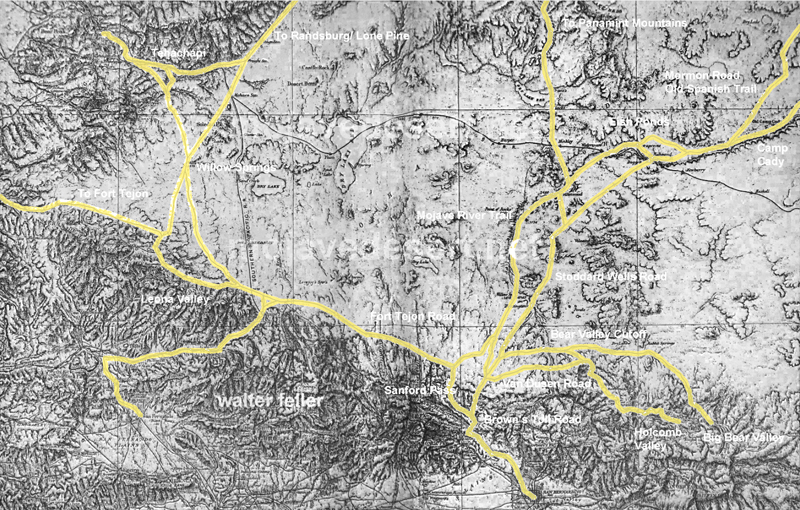
Even with these earliest permanent intrusions, the long-standing dynamic between people and landscape was not immediately overturned. Mining camps rose and disappeared as ore deposits and water supplies fluctuated. Wagon roads faded when springs failed. Small railroad towns appeared abruptly but often remained fragile in the face of the scale and hostility of the surrounding landscape. Much of the Mojave still retained the appearance of a place shaped principally by geology rather than by civilization.
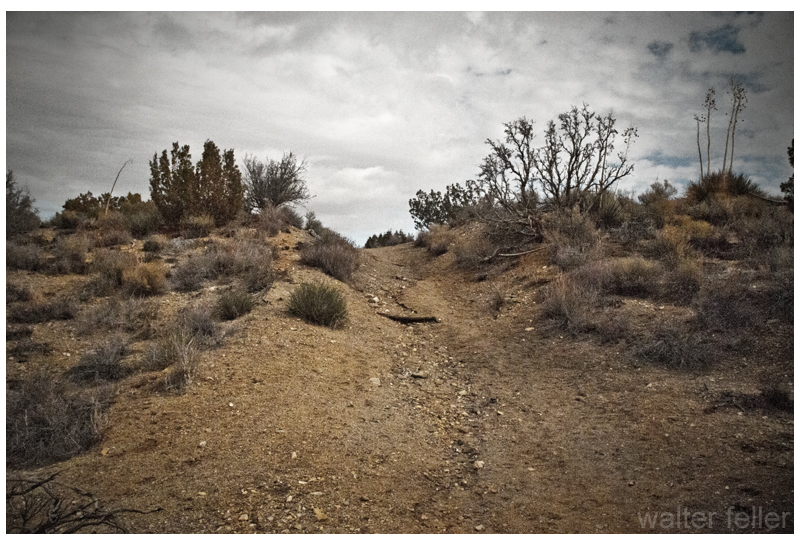
Over time, a shift occurred: the Mojave, once defined by natural systems, increasingly came to be structured around human needs. The first key shift came with railroads, which established artificial centers in previously insignificant locations—places that had mattered only as crossings or water stops. Afterward, elements like highways, aqueducts, transmission corridors, military reservations, utility infrastructure, suburban expansion, recreational development, industrial agriculture along the margins, and large-scale energy production continued this trend. These forces did not simply occupy the desert; they actively reorganized it.
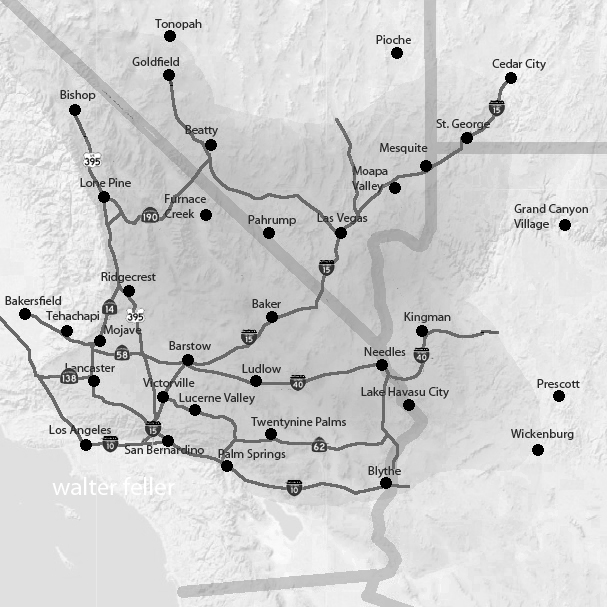
A modern map of the Mojave clearly reveals this shift: vast military boundaries now dominate entire valleys and mountain ranges. Meanwhile, interstate highways create strong directional corridors across what were once diffuse travel landscapes. Utility-scale solar developments, visible for miles, convert open basins into industrial energy fields. Transmission towers march across dry lakes and bajadas. Off-road recreation networks carve repeating tracks into fragile terrain. Finally, conservation areas and national preserves add another layer of organization by establishing access restrictions, managing habitats, providing tourism infrastructure, and developing preservation policies.

Increasingly, the Mojave is understood less through watersheds and landforms than through jurisdiction and use. One valley becomes associated with military training, another with renewable energy, others with recreation, habitat protection, logistics, or suburban expansion. This shift is reflected in the language used to describe the desert. Whereas earlier generations emphasized playas, volcanic mesas, spring systems, or mountain passes, modern discussions focus on renewable energy zones, conservation plans, transportation corridors, protected acreage, groundwater management, housing pressure, and recreational access.

Yet the older desert has not disappeared beneath these overlays. The geology remains the controlling framework beneath every human system. Basin-and-range topography still governs drainage and movement. Mountain ranges still create rain shadows and isolate valleys. Heat still limits settlement density. Water scarcity still defines possibility. Dry lakes still gather runoff after storms, just as they did centuries ago. In many places, the desert resists permanent transformation. Every generation is reminded that the underlying landscape remains older and more powerful than any system laid upon it.

Building on these evolving layers of meaning, what has changed most is not simply the Mojave’s physical appearance but its significance. The desert has shifted in its conceptual role: initially perceived as a natural form, then as a landscape of use, and now increasingly as a landscape of negotiation.

The central question is no longer merely “What is the Mojave?” but “What is the Mojave for?” Different groups now approach the same landscape with competing visions: energy developers see open basins suitable for solar fields and transmission infrastructure; conservationists see fragile ecosystems, migration corridors, and biological continuity; tribes see ancestral homelands, sacred sites, and cultural memory in the terrain itself. The military sees strategic training space, defined by isolation and open airspace, while residents see communities and livelihoods. Recreationists seek freedom, mobility, solitude, and escape, while cities beyond the desert offer land, water, transportation routes, and energy supplies.

As these pressures intensify, nearly every part of the Mojave acquires overlapping claims—emptiness itself becomes contestable. Open land is no longer simply open; instead, it becomes designated, managed, leased, protected, restricted, industrialized, or defended. Consequently, the future Mojave is likely to be shaped not by a single activity, but by tensions among many competing systems, all operating simultaneously across the same terrain.

In this evolving context, the Mojave is entering a third historical phase. Initially, it was defined by its physical landforms. Next, human activities and uses became the defining factors. Now, the Mojave’s identity may increasingly depend on negotiations and conflicts over its meaning, access, and purpose.

The old desert will still remain beneath these arguments. The playas will still whiten under summer heat. Winds will still sweep across creosote flats. Mountain ranges will still rise abruptly from broad basins at dusk. Seasonal floods will still cut across washes after sudden storms. The geological skeleton of the Mojave will endure. However, as human systems become more extensive and entangled, the experience and interpretation of the desert will continue to change.

The future Mojave will be governed as a layered landscape. No single authority will determine its fate: federal agencies will control vast public lands; counties will regulate roads, zoning, and development pressure; tribes will press claims rooted in sovereignty, memory, and sacred geography; energy and mining companies will seek permits, leases, and corridors; conservation groups will defend habitat and species; recreationists will demand access; and residents will argue for the right to live within the desert, not just be managed from outside. In light of these overlapping interests, governance will become less about drawing boundaries and more about arbitrating between claims. The desert will be administered through plans, lawsuits, permits, consultations, closures, leases, and exceptions. Its future will not be decided all at once; instead, it will be determined valley by valley, corridor by corridor, and project by project.

The Mojave functions as both an ancient physical landscape and a modern human one. While it is no longer shaped solely by tectonics, erosion, and climate, it is no longer defined solely by railroads, highways, military reservations, and energy development. Increasingly, the desert is formed by negotiations over how such a landscape should exist. Thus, what once was defined by its form is now shaped by the competing meanings people assign to it.
The Pioneers of the Mojave Desert: A Historical Overview

Several pioneering families and individuals significantly influenced the development of the Mojave Desert. Among them were the Stoddard brothers, Lafayette Mecham, Aaron Lane, John Brown Sr., Hieronymous Hartman, the Fears family, the Swarthout family, William Holcomb, Jed Van Duzen, Heber Huntington, and Max Stroebel. These figures played a crucial role in shaping the region’s history through their contributions to infrastructure, mining, ranching, and settlement.

The Stoddard Brothers

Sheldon Stoddard

Arvin and Sheldon Stoddard were instrumental in developing the Mojave Desert. The brothers, originally from Canada, moved to the United States and later settled in San Bernardino. They contributed to the establishment of infrastructure such as wells and roads. Arvin drilled the well-known Stoddard Well, and the brothers created Stoddard Wells Road, reducing travel time and aiding in the region’s development​ (Desert Gazette)​​ (Desert Gazette)​​ (Digital Desert)​​ (Digital Desert)​.

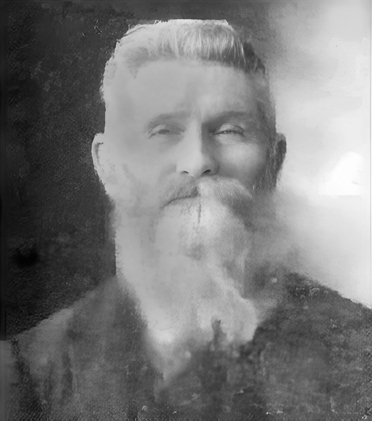
Lafayette Mecham

Lafayette Mecham

Lafayette Mecham was awarded a contract in 1867 to transport hay from Little Meadows to Camp Cady. He established a more direct route, which later became part of Stoddard Wells Road, and operated a station at Fish Ponds. His efforts significantly improved transportation and infrastructure in the Mojave Desert​ (Digital Desert)​​ (Digital Desert)​.

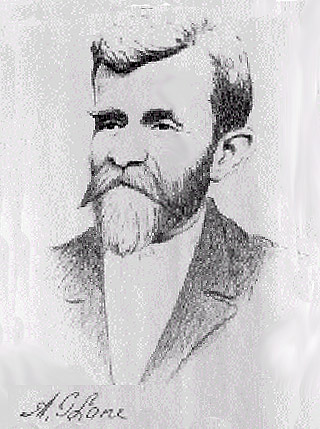
Aaron Lane

Aaron G. Lane

Aaron G. Lane was the first permanent settler on the High Desert, establishing Lane’s Crossing in 1858. Despite facing numerous challenges, including raids and threats, Lane’s settlement became a crucial waypoint for travelers and military missions, contributing to the early development of the area​ (Mojave Guide)​​ (Mojave Guide)​.

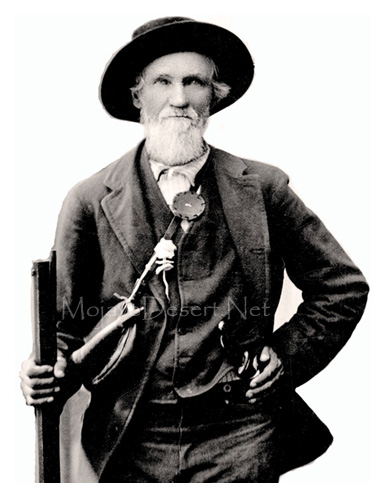
John Brown Sr.

John Brown Sr. built a toll road through the Cajon Pass in 1861, facilitating the movement of goods and people. This road, known as Brown’s Toll Road, was essential for travelers and significantly impacted the region’s development. Brown also engaged in trade with local Native American tribes and operated a ferry at Fort Mojave​ (Mojave Guide)​​ (Desert Gazette)​​ (Digital Desert)​.

Hieronymous Hartman

Hieronymous Hartman, also known as Hiram Hartman, was a rancher and prospector involved in significant mining operations, including the Hartman Tungsten Mine. Despite his contributions to the local economy, Hartman had a controversial reputation. He was a storekeeper in Calico, a booming silver mining town in the 1880s. Hartman was imprisoned for bigamy in 1900, and his wife died before his release, ironically leaving him her estate. Hartman was later killed in 1908 by Stanley Houghton, who was acquitted, indicating Hartman’s unpopularity in the community​ (Mojave Guide)​​ (Mojave Guide)​​ (Mojave History)​​ (FindAGrave)​​ (Southwest Parks)​​ (CampReview)​.

The Fears Family

The Fears family, led by James “Uncle Jim” Fears, were significant settlers in the Cajon Pass during the 1860s. They established a way station that served travelers, providing essential services and facilitating commerce. James Fears later moved to Spadra and remained there until his death​ (Digital Desert)​​ (Buckthorn Publishing)​​ (Digital Desert)​.

The Swarthout Family

The Swarthout family arrived in San Bernardino in 1851 and established themselves as prominent ranchers. Nathan, Albert, Truman, and George Swarthout owned large tracts of land and raised cattle, with the Swarthout Valley named in their honor due to their significant presence​ (Wrightwood Historical Society)​​ (Mojave Desert Archives)​.

William Holcomb

William Holcomb

William F. Holcomb discovered gold in Holcomb Valley in 1860, sparking the biggest gold rush in Southern California history. Holcomb’s discovery brought many prospectors to the area, and Holcomb Valley became a thriving mining community. His contributions to the region’s mining history are commemorated through the valley named after him​ (Digital Desert)​​ (Mojave Guide)​​ (Digital Desert)​.

Jed Van Duzen

Jed Van Duzen was a blacksmith who graded a crucial road between the Victor Valley and the San Bernardino Mountains. In 1874, he was contracted to carry the U.S. Mail from San Bernardino to Prescott, Arizona, ensuring weekly postal delivery to the Mojave River Settlement. His road played a significant role in facilitating the transport of goods and mail through the region​ (SBC Sentinel)​.

Heber Huntington

Heber Huntington operated a prominent way station in Victorville during the 1870s. He transformed the station into a trading post, providing provisions, ammunition, fresh horses, blacksmithing services, and meals, supporting the needs of travelers and settlers in the Mojave Desert​.

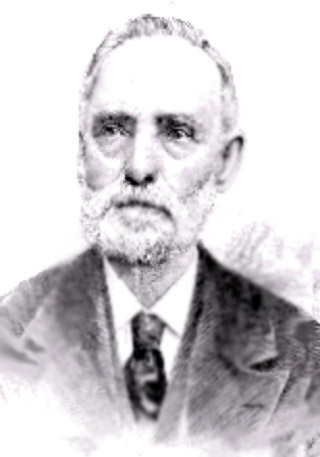
Max Stroebel

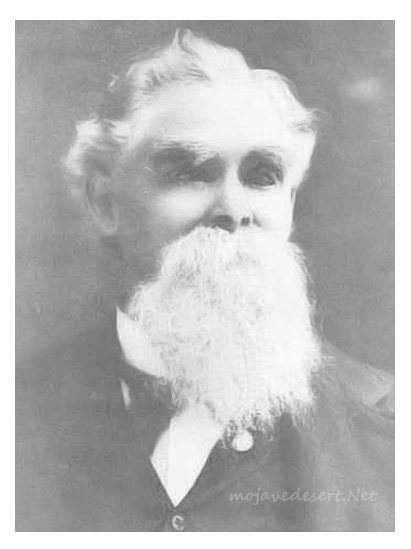
Maximilian Franz Otto Von Strobel

Max Stroebel purchased the entire Hesperia townsite for cash in 1870. His acquisition and subsequent development efforts contributed to the area’s growth and settlement, supporting the regional economy and infrastructure during a critical period of expansion in the Mojave Desert​ (SBC Sentinel)​.

Connections and Overlaps

The pioneers who shaped the Mojave Desert likely knew of each other or interacted due to overlapping activities, periods, and geographical regions.

  1. Stoddard Brothers and John Brown Sr.:
  2. Lafayette Mecham and the Stoddard Brothers:
  3. Aaron Lane and Other Settlers:
  4. Hieronymous Hartman:
    • Hartman’s activities in ranching and mining placed him in proximity to other significant figures in the Mojave Desert, though his controversial reputation set him apart​ (Mojave Guide)​​ (Mojave Guide)​​ (Mojave History)​​ (FindAGrave)​.
  5. Fears Family and Regional Pioneers:
  6. Swarthout Family:
  7. William Holcomb:
    • Holcomb’s gold discovery drew many to the area, likely resulting in interactions with other miners and settlers involved in the desert’s development​ (Digital Desert)​​ (Mojave Guide)​​ (Digital Desert)​.
  8. Jed Van Duzen:
    • Van Duzen’s road construction and mail delivery services connected vital areas, linking him with other pioneers involved in transportation and settlement activities in the Mojave Desert​ (SBC Sentinel)​.
  9. Heber Huntington:
    • The area now Victorville was initially known as Huntington’s Crossing, named after Heber Huntington, a Mormon pioneer who settled there in the mid-19th century. Huntington’s operation of a way station and trading post connected him with travelers and other settlers, making him a significant figure regionally.
  10. Max Stroebel:
    • Stroebel’s purchase and development of the Hesperia townsite positioned him as a key player in the expansion and economic growth of the Mojave Desert, interacting with other pioneers involved in settlement activities​ (SBC Sentinel)​.

Conclusion

These pioneers’ combined efforts significantly impacted the Mojave Desert’s development. Their work in establishing critical infrastructure, supporting community development, and their adventurous pursuits left a lasting mark on the region. Today, their names are commemorated through various landmarks, ensuring their contributions are remembered in the history of the American West.

Barstow Index

Barstow California Area

digital-desert.com › barstow

Barstow Area. Barstow lies in the intersection of the three largest ecosubsections in the Mojave Desert; High Desert Plains & Hills (322Ag), Mojave Valley – …

Barstow, California

digital-desert.com › barstow-ca

Barstow 1890. Barstow is situated at the junction of the California Southern and the A. &. P. Railway, eighty-two miles from San Bernardino and twelve miles …

Kramer Junction (Four Corners) Mojave High Desert

digital-desert.com › kramer-junction-ca

3) Go west on the State Route 58 through Boron, Mojave or California City and up to Tehachapi and over the Southern Sierra. 4) Go east to Barstow. There is food …

Vanyume Indians

mojavedesert.net › vanyume-indians

Mojave Desert Indians – Map. Vanyume Indians. The Vanyume or Beñemé, as Father Garces called them, lived beyond and along much of the length of the Mojave …

Casa del Desierto

digital-desert.com › casa-del-desierto

Casa del Desierto – Harvey House. Barstow Harvey House and train station photo – Casa del Desierto Casa del Desierto: The Spanish for “House of the Desert” In …

Barstow, California – Notes

digital-desert.com › blog

Nov 4, 2023  Today, it remains an essential point of access and commerce for those traveling through the Mojave Desert in Southern California. Post Views: 12.

Goldstone, Barstow California, Mojave Desert

digital-desert.com › goldstone-ghost-town

Goldstone Ghost Town. More of a site than a ghost town, there are only a few scattered foundations and some rubble to be found. The area is now home to NASA’s …

History of Barstow the National Old Trails Road and Route 66

digital-desert.com › barstow-ca › moving-barstow

The Barstow yards are used jointly by the Santa Fe and Union Pacific and handily very considerable volume of the transcontinental traffic. Hence the railroad …

Barstow, Ca Historic Photos

digital-desert.com › barstow-ca › historic-photos

Burton Frasher photos of Barstow, California.