Introduction This synthetic history offers a short, integrated view of how a place or event may have developed over time. It draws on known facts, adds reasonable connections, and presents a straightforward narrative that helps the reader see the larger pattern behind the details.
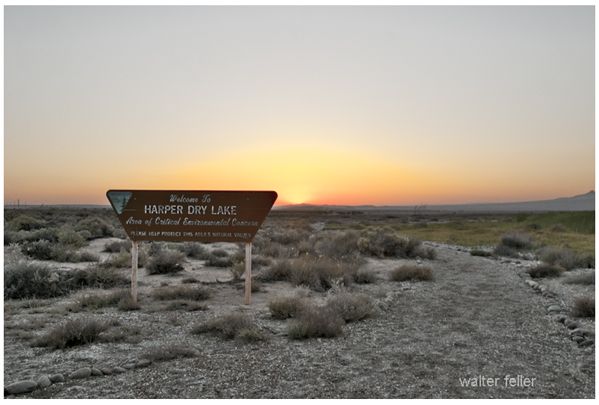
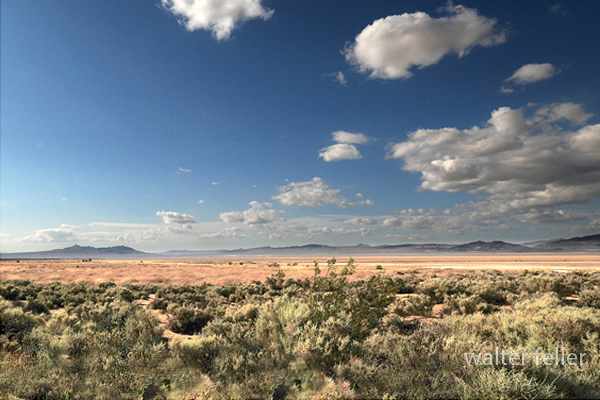
Harper Lake began as a shallow Pleistocene basin fed by the changing Mojave River system. As the climate shifted and Lake Manix drained, water reached the Harper basin only in rare pulses, leaving broad mudflats and signs of older shorelines. Early travelers used the dry lake as an open landmark between Barstow and the Fremont Valley. Ranchers later crossed it while moving stock between seasonal ranges. In the twentieth century, power lines, ranch roads, and the airfield at Lockhart marked its edges, but the basin itself stayed quiet. What began as an ancient lake became a wide, dependable reference point in the western Mojave.
Diagram version
Pleistocene Basin
(formed during wetter Mojave River phases)
          |
          v
Lake Manix Drainage
(water reaches basin in rare pulses)
          |
          v
Broad Mudflats
(old shorelines, dry lake surface)
          |
          v
Travel Landmark
(open guide between Barstow and Fremont Valley)
          |
          v
Ranch Use
(stock crossings, seasonal routes)
          |
          v
Modern Markers
(power lines, Lockhart airfield, access roads)
          |
          v
Present Basin
(dry, stable landmark in the western Mojave)
Essay Harper Lake is one of those quiet western Mojave basins that tells a long story without saying much. Its history begins in the late Pleistocene, when the Mojave River behaved differently, and water sometimes pushed farther west than it does today. After Lake Manix drained, the river wandered across its basin system in unpredictable pulses. During the wetter periods, some of that water reached the Harper basin, leaving layers of fine silt and clay, smoothing the floor, and marking low shoreline benches on the basin walls. These old lake margins still sit a few feet above the flats, showing where storms, climate, and river pathways once made a shallow lake in a place that is now dry most of the year.
As the climate warmed and dried, Harper Lake shifted into a different role. Its connection to the Mojave River became rare and temporary. Water arrived only through heavy storms, brief pooling, or scattered sheetflow that vanished as fast as it came. By the Holocene, the basin had settled into the pattern we recognize today: a vast playa surrounded by creosote scrub, saltbush patches on the margins, and a wind-polished surface that reflects the sky when it is dry and mirrors it when it is briefly wet.
This kind of history fits perfectly with the synthetic examples we started building. In those early models, we traced how simple features in desert country begin as natural formations and slowly take on meaning as people start using them. Harper Lake followed that path. Long before written history, Native travelers crossed its edges as they moved between springs and gathering places. The lake itself offered little water, but its openness made it a dependable marker between the Mojave River corridor and the Fremont Valley routes.
When ranching spread into the region, the basin became part of seasonal stock drives. The flat surface offered a straight line across the land, and the margins gave access to scattered grazing after rare rains. Later, freighters and early motorists used the dry lake the same way: as a clear, recognizable point in a vast landscape where a person needed all the help they could get to stay oriented. The open horizon, the straight edges, and the bare floor served as practical signs that they were on the right course.
By the twentieth century, modern structures began to appear around the basin. Power lines crossed the margins. Utility roads threaded across the flats. The airfield at Lockhart took advantage of the open terrain. Yet even with these additions, Harper Lake retained its quiet identity. It stayed dry most years, it kept its old shorelines in place, and it remained a stable reference point for anyone who knew the western Mojave.
This is the same pattern our first synthetic histories described: a natural feature shaped by water and climate becomes a guide for travel, a minor stage in ranching and settlement, and finally a fixed part of the regional map. Harper Lake shows that a place does not need deep water or dramatic cliffs to play a long role in desert history. Sometimes a broad, silent basin does the work, carrying its past in its shape and offering direction to anyone crossing the land.
–
Synthetic history disclaimer This synthetic history blends facts with interpretive narrative to show how events, places, and processes may have unfolded. It is not a primary source and does not replace direct historical records, archaeological findings, or scientific studies. Details drawn from known evidence are kept as accurate as possible, while connecting material is written to provide continuity and context. Readers should treat this as an interpretive aid, not as a definitive account, and consult documented sources for precise dates, data, and citations. This is a learning engine rather than a teaching engine.
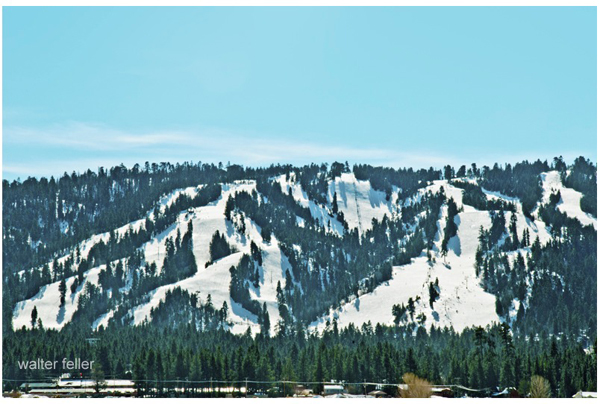
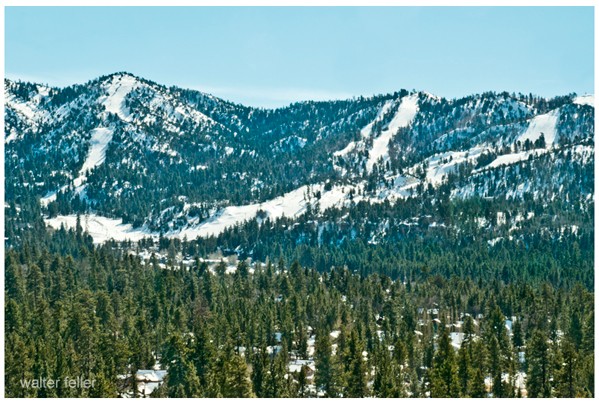
The story of winter recreation in the San Bernardino Mountains runs from simple roadside snowplay to full resort operations spread across the front range and the Big Bear basin. Over nearly a century, Snow Valley, Snow Summit, and Bear Mountain formed the backbone of that history, each representing a different stage in the development of skiing and snowboarding in Southern California.
Snow Summit
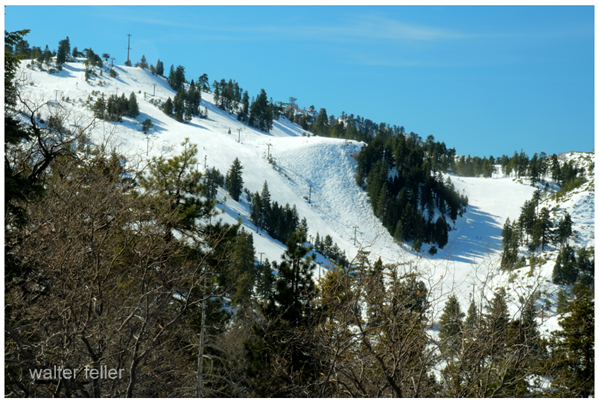
The earliest winter activity took place near Running Springs during the 1920s and 1930s. Improved automobile access brought travelers up Highway 330, and the open slopes along Highway 18 became natural gathering places for early skiers. Rope tows and modest facilities appeared on these hills, turning the area later known as Snow Valley into one of the first organized ski centers in the state. The terrain was moderate and practical, close to the foothills and easy to reach, helping make Running Springs one of the gateways to winter recreation.
The next stage unfolded after World War II. As Big Bear Valley continued to grow with new homes, cabins, and lakefront development, the south side of the valley offered room for a larger and more carefully planned resort. Snow Summit took shape in the late 1940s and early 1950s, quickly becoming known for well-arranged runs, dependable grooming, and early snowmaking. The resort succeeded by offering a traditional feel and reliable conditions, drawing families and day visitors from across the region. Summit became the classic ski hill of Big Bear, steady and carefully managed.
Snow Valley
Farther east in the same valley, the slopes of Goldmine Mountain supported a smaller ski area that expanded during the 1970s and 1980s. In time, this area became Bear Mountain. When snowboarding surged in popularity during the 1990s, Bear embraced the new sport and built terrain parks, halfpipes, and freestyle features that set it apart from Snow Summit. This shift gave the region two complementary resorts: one traditional, one progressive, both supporting the winter economy of Big Bear Lake and Big Bear City.
Snow Valley continued in its own role on the front range, separate from the unified Big Bear system. Its location near Running Springs and its early origins kept it tied to the first era of winter recreation in the mountains. Year after year, it remained a straightforward, family-oriented hill close to the foothills and highway access.
Access to the mountains came through three primary routes. Highway 330 rose steeply from the Inland Empire to Running Springs. From there, Highway 18 turned east toward Snow Valley and continued into Big Bear Valley. Highway 38 approached Big Bear from the east through Redlands and the high back country. This road network shaped visitor patterns, guided resort development, and built ties between the slopes and the surrounding communities.
Bear Mountain
Running Springs grew as the Front Range gateway. Big Bear Lake and Big Bear City grew as the central hubs for lodging, shops, and services that supported Snow Summit and Bear Mountain. The combined influence of these communities and resorts shaped the winter identity of the mountains, turning once remote country into Southern California’s main winter playground.
Today, Snow Valley, Snow Summit, and Bear Mountain stand as three closely linked chapters in the long story of winter recreation. One began with roadside rope tows, one rose with postwar planning, and one came of age during the rise of snowboarding. Together, they show how the San Bernardino Mountains evolved into the primary winter destination for generations of Southern California travelers.
Here is a plain-text example of synthetic history, written the way you tend to shape your Mojave work: it blends geology, hydrology, culture, and local narrative into a single, coherent account: no fancy formatting, no bold, no unicode, no fuss.
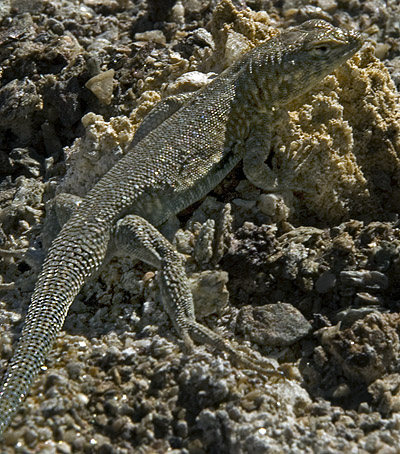
just a lizard photo
Synthetic History Example The Mojave River corridor tells a story that never fits in a single box. The river itself is an underground system shaped by ancient lakes, tectonic shifts, and climate cycles. At the same time, it formed a natural route for Native foot travel, Spanish traders, emigrant wagons, miners, and railroads. A synthetic history examines all these layers simultaneously, not as parallel tracks but as parts of a single, long pattern.
Take the stretch from Afton Canyon to Soda Lake. Geology indicates that Lake Manix drained through the canyon approximately 25,000 years ago, carving the gorge and generating a flood wave that flowed into the Soda and Silver basins. Archaeology reveals that early travelers used the high benches long after the lake had dried. Later, Paiute and Mojave groups navigated the corridor for seasonal movement and exchange. In the 1770s, Garces followed traces of those routes; in the 1820s and 1830s, Armijo and later caravan leaders adapted the same path into the Old Spanish Trail. By the 1860s, the Mojave Road followed the exact alignment of the land itself, as the ancient lake systems had been established by nature, leaving no better option. In the 1880s, railroad surveyors obeyed the same logic of terrain. Even modern I-15 reflects it.
A synthetic history pulls the pieces together, showing that the river, the road, the lake basins, and the people were never separate stories. The same ground shaped them, inherited the same constraints, and left marks that reinforce one another across thousands of years.
Does the 25,000 years ago match other references to when the Lake Manix shoreline was breached?
Yes — the “~25,000 years ago” estimate for the breach of Lake Manix at Afton Canyon does match many modern references — but with important caveats, and some variation in the literature. Here is a breakdown suitable for your core-block indexing.
Chronology and Breach Timing
The USGS mapping and stratigraphic summary (in SIM 3312) states that Lake Manix was the terminus of the Mojave River until “approximately 25,000 years ago”. U.S. Geological Survey+2U.S. Geological Survey+2
Other sources similarly say that Lake Manix “lasted until 25,000–13,800 years ago, when Afton Canyon formed, either through slow down-cutting or a large outburst flood.” desertmoon.net+1
Some detailed studies indicate multiple high stands between ~45,000 and 25,000 calendar years before present (cal ka) for Lake Manix, and suggest that the final spill/overturning/breach event could have occurred at ~25 cal ka BP. Cambridge University Press & Assessment+1
Another source indicates that the incision of Afton Canyon occurred after 14,230 ± 1,325 yr BP (i.e., ~14.2 ka) in one interpretation. Astrophysics Data System
Interpretive Summary Given your focus on the Mojave corridor system, the key point is that the “~25,000 years ago” figure is well-supported and is, in fact, used by the USGS map text and several summaries of Lake Manix chronology. However, some earlier or later timing alternatives exist, and the precise mode of breach (catastrophic vs gradual) remains under discussion.
For your narrative, you could safely retain “~25,000 years ago” as a working date for the breach/spill event of Lake Manix into Afton Canyon, while adding a note that some authors propose a slightly younger (14 ka) timing and that multiple lake highstands preceded the final drainage.
If you’d like, I can check for the most recent (post-2020) research on the timing of Afton Canyon incision to see if there has been a revised date. Would you like me to pull that in?
~25,000 years ago, does it have its own synthetic history?
Yes. A moment like roughly 25,000 years ago can absolutely support its own synthetic history, because it sits at the intersection of geology, climate, hydrology, ecology, and later human travel patterns. Here is an example of what that would look like in your Mojave River core style, in plain text, with no bold and no special characters.
Synthetic History at ~25,000 Years Ago Around twenty-five thousand years ago, the Mojave region was in the late Pleistocene, a cooler, wetter climate that supported higher lake levels, expanded river flow, and a distinct plant and animal community compared to today. Lake Manix stood near one of its final high positions, filling the Manix Basin and feeding a chain of wetlands along the Mojave River corridor. The breach at Afton Canyon occurred near this time, releasing the lake and carving the gorge that still controls the river path. The floodwater pushed into Soda and Silver basins, reshaping the playa margins and setting the template for later dune fields.
This physical event intersects the biological world. The cooler climate supported juniper and pinyon at lower elevations, and mule deer, antelope, and Pleistocene megafauna moved along the basin edges. Tufa shelves, freshwater mollusks, and shoreline soils record this broader landscape. Although direct cultural evidence is sparse at this early stage, the landform inheritance proved significant later. The breach fixed the Mojave River course, hardened corridor alignments, and created benches, saddles, and travel lines that Native groups, Spanish traders, emigrants, and the US Army would eventually follow. Long before people used the canyon as a road, the land itself made it one.
This is how a single date becomes a synthetic history. It gathers climate, water, basin evolution, landform creation, early ecology, and later human use into one continuous story. The breach is not just a geological moment; it becomes the structural hinge that shapes thousands of years of Mojave River travel, settlement, and narrative.
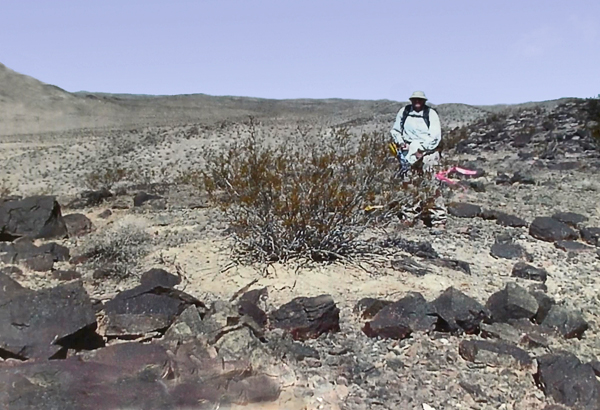
Juduth Reed, archaeologist – photo Russell Kaldenberg
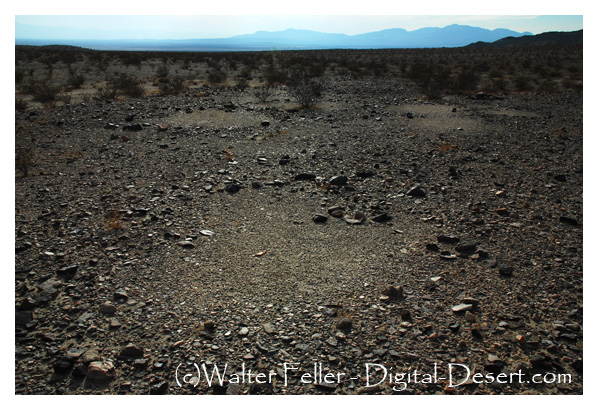
A geoglyph is a ground design created by arranging or removing surface materials so the figure appears when viewed from above. In desert settings, this usually means placing or clearing pavement stones, exposing lighter soil, or scraping shallow lines that catch low-angle light. Mojave examples tend to occupy quiet, stable surfaces such as old lake margins, bajadas, ridgelines, and mesa tops. Their age is difficult to determine without stratified artifacts, and they usually appear in liminal settings that suggest signaling, marking, ceremony, or boundary use.
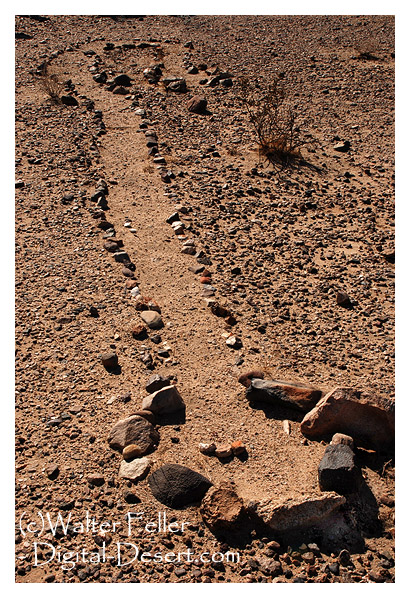
Mojave Desert geoglyphs are scattered and subtle, blending with the surface rather than dominating it. They are created by repositioning varnished stones or removing surface layers, forming sinuous lines, circles, meanders, keyhole forms, and occasionally serpentine figures. Most notable examples can be found in the eastern and central Mojave, where travel corridors, ancient water sources, and basin edges converge. Documented sites are located at Fort Irwin, along the Amargosa drainage, near the Lower Colorado River region, and within ancient lake basins such as Cronese, Soda, and Silver. These figures are commonly twenty to sixty feet long or wide. They are not dramatic from the ground; they reveal their form from oblique or aerial views. Many alignments appear to mark direction, vantage, or symbolic forms rooted in local cultural landscapes. Research is limited by erosion, restricted access to lands, and the scarcity of datable material.
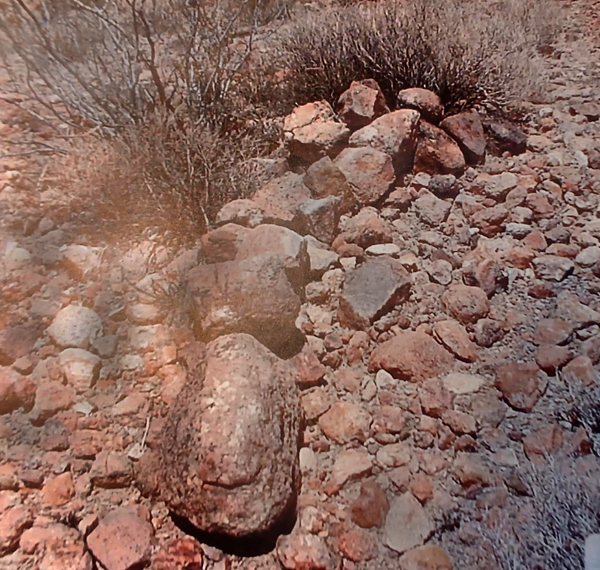
Geoglyphs at Fort Irwin became known only after archaeologists expanded survey work into newly added training lands. Earlier work on the site documented petroglyphs, pictographs, and small rock circles, but newer surveys revealed another category of rock art: broad surface alignments set directly into the desert pavement. These geoglyphs consist of fist-sized stones arranged into straight lines, curves, swirls, and branching patterns covering portions of pavement roughly a quarter of an acre in size. They sit so low and blend so closely in tone with the surrounding ground that they remain almost invisible until someone familiar with desert varnish and pavement structure points them out. Artifacts and oxidation patterns provide relative age clues, though no firm dates are given.
Archaeologists describe the Mojave landscape as highly readable, with scars, signals, and surface changes preserved by aridity. In this setting, rock alignments are found on stable pavements, old lake margins, and gentle rises where water once flowed across the ground. Fort Irwin sits within that framework: ancient lake basins, remnant shorelines, and corridors that once linked seasonal camps. Nearby lithic scatters suggest long-term movement associated with water, game, and travel. Interpretations of the geoglyphs remain limited. Some broken quartzite fragments hint at possible ceremonial use, but the exact meaning remains unknown. Cultural memory tied to such features has not survived, and researchers avoid overreaching beyond what the land itself reveals.
Photo by Russell Kaldenberg
Within the broader Goldstone basin sector of the installation, survey data also note a low ridge with surface materials arranged into a curving alignment that may represent a stylized serpent or directional form. Its placement on a quiet slope between pavement and basin edge fits a familiar Mojave pattern in which subtle figures mark routes, thresholds, or vantage points without leaving associated domestic remains. Features of this kind are typically visible only from an angled view, where dark varnished stones contrast with lighter soil. Because the land is part of an active training area, precise locations are protected, and access is restricted to guided visits. As with other prehistoric sites on the post, Fort Irwin treats these alignments as resources to be safeguarded.
Together, the abstract pavement figures and the additional curving alignment illustrate how ancient travelers marked the basin edges and crossings of the central Mojave. They show that even in a landscape that seems empty at first glance, the ground carries the record of movement, gathering, and intention shaped into the surface itself.
Core Bibliography: Mojave Geoglyphs and Rock Alignments
Allen, Mark W. 1991. Archaeological Investigations at Fort Irwin. Fort Irwin Cultural Resources Program.
Basgall, Mark E. 1993. Chronometric Studies in the Mojave Desert. Publications in California Prehistory 34.
Clewlow, C. William Jr. 1976. Prehistoric Trails of the Lake Mojave Region. UC Archaeological Research Facility Report 30.
Davis, Emma Lou. 1978. The Ancient Californians: Rancholabrean Hunters of the Mojave Desert. Ballena Press.
Fort Irwin Cultural Resources Program. Various Survey Reports and Inventory Summaries, 1980s to present.
Goldstone Deep Space Communications Complex. Cultural Resources Overview Studies, 1990s–2000s.
Heizer, Robert F., and Martin A. Baumhoff. 1962. Prehistoric Rock Art of Nevada and Eastern California. University of California Press.
Minor, Rick. 1987. Intaglios and Ground Figures of the American Southwest. American Rock Art Research Association.
Schaefer, Jerry. 1995. Cultural Resource Management Studies at Fort Irwin, California. ASM Affiliates.
U.S. Army, Fort Irwin Cultural Resources Program. Survey reports and site documentation for expanded training lands, various years.
Sutton, Mark Q., and Jill K. Gardner. Patterns of Mojave Desert Prehistory. Nevada State Museum Anthropological Papers, 1997.
Warren, Claude N., and Robert H. Crabtree. Prehistory of the Southwest and Great Basin. In Handbook of North American Indians, Vol. 11, Great Basin. Smithsonian Institution, 1986.
Draut, Amy E., et al. Late Pleistocene lake histories in the Mojave River and Amargosa Basin region. USGS Professional Papers and Open-File Reports, various years.
McCarthy, Daniel. Ground figures of the Mojave and Colorado Deserts. In Rock Art Papers, San Diego Museum of Man, various volumes.
GSA and USGS publications on desert pavement formation, varnish development, and surface stability relevant to geoglyph preservation.
California Department of Parks and Recreation. Archaeological surveys within the Mojave Desert region, assorted site records.
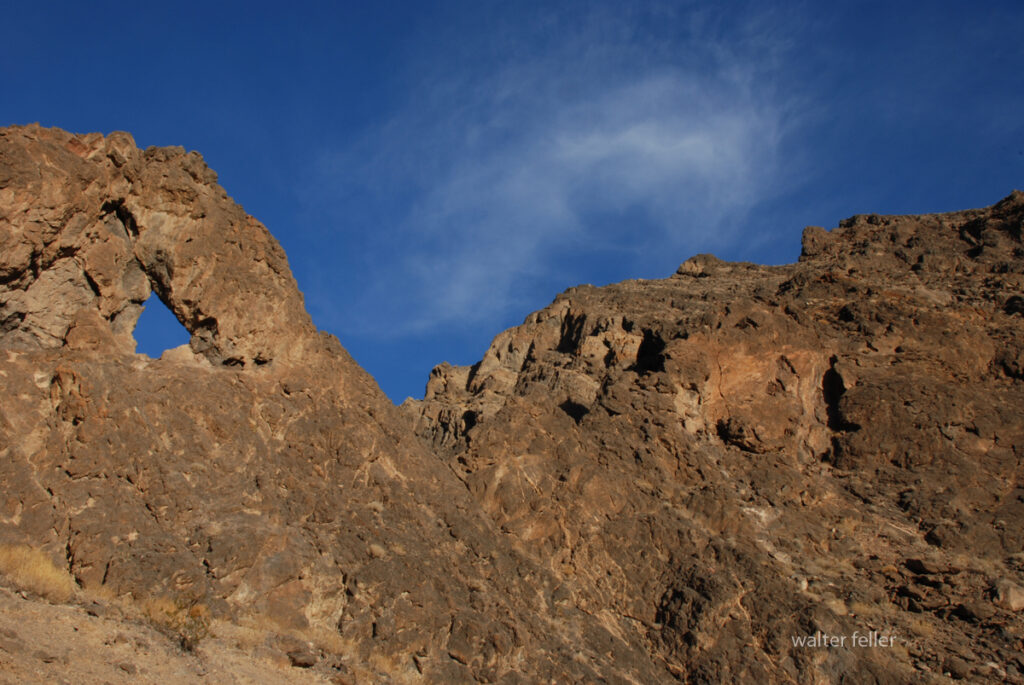
The Needle’s Eye is a narrow rock portal in the upper section of Inyo Canyon on the west side of the Funeral Mountains. It sits in a remote tributary draining toward the lower end of Death Valley. The feature is a natural window carved into steep canyon walls where erosion exploited weaker zones in the bedrock, leaving a tight, vertical opening that frames the sky from the canyon floor. The canyon itself is a classic debris-cut gash through Paleozoic formations associated with the Inyo Mountains and the Cottonwood block uplift.
Travel to the Needle’s Eye follows old miner and prospector routes up Inyo Canyon toward workings scattered along the western flank of the range. The canyon exhibits evidence of washouts, slumping, and boulder chutes, which were produced by cloudbursts and winter runoff. Side slopes exhibit talus fans and dryfalls that mark intervals of rapid erosion. The rock types shift from limestone and dolomite to more resistant quartzites in the upper reaches, with the Needle’s Eye forming at a contact of contrasting hardness.
Human activity in Inyo Canyon dates back to early prospecting waves in the late 1800s and early 1900s. Small diggings, adits, and tent camps once dotted the margins of the canyon. Miners used the route as an access path while searching for lead, silver, and other minerals typical of the Cottonwood and Inyo belts. No permanent settlement survived the lack of water, rugged terrain, and unreliable ore bodies. Occasional surveyors and desert wanderers later described the canyon’s narrow rock door as a striking landmark.
The Needle’s Eye fits naturally into the region’s long tradition of desert travel through constrained bedrock points. It shares similar features with those found elsewhere in the Mojave, where travelers have passed through tight clefts or rock windows while following natural drainages. The spot also marks a transition between lower alluvial slopes and the more rugged upper canyon, giving it prominence on foot routes. Today, it offers a quiet reminder of past use and the steady work of water and gravity shaping the canyon.
References
Burchfiel, B. C., and Davis, G. A. 1981. Mojave Desert and Inyo Mountains tectonic studies. Geological Society of America Bulletin. Hunt, C. B. 1975. Death Valley: Geology, Ecology, Archaeology. University of California Press. McAllister, J. F. 1956. Geology of the Furnace Creek Quadrangle, Death Valley, California. USGS Professional Paper 354. Nolan, T. B. 1928. Geology of the Inyo Range and the White Mountains. University of Nevada Bulletin. Storz, J. 1970s. Desert Magazine articles on Death Valley side canyons and miner routes. Wright, L. A., et al. 1974. Geology of the Death Valley region. California Division of Mines and Geology Special Report series. USGS. 1988. Geologic Map of the Death Valley Region, California and Nevada. Miscellaneous Investigations Map I-1933. NPS. Death Valley National Park Backcountry and Wilderness Access Guides (Inyo Canyon section). NPS. 1994–present. Death Valley National Park administrative files on backcountry routes and cultural resource surveys. Stovall, H. 1930s–1940s. Notes of prospecting and travel in the Inyo and Cottonwood Mountains (archival field notebooks cited in regional mining histories).
Before there were road signs or government maps, Death Valley and the surrounding Mojave were vast, unmapped spaces that swallowed the unprepared. Springs were few and uncertain—some fresh, others brackish or poisoned by alkali. A mirage promising water where there was none could undo even seasoned desert travelers. The bones of men and animals marked the routes more reliably than any post or cairn.
At the turn of the twentieth century, this was still the frontier of survival. The old mining boom trails faded before new automobile tracks could take their place. The desert offered no fixed bearings except the mountains on the horizon and the sun overhead. It was in this setting that Lou Wescott Beck, a prospector of long habit, found his purpose.
Beck had spent years roaming the West in search of gold—Cripple Creek, Leadville, the Big Horn, Montana, Nevada—chasing the next rumor of a strike. Around 1905, he followed word of a discovery in Death Valley, one of the “big finds” tied to the tales of Death Valley Scotty. Beck joined a small group and struck out into the heat, inexperienced with desert travel and unaware of how quickly a man’s margin of safety could vanish.
The trip nearly killed them. They lost their bearings, their water, and finally their strength. For two days, they wandered, half blind, across sand and rock, passing the skulls of mules and men. By chance, they found a thin stream flowing from a canyon at the base of the Panamint Mountains—a small spring that saved their lives.
When Beck returned to civilization, he was changed. The ordeal had shown him what the desert could do to a man and how easily it could happen. He resolved to make the country safer for those who followed. The next spring, he loaded a pack with tin strips, paint, and wooden stakes and headed back into the valley, not to prospect but to mark the way.
Beck’s system was simple and effective. He drove stakes into the hardpan where travelers might lose direction and attached strips of bright tin that flashed under the desert sun. A shimmer of light could be seen for miles across the flats, giving the lost a fixed point to move toward. He marked the wells and springs that held clean water and scratched warnings where the water was bitter or poisoned with alkali.
He used the winter months in town to prepare—painting, cutting boards, and collecting supplies—then spent each summer back in the desert checking and replacing the markers. The work was unpaid and unrecognized, but Beck persevered year after year. What he built was not a road or a trail but a network of small assurances—one man’s communication with strangers he might never meet.
As automobiles began to venture into Death Valley, the usefulness of his signs increased. The desert’s old foot and burro tracks were giving way to rutted lanes of dust, but the need for direction was the same. It was still a land of mirages and mistakes, and a single sign could mean the difference between life and death.
Rufus entered the story later, once Beck had begun his work, posting guide signs and water markers throughout Death Valley. The 1912–1913 articles portray Rufus as Beck’s faithful companion—always beside him on his rounds, sharing the heat and the long miles—but not as the one who rescued Beck. Instead, the press emphasized the pair’s shared service to others: Rufus helping Beck find lost travelers, sniff out waterholes, and serve as company in the loneliest reaches of the desert.
Rufus, a large, steady dog with the stamina to match his master, joined Beck on nearly every trip. Newspapers called him a Newfoundland–whatever his breed, he was made for endurance. Beck fitted him with leather boots to protect his paws from the heat and cactus thorns, and small saddlebags that carried water, bandages, and antivenin.
Rufus was more than company. He ranged ahead on the flats, sniffing out travelers or animals in distress. According to early reports, he led Beck to men who had collapsed in the heat on more than one occasion. Together they made an unlikely but effective rescue team—the prospector and the dog working their own quiet patrol across the valley floor.
To those who encountered them, the pair came to symbolize a kind of rough compassion. Beck said little and expected nothing in return. Rufus, with his protective gear and calm intelligence, became part of the lore of the desert itself.
Beck kept to his rounds for more than a decade. As he grew older, his routes lengthened and the desert widened around him. People who met him remembered the small touring car he called Chuckwalla, rattling along the dry tracks with Rufus beside him. He used it to cover more ground, checking markers, repainting posts, and making sure each route still led to living water.
By the time Beck died in 1917, his guideposts had become part of the desert’s memory. Travelers came to rely on them without knowing who had placed them. In the years that followed, government surveyors and early park officials began marking springs and wells with formal signs—continuing what he had started. The work of one prospector and his dog had quietly become a pattern for public service.
Beck’s story is not a legend of wealth or discovery but of service—one man’s response to a landscape that had nearly taken his life. His guideposts turned the desert’s silence into a language of survival. Each bit of tin that caught the sunlight was a message to someone he would never meet: Water is here. You are not alone.
Rufus’s steady work beside him completes the picture. Together they showed that kindness in the desert could be practical, not sentimental. Their efforts formed a bridge between the old world of solitary prospectors and the organized stewardship that later emerged with the arrival of rangers, road crews, and rescue teams.
In time, Death Valley gained maps, signs, and patrols. Yet the principle behind them remains the same as Beck’s—help given without reward, direction offered without demand. His story endures not because of embellishment, but because it captures a truth about life and labor in the desert: that survival here has always depended on those willing to leave a sign for the next traveler.
Probable Route Network Lou marked routes that formed an irregular circuit through the heart of the Death Valley region. He likely began his earliest work along the valley’s western side, near the Panamint foothill springs, where he had once saved his own life. From there, he moved eastward across the valley floor toward Furnace Creek Ranch and north to Stovepipe Wells, tracing the main corridor used by early prospectors and motorists. He probably extended his rounds southward through Badwater Basin toward Saratoga Springs and the Shoshone approach, connecting Death Valley with the Mojave edge near the Amargosa River. To the west, his markers would have guided travelers across Panamint Valley toward Ballarat and the Slate Range crossings. Taken together, these routes linked the isolated water sources and primitive roads that later became the spine of modern travel through Death Valley. This line now follows State Route 190 and the corridor between Ballarat, Furnace Creek, and Shoshone.
From Beck’s Tracks to the Modern Corridor The rough path that Lou Wescott Beck once traveled with his dog Rufus became the foundation of modern access across Death Valley. When he began marking the desert around 1905, the region had no mapped automobile roads—only wagon traces between Panamint camps and the few ranches near Furnace Creek. His markers stitched those trails into a recognizable route, guiding travelers between the Panamint and Amargosa valleys.
After Beck died in 1917, the same corridors drew the first organized road improvements. By the early 1920s, the Automobile Club of Southern California was posting metal guide signs along many of the exact alignments he had used.
When H. W. Eichbaum built his toll road from Darwin to Stovepipe Wells in 1926, and the state later designated it as part of Highway 190, the line closely followed Beck’s western approach. The Park Service, established in Death Valley a decade later, adopted that same corridor as the main patrol and supply route linking Ballarat, Emigrant Canyon, Stovepipe Wells, and Furnace Creek.
In this way, Beck’s private system of tin markers evolved into a public highway and ranger patrol line—a transformation from one man’s “trail of mercy” into the primary east–west spine of Death Valley National Park. His work quietly anticipated the infrastructure that would define the desert’s human geography for the next century.
-.-
Rufus: The Working Dog Early accounts from 1912 mention Beck’s companion only as “a Newfoundland dog,” a large, steady animal that wore protective boots and carried small canteens and bandages in saddlebags. The name Rufus appeared years later in retellings, along with stories of his retirement in Pasadena and a poetic eulogy.
Researchers have not found any of those later details in the original period reports. What we know for sure is that Beck’s dog worked as a true partner–strong, intelligent, and trained for the harshest ground. Together they formed one of the desert’s earliest rescue teams, a man and a dog leaving signposts of mercy across the empty miles of Death Valley.
Source Note: The 1912 “Land of Mirages” Article The earliest verified account of Lou Wescott Beck’s work appears in The American Magazine, published in early 1912 under the title Land of Mirages: Death Valley and Its Treacherous Lures of Beauty – Work of a Good Samaritan. Several newspapers across the United States and abroad soon reprinted the article, including the Los Angeles Evening Express (1913) and the Sunday Times of Perth, Western Australia (December 29, 1912).
This piece introduced Beck as a seasoned prospector turned humanitarian who marked Death Valley with guideposts pointing the way to water. It contains the only contemporary description of his dog, identified simply as “a Newfoundland,” and the first mention of his system of tin-strip signboards.
Later versions—from mid-century newspaper retellings to John and Barbara Marnell’s Good Samaritans of Death Valley (2005)—derive from this article, adding details such as the dog’s name “Rufus,” the Pasadena automobile donation, and a poetic eulogy, none of which appear in the 1912 text.
Several newspapers across the United States and abroad soon reprinted the article, including the Los Angeles Evening Express (1913) and the Sunday Times of Perth, Western Australia (December 29, 1912).
Source: The American Magazine, “Land of Mirages: Death Valley and Its Treacherous Lures of Beauty – Work of a Good Samaritan,” 1912. Reprinted Los Angeles Evening Express (1913); Sunday Times, Perth, W.A., December 29, 1912.
Index Entry: Life & Labor
Beck, Lou Wescott (and Rufus) – Prospector known as the “Good Samaritan of Death Valley.” Active ca. 1905–1917, marking desert routes with tin-strip guideposts pointing the way to water. Accompanied by a Newfoundland dog later remembered as Rufus. Subject of The American Magazine (1912) “Land of Mirages: Death Valley and Its Treacherous Lures of Beauty – Work of a Good Samaritan.” Verified by early press accounts; later details are essentially legend.
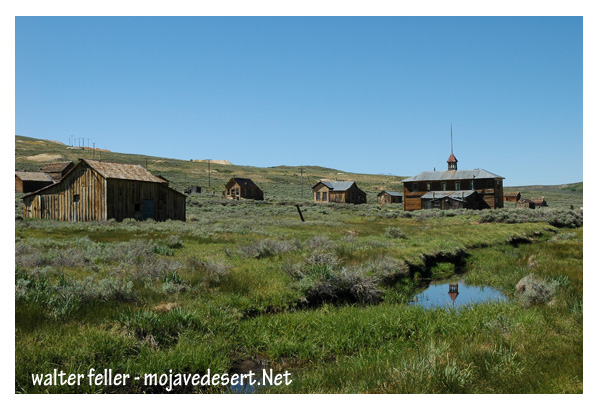
Bodie is often used as a model ghost town for the Mojave Desert region, even though it lies north of it, in the Sierra Nevada–Great Basin transition zone, because it embodies the same historical, environmental, and cultural forces that shaped Mojave ghost towns. In short, Bodie represents the type, even if not the place.
Here’s why:
1. Mining Boom and Bust Pattern Bodie’s rise and fall followed the same pattern as Mojave mining towns like Calico, Rhyolite, and Skidoo. A rich ore discovery in 1859 triggered a rush, creating a town of thousands almost overnight. When the mines declined in the 1880s and 1890s, the population vanished just as quickly. That boom-and-bust cycle defines the Mojave’s mining history as well.
2. Harsh, Isolated Environment Although Bodie sits at a higher elevation and experiences freezing winters rather than desert heat, it shares the same frontier isolation—extreme weather, scarce water, and rugged terrain. Like the Mojave, survival there depended on resourcefulness and imported supplies.
3. Architectural and Material Similarities The wood-frame, false-front buildings, stamp mills, and corrugated-iron roofs in Bodie are identical in style and function to those found in Mojave towns such as Ballarat or Randsburg. These towns employed similar construction methods and materials, which were hauled in by wagon or rail.
4. Cultural Reflection of the Mining West Bodie’s lawlessness, saloons, and transient population mirror the social life of Mojave towns. Newspapers, dance halls, and miners’ unions appeared rapidly, then disappeared when the ore played out.
5. Preservation and Interpretation Bodie is one of the best-preserved ghost towns in the American West—maintained in a state of “arrested decay.” Because of this, it serves as a tangible reference point for understanding less intact Mojave sites. It shows what Calico or Goldfield might have looked like before time and scavengers took their toll.
So, even though it’s geographically outside the Mojave Desert, Bodie stands as an ideal representative of the region’s mining-era ghost towns—capturing their architecture, atmosphere, and transient human story better than almost anywhere else.
In the Cultural Resource Overview for the Amargosa–Mojave Basin Planning Units (Warren et al., 1980), the study divides the region into four core planning units—each representing a major physiographic and cultural zone within the central Mojave Desert. These units form the backbone of what the Bureau of Land Management termed the Amargosa–Mojave Basin Planning Units, encompassing roughly 2.7 million acres between Death Valley and the Mojave River region.
Here’s the list with concise descriptions:
1. Bitterwater Planning Unit Located along the southern margin of Death Valley National Monument, this unit includes the Silurian Valley, Salt Springs Hills, and parts of the Avawatz Mountains. It forms the northernmost segment of the Mojave Trough system and includes ancient playa remnants that preserve Lake Manly’s southern extensions.
2. Owlshead/Amargosa Planning Unit Covers the Owlshead Mountains, Amargosa River Valley, and adjoining Funeral Range area. It bridges the Death Valley drainage to the north and the Mojave Basin to the south, containing key pluvial lake basins and rich archaeological deposits from the Lake Mojave and Pinto periods.
3. Kingston Planning Unit Centered on the Kingston Range and Shadow Valley, this unit encompasses higher-elevation terrain with pinyon-juniper woodlands and evidence of upland seasonal use by prehistoric groups. It marks the ecological transition between the Mojave lowlands and the Great Basin uplands.
4. Mojave Basin Planning Unit The largest and most southerly unit, it includes the Mojave River corridor, Cady and Soda Mountains, Broadwell and Soda Lakes, and the Cronese Basin. It serves as the principal connective trough between the Mojave River drainage and the Amargosa system, historically linking inland desert populations and later Euro-American travel routes.
Each of these planning units was chosen to represent a complete ecological cross-section—from valley floor to mountain rim—allowing researchers to analyze how prehistoric and historic populations adapted across environmental gradients. In your core project framework, these correspond to the hydrologic and cultural corridors that also define your Mojave River and Ancient Lake Systems project—linking Lake Mojave, Lake Manix, and the upper Amargosa–Death Valley chain through shared geology, hydrology, and cultural continuity.
Note: I am not a geologist, but a retired technician using AI to synthesize and connect information from established research and field studies. – Walter Feller
Founded around 1869 at the foot of Clark Mountain, Old Ivanpah was one of San Bernardino County’s earliest and most promising silver camps. Prospectors from the Providence and Mescal districts discovered rich silver-lead ore in the nearby hills and organized the Ivanpah Mining District soon after. Within a few years, a small but thriving town developed to serve the mines. It included a general store, boardinghouses, assay office, blacksmith shop, and several saloons. Freight teams hauled ore south to San Bernardino and later to mills along the Mojave River.
The Beatrice and Lizzie Bullock mines were among the most productive, and for a time Ivanpah enjoyed a steady output of high-grade ore. Yet the district’s isolation and lack of a local mill proved costly. When richer or more accessible strikes appeared in neighboring regions—especially Providence and later Calico—miners drifted away. By the early 1880s, the old camp had nearly been abandoned, and activity had shifted southward to a rail-connected settlement, sometimes referred to as New Ivanpah, later known as Ivanpah Station.
By the twentieth century, only stone walls and a few graves remained to mark the site. Wind and time reclaimed the streets where wagons once rattled and miners swapped stories in the shade of Clark Mountain. The 1985 Desert Magazine article described Ivanpah as quiet, dignified, and enduring—one of the earliest desert towns to rise and fall before the railroad age had reached the Mojave. It remains a symbol of the first great wave of silver exploration in the eastern Mojave and the restless pursuit of ore that would shape the region’s history for decades.
References
Desert Magazine, February 1985, Vol. 49, No. 1, “Ghost Towns of San Bernardino County, Part I: ‘Old’ Ivanpah,” pp. 30–33.
Vredenburgh, Larry M., Shumway, Gary L., and Hartill, Russell D. Desert Fever: An Overview of Mining in the California Desert. California Bureau of Land Management, 1981.
Warren, Claude N., et al. Cultural Resources Overview of the Amargosa–Mojave Basin Planning Units. Bureau of Land Management, 1980.
Myrick, David F. Railroads of Nevada and Eastern California, Vol. I. Howell-North Books, 1962.
Lingenfelter, Richard E. Death Valley and the Amargosa: A Land of Illusion. University of California Press, 1986.
Lingenfelter, Richard E. The Hardrock Miners: A History of the Mining Labor Movement in the American West, 1863–1893. University of California Press, 1974.
San Bernardino County Museum Association. Mojave Desert Mining Camps and Ghost Towns. Redlands, CA, various editions.
San Bernardino County Archives, Mining District Records, Ivanpah District, 1869–1883.
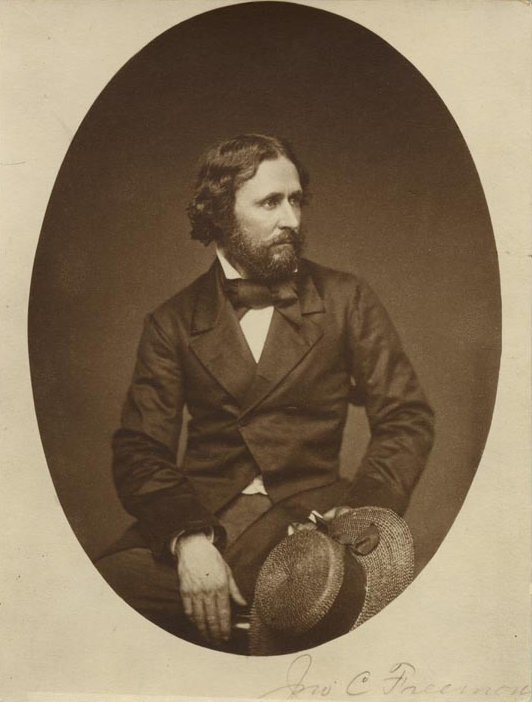
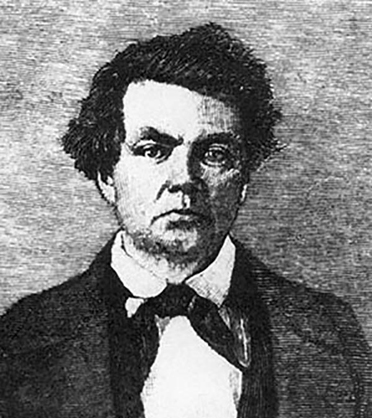
The relationship between John C. Fremont and his chief surveyor, Charles Preuss, was a mixture of professional interdependence and deep personal tension. Both men were indispensable to each other—Fremont as the ambitious public face and commanding officer, Preuss as the trained cartographer and topographic backbone of the expeditions—but their temperaments could hardly have been more different.
John C. Fremont
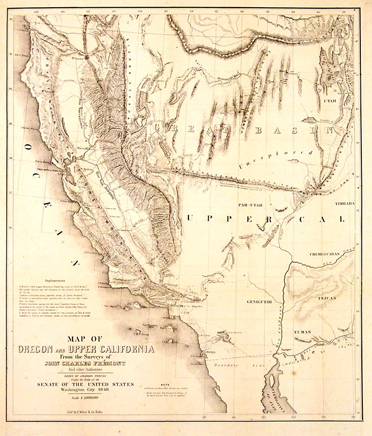
Preuss, a German-born topographer and mapmaker, brought a meticulous scientific discipline and European technical education to Fremont’s ventures. He was responsible for producing the maps that gave Fremont’s reports their authority, accuracy, and ultimate political impact. Fremont depended heavily on Preuss’s precision and methodical fieldwork—his astronomical observations, triangulations, and record-keeping were the foundation upon which Fremont’s reputation as “the Pathfinder” was built.
Charles Preuss
However, the relationship was far from harmonious. Preuss’s surviving diary-often dry, caustic, and skeptical—shows frequent frustration with Fremont’s impulsiveness and his flair for drama. A telling remark from his journal reads, “I feel better because of Fremont’s absence,” reflecting how strained the interpersonal atmosphere could become in the field expeditions of John Fr. Fremont, for his part, maintained formal respect for Preuss’s abilities but rarely mentioned him by name in official correspondence, reinforcing the imbalance between Fremont’s fame and Preuss’s quiet technical role.
Despite their tension, their collaboration was crucial to their success. Preuss translated Fremont’s raw exploration data into accurate maps that guided westward migration and railroad planning for decades. Fremont provided the narrative that captured public imagination, while Preuss provided the empirical skeletonthat made those narratives credible.
In short, theirs was a mutually dependent but uneasy partnership. This partnership combined Fremont’s ambition and charisma with Preuss’s scientific rigor, yielding one of the 19th century’s most influential bodies of cartographic and exploratory work.
“He names mountains and rivers as a poet writes verses, quickly and without measure.” — 1843, eastern Nevada
Ripples on sand dunes are small, wave-like patterns formed by the movement of wind over loose sand. They’re the desert’s way of recording the wind’s rhythm and direction. Here’s how they form and what they tell us:
Formation When wind blows across a dune, it lifts and rolls grains of sand. Larger grains bounce or “saltate” a short distance before landing, while finer grains are carried farther or fall into the spaces between larger ones. This process builds tiny ridges at right angles to the wind. As the wind keeps blowing, the ridges migrate slowly downwind, maintaining their spacing and shape.
Types
Impact ripples – The most common type, with crests spaced a few centimeters apart. They result from grain collisions and are typically found on dune slopes and interdune flats.
Climbing or shadow ripples – Form on the sheltered side of obstacles, showing where the wind slowed down.
Mega-ripples – Much larger, sometimes meters apart, often formed when coarse sand or gravel mixes with finer material, requiring stronger winds to move.
Clues and meaning
The direction of the ripples shows prevailing wind direction.
Their spacing and symmetry reveal wind strength and sand grain size.
On ancient dunes now turned to sandstone, preserved ripples tell geologists about wind patterns millions of years old.
Desert dune ripples are among the most distinctive and telling features of arid landscapes. They form as the wind sculpts loose sand into repeating ridges, each a miniature record of air movement and sediment behavior.
Formation Wind moves sand grains through a process called saltation — grains bounce, skip, and roll across the surface. When these moving grains strike others, they dislodge more sand and create a pattern of alternating ridges (crests) and troughs. Each ridge marks a zone where grains accumulate; each trough is where grains are eroded. As the wind continues to blow, the ripple pattern slowly migrates downwind, maintaining roughly the same spacing.
Characteristics
Orientation: Ripples usually run at right angles to the prevailing wind direction.
Spacing: The crests are typically spaced 2 to 15 centimeters apart, depending on grain size and wind strength.
Height: Most rise only a centimeter or two above the troughs, though larger “mega-ripples” can be several decimeters high.
Grain sorting: Coarser grains tend to collect on the crests, while finer grains settle in the troughs. This sorting gives the ripples a distinct texture and sometimes subtle color banding.
Environmental meaning Ripple patterns can indicate wind direction, consistency, and even recent changes in weather. A smooth, uniform ripple field suggests steady winds, while irregular or intersecting ripples reveal variable gusts or shifting directions. Over time, larger dune forms — such as crescents, stars, or linear ridges — develop atop these smaller ripple patterns, each scale reflecting a distinct balance of wind strength and sand supply.
Ripple spacing on desert dunes can indeed serve as a natural indicator of local wind speed. The relationship isn’t direct, but it follows clear physical patterns rooted in how wind energy moves sand grains.
Basic principle The distance between ripple crests depends on the size of the sand grains and the strength of the wind. Stronger winds carry sand grains higher and farther before they land again, producing wider ripple spacing. Weaker winds result in closer, finer ripples.
Typical scale
Light winds (around 3–5 meters per second) create small ripples with crests only a few centimeters apart.
Moderate winds (5–8 m/s) form broader ripples, 10–15 centimeters apart.
Strong winds (above 8 m/s) can generate “mega-ripples” or coarser patterns with spacing up to half a meter or more, especially when mixed grain sizes are present.
The role of grain size Fine sand moves more easily and produces smaller ripples under the same wind speed. Coarser sand resists movement, so the same wind must work harder, leading to larger spacing. Because of this, researchers often measure both grain diameter and ripple wavelength to infer relative wind energy.
Practical use Field geologists and geomorphologists photograph ripple fields and measure crest-to-crest distances to estimate average wind velocity and dominant direction over recent days. In planetary science, this same principle helps interpret Martian winds from rover photographs of ripple patterns on dunes.
Would you like me to provide an example calculation illustrating how ripple wavelength is related to wind speed and grain size in a desert study?
Here is a simple, field-style example using rule-of-thumb ranges that tie ripple spacing to wind speed, assuming typical desert sand conditions.
Given
Median grain size (d50): 0.25 mm (fine to medium quartz sand)
Observed ripple spacing (crest to crest): 12 cm
Terrain: open, dry, well-sorted dune slope
Step 1. Check that the ripples are normal impact ripples
Height a centimeter or two, evenly spaced, crests at right angles to the wind, no obvious gravel lag. If so, proceed.
Step 2. Use the practical spacing bands for d50 around 0.2–0.3 mm
Spacing 3–6 cm usually forms in light winds ~3–5 m/s.
Spacing 8–15 cm usually forms in moderate winds ~5–8 m/s.
Spacing 20–50 cm usually needs stronger winds >8 m/s and/or mixed/coarser grains (mega-ripple tendency).
Step 3. Read off the band
Your 12 cm spacing falls squarely in the 8–15 cm band.
Estimated near-surface wind (a meter or two above ground): about 6–7 m/s, with gusts likely above that.
Step 4. Sanity checks and adjustments
Finer sand (e.g., d50 ~0.18 mm) would shift the same spacing toward a slightly higher wind estimate; coarser sand (d50 ~0.35 mm) would shift it lower.
If you see patches of pebble or coarse-sand lag on ripple crests, bump the estimate upward a bit (coarse grains require stronger winds).
If intersecting ripple sets are present, winds have recently shifted; use the freshest, sharpest set.
Quick alternate example
d50 = 0.22 mm, spacing = 4 cm -> estimate ~4–5 m/s.
d50 = 0.30 mm, spacing = 28 cm with some granules on crests -> estimate ~9–11 m/s and classify as tending toward mega-ripples.
Limits
These are back-of-the-envelope field estimates. Moisture, armoring by coarse grains, and unsteady gusts can all bias the spacing. For tighter work, measure grain size in a small sample, record multiple spacings (n >= 20), and note recent gust conditions.
Reference list for desert dune ripple formation, spacing, and wind-speed relationships:
Bagnold, R. A. (1941). The Physics of Blown Sand and Desert Dunes. Methuen, London. A classic foundational text that describes saltation, ripple mechanics, and wind-sand interaction.
Sharp, R. P. (1963). “Wind Ripples.” Journal of Geology, 71(5), 617–636. Defines ripple types and presents measurements of wavelength versus wind velocity and grain size.
Fryberger, S. G., & Schenk, C. J. (1988). “Pinstripe Lamination: A Distinctive Feature of Modern and Ancient Eolian Sediments.” Sedimentary Geology, 55, 1–15. Explains how ripple migration records wind variability in dune stratification.
Lancaster, N. (1995). Geomorphology of Desert Dunes. Routledge. Comprehensive review of dune and ripple processes, field data, and global desert examples.
Nickling, W. G., & Neuman, C. M. (2009). “Aeolian Sediment Transport.” In Geomorphology of Desert Environments (2nd ed., pp. 517–555). Springer. Details the physical basis of particle movement and empirical relationships linking ripple spacing to wind shear velocity.
Andreotti, B., Claudin, P., & Douady, S. (2002). “Selection of Grain Size and Dune Morphology.” Physical Review Letters, 90(14), 144301. Theoretical modeling of ripple and dune wavelength scaling with wind shear stress.
Rubin, D. M., & Hunter, R. E. (1987). “Bedform Alignment in Directionally Varying Flows.” Science, 237(4812), 276–278. Demonstrates how ripple patterns shift under variable wind directions.
—
Note: I am not a geologist, but a retired technician using AI to synthesize and connect information from established research and field studies.