Mojave Desert History:

Who Is in Charge?

No single government, tribe, agency, or company controls the Mojave Desert. That is the first rule for understanding its history. The Mojave is not one jurisdiction. It is an area with many overlapping authorities. It is older than the borders now drawn. It is still managed piece by piece: by federal land agencies, tribal nations, state governments, county supervisors, city councils, military commands, water districts, railroads, utilities, conservation laws, mining claims, private property, and custom.

Before American maps and agencies, Native peoples held authority over the region. Their homelands, trails, springs, food-gathering areas, trade routes, and river crossings shaped the land. This was not “ownership” in the later courthouse sense; instead, it meant use, memory, obligation, defense, kinship, and sacred geography. The Mojave people controlled key parts of the Colorado River. Paiute, Chemehuevi, Serrano, Cahuilla, Kawaiisu, Timbisha Shoshone, and others were tied to desert and mountain margins. Authority followed water, trails, seasonal movement, and social ties.

Spanish and Mexican authority followed, coming lightly and unevenly. The Mojave was crossed, described, feared, and sometimes claimed. It was not closely governed. Missions, ranchos, military parties, and traders affected the edges and corridors more than the interior. The desert was difficult to occupy in the usual colonial way. Water was scarce. Distances were great. Native people still controlled much of the practical geography.

After the United States took California and the Southwest, authority became more formal but not necessarily more complete. Surveyors, soldiers, miners, freighters, railroad companies, and county officials imposed new systems of control. Military posts guarded roads and river crossings. Mining districts drafted local rules before the full government arrived. Stage and wagon roads made certain corridors important. Counties claimed jurisdiction, but their reach was often thin.

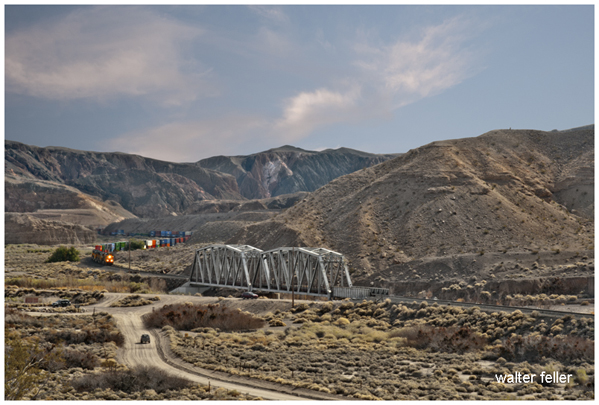
The arrival of the railroad changed the balance of power. The Atlantic and Pacific Railroad, later tied to the Santa Fe system, crossed the Mojave. Authority gathered around depots, water stops, sidings, land grants, and townsites. Places like Daggett, Barstow, Needles, Kelso, and Mojave developed. Transportation created order in a land that had previously resisted centralized control. The railroad did not govern the whole desert. However, it controlled movement, freight, settlement patterns, and economic opportunity.

Mining created another layer. Silver, gold, borax, copper, iron, salt, and other minerals brought camps, claims, mills, roads, and speculation. In many districts, authority came from miners’ meetings, claim notices, local custom, and whoever could pay for extraction and hauling. Over time, state and federal law provided the legal framework. On the ground, the desert was ruled by remoteness, money, water, and endurance.

Homesteading added another layer to authority. The government encouraged settlement through land laws. Much of the Mojave, however, was marginal for farming. Some settlers proved up claims. Some built cabins. Some failed. Some left behind the jackrabbit homestead landscape. Authority here was paper-based: legal descriptions, patents, assessment rolls, roads, school districts, and county maps. But the land itself often had the final word.

In the 20th century, the federal government became the main land authority. National parks, military bases, grazing districts, wildlife refuges, reclamation projects, and later BLM management made much of the Mojave public land. World War II and the Cold War expanded the military presence. Fort Irwin, China Lake, Edwards Air Force Base, Marine Corps bases, and training ranges made the desert a national defense site.

At the same time, water and power authorities became decisive. As a result, projects like the Hoover Dam, the Colorado River system, aqueducts, transmission lines, pipelines, and later solar and wind initiatives connected the Mojave to cities across the Southwest. In this phase, the desert was governed by both land ownership and infrastructure.

Later, the conservation era changed the question of authority again. Laws and designations like the 1964 Wilderness Act, the 1976 Federal Land Policy and Management Act, the California Desert Conservation Area, and the 1994 California Desert Protection Act redefined much of the Mojave as habitat, wilderness, cultural landscape, and public trust. Groups such as the National Park Service, BLM, Fish and Wildlife, state agencies, county governments, tribes, miners, ranchers, off-road users, utilities, conservation groups, and local residents all joined the debate.

Today, much of the California desert is managed by the Bureau of Land Management. Other major areas are under the National Park Service, such as Mojave National Preserve, Joshua Tree National Park, and Death Valley National Park. The military is also a major landholder and decision-maker. Tribal authority is increasingly recognized through consultation, co-stewardship, and co-management, though this is not always done equally or adequately. Counties regulate land use in private and unincorporated areas. Cities govern their own townsites. Water districts, utilities, mining companies, conservation groups, and private owners all hold some authority.

Also, who is in charge?

The best answer is: it depends on where you are, what resource is at issue, and what kind of authority you mean. A ranger can control a campground. A county may control the zoning. A sheriff can enforce local law. The BLM can manage grazing, recreation, mining access, or conservation on public land. The Park Service may regulate activity within a preserve or park. A tribe may exercise cultural, historical, legal, and, sometimes, land-management authority. The military can close an entire landscape. A water district can decide the fate of an aquifer. A railway or utility may control a corridor. A private owner may hold title to a desert square surrounded by public land.

That is the Mojave’s pattern: not centralized command, but layered jurisdiction. The desert has always been negotiated valley by valley, spring by spring, road by road. Its history is people trying to cross it, use it, protect it, extract from it, defend it, name it, and claim it—but never mastering it. Whoever controlled water, movement, maps, law, minerals, military access, or infrastructure controlled part of the desert. But no one controlled it all. The Mojave is best seen not as a single chain of command, but as a contest between landform, use, law, memory, and power.
Desert Literature of the Mojave and American Southwest

The deserts of California and the greater Southwest have produced a distinct body of writing shaped by aridity, distance, scarcity, and endurance. This literature does more than describe the landscape. It records how people have understood, moved through, depended on, and argued about dry country. In the Mojave system and its adjoining regions, literature serves as evidence, showing how the desert has been interpreted over time.

Mary Austin
Mary Austin stands at the foundation of desert literature in the American West. In The Land of Little Rain (1903) and The Country of Lost Borders (1909), she described the Mojave, Owens Valley, and eastern Sierra as living systems shaped by water, ecology, and long human presence. Her work established the desert as a place of complexity rather than emptiness.

W. A. Chalfant
W. A. Chalfant represents the historical record of the desert borderlands. Through his work on Owens Valley and Inyo County, especially The Story of Inyo (1922), he documented settlement, mining, agriculture, and the major water conflicts tied to the Los Angeles Aqueduct. His writing anchors the desert in documented civic and regional history.

Edna Brush Perkins
Edna Brush Perkins brings the experience of movement through the desert into focus. In The White Heart of Mojave (1922), she recorded her travels across open desert country, emphasizing distance, silence, exposure, and the psychological effects of arid landscapes. Her work preserves what it felt like to cross the Mojave when the land still imposed strict limits.

Joseph Wood Krutch
Joseph Wood Krutch marks a shift toward ecological understanding. In The Desert Year (1951), he described the seasonal rhythms of desert plants and animals, portraying the desert as a balanced, functioning natural system. His work helped move public perception away from the idea of the desert as barren and toward recognition of its internal order.

Edward Abbey
Edward Abbey represents the modern phase of desert literature, where preservation becomes central. In Desert Solitaire (1968), he argued against overdevelopment, excessive access, and the industrialization of wilderness. His writing reframes the desert as something to be defended, not simply explored or used.

Together, these writers form a complete cultural layer for understanding the Mojave and the broader desert Southwest. Their work complements geology, ecology, transportation, and settlement history by providing a record of how the desert has been observed, experienced, documented, and contested.

1. “How to Overthrow the System: brew your own beer; kick in your Tee Vee; kill your own beef; build your own cabin and piss off the front porch whenever you bloody well feel like it.”

2. “The idea of wilderness needs no defense, it only needs defenders.”

3. “Life is too short for grief. Or regret. Or bullshit.”

4. “Freedom begins between the ears.”

5. “I’ve never yet read a review of one of my own books that I couldn’t have written much better myself.”

6. “Belief? What do I believe in? I believe in sun. In rock. In the dogma of the sun and the doctrine of the rock. I believe in blood, fire, woman, rivers, eagles, storm, drums, flutes, banjos, and broom-tailed horses…”

7. “In the first place you can’t see anything from a car; you’ve got to get out of the goddamned contraption and walk, better yet crawl, on hands and knees, over the sandstone and through the thornbush and cactus. When traces of blood begin to mark your trail you’ll begin to see something, maybe. Probably not.”

8. “This is the most beautiful place on Earth. There are many such places. Every man, every woman, carries in heart and mind the image of the ideal place, the right place, the one true home, known or unknown, actual or visionary.”

9. “I have been called a curmudgeon, which my obsolescent dictionary defines as a ‘surly, ill-mannered, bad-tempered fellow’. Nowadays, curmudgeon is likely to refer to anyone who hates hypocrisy, cant, sham, dogmatic ideologies, and has the nerve to point out unpleasant facts and takes the trouble to impale these sins on the skewer of humor and roast them over the fires of fact, common sense, and native intelligence. In this nation of bleating sheep and braying jackasses, it then becomes an honor to be labeled curmudgeon.”

10. “A world without open country would be universal jail.”

As a Play

You could think of the Mojave Desert as a grand Broadway production—ancient, dramatic, and full of subtle choreography that has played out for millions of years.

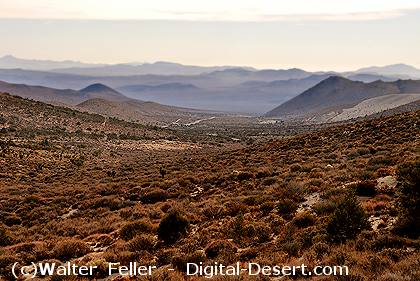
view from walker pass

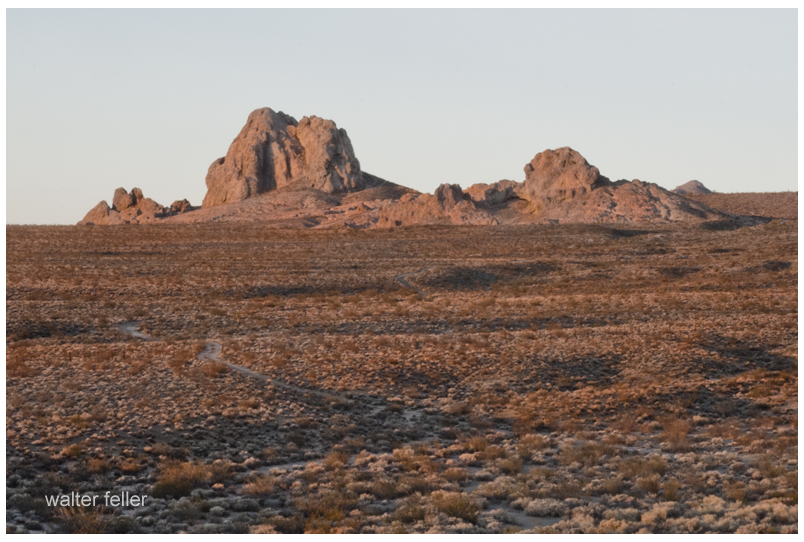
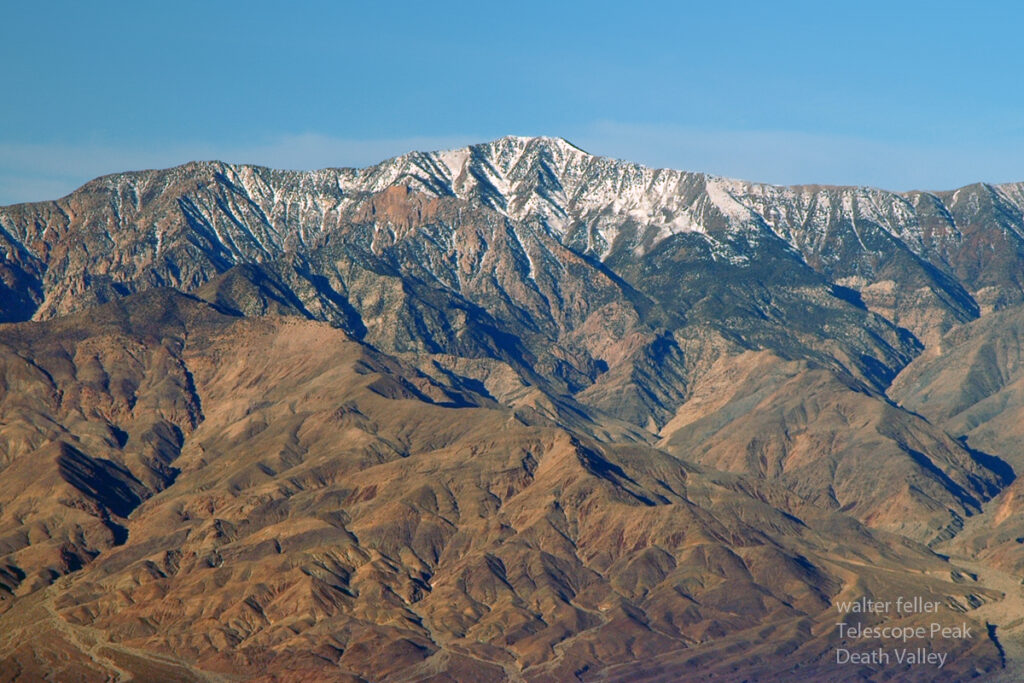
The stage is the geology: immense backdrops of folded mountains, tilted strata, and fault lines painted by time. Volcanic cones serve as spotlight towers, alluvial fans sweep like curtains drawn across the basin floor, and the Mojave River cuts a wandering path like a traveling stagehand moving props between acts.

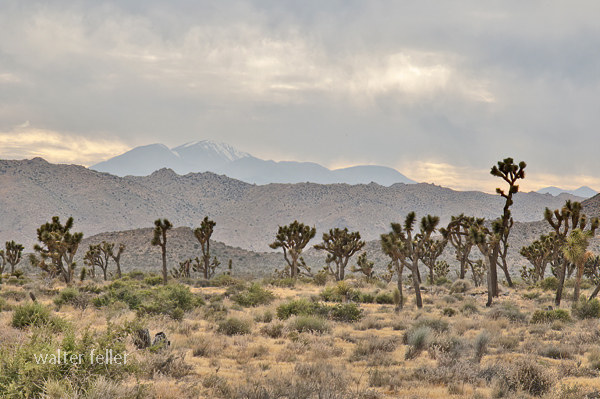
The set is built from plants, rocks, and the occasional weathered structure. Joshua trees rise like eccentric stage pieces, each with its own pose under the lights. Creosote bushes fill in the ensemble—reliable, understated performers who know every cue. Abandoned mining cabins, ghost towns, and derelict rail ties serve as the props and scenery from earlier acts, remnants left between scenes of prosperity and decline.

The lighting crew is the sun, directing each scene with precision—blinding spotlights at noon, warm amber tones at dusk, and moonlit silver rehearsals after dark. The wind adds the soundtrack, whispering through canyons or howling like a restless audience.

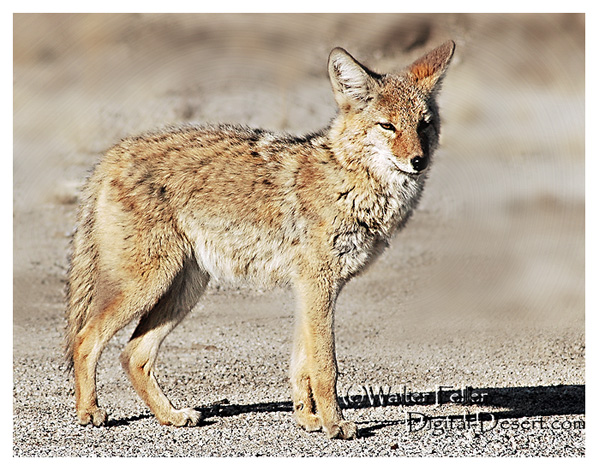
The actors? Coyotes, bighorn sheep, and lizards—all improvising within a script written by climate and time. Even the rain, when it shows up, steals the scene with a brief but powerful soliloquy, transforming everything for one fleeting act before bowing out again for months, sometimes years.

Every performance is different, but the play never closes. The Mojave’s production runs continuously, with geology always holding center stage and life finding its cues wherever it can.

Casa Del Desierto

/casa-del-desierto/

History of Casa del Desierto, Harvey House, Barstow, California

Casa del Desierto

The Casa del Desierto in Barstow, California, is a significant landmark with a rich history, symbolizing the Harvey Houses’ bygone era. In partnership with the Santa Fe Railway, Fred Harvey established a chain of Harvey Houses along the railroad in the late 19th and early 20th centuries. These establishments provided high-quality food and lodging to travelers, revolutionizing railway dining and accommodation in the United States.

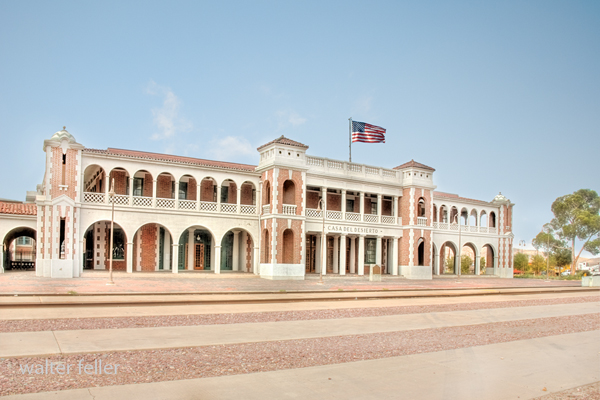
The Casa del Desierto, meaning “House of the Desert,” was built in 1911 and is one of the finest examples of the Harvey House establishments. Designed in the Spanish Colonial Revival style, it reflects the architectural elegance and grandeur intended to attract and serve passengers of the Santa Fe Railway. This particular Harvey House played a crucial role in the development of the American Southwest by providing a luxurious stopover for travelers traversing the vast and arid Mojave Desert.

Throughout its operational years, the Casa del Desierto served as a restaurant and hotel and housed the Barstow railroad depot, a Harvey Company retail store, and a telegraph office. It was a vital part of the community and a hub of activity, embodying the spirit of hospitality and the cultural exchange between the East and West.

However, with the decline of railway travel and the rise of automobile transportation, the demand for Harvey House services diminished. The Casa del Desierto closed its doors in the late 20th century and fell into disrepair. Recognizing its historical and architectural significance, efforts were made to preserve and restore the building.

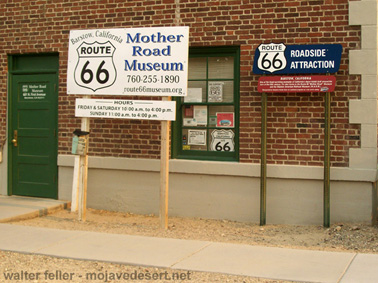
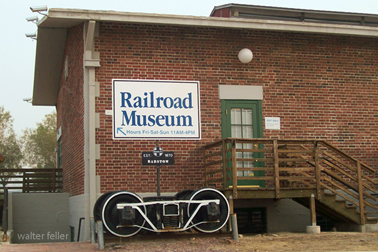
Today, the Casa del Desierto has been repurposed and houses the Barstow Area Chamber of Commerce, the Western America Railroad Museum, and the Route 66 “Mother Road” Museum. It stands as a testament to the vision of Fred Harvey and the importance of the Harvey Houses in American history. It is listed on the National Register of Historic Places, ensuring its preservation for future generations to appreciate the legacy of the Harvey Houses and their impact on travel and culture in the American Southwest.