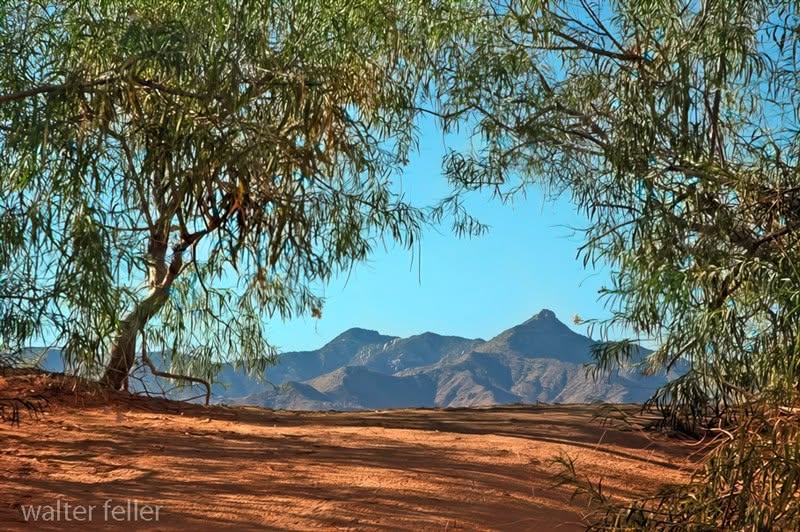
Desert photography starts out as a simple urge: “That looks good—take a picture.” If it stays there, it can go stale, because the camera becomes a souvenir machine and nothing more. But if you pull the pieces together—purpose, learning, editing, and display—it becomes something older and steadier: a craft that turns attention into knowledge, and knowledge into a record you can live with, share, and pass along.
The first part is purpose, because it keeps the work from turning into an endless string of casual snaps. In the desert, purpose can be as plain as an assignment. “Follow the wash and photograph what changes.” “Track an old route and record the artifacts.” “Show a plant community, not a single plant.” “Make a sequence that explains a place, not just a postcard.” When you have an assignment, you stop hunting for random pretty scenes and start asking the kind of questions that lead to better photographs: What is the subject? What is it doing here? What does the light reveal? What is the story the landscape is telling?
That’s what purpose does: it forces you to look longer. And in the desert, looking longer is the whole game. The desert isn’t loud the way a city is loud; it’s legible. A dry fan tells you where water used to run. A wash shows you how recent storms rearranged the ground. Desert varnish and pavement show the passage of time. A line of cottonwoods or reeds tells you where water persists even when everything else says “no.” Old grades, culverts, pole lines, and broken pavement show how people tried to solve the desert’s problems—water, distance, and heat—using the tools of their era. When your photography has purpose, you start photographing these clues on purpose. That’s the moment the camera stops being a mirror and starts being a notebook.
The second part is learning, because desert photographs can be more than attractive; they can be evidence. If you want your images to teach you something later—and teach other people something too—you need a simple discipline: shoot identifiers, not just beauty. For plants, that means the flower (if present), the leaves, the overall form, and the habitat context. For geology, it means a close-up texture shot, a mid shot showing where the rock sits, and a wide establishing shot showing the landform. For historic sites, this means details of construction, a sign or marker (if one exists), and the relationship to the landscape (because the landscape explains why the site is there). Add one shot that gives scale. It can be as simple as your boot near a track, a coin next to a fossil fragment (where legal and ethical), or a hand near a tool mark—anything that anchors size.
That method sounds almost dull, but it’s the opposite. It’s how you build a personal archive that gets more valuable with time. Later, when you want to confirm an ID, write an article, or compare changes across seasons, you have what you need. You’re not guessing. You’re working from proof.
The third part is technique, and in desert work, technique is mostly about light, distance, and protection. Desert light is brutally honest. Midday sun flattens color, blows highlights, and makes the scene look harsher than it felt. Early and late light—side-light especially—reveals texture and makes the land readable. Overcast, though rarer in the desert, is excellent for plants and details because it reduces contrast and preserves color. After rain is its own gift: clearer air, richer tones, and sometimes standing water or damp sand that photographs like velvet. Distance is the next factor: heat shimmer can ruin long telephoto shots across a flat basin in the middle of the day, and wind can turn a gentle tripod setup into a vibrating mess. Protection is the constant: dust, grit, and sun don’t care what brand of camera you brought. The desert is hard on gear and harder on complacency.
But technique isn’t only about settings. It’s about how you choose to see. A phone can make fine desert photographs if you treat it like a camera and not a distraction. A “serious” camera gives you more control and consistency, but it doesn’t give you purpose. Purpose is earned.
The fourth part is editing, because editing is where your photographs become cohesive. Editing isn’t just “making it prettier.” It’s where you declare what you’re loyal to. Are you loyal to realism—making it look like it felt? Are you loyal to form—graphic lines and hard light? Are you loyal to color—subtle separation of tans, blues, and varnish-black? Are you loyal to the story—an image that serves a sequence more than it serves itself? Once you know your loyalty, the sliders stop being a casino and start being tools.
A good way to think about editing is in terms of “mode and style.” Mode is the job. Style is the repeated set of choices. Documentary realism is a solid mode for desert work because it respects the place. You protect highlights, keep color believable, lift shadows without flattening, and use sharpening with restraint so rocks look like rock rather than crunchy digital grit. Classic landscape is another: slightly deeper contrast, careful dodging and burning, and a “printed” look that suits wide scenes. Graphic high-contrast can be powerful too—especially on dunes, volcanic rock, road cuts, and old concrete—where shape and shadow are the story. Film-like or vintage styles can work, but only if you keep them consistent; otherwise, it becomes a costume you put on photos at random.
The most important editing decision is not what you add—it’s what you refuse. Decide your line in the sand. Many desert photographers do better the moment they reject heavy HDR halos, neon saturation, and fake skies. The desert has plenty of drama; you don’t need to manufacture it. Restraint reads as confidence.
The fifth part is display, because display is where the whole thing becomes real. A photograph that lives only on a hard drive is unfinished. Display is also where people get confused, because every output has different needs. A print for the wall is not the same as an image for a phone screen, and neither is the same as an image for publication.
For home display, you’re making something you’ll live with. That calls for calm editing, predictable sizes, and consistency. A single strong piece can anchor a room, but series work—washes, roads, dunes, textures—can turn a wall into a story. A traditional approach helps: standard sizes, consistent frame style, consistent mat color. The goal is for the work to read as a body rather than a pile.
For a gallery, cohesion is everything. A gallery show is not a “best of.” It’s a statement. Limiting sizes, limiting styles, and arranging images as sequences make viewers slow down and follow the logic. Captions matter more than people like to admit in landscape work. One sentence can turn a pretty scene into a scene with meaning: what it is, where it is, and why it matters. Desert photography especially benefits from this because the land is full of clues that most viewers don’t yet know how to read.
For gifts, you’re choosing ease and friendliness. Smaller sizes, a bit more brightness than you’d keep for yourself, and subjects that communicate immediately. A clean Joshua tree silhouette, a classic road fragment, a dramatic ridge line—these are images people can place in their own homes without needing the backstory. You can still include the backstory, but the gift should stand on its own.
For publications, you’re in a world of specifications, accuracy, and reproducibility. You keep color conservative, avoid heavy sharpening, and give editors room for crop and caption. A publication image is as much about clarity as it is about mood. In this setting, your photographs become a form of documentation—proof again—especially when they support a narrative about history, ecology, or place.
When you combine these parts, you can finally answer what it means and what it does.
What it means is that desert photography becomes a form of attention practiced over time. It’s a way of noticing that isn’t casual. You go out with a purpose, you learn what you’re seeing, you refine how you translate it into an image, and you finish it in a form that can be shared. In other words, it becomes a craft rather than a pastime. The desert rewards craft because it’s a place where small differences matter: a slight change in slope tells a water story; a slight change in soil tells a plant story; a slight change in light turns a flat scene into a readable one.
What it does is equally concrete. It builds a personal archive that grows in value over time. It trains your eye to recognize patterns. It gives you a record of places that change—sometimes slowly, sometimes abruptly. It creates material for sharing: a wall series, a booklet, a website page, a classroom talk, a gift that carries a place into someone else’s home. It also has a quiet civic function: photographs can support memory, and memory can support stewardship. When you have images that show how a site looked, where a route ran, what a wash did after a storm, or what a grove of cottonwoods looked like before a dry year, you have evidence. You can argue from something more solid than nostalgia.
There’s also a personal effect that’s easy to underestimate: purpose-driven photography makes desert time feel fuller. A day out stops being “a drive with a few stops” and becomes “a study of a place.” Even if you come home with only a handful of images worth keeping, you still have knowledge.