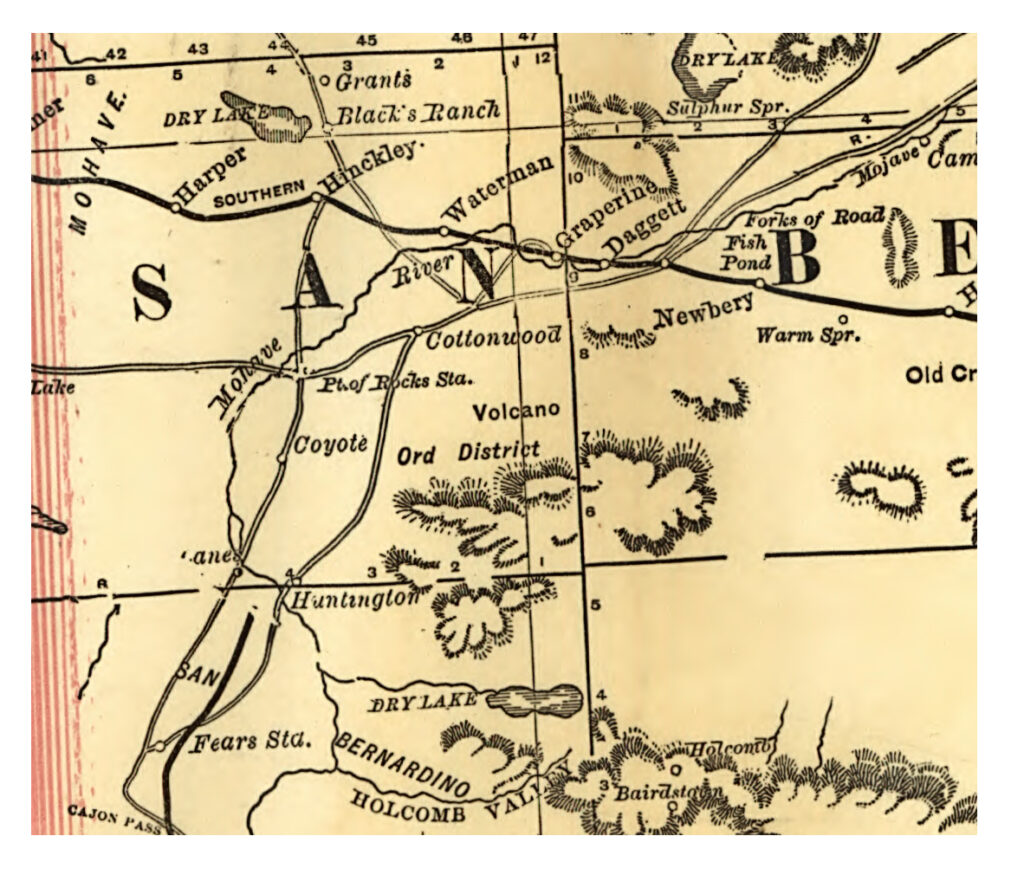
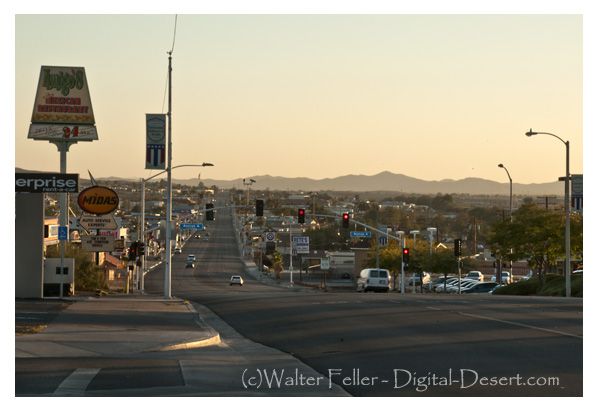
Daggett occupies a decisive position in the Mojave rail system. While smaller in present appearance than nearby Barstow, its historical and structural role is foundational. It is the point where the trans-Mojave railroad, advancing eastward from Mojave, first established a stable desert operating base tied directly to the Mojave River corridor. Before Barstow emerged as the dominant classification center, Daggett served as the region’s early rail hub and the initial organizing node for eastward expansion toward the Colorado River.
The arrival of the Southern Pacific Railroad at Daggett in the early 1880s marked a transition from mountain-to-desert rail building into true trans-desert operation. From this point, construction continued east toward Needles, completing the Mojave crossing in 1883. At the same time, the broader competitive framework involving the Atlantic and Pacific Railroad and, later, the Atchison, Topeka, and Santa Fe Railway placed Daggett within a contested, strategically important rail geography.
Daggett’s importance is not just chronological, but geographic. It sits along the Mojave River, one of the few reliable water corridors in the desert. That placement made it viable as a servicing and staging point in an otherwise resource-scarce environment. Early railroad logistics depended heavily on water, fuel, and manageable grades, and Daggett offered all three within a workable alignment. In this sense, the town represents the moment when the railroad system fully adapted to desert conditions rather than simply crossing into them.
Structurally, Daggett operates as an intermediate junction and early hub, positioned between Mojave and Barstow. It does not replace either node but instead explains how the system developed between them. Mojave serves as the western pivot, and Barstow later becomes the dominant classification hub, but Daggett shows the earlier phase of organization when rail operations first stabilized in the central Mojave. It is also tied to branching industrial and mining lines, including connections associated with borax and desert resource extraction, which radiated outward from this corridor.
Within the Mojave system framework, Daggett belongs to several layers simultaneously. It is part of the Mojave-Needles trans-desert corridor, a node along the Mojave River spine, and an early operational anchor that predates Barstow’s later dominance. This layered identity makes it essential to explain not just where the railroad went, but also how it functioned during its formative period.
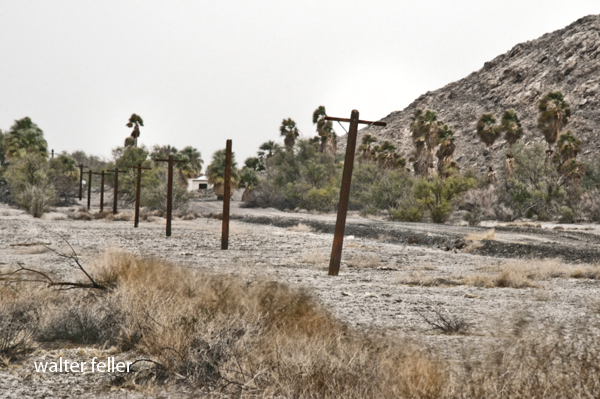
Telegraph poles along the side of the T&T RR roadbed.
Across the Mojave Desert, distance has always been the central challenge, fundamentally shaping the region’s social and economic development. Before the introduction of the telegraph and other forms of rapid communication, travelers, soldiers, and traders moved slowly between scattered springs, river crossings, and mountain passes. Messages traveled only as fast as the horses or wagons carrying them. In this landscape, information lagged behind events, leaving settlements, mining camps, and transportation routes isolated for days. This persistent isolation highlights the importance of the telegraph’s arrival. In this essay, I will examine how the emergence and spread of the telegraph transformed communication in the Mojave, tracing its gradual development, its integration into the transportation and mining infrastructure, and its broader role in connecting the region to the economic and administrative systems of the American West.
The telegraph’s arrival in the nineteenth century transformed communication in the Mojave. As wires were laid alongside railroads and travel routes, the region’s first network emerged—turning settlements and stations into nodes that instantly transported news, business, and personal messages across vast distances. In this way, the once-remote Mojave became part of a coordinated economic and transportation landscape.
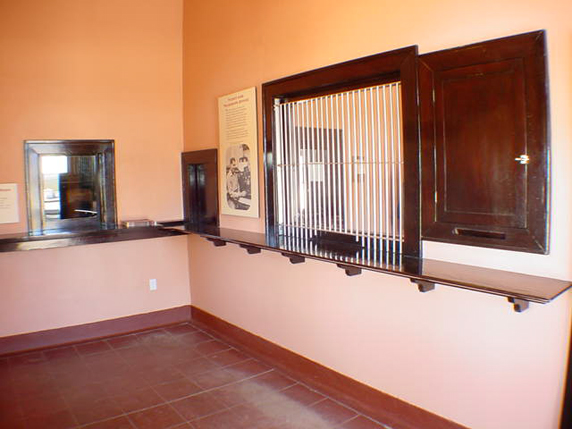
Telegraph room, Kelso Depot
The telegraph lines were more than a technological milestone—they turned the desert’s corridors into channels for movement and information, connecting towns from Needles to Barstow and Mojave as part of a regional network. To understand this transformation, note that the telegraph’s spread across the Mojave was not a single event but a gradual process spanning several decades. Initially, communication lines traced existing corridors: first, military roads in the mid-nineteenth century; then stage routes; and finally, most decisively, railroads beginning in the 1870s. With each advance, as the wire reached new parts of the Mojave, the effective distance shrank. Consequently, remote stations, mining camps, depots, and river crossings could now report conditions, request supplies, transmit orders, and relay market news in near real time.
Before the telegraph—throughout the early to mid-1800s—communication across the Mojave depended entirely on physical travel. Messages were moved by rider, wagon, stage, or military courier over routes such as the Mojave Road and the Salt Lake Road. Later in the century, they traveled along the wagon corridors tied to San Bernardino, Fort Mojave, and the Colorado River crossings. As a result, delay, uncertainty, and isolation were the norm. For example, a storm, a washout, a hostile encounter, or a shortage of animals could disrupt message delivery for days. In a region where water, distance, and timing mattered, that limitation was severe.
In 1861, the construction of the first transcontinental telegraph line marked a major turning point in American communications, but this initial line bypassed the Mojave. Only after the Civil War, as settlement, military use, mining, and rail transport expanded in the region during the late 1860s and 1870s, did the Mojave begin to develop its own telegraph lines. (Editors, 2009) In the desert Southwest, telegraph lines thrived where regular travel and economic support made maintenance feasible.
Against this backdrop, by the 1870s and 1880s, railroads became the main builders of telegraph infrastructure in the Mojave. As tracks crossed the desert, telegraph poles inevitably followed, since the railroad needed wire as much as rails. To dispatch trains efficiently over long single-track stretches, rapid communication between stations, sidings, yards, and division points became vital. In this way, telegraph offices at depots and section stations became the desert railroad’s nervous system, turning what was once open distance into a managed corridor.
This approach was exemplified by the Southern Pacific’s advance into the greater Mojave in the 1870s. Rail stations were not just stops for passengers and freight; they were communication nodes. A station agent might also serve as a telegraph operator, sending orders, reporting shipments, relaying delays, and linking local businesses to regional markets. Settlements with rail stops often gained telegraphic relevance as well.
The Mojave corridor’s transformation accelerated in 1883, when the Atlantic & Pacific Railroad—later controlled by Santa Fe—completed its line from Needles to Mojave. This milestone marked a decisive moment in regional communication (Atlantic and Pacific Railroad records, 1889-1893, n.d.). With the railroad came a continuous telegraph, linking Colorado River gateways, desert sidings, supply hubs, and western connections. As a result, towns such as Needles, Fenner, Cadiz, Ludlow, Barstow, and Mojave gained new significance—they became points in an interconnected network, not just locations on a map.
As a result of these shifts, Barstow’s later importance rested partly on this logic. As lines converged and railroad functions intensified, so did telegraph traffic. Train movements, freight, maintenance orders, livestock, mining output, and commercial messages all depended on the wire. Telegraphy made Barstow a control point, not just a stopover. The same applied, more modestly, to smaller stations, whose importance stemmed from siding capacity, water supply, or As the route developed into a major rail corridor after 1901, its telegraph infrastructure expanded, and places such as Daggett and the line toward Las Vegas became part of a communications spine linking Southern California with the Great Basin and the interior West (Guide to the San Pedro, Los Angeles & Salt Lake Railroad Company Records, 2024). In turn, the wire made the entire corridor legible to managers, dispatchers, and officials.
As rail and telegraph lines expanded, mining districts also benefited, though typically only indirectly at first. Mines needed access to a telegraph office, whether at their own camp, a nearby rail station, or a supply town—not a full regional grid. In the Mojave, camps often rose and fell too quickly for elaborate infrastructure, but more durable districts spread communication from the railheads. As one mining superintendent observed in an 1882 report, “With the wire to hand, news of strikes or shipments is sent in minutes, not weeks.” Telegraphy enabled ore buyers, investors, freighters, smelters, and operators to coordinate activities far faster than before. The telegraph was an economic multiplier; however, it did not create mineral wealth, but accelerated extraction and speculation.
Beyond its economic impact, the telegraph fundamentally reshaped the exercise of governance in the desert by enabling authorities to coordinate and intervene over long distances far more effectively than before. Sheriffs, military officers, railroad managers, and commercial entities gained the ability to transmit orders, directives, and requests for aid almost instantaneously, enabling more proactive, coordinated responses to emergencies and routine matters alike. The telegraph enabled the rapid management of crises such as accidents, conflicts, floods, labor disputes, supply shortages, and equipment failures. In a region where low population density and vast expanses had previously hindered centralized oversight and delayed administrative actions, the telegraph facilitated more timely decision-making and remote supervision. In effect, telegraphy became not just a technical advance but a core administrative instrument that altered patterns of authority and governance in the Mojave Desert. (Schwoch, n.d.)
Socially, the telegraph drew isolated desert communities into a broader world, fostering new cultural connections and a sense of participation in national affairs. Telegraph offices not only provided access to newspapers, commodity prices, railroad schedules, political news, and personal messages, but also exposed residents to broader currents of information and social change. The resulting increase in awareness allowed Mojave inhabitants to engage more actively with markets, politics, and news beyond their immediate environment. However, it is important to recognize that these benefits were not experienced equally by all residents. Some individuals and communities, particularly those unable to afford telegraph services or lacking easy access to the wire, may have found themselves left further behind as information and economic opportunities flowed to more connected settlements. Although expensive and specialized compared to mail, the telegraph’s symbolic value was enormous, representing technological progress and integration with modern society. (Schwoch, 2019) Nevertheless, while a desert station with a telegraph key was no longer truly remote, those without such infrastructure could remain marginalized—demonstrating that technological advancement could both connect and divide communities within the Mojave. In this sense, the telegraph’s integration sometimes reinforced social and economic disparities, complicating the narrative of universal connectedness and belonging to the broader American experience.
By the early twentieth century, telegraph service across the Mojave had become routine but remained crucial. It laid the groundwork for later advances like telephones and radio, proving that main corridors were channels of information as significant as the rails.
The development of the telegraph across the Mojave can be divided into three clearly defined stages. The first stage, prior to the 1860s, was characterized by a pre-wire desert that relied entirely on courier communication, with messages delivered by riders or wagons. The second stage, spanning the mid to late nineteenth century, marked a transition, as growing military, commercial, and transportation demands increased the need for more rapid communication, prompting the initial spread of telegraph lines along established routes. The third stage began in the 1870s and extended into the early 1900s, when the expansion of railroads led to the widespread installation of telegraph lines along the main transportation corridors of the desert, making telegraphic communication a standard feature of the Mojave (Axotl, 2025). While the telegraph did not conquer the Mojave by itself, its expansion demonstrated a new order: the desert was transformed from a space merely traversed into one constantly monitored, coordinated, and integrated.
By the early twentieth century, telegraph offices at railroad depots relayed train orders and freight movements, connecting desert settlements with distant cities and enabling coordination with markets and administrative centers beyond the desert.
Although later technologies—such as the telephone, radio, and digital communication—replaced the telegraph’s practical role, it is important to remember that the system it created marked a turning point in the region’s history. The telegraph bound the Mojave Desert into the economic and administrative framework of the American West and enabled information to travel as quickly as railroads carried people and goods.
Seen in this light, the telegraph poles that once lined the desert rail corridors represented far more than mere infrastructure. They signaled a profound transformation in the region’s social and economic fabric, marking the Mojave’s entry into the networks that shaped the modern American West.
Alongside the development of railroads and roads, the telegraph fundamentally redefined the meaning of distance and isolation in the desert. By enabling near-instantaneous communication, it not only connected settlements but also facilitated new forms of economic coordination, administrative oversight, and social engagement. Ultimately, the arrival of the telegraph was not simply a technological change: it reimagined the Mojave as part of a broader, interconnected world, demonstrating how technological innovations can reshape both the lived experience and future possibilities of even the most remote regions.
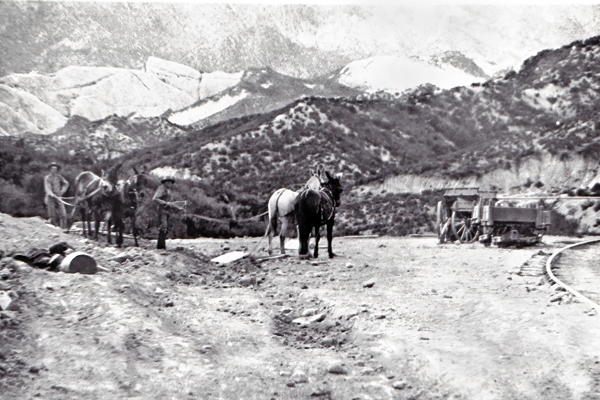
Construction on the Southern California Railway in the Cajon Pass. From the collection of the San Bernardino Historical and Pioneer Society.
The California Southern Railroad was a critical 1880s project that connected Southern California to the transcontinental rail network. Backed by the Atchison, Topeka & Santa Fe (AT&SF) Railway, it built a line from San Diego northward through San Bernardino and the Cajon Pass to reach the Atlantic & Pacific Railroad at Barstow. This report chronicles the railroad’s planning and surveying, its phased construction timeline, the engineering challenges of Cajon Pass, key figures involved, construction methods, conflicts encountered, and the line’s integration into the Santa Fe system and impact on the region.
Background and Planning
In the late 1870s, San Diego businessmen – notably Frank Kimball – were desperate to end the city’s isolation by rail. After failing to interest tycoons like Jay Gould or Collis Huntington, Kimball courted the Santa Fe leadership with incentives, including land grants around San Diego. The Santa Fe saw an opportunity to break Southern Pacific’s monopoly in California and agreed to support a new subsidiary line via San Bernardino. Thus, the California Southern Railroad was incorporated on October 16, 1880, with Santa Fe officers (led by President Thomas Nickerson) on its board. The plan was to build 116 miles from San Diego to San Bernardino by mid-1882, where it would link up with Santa Fe’s transcontinental partner, the Atlantic & Pacific (A&P) Railway. This ambitious scheme set the stage for a difficult but historic construction effort through some of California’s most challenging terrain.
Construction Timeline (1880–1885)
Construction of the California Southern proceeded in two major phases: Phase 1, from San Diego to San Bernardino (via Colton), and Phase 2, from San Bernardino through the Cajon Pass to Barstow. Below is a timeline of key construction milestones and setbacks:
October 1880 – Groundbreaking: The railroad’s Chief Engineer, Joseph Osgood, established headquarters in San Diego on October 11, 1880, marking the unofficial start of construction. With Santa Fe financing and local land grants secured, grading and tracklaying began northward from National City (San Diego’s port terminus).
January 1882 – Reaching Oceanside/Fallbrook: By January 2, 1882, crews had laid about 55 miles of track, reaching Fallbrook Junction in northern San Diego County. The line hugged the coast through Oceanside, then turned inland up the Santa Margarita River valley, requiring many bridge crossings in Temecula Canyon, a gorge with sheer rock cliffs.
August 1882 – Arrival at Colton: Construction pressed on through Riverside County, and by August 16, 1882, tracks reached Colton, just shy of San Bernardino. Here, the California Southern confronted the Southern Pacific Railroad (SP), which vehemently opposed any crossing of its tracks. SP officials even parked a locomotive on the proposed crossing point to obstruct the crew. A legal battle ensued; ultimately, California’s governor (Robert Waterman) ordered the local sheriff to enforce a court injunction, compelling SP to allow the crossing. With the blockage removed, the California Southern built a diamond crossing over SP’s line at Colton.
September 1883 – Line Opens to San Bernardino: The first California Southern train triumphantly steamed into San Bernardino on September 13, 1883. San Bernardino, having been founded as a Mormon colony decades earlier, welcomed the new competition to SP’s rail monopoly. The completed San Diego–San Bernardino segment (via Temecula Canyon) formed part of Santa Fe’s “Second Transcontinental” route, albeit still disconnected from the A&P mainline in the Mojave Desert.
Winter 1884 – Catastrophic Floods: Disaster struck just months later. In February 1884, torrential rains turned the Santa Margarita and Temecula creeks into raging torrents. Floodwaters obliterated about 8 miles of track in Temecula Canyon, washing away trestles and roadbed – with rails and timbers reportedly floating out to sea. The damage, estimated at $319,000, far exceeded the cash-strapped railroad’s means. Service on the line was completely halted for nine months while crews struggled to make repairs. By January 6, 1885, the route was finally reopened to traffic after extensive rebuilding.
Late 1884 – Santa Fe Takeover: The 1884 flood crisis left the California Southern on the brink of bankruptcy. Fearing the line might fall into rival hands, Santa Fe’s President William Barstow Strong moved decisively to absorb the company. In October 1884, the AT&SF acquired a controlling interest in the California Southern through a stock swap and also negotiated the purchase of Southern Pacific’s Mojave-to-Needles branch line (which ran via Barstow). These moves ensured Santa Fe’s full control of the San Diego–Barstow project and secured the route to the East via Barstow/Needles.
1885 – Building Through Cajon Pass: With finances and leadership now backed by Santa Fe, the final 81-mile gap from San Bernardino through Cajon Pass to Barstow was tackled in 1885. Santa Fe’s locating engineer, William Raymond “Ray” Morley, and local chief engineer Fred T. Perris led surveying parties to plot a feasible ascent through the San Bernardino Mountains. Construction crews attacked the pass from both ends – working northward from San Bernardino and southward from the Barstow area (then called Waterman).
November 1885 – Completion of the Line: On November 15, 1885, the last spike was driven in Cajon Pass, marking the completion of the California Southern Railroad and a continuous rail link from San Diego to the transcontinental mainline. Within a day, the first through passenger trains ran between San Diego and Chicago (via Barstow), establishing a second Pacific coast connection in competition with the Southern Pacific. The once-isolated San Diego now had rail access to the rest of the country.
Surveying and Engineering Challenges in Cajon Pass
Surveying a railroad through Cajon Pass – the cleft between the San Gabriel and San Bernardino mountain ranges – posed formidable engineering challenges. The pass, created by the San Andreas Fault, is a naturally rugged corridor filled with steep grades and unstable geology. Chief Engineer Fred T. Perris and surveyor Ray Morley scouted the route in 1885, seeking a path that locomotives of the era could climb. They managed to keep the maximum grade to 3.4% on the eastbound (uphill) tracks to Cajon Summit at an elevation of 3,823 feet. This roughly 1,000-foot ascent from the base of the pass was achieved by tracing winding curves along the canyon walls, avoiding any single, overly steep incline. Early surveys had to balance the line’s curvature and grade: too sharp a curve or too heavy a grade would prevent trains from safely traversing the pass.
Complicating matters, the terrain through Cajon consists of fractured rock and sandy washes prone to erosion, a legacy of the fault line. Unlike easier routes, there was no gentle river valley to follow – only dry canyons and slopes. Morley and Perris chose to contour along natural benches and cut into hillsides, minimizing the need for expensive tunneling or switchbacks. (In fact, the original 1885 line included no significant tunnels; only in 1913, during a double-tracking project, were two short tunnels added – later “daylighted” in modern times.) The surveying team had to find stable ground for the railbed and design ample drainage to protect against flash floods in the desert gullies. The result was a sinuous route featuring famous curves (like Sullivan’s Curve) that allowed trains to gain altitude gradually. The achievement was considered one of Santa Fe’s great engineering feats of the 1880s, creating a viable railroad through a region previously deemed too rugged for rail travel.
Elsewhere along the route, natural obstacles also tested the engineers. South of San Bernardino, the line’s earlier segment through Temecula Canyon had demanded seven miles of roadbed chiseled through almost perpendicular rock cliffs. There, the railroad crisscrossed the Santa Margarita River numerous times on low wooden bridges – an engineering necessity that unfortunately exposed the line to destruction by floods. One Chinese laborer working in the sweltering Temecula gorge reputedly quipped that it was “all the same hellee, you bet,” referring to the hellish difficulty of the work. That experience underscored the need for solid engineering in Cajon Pass. Learning from prior washouts, the builders in Cajon placed bridges and culverts to carry ephemeral streams under the track and built up embankments to elevate the line in flood-prone areas. Still, steep mountain topography and seismic geology made Cajon Pass a supreme test of the railroad’s surveyors and graders, one that Perris and his team met with grit and ingenuity.
Construction Methods and Workforce
Building the California Southern Railroad in the 1880s required massive manual effort and traditional construction techniques. The project had no heavy machinery as we know it today – construction was essentially by hand labor with picks, shovels, horse-drawn scrapers, and black-powder explosives for blasting rock. The workforce swelled to thousands; in fact, over 6,000 laborers were employed at one point to push the line through Cajon Pass and down into Los Angeles. Chinese and Mexican immigrant laborers made up a large portion of the crews, especially on the hard sections through canyons and desert. These workers cleared brush, graded hillsides, dug cuttings, and built fills with wheelbarrows and dump carts. For rock cuts, crews drilled holes by hand or with rudimentary pneumatic drills, filled them with black powder, and blasted through obstacles. Timber was cut for trestle bridges and culverts, which were assembled on-site to span washes and rivers.
Material supply was an enormous logistical challenge for this railroad. San Diego had no existing rail connection in 1880, so every piece of rail, hardware, and rolling stock had to be shipped. Rails and fastenings were sourced from Belgium and Germany, loaded onto sailing ships, and carried around Cape Horn to San Diego’s port. The first load of steel rail arrived in March 1881 aboard the British ship Trafalgar, delivering the metal needed to push the line northward. Wooden ties (sleepers) were likely procured from Pacific Coast forests and brought by coastal schooners. At the railhead, workers practiced the standard tracklaying method of the era: teams of men known as “iron men” would lift rails into place with tongs, while others spiked them to the ties and gauged the track. Progress could reach several miles of track laid per day on flat ground, but slowed to a crawl in difficult terrain.
In Cajon Pass, construction methods had to adapt to the steep grades. Cuts and fills were carefully engineered: material from cuts was used to build up fills around curves, a balancing act that reduced how far debris had to be hauled. In some areas, temporary inclines and switchbacks were used to move construction equipment (such as small work locomotives) until the permanent grade was ready. Photographic evidence from the 1880s shows work trains carrying supplies up partially completed grades, and construction camps housing hundreds of workers in tent cities along the route. Despite the crude methods, the crews in Cajon Pass succeeded in laying a robust track. When the last rail was spiked down in November 1885, the California Southern’s construction legacy was one of dogged persistence with picks and shovels, achieving a task many thought impossible.
Key Personnel and Leadership
Several key figures were instrumental in the design, surveying, and construction of the California Southern Railroad’s route through Cajon Pass:
Fred T. Perris – Chief Engineer: A British-born surveyor who settled in San Bernardino, Frederick T. Perris served as Chief Engineer of the California Southern (and later the Santa Fe). Perris personally directed the location surveys through Cajon Pass in 1885 and oversaw the construction of this last leg of Santa Fe’s second transcontinental route. The difficult passage through Cajon (often mis-called “El Cajon Pass”) was his crowning achievement, and the city of Perris, California (originally a railroad camp on the line) was named in his honor.
William Barstow Strong – Santa Fe President:W.B. Strong was the AT&SF Railway’s president during the 1880s and the strategic mind behind the push into Southern California. He outmaneuvered Southern Pacific’s Collis Huntington to break the rail monopoly and spearheaded the Santa Fe’s support of the California Southern project. Strong authorized the heavy investment to rebuild after the 1884 floods and to conquer Cajon Pass, and Barstow (originally “Waterman Junction”) was later renamed in his honor once the line was complete.
William Raymond “Ray” Morley – Chief Location Engineer:Ray Morley was a civil engineer for Santa Fe who had previously surveyed challenging mountain routes (his father surveyed Raton Pass in New Mexico). Morley partnered with Perris to plot the Cajon Pass alignment. His expertise in mountain railroading helped find a path with acceptable curvature and grade through Cajon’s canyons. Morley’s survey work ensured the railroad could be built without resorting to impractical solutions; he is credited with successfully locating the line.
Frank Kimball – San Diego Advocate:Frank Kimball was not an engineer but rather a San Diego land developer whose vision and persistence were crucial in launching the railroad. He lobbied Eastern financiers and offered land from his Rancho de la Nación to entice the Santa Fe to back the line Kimball’s efforts paid off—he secured 10,000 acres in land grants and other concessions for the railroad, directly leading to the California Southern’s incorporation. He is often regarded as the “father” of the project, ensuring San Diego would finally get a transcontinental link.
Joseph O. Osgood – Initial Chief Engineer:Joseph Osgood was the California Southern’s chief engineer at the outset of construction. He organized the surveying parties in 1880 and established the construction headquarters in San Diego. Under Osgood’s supervision, the first 70 miles of track were built from National City to Colton. He resigned before the Cajon Pass phase (with Perris taking over), but his groundwork from 1880–1882 laid the foundation for the line’s eventual success.
(Many others contributed, including hundreds of anonymous labor foremen, as well as contractors for grading and bridge building. Governor Robert Waterman and Sheriff J.B. Burkhart also played a memorable role by enforcing the law against Southern Pacific’s interference at Colton. But the figures above stand out as the principal players in getting the railroad built.)
Conflicts and Community Interactions
From its inception, the California Southern Railroad faced determined resistance from the entrenched Southern Pacific Railroad (SP), which jealously guarded its dominance in California. The most dramatic conflict occurred at Colton Crossing in 1882–1883. As California Southern crews prepared to lay track across SP’s north-south line, SP’s agents literally blocked the crossing with a locomotive and railcar, moving them back and forth to prevent any grade crossing construction. This showdown, known as the “Battle of Colton,” escalated until a court ordered SP to cease obstruction. When SP initially ignored the order, Governor Waterman dispatched the San Bernardino County Sheriff and militia to enforce it. Under this pressure, Collis Huntington’s SP capitulated, allowing the crossing to be completed. The successful crossing at Colton opened the way for the Santa Fe affiliate to enter San Bernardino, much to the delight of residents who had felt bullied by SP’s monopoly. The arrival of the first California Southern train in San Bernardino in 1883 was met with celebration – a vindication of the community’s support for a second railroad.
Local communities along the route mostly welcomed the railroad and the economic opportunities it promised. Towns like Oceanside, Riverside, and San Bernardino saw immediate benefits in freight and passenger service. New townsites sprang up as well – Pinacate (in Riverside County) was a railroad camp that evolved into the town of Perris (named after Fred Perris) in 1886. There were, however, instances of tension. Some farmers in the Temecula area were reportedly skeptical of the railroad’s precarious route along the flood-prone canyon, advice that proved well-founded when the line washed out. Additionally, the construction crews themselves (many of whom were Chinese) sometimes met prejudice or hostility in local communities, as was common in that era.
On the whole, the coming of the California Southern was a boon to Southern California communities. It broke the isolation of San Diego and San Bernardino, lowered freight rates, and sparked a fare war that made travel more affordable (as detailed in a later section). The railroad also brought jobs and expanded agricultural markets. Conflicts that did occur – aside from corporate battles with Southern Pacific – were relatively minor and often stemmed from disputes over right-of-way or damage to land during construction, which the railroad typically settled. By 1885, most local stakeholders recognized that Santa Fe’s entry via the California Southern meant freedom from the SP monopoly and the start of a more competitive era in transportation.
Completion and Connection at Barstow
The completion of the California Southern Railroad through Cajon Pass in November 1885 was a pivotal moment in western railroad history. It effectively joined Southern California to the transcontinental rail network, creating a new through route from Chicago (via the Santa Fe and A&P lines) to San Diego and Los Angeles. The meeting point was at the desert town of Barstow – known at the time as Waterman Junction. Barstow was where the California Southern’s rails met the Atlantic & Pacific Railroad (A&P), which had built west from Albuquerque to Needles by 1883. Notably, the tracks between Needles and Barstow had been laid by the Southern Pacific (under an arrangement to block Santa Fe) but were acquired by AT&SF in 1884. Thus, by late 1885, Santa Fe controlled an unbroken line from Kansas City to Barstow.
On November 15, 1885, workers drove the last spike in Cajon Pass, after track gangs from San Bernardino and Barstow met on the grade. Service commenced immediately: on November 16, the first trains to traverse the entire line ran between San Diego and points east. One train originated at Barstow heading toward San Diego, and another left National City (San Diego) bound for the East. These inaugural runs symbolized the end of Southern Pacific’s stranglehold – passengers and freight could now travel over an independent transcontinental route to Southern California. The completion of California Southern also made Barstow a key junction. The town soon developed into a bustling division point, with yards and shops to sort the influx of transcontinental freight descending from the Mojave Desert.
To formalize the connection, the California Southern built a junction with the A&P just outside Barstow. The A&P (which was half-owned by Santa Fe) continued west to Mojave, but Santa Fe shifted its focus to the new link south to San Diego. The entire route operated seamlessly under Santa Fe management, effectively making the California Southern the western leg of Santa Fe’s main line. In railroad publicity, Santa Fe touted its new “Pacific Route” reaching San Diego’s harbor – though Los Angeles would soon eclipse San Diego as the primary terminus (see below). Still, the achievement at Barstow in 1885 cannot be overstated: it completed the second transcontinental railroad into California, providing a competitive alternative to the Central/Southern Pacific’s lines. From this point on, Southern California was served by two transcontinental systems, and Barstow (named in honor of W.B. Strong) became a lasting reminder of Santa Fe’s triumph.
Natural Disasters and Line Modifications
Nature proved to be an ongoing adversary for the California Southern Railroad, even after the line’s completion. The Temecula Canyon segment (between San Diego and San Bernardino) was especially vulnerable. As noted, the Great Flood of 1884 devastated that canyon, shutting down the line for most of that year. The Santa Fe takeover allowed repairs to proceed, and by early 1885, trains were running again. However, the lesson was learned: Temecula Canyon was a risky route. Santa Fe soon invested in alternate lines to avoid this chokepoint (discussed in the next section).
The most fateful natural event came in February 1891, when another series of Pacific storms pounded Southern California. That month saw relentless rainfall and flooding. All railroads in the region were washed out in places, but the Santa Margarita/Temecula Canyon line was hit catastrophically once more. Bridges and tracks that had been rebuilt after 1884 were again torn from their foundations. In some spots, rails were reportedly carried miles downstream, with witnesses claiming they could see railroad ties bobbing in the ocean surf after being swept out of the canyon. This time, the Santa Fe Railroad decided not to pour more money into rebuilding the vulnerable canyon segment. By 1891, an alternate route to San Diego was nearly in place (via Orange County), making the Temecula line somewhat expendable.
After the 1891 floods, Santa Fe permanently abandoned the rail line between Fallbrook (north of Oceanside) and Temecula. No train ever ran through Temecula Canyon again after that disaster. The Santa Fe instead completed its Surf Line down the coast: by 1888, a line was finished from Los Angeles south to Oceanside (connecting with the remaining part of the California Southern into San Diego). Thus, when the 1891 storms destroyed the inland canyon route, Santa Fe shifted all San Diego traffic to the coastal route via Los Angeles. The isolated Temecula canyon grade was left to nature and quickly fell into ruin, save for a few work trains that salvaged usable materials. That segment became one of the West’s earliest mainline abandonments due to natural forces.
Cajon Pass, in contrast, proved more resilient. While subject to occasional flash floods and landslides, the Cajon route did not suffer the kind of complete washouts that Temecula did. The railroad’s engineering (keeping the line above streambeds and providing culverts) paid off. One notable natural incident in Cajon’s later years was a wildfire and subsequent rain in 1923 that caused a major mudslide, but the line was quickly cleared. Overall, the 1891 floods were the turning point that relegated the original San Diego–San Bernardino line to secondary status, while the Cajon Pass route, by virtue of its sturdier construction and strategic importance, remained the primary gateway. The legacy of these natural events is evident in today’s rail map: the coastal Surf Line (Los Angeles–San Diego) became the main passenger route, and Cajon Pass remains a vital freight corridor for the BNSF Railway, whereas Temecula Canyon holds only rusted rails as a historical footnote.
Integration into the Santa Fe System
The California Southern Railroad’s identity as an independent company was relatively short-lived. Once the Santa Fe assumed control in late 1884, the line was gradually folded into Santa Fe’s corporate structure. In 1885, Santa Fe operated it as a subsidiary, using the California Southern name for a few more years. But as Santa Fe rapidly expanded its network in Southern California, it made sense to consolidate its operations. In July 1888, Santa Fe finished its own line into Los Angeles (via Pasadena and the San Gabriel Valley), and by 1888–1889, it had also completed the “Surf Line” along the coast to San Diego. These new lines, along with the California Southern, California Central, and other subsidiaries, were merged in 1889 to form the Southern California Railway Company. The California Southern thus ceased to exist as a separate entity in 1889, becoming part of the Southern California Ry. (a holding company controlled by AT&SF).
This consolidation simplified operations, and soon the Santa Fe system in California was branded simply as the “Santa Fe Route.” In 1893, the parent AT&SF Railway went through a bankruptcy and reorganization (due to over-expansion in the 1880s), emerging in 1895 as the reorganized Atchison, Topeka & Santa Fe Railway. The Southern California Railway (and all its component former companies, including the California Southern) was fully absorbed into the Santa Fe Railway in the early 1900s once financial stability returned. After 1906, maps no longer labeled the “California Southern”; it was simply the Santa Fe main line.
Under Santa Fe management, the line through Cajon Pass became the backbone of Santa Fe’s Los Angeles Division. While the original intent was to bring trains to San Diego, the Santa Fe soon focused on Los Angeles as the principal Pacific terminus (LA’s larger population and port potential drove this decision). By leasing a short segment from SP, Santa Fe started running trains from San Bernardino into Los Angeles in 1885; by 1887, it built its own line into LA, allowing direct service. Thereafter, most transcontinental trains bypassed the San Diego branch, running from Barstow over Cajon Pass straight to Los Angeles. San Diego was served by a spur line from Orange County (the Surf Line connection completed in 1888). The California Southern’s original route between San Bernardino and San Diego thus became partly a branch line and partly abandoned (after Temecula Canyon’s washout in 1891). Santa Fe did keep the segment from San Bernardino south to Perris and Oceanside in service as the “Fallbrook Line,” but its strategic importance waned.
Meanwhile, Cajon Pass solidified as a critical link in Santa Fe’s transcontinental network. Santa Fe double-tracked Cajon in 1913 (adding tunnels and a parallel route with gentler curvature) to increase capacity. By the mid-20th century, the line was hosting many of Santa Fe’s famous named passenger trains (the Chief, Super Chief, El Capitan, etc., as well as Union Pacific’s Los Angeles Limited under trackage rights). In the Santa Fe corporate lineage, the California Southern was the progenitor of all Santa Fe lines in Southern California. That heritage lives on: after the AT&SF merged into BNSF Railway in 1995, the Cajon Pass route remains one of BNSF’s busiest main lines, shared with the Union Pacific by agreement. The once-independent California Southern is thus fully integrated – it became the rail highway by which modern container trains and Amtrak passenger service reach Los Angeles, a far cry from its humble, struggling beginnings in the 1880s.
Regional Impact and Legacy
The construction of the California Southern Railroad through Cajon Pass had profound effects on Southern California’s development. Most immediately, it broke the Southern Pacific’s monopoly on transcontinental rail service to the region. With Santa Fe as a competitor, shipping costs and passenger fares plummeted. By the late 1880s, tickets from the Midwest to California dropped from over $100 to as low as $25. A famous rate war in 1886–1887 even saw cross-country fares temporarily fall to nearly zero, as the railroads competed for settlers. The result was a population and economic boom in Southern California, notably the great “Boom of the Eighties.” Towns along the Santa Fe lines prospered. For example, San Bernardino grew as a rail hub with a grand Santa Fe depot (completed 1886), and new agricultural communities bloomed in areas now reachable by rail. Santa Fe’s presence enabled citrus growers in San Bernardino and Riverside counties to ship oranges to eastern markets in refrigerated railcars, sparking the Citrus Belt boom. Likewise, farmers and ranchers benefited from lower freight rates for importing equipment and exporting produce.
The linkage through Cajon Pass also elevated Los Angeles and San Diego as seaports. While San Diego’s direct line suffered from the Temecula washouts, the city still gained a reliable connection by 1888 via the Santa Fe’s coastal line. The famous Hotel Del Coronado (opened in 1888 in San Diego) was built to accommodate wealthy eastern tourists arriving on Santa Fe’s line. Los Angeles, connected in 1887, saw an explosion of growth; Santa Fe’s entry sparked a real estate boom and gave Los Angeles a second transcontinental outlet in addition to the SP line from the north. By securing its own route into Los Angeles (completed just after Cajon in 1887), Santa Fe ensured the region would have long-term competitive rail service.
Cajon Pass’s railroad itself became an enduring asset. Despite the challenges posed by its 3.4% grade, it enabled direct freight routes from the port of Los Angeles to the rest of the country, cementing LA’s status as a significant trade center. Over the decades, Santa Fe upgraded the route (reducing the summit elevation slightly and easing curves in the 1960s). In modern times, BNSF and Union Pacific each operate multiple main tracks through the Cajon Pass to handle the enormous flow of cargo containers from the Ports of Los Angeles and Long Beach. The line is so busy and scenic that Cajon Pass has become a famous railfanning location, with photographs of long freight trains snaking through its dramatic mountain backdrop appearing in countless books and magazines.
Finally, the legacy of the California Southern Railroad is seen in the place names and cultural memory it left behind. The city of Perris and the town of Barstow commemorate figures who built the line. The phrase “Second Transcontinental Railroad” is often applied to the Santa Fe’s route via Cajon Pass, acknowledging that the 1885 completion was the first true competitor to the original 1869 transcontinental line. Today’s Interstate 15 roughly follows the Cajon Pass rail corridor, a testament to how railroad pioneers found a practical route through the mountains. In sum, what began as a risky venture by the California Southern in 1880 blossomed into a key component of a national railway system, transforming Southern California’s economy and transportation landscape. The trains that labor up the steep grades of Cajon Pass today are living proof of the region’s 19th-century railroad heritage – a legacy of bold surveying, arduous construction, and the triumph over geographic odds.
Santa Fe locomotives climb the 2.2% grade on a newer alignment near Cajon Summit in 1964. The Cajon Pass rail corridor – first opened in 1885 – remains a crucial and busy route, now part of BNSF Railway’s transcontinental line.
Sources:
Serpico, Philip C. Santa Fé Route to the Pacific (Omni Publications, 1988), pp. 18–24 – via Wikipedia.
Burns, Adam. “Cajon Pass (Railroad Grade): History & Map.” (updated Aug. 24, 2024)
Rails West. “Second Transcontinental Line to California – ATSF Brings Competition.” RlsWest.com (Richard Boehle).
Dodge, Richard V. “History of the California Southern Railway (Fallbrook Line).” Mojave Desert Archives (1957).
Santa Margarita Ecological Reserve (San Diego State Univ.). “The Historic California Southern Railroad.” (n.d.)
Los Angeles Public Library Photo Collection. “Santa Fe R.R. in Cajon Pass” (Photograph, ca. 1885, engine #40 at Cajon Summit).
San Diego History Center. “The California Southern Railroad and the Growth of San Diego” (Article, n.d.)
Perris City Historical Archives. “Frederick T. Perris” (Biography)
Barstow, California, from the 1870s through the present, with all key details preserved and arranged chronologically:
Barstow stands today at the center of the Mojave Desert’s long story of ranching, mining, railroads, and highways. Its history reflects the layered development of the Mojave River corridor, where water, transportation, and enterprise have drawn people across the desert for more than a century and a half.
In the years following the Civil War, the upper Mojave River region supported a few scattered cattle ranches and wagon stations. Before Barstow existed, the country between Oro Grande and Daggett was known for its open range and desert pastures. Herds were grazed along the Mojave River, using its shallow pools, seeps, and hand-dug wells. During the 1870s and 1880s, ranchers moved stock between the high country of the San Bernardino Mountains and the desert valleys, following trails that paralleled the river. Stations at places such as Lane’s Crossing and Fish Ponds served as watering points for stock and travelers. As the Santa Fe Railroad advanced across the desert, freight access to distant markets encouraged limited agriculture along the riverbanks. By the early 1900s, alfalfa, grain, and small orchards appeared in Victor Valley, and a few experimental plots extended downstream toward Barstow. The Arrowhead Reservoir and Power Company began purchasing riparian tracts between Victorville and Barstow to secure water rights, recognizing that the Mojave River would control the future of settlement. Though the arid climate limited cultivation, these early ranches and farms laid the foundation for the region’s first lasting economy before industry and highway travel arrived.
Barstow’s founding dates to the early 1880s, when the Atlantic & Pacific Railroad, later part of the Atchison, Topeka & Santa Fe system, pushed its line westward from Needles toward Mojave. In 1883, the mainline was completed across the desert, and a division point was established to centralize maintenance, crew changes, and fueling. This camp, called initially Waterman Junction, became the nucleus of Barstow. The town was renamed in 1884 for William Barstow Strong, president of the Santa Fe, and quickly became the railroad’s desert headquarters. Roundhouses, repair shops, and supply depots were built to serve the trains moving freight and passengers across the Mojave.
While Barstow developed as a railroad town, the nearby community of Daggett became the milling and shipping center for the Calico silver mines. The Calico district boomed in the early 1880s, with more than a hundred mines producing ore that was hauled to Daggett for reduction and shipment east. In 1898, a short branch line was built from Daggett to Calico to carry ore directly to the Santa Fe main line. This small spur improved mining transport but did not found Barstow; the town was already well established as a division headquarters long before. Barstow’s location on the main transcontinental line—roughly midway between San Bernardino and Needles—gave it strategic importance that would outlast the mining booms around it.
As the 1890s ended and silver prices dropped, mining declined, but the railroad presence ensured Barstow’s survival. The town expanded with railroad housing, stores, and services for workers and travelers. The Mojave River valley became a modest agricultural district, producing hay, fruit, and dairy products for local use. By 1910, Barstow had schools, churches, and small businesses serving both rail employees and the surrounding ranch country.
In 1911, the Fred Harvey Company constructed the Casa del Desierto, a grand Mission Revival depot and Harvey House that brought elegance and permanence to the desert town. The building served as a hotel, restaurant, and railroad office, offering travelers comfort along the route between Los Angeles and the Colorado River. It quickly became Barstow’s social center and symbol of progress. The Santa Fe expanded its shops, roundhouse, and yards, reinforcing the town’s position as a key maintenance and operating base.
At the same time, the automobile age arrived. The National Old Trails Highway followed the corridor of the railroad, and by the 1920s, U.S. Route 66 brought a steady stream of motorists through town. Gas stations, garages, and cafes appeared along the main street, which paralleled the railroad tracks. Barstow became a vital service stop for travelers crossing the Mojave Desert, bridging two eras of transportation—steam and motor—and transforming from a company town into a crossroads community.
The Great Depression slowed new growth, but Barstow endured. The flow of automobiles along Route 66 kept the economy alive, while the railroad continued to carry freight and passengers across the desert. By the late 1930s, the town’s main street was lined with motor courts, diners, and filling stations.
World War II brought another surge of activity. Barstow’s location on both the Santa Fe main line and Route 66 made it ideal for military supply and logistics. The Marine Corps established the Nebo Depot just west of town, handling ordnance and supplies for the Pacific war effort. Additional facilities at Daggett and Yermo supported troop movements and desert training exercises. Troop trains, fuel convoys, and war freight filled the region, and the population grew rapidly as railroad workers, servicemen, and civilian contractors arrived.
By the late 1940s, Barstow had become the true hub of the Mojave. Mining had faded, but rail, highway, and military operations kept the town busy. Route 66 was in its prime, bringing travelers east and west through a landscape alive with neon lights and the constant hum of engines. Barstow’s economy rested on three pillars: the Santa Fe Railroad, the Marine base, and the steady flow of cross-country traffic.
After the war, the new interstate system reshaped the desert. The Marine Corps Logistics Base at Nebo expanded during the 1950s, and the Yermo Annex was developed for vehicle storage and repair. Together, they became major employers for the region. Barstow’s population grew as families settled near the base, supported by trucking companies, service stations, and small industries. Route 66 reached its height during this period, and Barstow’s main street glittered with motels, diners, and bright neon signs welcoming motorists.
By the late 1960s, however, the new Interstate 15 and Interstate 40 began to bypass the older downtown route. Travel patterns shifted, and many classic roadside businesses declined. Still, the same geography that had favored Barstow from the start—its place at the meeting of routes—kept it alive. The Santa Fe Railroad remained one of the town’s largest employers, operating extensive classification yards. The Marine bases continued their vital supply missions, and long-haul trucking replaced some of the lost highway trade.
Through the 1970s, Barstow adapted to the new interstate era. Truck stops and logistics centers replaced many of the old motor courts. Route 66, though decommissioned later, remained a nostalgic symbol of the town’s mid-century heyday. The Casa del Desierto depot closed in 1973 when passenger rail service declined, but the building survived. Preservation efforts during the 1980s and 1990s restored it as a civic landmark housing the Western America Railroad Museum and the Route 66 Museum offices. The restored depot reopened to the public, honoring the legacy of the Harvey Girls and the long railroad heritage that gave the town its start.
Today, Barstow continues to serve as the crossroads of the Mojave Desert. It stands at the junction of Interstates 15 and 40, serving travelers, truckers, and freight moving between Southern California and the interior West. The BNSF Railway, successor to the Santa Fe, operates one of its largest freight classification yards in town, handling thousands of cars daily. The Marine Corps Logistics Base remains a major employer, linking Barstow to the modern defense and transportation economy.
Though much has changed, the pattern remains the same. The Mojave River still winds below the town, the rails still hum with freight, and the highways still carry travelers across the vast desert plain. Barstow’s story—from cattle ranching and mining to railroads and freeways—reflects the larger history of the Mojave itself: a land shaped by endurance, movement, and the constant meeting of past and present at the desert’s enduring crossroads.