Mojave Movement Primer

The Mojave Desert can appear vast and open, yet movement across it has never been random. For thousands of years, travelers—whether on foot, horseback, wagon, train, or automobile—have followed a few geographic pathways. These pathways exist because the desert landscape constrains movement. Mountains must be crossed through passes, rivers must be crossed where bridges or fords are possible, and long desert basins must be traversed along routes where grades are manageable and water is available. The result is a transportation system organized around a limited number of natural gateways.

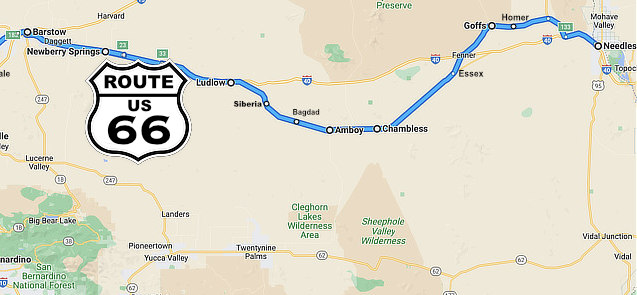
In the Mojave region, these gateways serve as control points for travel. Cajon Pass provides the principal crossing between the Los Angeles Basin and the Mojave Desert. Tehachapi Pass links the desert with California’s Central Valley. The Colorado River crossing near Needles and Topock serves as the primary gateway between California and Arizona. Junctions such as Mojave and Barstow exist where multiple corridors meet, while places like Daggett serve as hinge points connecting Southern California with Southern Nevada.

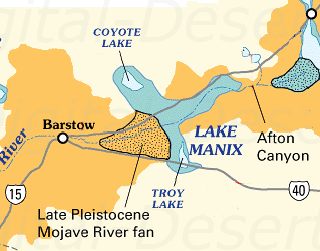
Other gateways reflect local geographic realities. The Mojave River corridor offers a rare linear water route through the desert, influencing both early travel and later settlement. The eastern Mojave basin corridor—stretching through Cadiz and Fenner—provides a broad, relatively level path across the desert interior. In the north, Owens Valley forms a long north–south corridor along the eastern flank of the Sierra Nevada. Mining districts around Death Valley created additional gateways where mineral railroads connected isolated basins to the main transportation network.

Across time, different transportation technologies reused these same pathways. Indigenous trails first established practical routes between water sources and passes. Wagon roads and stage routes later formalized these corridors. Railroads engineered permanent alignments through the same gateways, concentrating activity at junction towns such as Mojave, Barstow, and Needles. In the twentieth century, highways often paralleled these earlier routes, following the same geographic logic through the desert.

Understanding these gateways helps explain why towns, rail yards, and highways appear where they do. They are not accidental settlements but the result of long-standing corridors shaped by geography. Once these gateways are recognized, the transportation history of the Mojave Desert becomes easier to interpret: most routes are simply different eras of travel passing through the same landscape constraints.

Ecology of Wilsona Gardens in the Western Mojave Desert

Report date: February 28, 2026

Executive summary

Wilsona Gardens is a small unincorporated community in northeastern Los Angeles County within the Antelope Valley on the western edge of the Mojave Desert. Best-available public gazetteer-style coordinates cluster tightly around 34.6678° N, 117.8256° W, with elevation reported around 2,560–2,570 ft (≈780–783 m), but these values should be treated as an approximate centroid rather than a surveyed boundary point. 

The regional climate is strongly arid to semi-arid “high desert,” with cool winters, hot summers, and precipitation concentrated in the cool season. Using 1991–2020 climate normals for nearby Lancaster (William J. Fox Airfield) as a defensible proxy for Wilsona Gardens, mean monthly temperatures range from ~45°F in January to ~82°F in July; annual precipitation normals total ~6.81 inches (173 mm), with ~83% of the annual total falling from November–March. 

Vegetation in and around Wilsona Gardens sits at the ecotone between Joshua tree woodland and creosote bush scrub, with additional patch types tied to soil/landform variation: sandy to loamy alluvial fans and washes (supporting creosote and episodic annual wildflowers), granitic pediments/hills (shrub-dominated with sparse cover), and small disturbed parcels/roads that disproportionately favor invasive annual grasses. Nearby Saddleback Butte State Park was established specifically to preserve a Joshua tree woodland in this landscape context, underscoring the local ecological importance and sensitivity of that community. 

Key ecological drivers are (i) limited and highly variable water supply (winter storms plus occasional convective summer precipitation), (ii) substrate/soil controls on rooting depth and water holding capacity, (iii) disturbance regimes—especially the modern invasive-grass/fine-fuel pathway that enables uncharacteristic fire in desert shrublands/woodlands, and (iv) expanding land use pressures (parcel development, roads, off-highway vehicle activity, and utility/renewable-energy corridors at a regional scale). 

Conservation-relevant species in the broader western Mojave context include the federally threatened Mojave population of the desert tortoise and the state-threatened Mohave ground squirrel; both are sensitive to habitat fragmentation, road mortality, and disturbance. State policy attention is also high for western Joshua tree via the Western Joshua Tree Conservation Act (WJTCA, enacted July 2023), which governs take and permitting. 

Geographic setting and administrative boundaries

Assumed place target. This report follows your instruction to treat “Wilsona Gardens” as the community in the Lancaster/High Vista portion of ZIP 93535, rather than similarly named entities elsewhere. 

Best-available coordinates and elevation (centroid-style). Multiple independent gazetteer-like sources converge on essentially the same point location:

  • Coordinate estimate: 34.6678° N, −117.8256° W (decimal degrees) 
  • Elevation estimate: ~2,560–2,570 ft (≈780–783 m) 

Because these sources behave as “place point” representations (not surveyed boundary vertices), they should be interpreted as an approximate community center suitable for landscape-scale ecological context, not a legal boundary for entitlement, permitting, or parcel decisions. 

County and unincorporated status. Los Angeles County contains extensive unincorporated territory governed by the County Board of Supervisors (functionally acting as municipal government for unincorporated areas).  A compiled list of unincorporated areas places Wilsona Gardens in Supervisorial District 5 in at least one published local-government reference document. 

Relationship to nearby named places and map frameworks. Wilsona Gardens is mapped in the vicinity of Hi Vista and is referenced as appearing on the “Hi Vista” USGS topo quadrangle in at least one place-profile source.  These cartographic associations reinforce the appropriateness of analyzing Wilsona Gardens as part of the western Mojave high-desert mosaic rather than the urban Lancaster basin proper. 

5 km buffer polygon (for ecological analysis when administrative boundaries are uncertain). Because an authoritative polygon boundary for “Wilsona Gardens” was not retrieved from a primary boundary dataset within the constraints of the sources accessed here, the remainder of this report treats a 5 km radius buffer around the coordinate above as the analysis area of interest (AOI). This is an ecological—not administrative—boundary selection.

  • Center (WGS84): (−117.82562, 34.66777) 
  • Buffer radius: 5,000 m
  • Approximate geodesic polygon (WKT; 17-vertex approximation):

POLYGON ((-117.825620 34.712736, -117.805129 34.709460, -117.787627 34.700110, -117.775115 34.686059, -117.769071 34.669837, -117.770117 34.653243, -117.778120 34.638039, -117.792188 34.626827, -117.810667 34.620090, -117.831390 34.618041, -117.852035 34.620584, -117.870518 34.627320, -117.884586 34.638532, -117.892589 34.653736, -117.893635 34.670330, -117.887591 34.686552, -117.875079 34.700603, -117.825620 34.712736))

(Construction method: geodesic forward calculation on a spherical Earth approximation with evenly spaced bearings; intended for communication and reproducibility, not cadastral work.)

Regional physical environment

Physiographic context. Wilsona Gardens lies on the western margin of the Mojave Desert where broad alluvial plains are punctuated by granite buttes and pediments; a nearby reference point is Saddleback Butte, described as a granite mountaintop rising ~1,000 ft above surrounding alluvial plains and reaching 3,651 ft elevation.  This terrain creates strong local gradients in exposure, soil depth, and runoff concentration, which drive patchy vegetation patterns despite the region’s overall aridity. 

Climate normals (1991–2020) and proxy selection. Station-based 30-year climate normals are the official U.S. reference for “typical” climate conditions and are produced by NOAA National Centers for Environmental Information.  For Wilsona Gardens, a practical and transparent approach is to use the nearest long-record station normals that represent the same high-desert air mass and elevation band; LA County compilations report 1991–2020 normals for Lancaster (William J. Fox Airfield) and show close agreement with other regional references. 

Temperature regime (1991–2020 normals). Monthly mean temperatures for Lancaster (Fox Field) are ~45°F (Jan), 48°F (Feb), 54°F (Mar), 59°F (Apr), 68°F (May), 76°F (Jun), 82°F (Jul), 81°F (Aug), 74°F (Sep), 63°F (Oct), 51°F (Nov), and 44°F (Dec), with annual mean ~62°F. Average monthly maximums peak near ~98°F in July–August, while average monthly minimums fall to ~30°F in December–January, consistent with strong radiational cooling in dry air and open terrain. 

Precipitation seasonality (1991–2020 normals). Normal annual precipitation for the Lancaster (Fox Field) station is 6.81 inches (July–June “rainfall season” framing), with monthly normals strongly weighted to winter: Dec–Feb alone sum to ~4.33 inches (≈64% of annual), and Nov–Mar sum to ~5.66 inches (≈83%). Summer precipitation is typically minimal (e.g., Aug normal ~0.01 in). This seasonality structures the timing and intensity of primary productivity pulses (germination, herbaceous growth, flowering) and constrains perennial recruitment opportunities. 

Landforms and soils

Dominant landforms in the 5 km AOI. The key landform template in this sector of the western Mojave is a set of alluvial plains and fans shed from granitic uplands and buttes, plus local washes that convey episodic runoff. Saddleback Butte is explicitly described as a granite feature towering above broad alluvial plains, implying extensive fan and bajada development around nearby uplands.  A representative drainage element of this landscape is the region’s washes (ephemeral channels); “Big Rock Wash” is mapped nearby as a GNIS-class feature, illustrating the local importance of episodic flowpaths and shallow alluvial deposition in an otherwise dry matrix. 

Why soil series matter ecologically. In arid ecosystems, soil depth to restrictive layers (bedrock, petrocalcic horizons), texture (sand vs loam vs clay), and carbonate content strongly govern (i) infiltration versus runoff, (ii) soil-moisture residence time after storms, (iii) rooting depth for shrubs/trees, and (iv) germination windows for annual wildflowers. NRCS Official Soil Series Descriptions (OSDs) provide standardized, primary descriptions of these properties and the landscape positions where each series occurs. 

Likely soil/landform assemblage near Wilsona Gardens (series-level). A fully authoritative soil-map-unit attribution typically requires an AOI query in NRCS Web Soil Survey; the sources accessed here do not include an AOI-specific map output for the Wilsona Gardens centroid.  Nevertheless, several OSD soil series are explicitly defined for Mojave Desert settings matching the local landforms and elevations, and they plausibly bracket the range of soil conditions expected within a 5 km AOI:

  • Hi Vista series: moderately deep to rock; formed in granitic residuum on hills and rock pediments; mean annual precipitation ~5 inches; vegetation described as native desert shrubs. 
  • Rosamond series: deep, well-drained, fine-loamy soils on lower margins of alluvial fans between sloping fans and playas; mean annual precipitation ~5 inches. 
  • Hesperia series: very deep, well-drained soils on alluvial fans, valley plains, and stream terraces; formed in granitic alluvium; native vegetation includes creosote bush in the high desert. 
  • Lucerne series: arid alluvial fans/terraces in the Mojave Desert; vegetation includes Utah juniper, scattered Joshua tree, annual grasses/forbs, and perennial grasses, indicating a slightly higher-elevation or cooler/moister microclimate subset within the desert fan system. 
  • Popson series: broad alluvial fans/flood plains in the arid Mojave; mean annual precipitation ~4–5 inches; associated with other fan soils including Hesperia and Rosamond, and explicitly described at elevations ~2,300–2,550 ft—very close to the Wilsona Gardens elevation estimates. 

Soils and landforms comparison table

Soil series (NRCS OSD)Typical landform positionKey physical traits (ecologically relevant)Likely vegetation signal in OSDRelevance to Wilsona Gardens AOI
Hi VistaHills and granitic rock pedimentsModerately deep to bedrock; residuum from granitic rock; slopes 2–50% Native desert shrubs Represents shallow-soil/upland edges and pediment patches likely present near local buttes 
RosamondLower margins of alluvial fans near playasDeep, fine-loamy, calcareous; low slopes (0–2%) Desert range (typical pedon context) Represents fan-to-basin transition soils that can support creosote scrub and annual forbs on flats 
HesperiaAlluvial fans, valley plains, stream terracesVery deep; coarse-loamy; moderately rapid permeability; semiarid to arid setting Creosote bush and sparse annuals in high desert settings Strong candidate for the dominant “developable” fan surfaces around a community centroid 
LucerneAlluvial fans, fan terraces, terracesArid; moderately rapid permeability; elevations 2,900–4,800 ft (series range) Utah juniper, scattered Joshua tree, annuals, perennial grasses Brackets cooler/moister micro-sites and higher nearby fan/terrace positions; useful for understanding woodland/grassland patches 
PopsonBroad alluvial fans and flood plainsArid; mean annual precip 4–5 in; elevations 2,300–2,550 ft (series range) Fan soils, associated with Hesperia/Rosamond and Mojave settings Elevation match suggests Popson-like fan soils may occur near the AOI core 

Vegetation and plant communities

Regional vegetation frame. The nearby Saddleback Butte State Park description explicitly frames the local ecosystem as “high-desert Joshua tree woodland” with a “Joshua Tree/Creosote habitat,” and notes that springtime wildflower displays vary strongly by year—an ecological signature of precipitation-driven annual pulses on desert soils.  NRCS OSDs for adjacent Mojave soil series independently point to creosote dominance on many fan soils and to Joshua tree presence on certain fan/terrace or woodland-inclined soils (e.g., Lucerne). 

Interpreting “percent cover” at two scales. Because a site-specific vegetation survey for Wilsona Gardens (plots/transects) is not included in the accessed primary sources, the report distinguishes between:
(1) Landscape composition (percent of AOI area in broad community types), estimated analytically from landform/soil drivers and verified qualitatively by the documented presence of Joshua tree woodland and creosote habitats in the immediate regional matrix; and
(2) Within-community vegetative cover (e.g., shrub canopy cover), which is not directly estimated here beyond relative structure descriptors due to lack of plot-based measurements in primary sources. 

Dominant plant communities expected in the 5 km AOI (with explicit uncertainty). The following landscape composition is presented as a best-estimate range consistent with (i) the explicit Joshua tree woodland/creosote habitat descriptions for the nearest preserved area, (ii) soil-series vegetation hints in NRCS OSDs, and (iii) the strong alluvial-fan template of the western Mojave edge:

  • Creosote bush scrub (Larrea tridentata-dominated)~45–70% of AOI area (highest on broad, low-slope fan surfaces with deep alluvium such as Hesperia/Popson-like settings). 
  • Joshua tree woodland / Joshua tree–creosote ecotone~15–35% (concentrated on slightly higher, cooler terrace/fan positions and near granitic uplands; reinforced by the park established to preserve Joshua tree woodland and by OSDs acknowledging Joshua presence in Mojave fan/terrace soils). 
  • Mojave desert grassland elements (native perennial bunchgrasses and forbs in shrub interspaces, plus increased annual cover in wet years): ~5–15% as discrete patches or functional components within shrubs/woodland, particularly where soil texture and disturbance history permit grass persistence. 
  • Annual wildflower fields / ephemeral herbaceous flats~2–10% as event-driven, precipitation-dependent expression on favorable soils (notably fan flats and disturbed or sandy microsites), with strong interannual variability. 
  • Disturbed/developed parcels, roads, and altered ground~3–15%, depending on how intensively the 5 km AOI intersects parcel grids and graded surfaces; these areas are ecologically important because they can amplify invasive annual grass establishment and fuel continuity. 

Plant community comparison table

Community typeDiagnostic setting in AOIDominant/indicator plants (representative, not exhaustive)Estimated AOI area sharePrimary ecological controls and uncertainties
Joshua tree woodland / Joshua tree–creosote ecotoneHigher or cooler fan/terrace positions; near granitic uplands and protected woodland remnantsJoshua tree with creosote in ecotone; woodland emphasis locally documented15–35% (range) Controlled by elevation/microclimate, soil depth/texture, and fire history; quantification is uncertain without mapped vegetation polygons or field plots 
Creosote bush scrubBroad alluvial fans/valley plains; deep granitic alluvium soilsCreosote bush indicated as native vegetation on high desert fan soils45–70% (range) Water limitation and soil moisture storage dominate; disturbance can shift understory toward invasives 
Mojave desert grassland functional componentInterspaces on suitable fan/terrace soils; some higher terrace positionsPerennial grasses and forbs noted in Mojave terrace soils; can form important interspace fuels if invaded by annual bromes5–15% (range) Sensitive to grazing/disturbance and invasive annual grasses; hard to map as discrete “patches” without field data 
Annual wildflower fields / ephemeral herbaceous expressionFavorable flats and sandy microsites in wet years; spring-bloom responseWildflower display explicitly noted as variable; driven by winter precipitation pulses2–10% (event-driven) High interannual variability; expression depends on timing and magnitude of winter precipitation and temperature windows 
Disturbed/developed groundParcel grids, graded pads, road shoulders, OHV-impacted surfacesOften dominated by nonnative annual grasses (e.g., bromes) and ruderal forbs3–15% (range) Disproportionate ecological leverage via invasive grass establishment and fuel continuity; actual extent is boundary/AOI dependent 

Fauna and ecological indicators

Evidence base and approach. Site-specific species inventories for Wilsona Gardens were not present in the accessed primary sources, so this section prioritizes (i) wildlife explicitly reported for the nearest formally managed reference area (Saddleback Butte State Park), and (ii) conservation-status species whose documented ranges include the western Mojave and Los Angeles County portions of that region. 

Representative fauna with conservation and indicator value.

  • Desert tortoise (Mojave population): Listed as threatened under the U.S. Endangered Species Act (final rule dated April 2, 1990), with threats centered on habitat degradation, fragmentation, disease, and human-caused mortality (including roads and off-highway vehicle impacts). Federal and USGS sources describe the tortoise as an indicator or umbrella species for the ecosystems it occupies, making its habitat needs a useful proxy for overall desert ecosystem integrity. 
  • Kit fox: Reported as part of the wildlife assemblage at Saddleback Butte State Park; functionally, kit fox presence signals relatively intact desert food webs and prey bases, but local occupancy is sensitive to road density and development pressures. 
  • Mountain bluebird: Reported at Saddleback Butte State Park; as an open-country insectivore, it reflects seasonal insect availability and habitat openness typical of desert woodland/scrub edges. 
  • Mohave ground squirrel: Listed as threatened under the California Endangered Species Act and described by state sources as endemic to the western Mojave Desert; the species is explicitly associated with desert scrub communities and Joshua tree woodlands, and CDFW emphasizes renewable energy development pressures as a risk factor. Federal review history documents substantial attention to development-related threats even when federal listing was found not warranted at that time. 

Invertebrates (functional role rather than site list). In this ecosystem, the spring annual wildflower pulse implies episodic but high ecological importance for native pollinators and other invertebrates, because short-lived flowering events are synchronized with winter precipitation availability and temperature windows. The strong precipitation seasonality and variable spring wildflower displays described for the local reference area provide the core support for this inference, even though a Wilsona Gardens-specific insect inventory is not sourced here. 

Ecological drivers, threats, and conservation context

Water limitation and pulse dynamics. The defining driver is water: annual precipitation is low and concentrated in winter months, producing discrete germination and productivity pulses rather than continuous growth. In the Lancaster-area normals used here, >75% of annual precipitation falls Dec–Mar and ~94% falls Oct–Apr, which tightly constrains recruitment opportunities for long-lived perennials and governs when annual wildflower “events” can occur. 

Fire regime transformation via invasive annual grasses. Desert shrublands and Joshua tree woodlands are not structured for frequent fire, yet multiple authoritative sources document how invasive annual grasses increase fine-fuel continuity and drive a grass–fire feedback:

  • USGS describes cheatgrass-driven expansion and the positive feedback loop where earlier curing fuels fires and promotes post-fire invasive spread. 
  • BLM similarly emphasizes that invasive annual grasses create continuous fine fuels, enabling uncharacteristic fire behavior at large scales and leaving native communities more vulnerable to reinvasion. 
  • USFS fire-effects syntheses report that in the Mojave Desert, red brome codominance (often with Schismus spp.) can allow extensive and rapid fire spread; the western Mojave is explicitly included in the experimental-fire data summarized. 

For Wilsona Gardens, the ecological implication is that disturbed surfaces (roadsides, graded pads, firebreak edges) can act as invasion “seedbeds,” converting originally discontinuous desert fuels into a connected matrix capable of carrying fire through shrub and woodland patches. 

Land use pressure and fragmentation. Regional conservation analyses for focal species identify a consistent suite of pressure pathways—urban/rural development, renewable energy buildout, road networks, and off-highway vehicle activity—each of which elevates direct mortality risk and fragments habitat. These exact stressors are cited in desert tortoise conservation analyses and in both state and federal discussions of Mohave ground squirrel risk context. 

Species- and habitat-specific conservation frameworks. Three governance signals are especially relevant for Wilsona Gardens’ ecological management context:

  • Western Joshua Tree Conservation Act (WJTCA): Enacted July 2023, governs take and permitting of western Joshua trees in California and allows permit pathways and potential local delegation under defined conditions. 
  • Desert tortoise (Mojave population) ESA status: Federally threatened listing (final rule April 2, 1990) with critical habitat and recovery planning history, making habitat disturbance and fragmentation a high-stakes consideration in the broader region. 
  • Mohave ground squirrel CESA status: State-threatened status and a dedicated conservation strategy framework, with explicit attention to renewable energy development pressures in the western Mojave. 

Light pollution and dark-sky policy tools (evidence-limited for AOI membership). Los Angeles County planning open-data services include a “Rural Outdoor Lighting District (Dark Skies)” layer, evidencing that the County uses zoning/planning instruments to manage outdoor lighting in at least some unincorporated areas. Whether Wilsona Gardens falls inside that district boundary was not determined from the sources accessed here, so this is treated as an available management lever rather than a confirmed local condition. 

Threats comparison table

ThreatMechanismEvidence baseExpected severity in Wilsona Gardens AOIEcological consequences
Invasive annual grasses (e.g., bromes)Increase fine-fuel continuity; outcompete natives; post-fire dominanceUSGS cheatgrass fire feedback; BLM invasive fuels; USFS red brome fire spread data including western MojaveHigh where disturbance/roads provide establishment nichesHigher probability of uncharacteristic fire; reduced shrub/woodland recovery potential; altered nutrient/water competition 
Fire (uncharacteristic frequency/intensity)Fueled by invasives; may kill fire-intolerant woody perennialsSame sources; local Joshua tree woodland value emphasized by protected area mandateIncreasing risk, especially after wet years that grow annual biomassConversion of shrub/woodland mosaics toward annual grasslands; loss of Joshua tree recruitment niches 
Habitat fragmentation (parcels/roads)Breaks contiguous habitat; increases mortality; facilitates invasivesDesert tortoise threats include habitat loss/degradation and road/OHV impacts; Mohave ground squirrel risk context includes developmentModerate to high depending on parcel density and nearby route networksReduced movement corridors; increased predator subsidies; invasive corridors via road shoulders 
OHV disturbance (regional pathway)Direct mortality; soil crust disturbance; spread of invasive seedsListed among tortoise threat drivers; regional management focus in conservation programsPotentially high if unmanaged routes concentrate near habitatsSoil destabilization, invasive spread, wildlife disturbance, tortoise mortality risk 
Climate warming and aridification trendsShifts suitability and recruitment windows; amplifies drought stressJoshua tree protection is explicitly framed as climate-relevant state policyLong-term, high consequence; interacts with fire and developmentReduced recruitment, increased mortality during drought; altered phenology of annual pulses 

Stewardship and management recommendations

Management goal framing (site-scale, AOI-scale). The most defensible objective for Wilsona Gardens is to maintain (or restore where degraded) the structural mosaic of Joshua tree–creosote ecotone, creosote scrub, and wash/fan microhabitats while preventing the disturbance-to-invasive-to-fire pathway from converting that mosaic into an annual-grass fuel bed. This goal is consistent with (i) the protected-area rationale for securing Joshua tree woodland nearby, (ii) the invasive annual grass/fire feedback described by federal land-management and science agencies, and (iii) the conservation requirements implied by sensitive species frameworks in the western Mojave. 

Invasive grass prevention as the top near-term intervention.
Prioritize prevention, early detection, and rapid response for invasive annual grasses along disturbance vectors (roadsides, graded pads, utility easements). The rationale is that invasive annual grasses can cure early and create continuous fine fuels that carry fire across landscapes otherwise too discontinuous to burn extensively.  Practical, site-scale tactics include: limiting new soil disturbance, requiring weed-free fill/materials, staging equipment on already disturbed ground, and suppressing invasive seed set in targeted strips before peak curing. 

Fire risk reduction tailored to desert ecology.
Because desert shrublands/woodlands can be highly vulnerable to fire once invasive fuels connect patches, prioritize fuel continuity interruption rather than broad brush removal. Use narrow, strategically placed breaks on already disturbed alignments (roads, parcel edges) and manage fine fuels (annual grasses) rather than removing native shrubs that stabilize soils and provide habitat. This is consistent with the Mojave-specific observation that annual grass codominance can enable rapid fire spread in desert systems. 

Joshua tree governance compliance and conservation design.
Any action involving western Joshua trees should be planned under WJTCA permitting logic (including incidental take pathways and mitigation/fee options where applicable). A conservative stewardship posture is to treat Joshua trees on-site as protected biological assets and to design development footprints and access routes to avoid impacts, consistent with the statute’s take prohibitions unless authorized. 

Habitat-friendly parcel and roadway practices.
Where development is occurring or planned, prioritize clustered footprints, minimized new road cuts, and dark-sky compatible lighting where feasible, using the County’s demonstrated availability of outdoor lighting district tools as a policy model even if AOI inclusion is uncertain. Fragmentation pathways are repeatedly identified as core threats to sensitive desert fauna, particularly for the desert tortoise and for regionally endemic species like Mohave ground squirrel. 

Wildlife-sensitive operations and education.
In areas likely to support high-value species habitat (especially broadly suitable desert scrub and Joshua woodland), reduce night driving on unpaved roads, limit free-roaming pets, and prioritize signage/education around sensitive species and invasive-seed hygiene. These measures align with the human-mortality and habitat-degradation pathways documented for desert tortoise and emphasized in western Mojave conservation initiatives. 

Seasonal ecological pulse model (Mermaid)

The following conceptual pulse timeline links the observed climate seasonality (winter-dominant precipitation, hot dry summers) to predictable ecological responses in Mojave scrub/woodland systems. 

flowchart TB

A[Oct–Apr: Storm season dominates annual precipitation] –>
B[Soil moisture recharge on fans, washes, shallow soils] B –>
C[Nov–Feb: Germination window opens for annuals in wet years] C –>
D[Feb–Apr: Peak flowering pulse (wildflowers vary strongly by year)] D –>
E[Mar–May: Seed set and seedbank replenishment] E –>
F[May–Jun: Rapid drying; annual senescence] F –>
G[Jun–Sep: Hot/dry summer; drought stress; low primary productivity] G –> H[Late summer: occasional convective storms (usually minor totals)] H –> I[Patchy late-season germination possible; generally limited] I –>
A F –>
J[If invasive annual grasses present: continuous fine fuels] J –>
K[Higher probability of uncharacteristic wildfire spread] K –>
L[Post-fire: invasive grass dominance risk increases] L –>
J

Corridor Archaeology

Between here and there

“Corridor archaeology” is an approach to archaeology that treats a route—and the landscape people moved through along it—as the primary unit of study, rather than focusing solely on a single site (a village, a mine, a camp, a ruin).

Instead of asking “What happened at this one place?”, it asks questions like: How did movement happen here over time? Where were the dependable resources (water, forage, stone, shelter) that structured travel? What were the choke points, forks, and bottlenecks? How did different eras reuse, overwrite, or abandon earlier paths?

Core idea. A corridor is a strip or network through the landscape (a river valley, pass, canyon, shoreline, ridge, or desert trail system) that concentrates movement. Corridor archaeology examines the material traces of that movement—both the “hard” evidence (artifacts, features, datable deposits) and the “soft” patterning (spacing, visibility, access, risk, seasonality).

What it typically studies (common evidence types).

  1. Route traces and wayfinding: trail braids, wagon ruts, cairns, cutbanks, switchbacks, “shortcuts” that grow into new alignments.
  2. Water and provisioning nodes: springs, seeps, tinajas, wells, river crossings, camps near dependable water, and the scatter patterns that form around them.
  3. Task- and stop-related features: hearths, rock alignments, windbreaks, temporary corrals, caches, packet scatters, repair debris.
  4. Artifact distributions: lithic scatters, ceramics, metal, glass, can dumps, horseshoe nails—often more informative as spatial patterns than as isolated finds.
  5. Overlapping time layers: Indigenous travel corridors, later trade routes, wagon roads, rail grades, highways—each leaving different signatures but often occupying the same logic of terrain.

How it differs from “site archaeology.” Traditional site work tends to privilege bounded places and discrete occupations. Corridor archaeology is comfortable with “low-density” archaeology: long, thin, messy distributions that don’t look like a classic site boundary, but still carry strong information when mapped and analyzed as a system.

Typical methods (the toolkit).

  • Transect survey and systematic recording along a corridor width (not just a line).
  • GIS / spatial statistics: least-cost path modeling, viewsheds, catchments to water, slope/aspect risk, node spacing.
  • Geoarchaeology: figuring out whether deposits were buried, eroded, reworked, or deflated—critical in deserts and river corridors.
  • Chronology building across nodes: relative dating from artifact typologies + targeted absolute dating where feasible.
  • Network thinking: nodes (stops), links (segments), and changing “friction” (terrain difficulty, security, policy, technology).

Why it matters. Corridors are where daily life happens at scale: travel, trade, seasonal rounds, herding, migration, mail routes, military movement, tourism. If you only study the famous “dots on the map,” you miss the connective tissue that explains why those dots exist where they do.

That Looks Good

Desert photography starts out as a simple urge: “That looks good—take a picture.” If it stays there, it can go stale, because the camera becomes a souvenir machine and nothing more. But if you pull the pieces together—purpose, learning, editing, and display—it becomes something older and steadier: a craft that turns attention into knowledge, and knowledge into a record you can live with, share, and pass along.

The first part is purpose, because it keeps the work from turning into an endless string of casual snaps. In the desert, purpose can be as plain as an assignment. “Follow the wash and photograph what changes.” “Track an old route and record the artifacts.” “Show a plant community, not a single plant.” “Make a sequence that explains a place, not just a postcard.” When you have an assignment, you stop hunting for random pretty scenes and start asking the kind of questions that lead to better photographs: What is the subject? What is it doing here? What does the light reveal? What is the story the landscape is telling?

That’s what purpose does: it forces you to look longer. And in the desert, looking longer is the whole game. The desert isn’t loud the way a city is loud; it’s legible. A dry fan tells you where water used to run. A wash shows you how recent storms rearranged the ground. Desert varnish and pavement show the passage of time. A line of cottonwoods or reeds tells you where water persists even when everything else says “no.” Old grades, culverts, pole lines, and broken pavement show how people tried to solve the desert’s problems—water, distance, and heat—using the tools of their era. When your photography has purpose, you start photographing these clues on purpose. That’s the moment the camera stops being a mirror and starts being a notebook.

The second part is learning, because desert photographs can be more than attractive; they can be evidence. If you want your images to teach you something later—and teach other people something too—you need a simple discipline: shoot identifiers, not just beauty. For plants, that means the flower (if present), the leaves, the overall form, and the habitat context. For geology, it means a close-up texture shot, a mid shot showing where the rock sits, and a wide establishing shot showing the landform. For historic sites, this means details of construction, a sign or marker (if one exists), and the relationship to the landscape (because the landscape explains why the site is there). Add one shot that gives scale. It can be as simple as your boot near a track, a coin next to a fossil fragment (where legal and ethical), or a hand near a tool mark—anything that anchors size.

That method sounds almost dull, but it’s the opposite. It’s how you build a personal archive that gets more valuable with time. Later, when you want to confirm an ID, write an article, or compare changes across seasons, you have what you need. You’re not guessing. You’re working from proof.

The third part is technique, and in desert work, technique is mostly about light, distance, and protection. Desert light is brutally honest. Midday sun flattens color, blows highlights, and makes the scene look harsher than it felt. Early and late light—side-light especially—reveals texture and makes the land readable. Overcast, though rarer in the desert, is excellent for plants and details because it reduces contrast and preserves color. After rain is its own gift: clearer air, richer tones, and sometimes standing water or damp sand that photographs like velvet. Distance is the next factor: heat shimmer can ruin long telephoto shots across a flat basin in the middle of the day, and wind can turn a gentle tripod setup into a vibrating mess. Protection is the constant: dust, grit, and sun don’t care what brand of camera you brought. The desert is hard on gear and harder on complacency.

But technique isn’t only about settings. It’s about how you choose to see. A phone can make fine desert photographs if you treat it like a camera and not a distraction. A “serious” camera gives you more control and consistency, but it doesn’t give you purpose. Purpose is earned.

The fourth part is editing, because editing is where your photographs become cohesive. Editing isn’t just “making it prettier.” It’s where you declare what you’re loyal to. Are you loyal to realism—making it look like it felt? Are you loyal to form—graphic lines and hard light? Are you loyal to color—subtle separation of tans, blues, and varnish-black? Are you loyal to the story—an image that serves a sequence more than it serves itself? Once you know your loyalty, the sliders stop being a casino and start being tools.

A good way to think about editing is in terms of “mode and style.” Mode is the job. Style is the repeated set of choices. Documentary realism is a solid mode for desert work because it respects the place. You protect highlights, keep color believable, lift shadows without flattening, and use sharpening with restraint so rocks look like rock rather than crunchy digital grit. Classic landscape is another: slightly deeper contrast, careful dodging and burning, and a “printed” look that suits wide scenes. Graphic high-contrast can be powerful too—especially on dunes, volcanic rock, road cuts, and old concrete—where shape and shadow are the story. Film-like or vintage styles can work, but only if you keep them consistent; otherwise, it becomes a costume you put on photos at random.

The most important editing decision is not what you add—it’s what you refuse. Decide your line in the sand. Many desert photographers do better the moment they reject heavy HDR halos, neon saturation, and fake skies. The desert has plenty of drama; you don’t need to manufacture it. Restraint reads as confidence.

The fifth part is display, because display is where the whole thing becomes real. A photograph that lives only on a hard drive is unfinished. Display is also where people get confused, because every output has different needs. A print for the wall is not the same as an image for a phone screen, and neither is the same as an image for publication.

For home display, you’re making something you’ll live with. That calls for calm editing, predictable sizes, and consistency. A single strong piece can anchor a room, but series work—washes, roads, dunes, textures—can turn a wall into a story. A traditional approach helps: standard sizes, consistent frame style, consistent mat color. The goal is for the work to read as a body rather than a pile.

For a gallery, cohesion is everything. A gallery show is not a “best of.” It’s a statement. Limiting sizes, limiting styles, and arranging images as sequences make viewers slow down and follow the logic. Captions matter more than people like to admit in landscape work. One sentence can turn a pretty scene into a scene with meaning: what it is, where it is, and why it matters. Desert photography especially benefits from this because the land is full of clues that most viewers don’t yet know how to read.

For gifts, you’re choosing ease and friendliness. Smaller sizes, a bit more brightness than you’d keep for yourself, and subjects that communicate immediately. A clean Joshua tree silhouette, a classic road fragment, a dramatic ridge line—these are images people can place in their own homes without needing the backstory. You can still include the backstory, but the gift should stand on its own.

For publications, you’re in a world of specifications, accuracy, and reproducibility. You keep color conservative, avoid heavy sharpening, and give editors room for crop and caption. A publication image is as much about clarity as it is about mood. In this setting, your photographs become a form of documentation—proof again—especially when they support a narrative about history, ecology, or place.

When you combine these parts, you can finally answer what it means and what it does.

What it means is that desert photography becomes a form of attention practiced over time. It’s a way of noticing that isn’t casual. You go out with a purpose, you learn what you’re seeing, you refine how you translate it into an image, and you finish it in a form that can be shared. In other words, it becomes a craft rather than a pastime. The desert rewards craft because it’s a place where small differences matter: a slight change in slope tells a water story; a slight change in soil tells a plant story; a slight change in light turns a flat scene into a readable one.

What it does is equally concrete. It builds a personal archive that grows in value over time. It trains your eye to recognize patterns. It gives you a record of places that change—sometimes slowly, sometimes abruptly. It creates material for sharing: a wall series, a booklet, a website page, a classroom talk, a gift that carries a place into someone else’s home. It also has a quiet civic function: photographs can support memory, and memory can support stewardship. When you have images that show how a site looked, where a route ran, what a wash did after a storm, or what a grove of cottonwoods looked like before a dry year, you have evidence. You can argue from something more solid than nostalgia.

There’s also a personal effect that’s easy to underestimate: purpose-driven photography makes desert time feel fuller. A day out stops being “a drive with a few stops” and becomes “a study of a place.” Even if you come home with only a handful of images worth keeping, you still have knowledge.

Selective Memory:

Intro: Selective memory is how a community turns a messy past into a usable public story. It can steady a place—shared symbols, shared pride, shared reference points—but it also sets a price: some details are pushed offstage so the official picture stays clean. The quiet usually falls on the people whose experiences complicate the preferred narrative, especially around land, access, labor, class, and power.

Example (Hilltop House Hill / Bass Hill, Apple Valley): The hilltop landmark became an easy civic emblem—an elevated “lookout” that photographed well and carried founder-era prestige. In that symbolic role, the story tends to emphasize aspiration, identity, and nostalgia. The harder parts—who controls the site, whether access is treated as a public commons or a managed property, how liability and cost are used in public justification, and how competing community visions are labeled as “trouble” versus “heritage”—often get minimized or treated as side issues. The result is unity around the image of the hill, paired with social pressure to mute arguments that would turn the emblem into a debate about rights, stewardship, and whose version of Apple Valley gets to be public.

Why this matters:

It matters because public memory isn’t just a story people tell; it becomes a steering mechanism. Once a place agrees on a “clean” narrative, that narrative starts deciding what gets funded, preserved, demolished, named, fenced, and whose complaints are treated as legitimate versus “noise.” In other words, memory becomes governance.

It also matters because selective memory sets the moral boundaries of belonging. When a community’s identity is built around a few symbols, disagreement about those symbols stops being an ordinary policy argument and turns into a loyalty test. People learn—often quietly—what can be said without social penalty and what must be softened, delayed, or dropped. That is how cohesion is maintained, but it is also how resentment accumulates.

Finally, it matters because the “quiet” never stays quiet forever. Stories that are excluded don’t disappear; they surface later as conflict—at council meetings, in public-comment letters, in lawsuits, in vandalism, in social media feuds, in bitter arguments over access and interpretation. A town that makes room for honest complexity early tends to have steadier institutions and fewer blowups later. A town that relies on silence gets a simpler story in the short run and a higher repair bill in the long run.

Memory as Power

Politics of Memory

History often functions less as a neutral record than as a contested resource. Control over public memory can legitimize the present by presenting current arrangements as noble, inevitable, or simply “how things have always worked.” When a ruling order is framed as the natural endpoint of a long story of sacrifice and necessity, opposition can be cast as unreasonable or even illegitimate.

Collective identity is built the same way. By elevating certain founders, victories, and defining traumas—and sidelining others—institutions help produce a shared sense of “who we are.” That identity work also draws boundaries: who counts as fully belonging, whose experiences matter, and who gets to speak for the group.

Selective history can also dampen dissent. If past injustices, past resistance, or credible alternative systems are minimized or forgotten, the range of imaginable change narrows. This does not require overt censorship; omission, euphemism, ridicule, and sheer imbalance of attention can be enough to tilt public understanding.

Such shaping can unify or divide. Mythologized narratives may cultivate patriotism and cohesion, but they can also alienate communities whose lived experience contradicts the official story. The more a shared myth depends on silence, the more fragile the unity becomes.

Finally, history supplies moral framing. The choice of heroes and villains, the emphasis on certain virtues, and even the vocabulary used (“riot” versus “uprising,” “pacification” versus “massacre”) teach a society what to admire, what to fear, and what to accept as normal.

In short, history is not only about what happened; it is about what becomes remembered, repeated, and institutionalized—and who benefits from that settlement of memory.

A Tiny Carnivore & otherwise Canniblistic Mouse

Sticks & Twigs & Rats & Rabbits

It starts with a sound that doesn’t belong in the night—a sharp, saw-edged scream that makes the desert go still for half a heartbeat. Not a bird, not a rabbit, nor even a grasshopper, not anything you’d expect from something so small. Then it comes skittering out of the shadows: the grasshopper mouse. Cute at a glance, sure—big eyes, soft fur, that tidy little face. But that’s the mask. Under it is a creature that’s too hungry, too carnivorous, and far too pleased with itself.

Grasshopper mouse – wikipedia

It moves like it owns the ground. Quick, confident, nose testing the smell like a bloodhound in miniature. Its hunger isn’t the mild, tidy kind. It’s the kind that looks for heat and motion. The type that makes it pause, head cocked, listening for a cricket’s scrape or a scorpion’s faint drag through sand. And when it hears it—when it knows—its whole body tightens like a spring.

Then it strikes. No dithering, no hesitation. It doesn’t “sample” prey; it takes it. A pounce, a bite, and those little jaws go to work with disturbing purpose. In the dark, it’s all business: pin, tear, chew. The desert is full of things that live on seeds and prudence, but this one lives on meat and nerve.

And that scream—lord, that scream. The grasshopper mouse tips its head back like it’s calling the night to order, and it lets loose again, a thin, triumphant howl scaled down to rodent size but carrying the attitude of something ten times larger. It doesn’t sound afraid. It sounds like a declaration. Like it’s telling every crawling thing in the sand: I’m here, and I’m hunting.

Too hungry. Too carnivorous. Too bold. It’s a pocket-sized outlaw of the desert, wearing a baby face and making a living the old-fashioned way—by taking what it wants and daring the world to argue about it.

It moves like it owns the ground. Quick, confident, nose testing the air like a bloodhound in miniature. Its hunger isn’t the mild, tidy kind. It’s the kind that looks for heat and motion. The kind that makes it pause, head cocked, listening for a cricket’s scrape or a scorpion’s faint drag through sand. And when it hears it—when it knows—its whole body tightens like a spring.

Then it strikes. No dithering, no hesitation. It doesn’t “sample” prey; it takes it. A pounce, a bite, and those little jaws go to work with unsettling purpose. In the dark, it’s all business: pin, tear, chew. The desert is full of things that live on seeds and caution, but this one lives on meat and nerve.

And that scream—lord, that scream. The grasshopper mouse tips its head back like it’s calling the night to order, and it lets loose again, a thin, triumphant howl scaled down to rodent size but carrying the attitude of something ten times larger. It doesn’t sound afraid. It sounds like a declaration. Like it’s telling every crawling thing in the sand: I’m here, and I’m hunting.

Too hungry. Too carnivorous. Too bold. It’s a pocket-sized outlaw of the desert, wearing a baby face and making a living the old-fashioned way—by taking what it wants and daring the world to argue about it.

Corridor Identification

A) The Mojave River spine (Colorado River → eastern Mojave springs → Mojave River corridor → Cajon Pass → San Bernardino/LA)

Mojave Indian Trail; Mojave River Trail; Mojave Road; Old Spanish Trail (where it drops into/uses Mojave River and related desert crossings); Beale’s Wagon Road (in its CA desert segment); Brown’s Toll Road (as the Cajon gateway upgrade); plus the generic “Wagon Roads” label when you’re talking about the 19th-century wagonable evolution of the same line.

The idea is simple: reliable water spacing and a workable pass dictated the alignment. The Mohave Trail conceptually underlies the later Mojave Road, and the NPS explicitly treats the Mojave Road through Mojave National Preserve as a branch of the Old Spanish National Historic Trail. Beale’s route description also ties his Mojave Desert segment to the Mojave Trail/Old Spanish Trail network, then notes the junction with the Mormon Road at the Mojave River. Brown’s Toll Road is best understood as “the Cajon Pass switch” that made the desert–coast connection more serviceable (toll/improvement era), not a whole new long-distance corridor by itself.

B) The LA ↔ Salt Lake “southern route” family (good-roads era branding laid over older travel)

Salt Lake Road; Old Spanish Trail (northern route pieces); Arrowhead Trails Highway; and again “Wagon Roads” as the pre-auto baseline.

This is the family that turns into the famous LA–Las Vegas–Salt Lake motor corridor in the auto-trails era. The BLM’s Arrowhead Trails Highway page is blunt about the lineage: the proposed/marketed auto route followed the late-19th-century “Old Mormon Road” and the earlier Old Spanish Trail. The Arrowhead Trail’s “association/branding layer” starts in 1916 (organized/incorporated that year) and is essentially a named-trail wrapper on that corridor.

C) “Good Roads” transcontinental overlays (names that often ride on top of existing roads, then feed into numbered highways)

National Old Trails; Midland Trail; Route 66 (as the numbered successor in the Southwest); and sometimes Arrowhead Trails Highway where it shares pavement with the NOTR in Southern California.

The key point: these aren’t necessarily new alignments end-to-end; they’re promotional/organizational systems that sign and improve what counties and states already had. FHWA and other summaries describe the National Old Trails Road Association as one of the early major named-trail movements (founded 1912). In the West, big stretches of the NOTR were later folded into US 66, which was established/commissioned in 1926 (signing followed). The Midland Trail is another early signed transcontinental auto trail (signed by 1913) that overlaps conceptually with the named-trails era rather than replacing everything on the ground.

D) The Sierra/Eastern Sierra north–south family (LA ↔ Mojave ↔ Owens Valley and beyond)

Sierra Highway / El Camino Sierra.

This one is its own long corridor family, and it intersects the desert east–west systems at junction towns rather than duplicating them. It’s commonly framed as an early 20th-century promoted route (established/advertised early, with later highway rebuilds) connecting Los Angeles into the Eastern Sierra.

E) The Tejon/Tehachapi gateway family (LA Basin ↔ San Joaquin Valley crossings)

Fort Tejon Road; Ridge Route.

Think “northbound exit from the LA Basin” rather than “Mojave crossing.” The Los Angeles–Fort Tejon Road is described as a successful wagon road solution over/near the Tehachapi barrier, completed in 1855. The Ridge Route is the early engineered state highway-era answer (opened 1915) that finally made that link paved and direct in the automobile age.

F) San Bernardino/San Gabriel mountain connectors (coast ↔ mountain communities, not trans-desert corridors)

Rim of the World Drive; Angeles Crest Scenic Drive (Angeles Crest Highway); Van Dusen Road.

These are “mountain access projects” more than “interregional desert crossings.” Rim of the World Drive is documented as opening in 1915 to connect San Bernardino with Big Bear through the range. Angeles Crest Highway construction begins in 1929 and the completed through-route opens much later (mid-20th century). Van Dusen Road sits here as an earlier wagon-road era Big Bear/Holcomb access line tied to the 1860–61 gold rush logistics (often described as a wagon road built in 1861).

G) Death Valley–Panamint access network (mining roads, toll-road tourism era, park-era backroads)

West Side Road (Death Valley); Road to Panamint; Eichbaum’s Toll Road (same as “Eichbaum Toll Road”).

This family is its own ecosystem: borax-era freight roads, mining camp supply lines, then purpose-built access to resorts/tourism. NPS frames the borax era as transport over “primitive roads” (1883–1889). The Eichbaum Toll Road is well-documented as a 1925–26 build from near Darwin to Stovepipe Wells (i.e., a deliberate west-side entry improvement). “Road to Panamint” is best treated as the umbrella for the Panamint Valley/Skidoo/Rhyolite road-pushing phase in the 1906–1907 window and its successors; NPS history material and HAER/other documentation talk explicitly about wagon-road development and the Rhyolite–Skidoo road beginning in 1906 and being in use by 1907. West Side Road is the park backroad line on the valley floor’s west side (modern status aside), squarely in the “Death Valley internal access” bucket.

Heritage Branding

A look out the window

Heritage branding and administrative designations (late name layers)
In the late 20th and 21st centuries, “historic” names often return as interpretive overlays: scenic byways, trail designations, monuments, and NRHP listings. These don’t always match the exact historic alignment, but they do become the public-facing name people repeat. (That’s not “wrong,” it’s just a different layer—commemoration rather than navigation.)

If you want a practical system for understanding Mojave pages, the old-fashioned way works best: treat names like strata. For any road/trail/place page, keep a short “Naming” paragraph that explicitly separates

(1) earliest known/traditional name,
(2) Spanish/Mexican-era name if applicable,
(3) wagon-era name,
(4) auto-trail/highway-era name,
(5) modern heritage/administrative name.

Then, when a reader asks, “Which is correct?” :
“all of them—just not in the same decade, and not for the same user group.”

Look out the window: Mojave naming changes usually aren’t random—they’re the paper trail of who was moving (and why) at a given moment. When feet become wagons, wagons become cars, and cars become heritage tourism, the corridor stays put, but the name on the map keeps changing with the times.