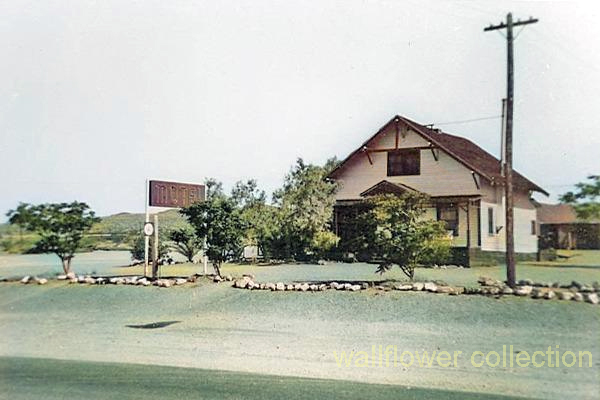
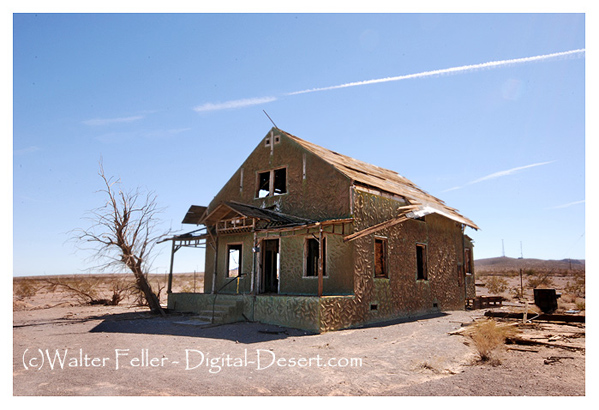
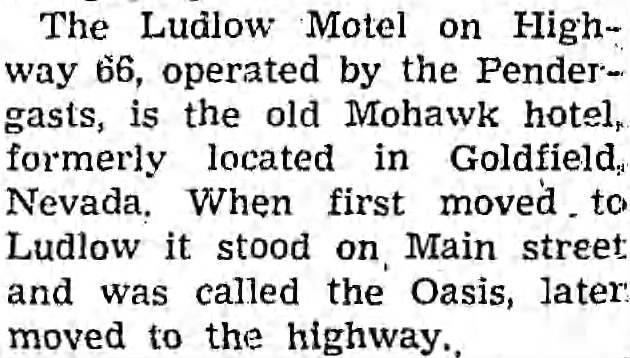
The Pendergast Hotel in Ludlow, California, has a rich history tied to the development of the Mojave Desert and the railroad’s bustling activity.
Early History and Construction: The Pendergast Hotel was established during the late 19th century, likely around the time the Southern Pacific Railroad extended its lines through the Mojave Desert. Ludlow became an important stop along the route, leading to the development of various amenities, including hotels to serve travelers and workers.
Ownership and Operation: The hotel was named after its owner, Edward Pendergast, a prominent figure in the local community. Pendergast was involved in various business ventures and contributed to the growth and development of Ludlow.
Role in the Community: The Pendergast Hotel served as a central hub for the community, providing lodging, meals, and a place for social gatherings. It catered to railroad workers, miners, and travelers passing through the region.
Decline and Historical Significance: As the railroad’s importance diminished and transportation shifted towards automobiles, Ludlow and the Pendergast Hotel experienced a decline. However, the hotel remains a significant part of Ludlow’s history, representing the era of railroad expansion and the development of the Mojave Desert.
Preservation and Legacy: While the hotel no longer operates, it stands as a historical landmark, offering a glimpse into the past and Ludlow’s role in the broader context of the Mojave Desert’s development.
If you are interested in more detailed historical accounts, local archives, and historical societies in the area may provide further insights into the Pendergast Hotel and its impact on the region.
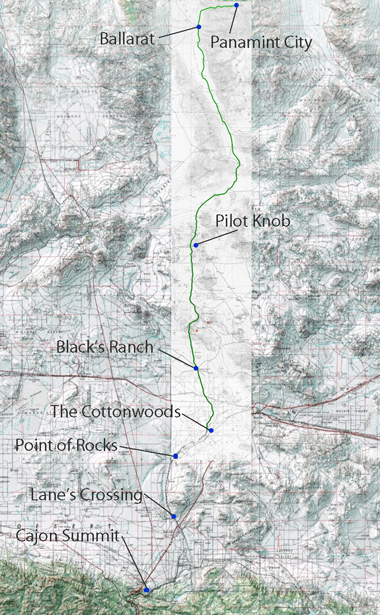
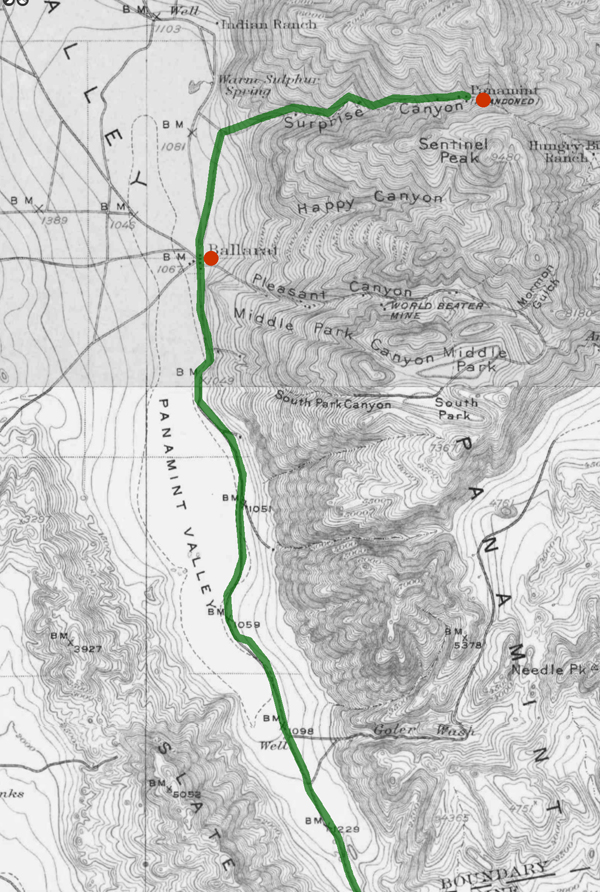
Nestled within the rugged landscapes of Eastern California, the Panamint Valley is home to a historical artery that has played a pivotal role in developing the American West—the road to Panamint. Originally trodden by Native Americans and later transformed by the ambitions of silver miners, this route not only facilitated economic booms but also bore witness to the ebbs and flows of fortune. The road to Panamint is a testament to the region’s mining era, epitomizing the broader transportation infrastructure development crucial for westward expansion.
Historical Background
The Panamint Valley, framed by the arid peaks of the Panamint Range, was first utilized by the Shoshone Native Americans, who traversed these harsh landscapes following seasonal migration patterns and trade routes. The discovery of silver in 1872 marked a turning point for the valley. News of silver attracted droves of prospectors, catalyzing the establishment of mining camps and the nascent stages of the road. This road would soon become the lifeline for a burgeoning settlement, later known as Panamint City.
Development of the Road
The transformation from a series of Native trails to a fully functional road was propelled by the mining industry’s explosive growth. As prospectors and entrepreneurs flooded the area, the demand for a reliable transportation route skyrocketed. The road to Panamint was quickly carved out of the valley’s rugged terrain, facilitating the movement of people and ore. During the mid-1870s, Panamint City blossomed into a boomtown, with the road being crucial for transporting silver ore to markets beyond the valley. However, as the mines depleted and profits dwindled, the road witnessed the departure of those who had come seeking fortune, leaving behind ghost towns and tales of a fleeting era.
Significance in Regional History
Beyond its economic contributions, the road to Panamint played a significant role in shaping the regional history of Eastern California. It facilitated the integration of remote areas into the state’s broader economic and cultural fabric. Moreover, it was a stage for several historical events, including conflicts between Native Americans and settlers and among competing mining companies. The road connected Panamint with the outside world and helped establish transportation routes that would later support the growth of other regional industries and settlements.
Preservation and Legacy
Today, the road to Panamint is a shadow of its former self, yet it remains an integral part of the cultural heritage of the American West. Efforts have been undertaken to preserve its historical significance, recognizing the road as a physical pathway and a historical document inscribed upon the landscape. It is featured in historical tours, providing insights into the challenges and triumphs of those who once traveled its length in pursuit of silver and survival. The preservation of this road allows contemporary visitors and historians alike to traverse the same paths miners once did, offering a tangible connection to the past.
Conclusion
The road to Panamint encapsulates the spirit of an era driven by the quest for precious metals and the relentless push toward the West. Its historical importance remains a key narrative in understanding how transportation helped shape the economic and cultural landscapes of the American West. As we reflect on its legacy, the road to Panamint continues to offer valuable lessons on resilience and the transient nature of human endeavors.
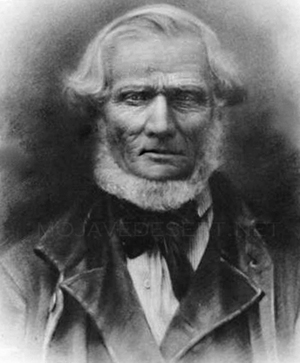
Jefferson Hunt was a significant figure in the history of the American West, particularly in the Mojave Desert. Born in 1803, Hunt was a captain in the Mormon Battalion during the Mexican-American War and later played a crucial role as a pioneer and explorer.
Key Contributions:
Mormon Battalion: As a captain in the Mormon Battalion, Hunt led his men on one of the longest infantry marches in U.S. history, from Council Bluffs, Iowa, to San Diego, California. This journey helped to open up the Southern Route, which passed through the Mojave Desert.
Guide and Explorer: Hunt became a prominent guide and explorer in the Southwest after his military service. He was instrumental in establishing and improving overland trails. His deep knowledge of the terrain and survival skills made him a valuable leader for settlers moving west.
California Legislature: Hunt served as a representative in the first California Legislature from 1850 to 1851. During his term, he advocated for the interests of settlers and worked on development policies that affected the Mojave Desert region.
Settlements and Communities: Jefferson Hunt founded several communities, notably contributing to the Mormon colonization of San Bernardino in California. His efforts helped establish vital supply routes and settlements that facilitated further migration and trade.
Jefferson Hunt’s contributions to the development and exploration of the Mojave Desert are a testament to his leadership and pioneering spirit. His work helped to shape the patterns of settlement and economic growth in the region during a crucial period in American history.
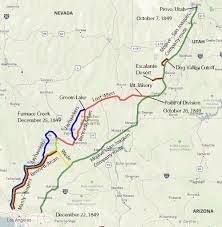
Dec 22, 2021 … Death Valley’s Lost ’49ers. Jefferson Hunt’s Mojave San Joaquin Company, a wagon train made up of anxious gold seekers and settlers frustrated …
On the 11th of June, 1847, accompanied by Captain Jefferson Hunt‘s Mormon Battalion, the Mormons trek for Salt Lake started. They left Council Bluffs, Iowa; …
Captain Jefferson Hunt. Captain in the Mormon Battalion – Led the Mojave/San Joaquin Company (Mojave Sand-walking Company) to Southern California, a portion of …
History: Profiles in Mojave Desert History. William Lewis Manly. The Bennett-Arcane party had split off from Jefferson Hunt’s “Mojave Sand-Walking …
Jefferson Hunt’s Mojave San Joaquin Company, a wagon train made up of … Jefferson Hunt to guide them to Los Angeles over the Old Spanish Trail. At the …
Jefferson Hunt’s Mojave San Joaquin Company, a wagon train made up of anxious gold seekers and settlers frustrated by a late start across the desert in late …
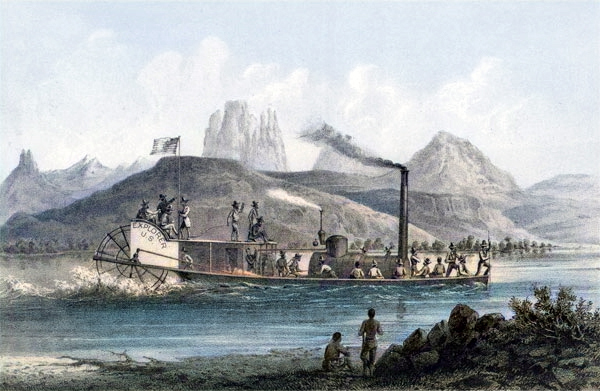
Steamboats on the Colorado River played a significant role in the development of the American West during the 19th and early 20th centuries. They were primarily used for transporting goods and people up and down the river, a critical artery for accessing the remote regions of the Mojave Desert, Arizona, and southern California.
The Era of Steamboats:
Beginnings: Steamboat navigation on the Colorado River began in earnest in the 1850s. The first successful steamboat to navigate the river was the “Uncle Sam” in 1852, which marked the start of steamboat commerce until the early 1900s.
Key Ports: Important ports along the river included Yuma (Arizona Territory), which served as a central distribution point for supplies to military posts in the region, settlements, and mining operations in areas like the Gila River the Mojave Desert and upriver to places like Callville and Rioville in Nevada.
Navigation Challenges: Navigating the Colorado River was notoriously difficult due to its unpredictable water flow, shifting sandbars, and snags. Boats with shallow drafts and powerful engines were necessary to handle these obstacles.
Impact and Decline:
Economic Impact: Steamboats on the Colorado River were crucial for the economy, particularly in supporting mining operations. They transported silver, gold ore, other minerals, and goods and supplies to isolated settlements.
Decline: The arrival of railroads in the late 19th century gradually led to the decline of steamboat traffic on the river. Railroads provided a more reliable and quicker means of transportation and could operate year-round without being affected by the river’s water levels.
The Explorer (colorized)
Legacy:
The steamboats of the Colorado River are an essential part of the history of transportation and commerce in the American Southwest. They contributed to the region’s economic development and helped shape the settlements along the river. Today, they are remembered through historical markers, museum exhibits, and river tours that explore their history.
Steamboats represent a fascinating chapter in the history of the American West, highlighting the adaptability and ingenuity required to tame such a challenging and vital waterway.
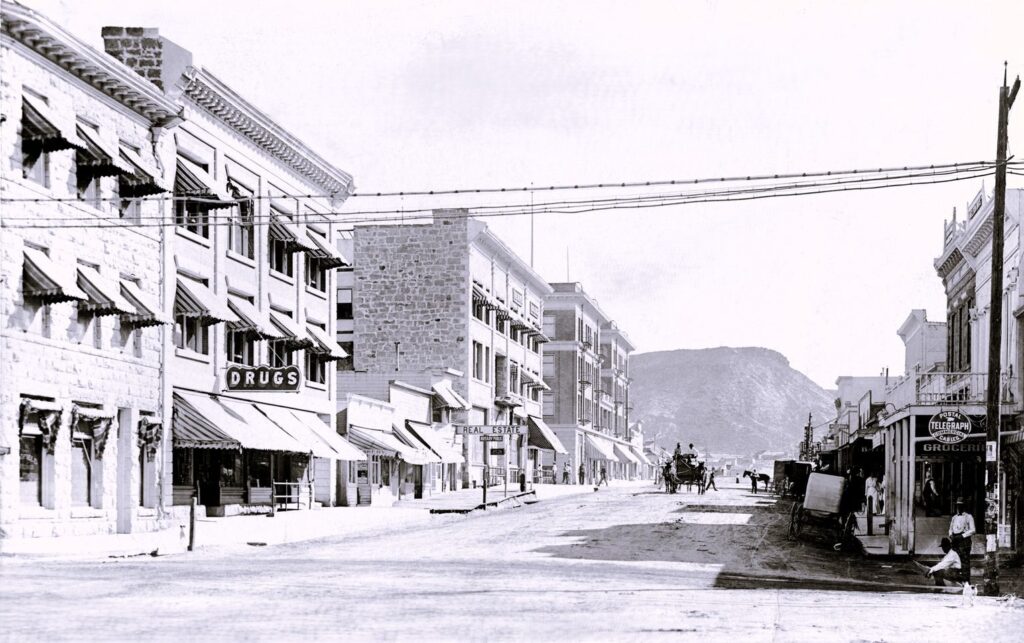
1910 Columbia Street in Goldfield, Nevada. Amidst the dust of mining fortunes, this town thrived as a hub of gold mining activity.
Goldfield, Nevada, was founded in 1902 after gold was discovered in the area. The town quickly grew into one of the largest in Nevada, with a population peaking at around 20,000 during its heyday. Goldfield was established to support the booming mining industry in the region, particularly the gold mines.
The town boasted numerous businesses, including saloons, hotels, banks, and brothels, catering to the needs of miners and prospectors. It became known as the “Queen of the Tonopah Mining District” due to its wealth and prominence in the area.
However, like many mining towns, Goldfield’s fortunes declined after the initial boom. By the 1920s, the population had dwindled, and the town fell into decline. Today, Goldfield is a ghost of it’s former self, with remnants of its past glory still visible today, including historic buildings, mines, and artifacts.
Image courtesy of the University of Nevada, Reno, Special Collections. Nevada Ghost Towns and Historic Sites is in Goldfield, NV.
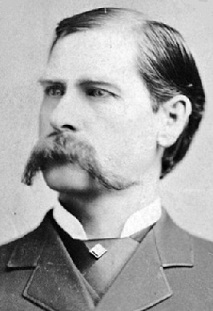
The recent death of Wyatt Earp (Wyatt died January 13, 1929) recalls to mind the part he played in the claim jumping expedition to Searles Lake in October 1910. At the time I was Acting Receiver for the California Trona Company and was in charge of a group of placer mining claims covering some 40,000 acres. The party had been organized at Los Angeles by Henry E. Lee, an Oakland attorney and probably was the best equipped gang of claim jumpers ever assembled in the west. It consisted of three complete crews of surveyors, the necessary helpers and laborers and about 20 armed guards or gunmen under the command of Wyatt Berry Stapp.
The party of 44 in number, arrived at Searles Lake in seven touring cars and established a camp at the abandoned town of “Slate Range City” about eight miles southeast of the company’s headquarters. On the morning following their arrival we saw some of the surveyors across the lake and our foreman road over and ordered them off the property but they paid no attention to his protest an proceeded to do a very thorough job or surveying and staking.
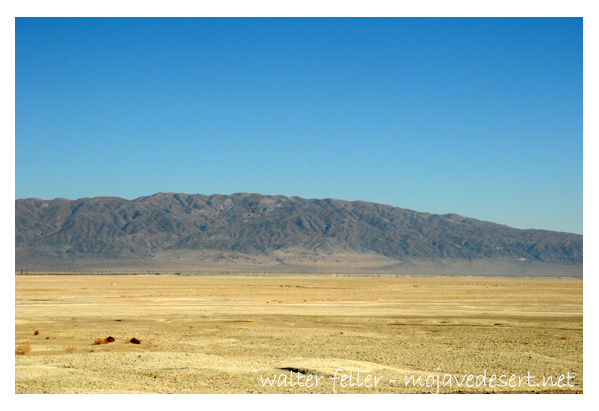
Searles Lake
As I considered it necessary to make some show of force in protecting our claims, I visited the enemy’s camp at sunrise the next day with our whole force of five men who were armed with all the weapons they could collect. It was a very critical moment when we jumped from our wagon and walked up in front of the mess house where the raiders were assembled for breakfast. I stood in the center with my boys on either side of me. There was a shout and men came running from all directions and fearing there might be trouble.
I started right off to explain to the surveyors present that I had only come over to give notice that I was officially and legally in possession of the claims and that they were trespassers.
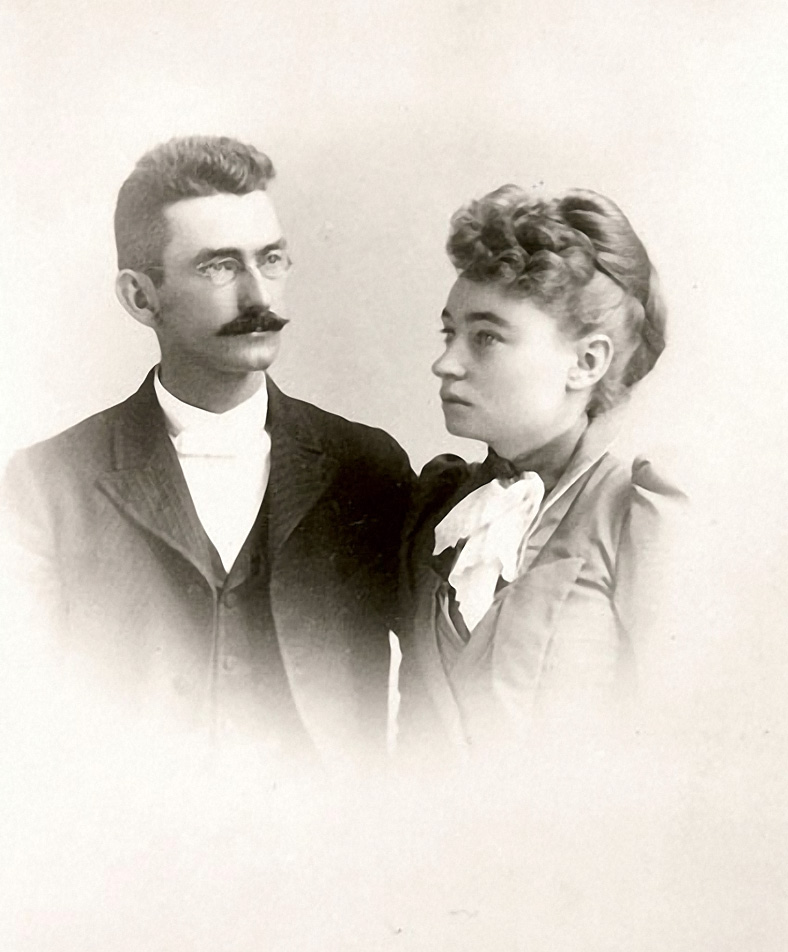
S. Wallace Austin & Mary Hunter Austin – 1891
Before I got very far a tall man with iron grey hair and a mustache pushed his way to the front and in a loud voice demanded why I had come into their camp with armed men. At the same time he grabbed hold of my shotgun held by the boy on my left and attempted to take it away from him. At this attack upon us I drew an automatic and ordered him to let go. He did so and then ran to a building nearby saying “I’ll fix you.” Before he could secure a rifle, however, the cooler headed members of the party surrounded him and calmed him down. Also, you may be sure every effort was made to prevent a fight, as, in spite of our bold being, we were pretty badly scared.
Just as things seemed to have quieted down, one of the excited jumpers accidentally discharged a gun. No one was hurt but, it was a very tense moment for all of us. Having failed to dislodge the enemy the following day I called for a US Marshall and when he arrive the claim jumpers were all arrested and sent home including “Wyatt Berry Stapp”, none other than the famous Marshall Wyatt Stapp Earp.
San Francisco Call, Volume 108, Number 151, 29 October 1910
SODA CLAIMS SEIZED BY BAND 0F ARMED MEN
United States Marshal, Elliott received a telegram yesterday from Deputy Marshal Fred Burling, in Los Angeles, stating that 24 armed-men had seized the properties of the California Trona Company near Johannesberg. A receiver has been placed in charge of the 40,000 acres of soda claims pending the decision of a suit by the Foreign Mines development company against the Trona Company for $200,000.
Deputy Marshal Burling was sent out to serve papers on certain persons alleged to be interfering with the receiver.
Los Angeles Herald, Volume 33, Number 28, 29 October 1910
GUNMEN PROTECT BORAX LAKE PROPERTY
Methods Used in Oil Fields Are Applied to Country Held by Borax Outfit
SEARLES, Cal., Oct. 28. — Borax Lake, located in the northwest corner of San Bernardino County, is again the scene of a claim jumping struggle. A party of armed men, thirty-five in number, with automobiles, led by a man named Splat, of Los Angeles, have entered the property of California Trona company and are surveying and locating over the locations of the Trona company which has just finished assessment work costing $25000.
This is the same property on which Charles Davidson of Oakland perished last June while leading a claim jumping expedition for the same property. The property is now in charge of a receiver of the United States court who notified the jumpers to desist. They replied by show of arms and refused. The United States marshal is now on his way to the scene of trouble.
The automobiles are in charge of Chauffeur M, C. Vorney and are numbered 24145, 32783, 36991, 37404 and 29487.
Names of locators are: H. C. Fursman, W. Hull, R. Wagmire, P. Perkins, H. A. Baker, E. Thompson, D. Smith, T. W. Pack. Witness, E. A. Rasor.
The Foreign Mines and Development company has a mortgage of $250,000 on this property. A sale is pending in |the east, said to be on a $1,000,000 basis.
The region’s earlier history includes the town of Carrara, established to support marble quarrying, which began in 1904. Despite initial optimism, the marble’s quality and economic factors led to the quarry and the town’s decline.
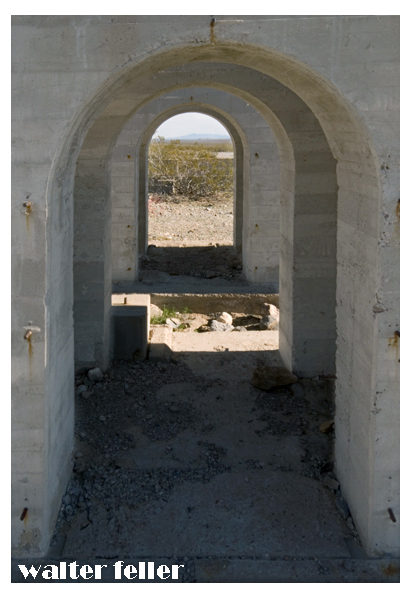
The “Elizalde Cement Plant” in Nevada has historical significance. It was established in the early 20th century to supply cement for Hoover Dam construction. The Elizalde Company built the plant and operated when the American Southwest underwent significant industrial and infrastructure development.
After the completion of the Hoover Dam, the demand for cement decreased, leading to the plant’s closure. The remnants of the Elizalde Cement Plant now stand as a testament to the region’s industrial history, attracting historians and enthusiasts interested in the area’s development and the broader story of American industrialization.
The Elizalde Cement Plant, located in Nevada, has a history tied to industrial ambitions and unforeseen setbacks. Incorporated in November 1940 as the Carrara Portland Cement Company, it aimed to produce standard gray and special white cement, utilizing crushed marble from the nearby Carrara quarry.
Incorporated in November 1940 as the Carrara Portland Cement Company, it aimed to produce standard gray and special white cement, utilizing crushed marble from the nearby Carrara quarry. By April 1941, construction was in full swing, with an estimated daily output planned for 80 tons of cement. However, a devastating fire in July 1941 destroyed significant parts of the plant, halting progress. Despite efforts to rebuild and expand, World War II’s fuel rationing ultimately doomed the plant, which never became operational.
By April 1941, construction was in full swing, with an estimated daily output planned for 80 tons of cement. However, a devastating fire in July 1941 destroyed significant parts of the plant, halting progress. Despite efforts to rebuild and expand, World War II’s fuel rationing ultimately doomed the plant, which never became operational.
The Elizalde Cement Plant was supposed to mark a new industrial phase, but it became a relic of unfulfilled industrial aspirations, now an intriguing ruin in the desert landscape.
OpenAI. (2024). ChatGPT (4) [Large language model]. https://chat.openai.comhttps://www.nvexpeditions.com/nye/elizalde.php https://nvtami.com/2023/05/09/ghost-towns-of-beatty/
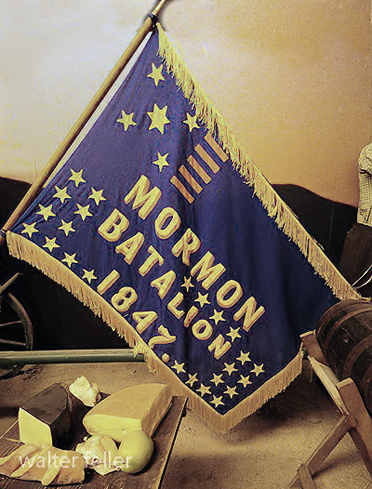
The Mormon Battalion was a unique military unit in American history, formed during the Mexican-American War in 1846. It consisted of about 500 Latter-day Saints (Mormons) volunteers. This battalion was the only religiously based unit in United States military history and was recruited to help the U.S. secure new territories in the American West.
The battalion was mustered in at Council Bluffs, Iowa, and marched nearly 2,000 miles to San Diego, California, one of the longest military marches in history. The journey helped to open new wagon routes in the West and was instrumental in the settlement and development of the region. The battalion never engaged in battle but faced hardships like disease, lack of provisions, and challenging terrain.
The Mormon Battalion is significant for its military contribution and impact on the westward expansion and settlement of the United States, particularly in Utah and California. Its members helped to establish communities and build infrastructure in the West after their military service ended.
After their discharge in 1847, members of the Mormon Battalion played a significant role in the history of the Mojave Desert and the broader American West. Their journey and subsequent activities helped to establish and improve trails across the desert, facilitating the movement of people and goods.
Some of the discharged members of the Mormon Battalion, along with other Mormons, were instrumental in developing the Southern Route, also known as the Mormon Road, through the Mojave Desert. This route later became critical for settlers moving to California, especially during the Gold Rush. They improved the trail, making it more passable for wagons, and established supply stations along the way, vital for the survival of travelers crossing the harsh desert environment.
Additionally, these battalion members engaged in early exploratory and settlement activities. They were among the first U.S. citizens to extensively travel through and document the Mojave Desert region. Their efforts contributed to the mapping of the area and provided valuable information about resources and potential settlement sites.
Their work in the Mojave Desert facilitated westward expansion and laid the groundwork for future economic development in the region, including mining, agriculture, and transportation. Through their endeavors, the discharged members of the Mormon Battalion left a lasting legacy in the development of the American Southwest.
THE JOURNAL OF THE American Medical Association VOLUME 105, No. 11, CHICAGO, ILL. SEPTEMBER 14, 1935
Curtis Howe Springer first came to the attention of the Bureau of Investigation through a display advertisement published in the Davenport (Iowa) Times on Oct. 2, 1929. This carried a picture of Springer, who was described as “Dean of Greer College.” The advertisement read in part as follows:
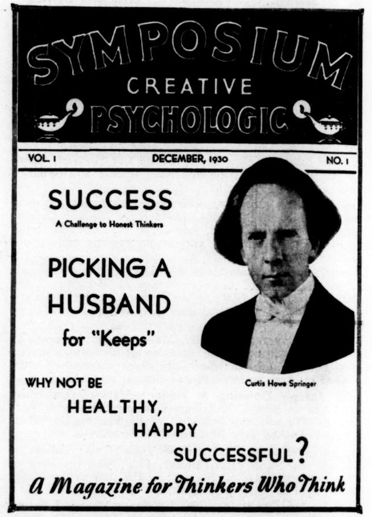
Photographic reproduction (greatly reduced) of the cover of an alleged magazine put out by Springer as an advertising asset. At that time Springer affected long hair; since then he has had it cut. In this “magazine” Springer had an “explanation” of why he had to cease broadcasting over WBRE.
“Money For You. Develop Your Powers. Be Healthy, Happy, Successful. A series of Free Lectures Is offered to the public under the auspices of the Extension Department of Greer College.
“Thousands have paid to hear these lectures, but you can hear them free, through the courtesy of the Davenport Psychology Class.
“President Hoover said the complete abolition of poverty is now a possibility for us. ;
“Analyze Yourself. Know Your Hidden Powers.
In August 1930, the Scranton (Pa.) Better Business Bureau wrote that Springer had been giving a course of “lectures” at the local Y. M. C. A., which he is said to have claimed were presented through the courtesy of the “Extension Department of the National Academy.” What this Academy is or was, if, which seems doubtful, it ever has been, we have been unable to learn. Neither have we been able to learn anything about the “Springer School of Humanism” that was also mentioned. The Better Business Bureau reported further that Springer’s “lectures” were entitled “How to Banish Disease and Know the Joy of Living.” Springer was said not to have charged any admission but to have taken up a collection and also to have sold so-called private courses in psychoanalysis at $25 a course.
Bureau stated further that a local woman who had contracted and paid for a “course” charged Springer with obtaining money under pretenses. When the case came up for a trial, the woman is said to have testified that for the money paid, Springer had agreed to give her twelve “readings” or “sittings,” two a week for six weeks, but that at the end of two weeks, Springer left the city and she received no further notice from him. The Scranton Better Business Bureau reported that prosecution was dropped when Springer refunded the woman’s money.
In December 1930 Springer put out what purported to be the first issue of a magazine entitled “Symposium Creative Psychologic,” a name that is as meaningless as some of the titles that Springer has annexed. This sheet was devoted mainly to advertising Springer and his activities, especially his “Doc. Springer Temple of Health.” In it Springer published an “explanation” of why he had had to cease broadcasting over WBRE.
At this point it may be interpolated that investigation seems to show that: Springer came originally from Birmingham, Ala., where his record, not being of a medical or quasi-medical character, need not be gone into at this time; he left there to come to Chicago; he organized the “Temple of Health” in Wilkes-Barre, Pa.; he sold “Springer’s Health Bread” at Johnstown, Pa.; he exploited a similar scheme in Cumberland, Md.; he made payments on some land at Mount Davis, near Salisbury, Pa. with the idea of starting a “health resort”; he incorporated Basic Foods, Inc., with an authorized capital of fifty shares, of which Springer and another man were said to held one share each and Springer’s wife to hold the other fortyeight shares; he published in not-too-particular papers alleged health columns with his picture accompanying the reading matter.
During the past few years Curtis Howe Springer, in advertising himself, has placed after his name the letters “M.D., N.D., D.O., Ph.D.,” sometimes with the statement beneath the “degrees” that they were “Honorarily conferred.” A most thorough search fails to show that Springer was ever graduated by any reputable college or university, medical or otherwise. In May 1933 a physician in Cumberland, Md., wrote to the Bureau of Investigation, stating that when Springer had appeared in his locality the local state’s attorney demanded that Springer produce a certificate showing that he had the right to use the title M.D. This, of course, Springer was unable to do. Then, according to our correspondent, Springer was charged with practicing medicine without a license, but, being at liberty without bail, he left Cumberland and could not be apprehended for trial. Later it was reported that he was broadcasting at Philadelphia and still later at Pittsburgh,
SPRINGER COMES TO CHICAGO In the latter part of December 1933 the broadcasting station WGN, operated by the Chicago Tribune, called up the Bureay of Investigation of the American Medical Association and asked for, and received, such information as was then available on Curtis Howe Springer. It appeared that Springer wanted to buy time on the air over WGN, but the contract he offered was rejected. A few days later (Jan. 4, 1934) Springer himself, with the effrontery of his kind, came to the headquarters of the American Medical Association and asked to see the Director of the Bureau of Investigation. He told the Director that he had called to correct what he described as certain misconceptions that the Bureau of Investigation was said to have regarding him.
Springer was asked where he had obtained and by what right he used the degree M.D. He stated that the degree had been bestowed by one Frederick W. Collins, a chiropractor of New Jersey, who runs the egregious “First National University of Naturopathy” and apparently several other high-sounding institutions of dubious educational character. Needless to say, the Collins outfit is not a recognized medical college. It has no scientific standing and, of course, has no legal authority whatever to grant the degree of Doctor of Medicine. Springer further admitted during the interview that his alleged degrees were granted without attendance and upon the payment of either $200 or $300 (he said he could not remember which) and the answering of certain questions !
Springer was told that interviews were unsatisfactory, as they left the problems discussed a matter of recollection on the part of two individuals. For that reason he was requested to send the Bureau of Investigation a letter setting forth the various facts regarding himself and correcting any alleged inaccuracies of which the Bureau of Investigation had been accused. At the time, Springer stated that he would go right hack to his hotel (one of the most expensive in Chicago) and write such a letter.
Within five minutes of the termination of the interview the Director of the Bureau of Investigation wrote a letter to Springer at his address in the hotel in Chicago, setting forth exactly the claims that he had just made. He was asked to confirm by letter his verbal claim that he had paid $200 or $300 for his M.D. “degree” granted by chiropractor Collins, who had no right to grant such a degree; he was asked from what institutions and on what dates he had received his “degrees” of N.D., D.O. and Ph.D.; he was asked whether the Greer College, of which he had been advertised as Dean, was the same concern that had been the subject of a cease and desist order from the Federal Trade Commission; he was asked, also, to furnish, as he had promised verbally, written evidence to indicate that he had some knowledge of nutrition and dietetics, and he was also asked to send any information he cared to regarding “Doc. Springer’s Temple of Health” at Wilkes-Barre, Pa. Needless to say, Springer was much too shrewd to fulfil his verbal promise to write a letter or to put in black and white answers to any of the questions that were put to him.
Although unsuccessful in buying time on the air over WGN, it was not long before Springer was broadcasting twice daily over WCFL, another radio station operating in the Chicago area. In this connection, we cannot do better than quote from the Chicago Better Business Bureau’s report on Springer’s Chicago radio activities :
“These talks were along sensational lines, tending to vilify those who disagreed with the New Deal and President Roosevelt’s program. Appeals for money for his activities were made and, according to information received, many sent him funds. In the early summer of 1934 Springer brought out a newspaper called the New Deal, which was labeled ‘Official Organ of Legion of Honor.’ The style ‘Legion of Honor’ was another creation of Springer’s, the stated purpose of which was to federate honest, patriotic and loyal merchants into an organization known as ‘Federation of New Dealers’ that will afford the opportunity to enlighten the working man, the forgotten man, and others seeking truth. Springer likewise carried on attacks against business establishments in Chicago, charging them with exploiting the public. Soon complaints started to come to the Better Business Bureau and a number of warrants were taken out for Springer in Chicago, charging him with slander, etc.”
About the middle of July 1934 Springer is said to have come to the office of the Chicago Better Business Bureau for the purpose of giving information regarding certain complaints which existed against him. While he was there, he was asked some questions by the officials of the Better Business Bureau Quoting again from that Bureau’s report:
“When asked about his qualifications as a medical doctor, Springer said that he took his degree of M.D. from the American College of Doctors and Surgeons in Washington, D. C. [There is no such institution—Ed.] He took his degree of osteopathy at Meyersdale, Pa. where he maintained a residence. [There never has been an osteopathic college there—Ed.] He states that he attended the Westlake West Virginia College for one year. [There is no such college and never has been.—Ed.], and -further, that he took his degree of Ph.D. from a New Jersey school of osteopathy. When it was called to his attention that a school of osteopathy did not confer such a degree as Ph.D., Springer did not answer the question.
Re-Hib, an anti-acid product, and the so-called Basic Food. Springer met the various complaints against him with counter-charges designed to discredit the complaints. About the middle of July he ceased broadcasting on radio station WCEL, following which complaints were received from business establishments alleging unsatisfied obligations left by Springer.”
One incidental point, as showing Springer’s character, is worth bringing out. While Springer was broadcasting in Chicago over radio station WCFL, he was defaming certain Chicago stores which were picketed because of strikes. At the same time Springer was staying at one of the most expensive hotels in Chicago which was also, both at that time and later, the subject of picketing!
CURTIS HOWE SPRINGER M. D., N. D., D. O., Ph. D. Honorarily Conferred
Formerly Dean of Greer College; Founder of the Springer Schools of Humanism; Honorary President of the National Academy
Photographic reproduction of the title page of a Springer booklet advertising his “patent medicine,”’ Antediluvian Tea, a mixture of chopped-up herbs. .
Since Springer wore out his welcome in Chicago, he has apparently been lying comparatively low—at least, the number of inquiries that have come in regarding him has been few. One did come in in April 1935 from the Philadelphia County Medical Society, which telegraphed the Bureau of Investigation of the American Medical Association, stating that a Philadelphia radio station was requesting advice on Springer’s Re-Hib and Antediluvian Tea. The Philadelphia County Medical Society was told that Springer was not a physician and that the Bureau of Investigation considered him a blatant faker, that his Re-Hib was apparently mainly baking soda, while the Antediluvian Tea was evidently nothing more than a crude mixture of laxative herbs. The Bureau was later advised by the Philadelphia County Medical Society that the radio station had refused Springer’s contract for broadcasting.
Summed up, it may be said that Springer is but one more example of what to the thoughtful citizen must appear as one of the most dangerous social phenomena of American city life: The person with an ignorance of the human body and its processes that is wide and deep, who by virtue of an unblushing effrontery combined with a flair for garrulity dupes an ignorant public. Loquacious fakers, faddists and quacks have for some years past made an easy living by their wits through the facility with which they could hire halls and announce so-called free lectures on subjects on which the ignorance of the audience was only exceeded by that of the speaker. The advent of the radio has multiplied the opportunities for dispensing misinformation at the public’s expense.
THE JOURNAL OF THE American Medical Association VOLUME 105, No. 11 535 North Dearborn Street, CHICAGO, ILL. SEPTEMBER 14, 1935
The conflict between Dr. Curtis Howe Springer and the American Medical Association (AMA) underscores a significant moment in the history of medical regulation and public awareness regarding health fraud. Springer, who was not a medically trained doctor, operated under the guise of one, promoting various health remedies, treatments, and establishments that had little to no scientific backing. His operations, most notably the Zzyzx Mineral Springs and Health Resort in the Mojave Desert, attracted attention for their bold claims about the curative powers of natural remedies and treatments offered. The AMA’s denouncement of Springer as the “King of Quacks” in 1969 was a part of its broader mission to protect public health from fraudulent medical practices.
An experience of Michael White (Miguel Blanco) on the Old Spanish Trail to San Bernardino, California.
We stopped a day or two on a lake called the San José (now known as the Beggars’), and I told my partner to take care of the horses, as I wanted to ride around and take a look at the country. Riding round I heard firing a little ahead of me. Hurrying on, I discovered that our New Mexicans had surrounded a rancheria of Piutes. I saw one little Indian boy, about 12 years old, with his arm nearly shot off, just hanging by the skin a little below the shoulder. I began to scold the New Mexicans and called them a pack of damned brutes and cowards, and they were so.
There was one old Indian, standing with his bow and arrow. They wanted to take and kill him, but were afraid to approach near enough to come within reach of his arrow. I went up to the Indian and asked him for his bow and arrows—they had solemnly promised me not to hurt him if I succeeded in disarming him. The Indian handed them to me and I shall never forgive myself for having taken the word of those villains, for villains they were, of the blackest kind. As soon as they saw the Indian without arms they came near and riddled him with bullets.
I parted with them and went by myself. This was a considerable distance from our camp. I found another rancheria in a thicket of willows. An Indian came out and by sign asked me if I had come to fight. I said no; then he asked me if I was hungry, and answering in the affirmative, he invited me to alight, and partake of what he had, which was atole [a drink], made of the seed of hogweed, and barbecued trout of the most delicious—as you may suppose, considering I had had nothing to eat in nearly 24 hours. Whilst I was eating up came the confounded New Mexicans, and the Indians ran to conceal themselves in the brush. All but two succeeded in escaping—those two unfortunate Piutes were taken by the Mexicans, tied, and shot in cold blood. I begged, entreated, threatened, and did all I could to have their lives spared but all my efforts were unavailing. When they were about to shoot the Indians, I was so indignant that I raised my gun, aimed at one of the gang, and pulled the trigger, and it wouldn’t fall, though I pulled it with all my force. 10 or 12 guns were pointed at me, but they didn’t fire, as my gun had not gone off—they said this was what saved me. The rascal’s name was Tomás Salazar. I assured them that I would never again travel with such a set of brutes. They answered, “ Que! no es pecado matar esos indios gentiles.” [Oh, well. It’s no sin to kill those pagan Indians.]
My partner in the camp wanted me to keep quiet, because the New Mexicans were exasperated against me and would put me to death if I said more. From that time I had no rest at night. I was apprehensive of being murdered.
California all the way back to 1828. By Michael C. White. Written by Thomas Savage for the Bancroft Library, 1877