California Southern Railroad through Cajon Pass: Design, Surveying, and Construction History

The California Southern Railroad was a critical 1880s project that connected Southern California to the transcontinental rail network. Backed by the Atchison, Topeka & Santa Fe (AT&SF) Railway, it built a line from San Diego northward through San Bernardino and the Cajon Pass to reach the Atlantic & Pacific Railroad at Barstow. This report chronicles the railroad’s planning and surveying, its phased construction timeline, the engineering challenges of Cajon Pass, key figures involved, construction methods, conflicts encountered, and the line’s integration into the Santa Fe system and impact on the region.

Background and Planning

In the late 1870s, San Diego businessmen – notably Frank Kimball – were desperate to end the city’s isolation by rail. After failing to interest tycoons like Jay Gould or Collis Huntington, Kimball courted the Santa Fe leadership with incentives, including land grants around San Diego. The Santa Fe saw an opportunity to break Southern Pacific’s monopoly in California and agreed to support a new subsidiary line via San Bernardino. Thus, the California Southern Railroad was incorporated on October 16, 1880, with Santa Fe officers (led by President Thomas Nickerson) on its board. The plan was to build 116 miles from San Diego to San Bernardino by mid-1882, where it would link up with Santa Fe’s transcontinental partner, the Atlantic & Pacific (A&P) Railway. This ambitious scheme set the stage for a difficult but historic construction effort through some of California’s most challenging terrain.

Construction Timeline (1880–1885)

Construction of the California Southern proceeded in two major phases: Phase 1, from San Diego to San Bernardino (via Colton), and Phase 2, from San Bernardino through the Cajon Pass to Barstow. Below is a timeline of key construction milestones and setbacks:

  1. October 1880 – Groundbreaking: The railroad’s Chief Engineer, Joseph Osgood, established headquarters in San Diego on October 11, 1880, marking the unofficial start of construction. With Santa Fe financing and local land grants secured, grading and tracklaying began northward from National City (San Diego’s port terminus).
  2. January 1882 – Reaching Oceanside/Fallbrook: By January 2, 1882, crews had laid about 55 miles of track, reaching Fallbrook Junction in northern San Diego County. The line hugged the coast through Oceanside, then turned inland up the Santa Margarita River valley, requiring many bridge crossings in Temecula Canyon, a gorge with sheer rock cliffs.
  3. August 1882 – Arrival at Colton: Construction pressed on through Riverside County, and by August 16, 1882, tracks reached Colton, just shy of San Bernardino. Here, the California Southern confronted the Southern Pacific Railroad (SP), which vehemently opposed any crossing of its tracks. SP officials even parked a locomotive on the proposed crossing point to obstruct the crew. A legal battle ensued; ultimately, California’s governor (Robert Waterman) ordered the local sheriff to enforce a court injunction, compelling SP to allow the crossing. With the blockage removed, the California Southern built a diamond crossing over SP’s line at Colton.
  4. September 1883 – Line Opens to San Bernardino: The first California Southern train triumphantly steamed into San Bernardino on September 13, 1883. San Bernardino, having been founded as a Mormon colony decades earlier, welcomed the new competition to SP’s rail monopoly. The completed San Diego–San Bernardino segment (via Temecula Canyon) formed part of Santa Fe’s “Second Transcontinental” route, albeit still disconnected from the A&P mainline in the Mojave Desert.
  5. Winter 1884 – Catastrophic Floods: Disaster struck just months later. In February 1884, torrential rains turned the Santa Margarita and Temecula creeks into raging torrents. Floodwaters obliterated about 8 miles of track in Temecula Canyon, washing away trestles and roadbed – with rails and timbers reportedly floating out to sea. The damage, estimated at $319,000, far exceeded the cash-strapped railroad’s means. Service on the line was completely halted for nine months while crews struggled to make repairs. By January 6, 1885, the route was finally reopened to traffic after extensive rebuilding.
  6. Late 1884 – Santa Fe Takeover: The 1884 flood crisis left the California Southern on the brink of bankruptcy. Fearing the line might fall into rival hands, Santa Fe’s President William Barstow Strong moved decisively to absorb the company. In October 1884, the AT&SF acquired a controlling interest in the California Southern through a stock swap and also negotiated the purchase of Southern Pacific’s Mojave-to-Needles branch line (which ran via Barstow). These moves ensured Santa Fe’s full control of the San Diego–Barstow project and secured the route to the East via Barstow/Needles.
  7. 1885 – Building Through Cajon Pass: With finances and leadership now backed by Santa Fe, the final 81-mile gap from San Bernardino through Cajon Pass to Barstow was tackled in 1885. Santa Fe’s locating engineer, William Raymond “Ray” Morley, and local chief engineer Fred T. Perris led surveying parties to plot a feasible ascent through the San Bernardino Mountains. Construction crews attacked the pass from both ends – working northward from San Bernardino and southward from the Barstow area (then called Waterman).
  8. November 1885 – Completion of the Line: On November 15, 1885, the last spike was driven in Cajon Pass, marking the completion of the California Southern Railroad and a continuous rail link from San Diego to the transcontinental mainline. Within a day, the first through passenger trains ran between San Diego and Chicago (via Barstow), establishing a second Pacific coast connection in competition with the Southern Pacific. The once-isolated San Diego now had rail access to the rest of the country.

Surveying and Engineering Challenges in Cajon Pass

Surveying a railroad through Cajon Pass – the cleft between the San Gabriel and San Bernardino mountain ranges – posed formidable engineering challenges. The pass, created by the San Andreas Fault, is a naturally rugged corridor filled with steep grades and unstable geology. Chief Engineer Fred T. Perris and surveyor Ray Morley scouted the route in 1885, seeking a path that locomotives of the era could climb. They managed to keep the maximum grade to 3.4% on eastbound (uphill) tracks to Cajon Summit at 3,823 feet elevation. This roughly 1,000-foot ascent from the base of the pass was achieved by tracing winding curves along the canyon walls, avoiding any single, overly steep incline. Early surveys had to balance the line’s curvature and grade: too sharp a curve or too heavy a grade would prevent trains from safely traversing the pass.

Complicating matters, the terrain through Cajon consists of fractured rock and sandy washes prone to erosion, a legacy of the fault line. Unlike easier routes, there was no gentle river valley to follow – only dry canyons and slopes. Morley and Perris chose to contour along natural benches and cut into hillsides, minimizing the need for expensive tunneling or switchbacks. (In fact, the original 1885 line included no significant tunnels; only in 1913, during a double-tracking project, were two short tunnels added – later “daylighted” in modern times.) The surveying team had to find stable ground for the railbed and design ample drainage to protect against flash floods in the desert gullies. The result was a sinuous route featuring famous curves (like Sullivan’s Curve) that allowed trains to gain altitude gradually. The achievement was considered one of Santa Fe’s great engineering feats of the 1880s, creating a viable railroad through a region previously deemed too rugged for rail travel.

Elsewhere along the route, natural obstacles also tested the engineers. South of San Bernardino, the line’s earlier segment through Temecula Canyon had demanded seven miles of roadbed chiseled through almost perpendicular rock cliffs. There, the railroad crisscrossed the Santa Margarita River numerous times on low wooden bridges – an engineering necessity that unfortunately exposed the line to destruction by floods. One Chinese laborer working in the sweltering Temecula gorge reputedly quipped that it was “all the same hellee, you bet,” referring to the hellish difficulty of the work. That experience underscored the need for solid engineering in Cajon Pass. Learning from prior washouts, the builders in Cajon placed bridges and culverts to carry ephemeral streams under the track and built up embankments to elevate the line in flood-prone areas. Still, steep mountain topography and seismic geology made Cajon Pass a supreme test of the railroad’s surveyors and graders, one that Perris and his team met with grit and ingenuity.

Construction Methods and Workforce

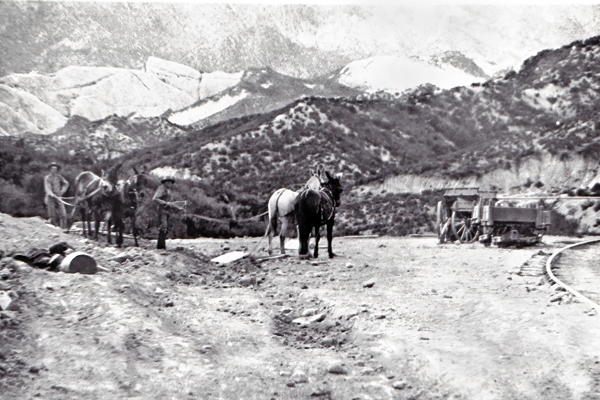
Building the California Southern Railroad in the 1880s required massive manual effort and traditional construction techniques. The project had no heavy machinery as we know it today – construction was essentially by hand labor with picks, shovels, horse-drawn scrapers, and black-powder explosives for blasting rock. The workforce swelled to thousands; in fact, over 6,000 laborers were employed at one point to push the line through Cajon Pass and down into Los Angeles. Chinese and Mexican immigrant laborers made up a large portion of the crews, especially on the hard sections through canyons and desert. These workers cleared brush, graded hillsides, dug cuttings, and built fills with wheelbarrows and dump carts. For rock cuts, crews drilled holes by hand or with rudimentary pneumatic drills, filled them with black powder, and blasted through obstacles. Timber was cut for trestle bridges and culverts, which were assembled on-site to span washes and rivers.

Material supply was an enormous logistical challenge for this railroad. San Diego had no existing rail connection in 1880, so every piece of rail, hardware, and rolling stock had to be shipped. Rails and fastenings were sourced from Belgium and Germany, loaded onto sailing ships, and carried around Cape Horn to San Diego’s port. The first load of steel rail arrived in March 1881 aboard the British ship Trafalgar, delivering the metal needed to push the line northward. Wooden ties (sleepers) were likely procured from Pacific Coast forests and brought by coastal schooners. At the railhead, workers practiced the standard tracklaying method of the era: teams of men known as “iron men” would lift rails into place with tongs, while others spiked them to the ties and gauged the track. Progress could reach several miles of track laid per day on flat ground, but slowed to a crawl in difficult terrain.

In Cajon Pass, construction methods had to adapt to the steep grades. Cuts and fills were carefully engineered: material from cuts was used to build up fills around curves, a balancing act that reduced how far debris had to be hauled. In some areas, temporary inclines and switchbacks were used to move construction equipment (such as small work locomotives) until the permanent grade was ready. Photographic evidence from the 1880s shows work trains carrying supplies up partially completed grades, and construction camps housing hundreds of workers in tent cities along the route. Despite the crude methods, the crews in Cajon Pass succeeded in laying a robust track. When the last rail was spiked down in November 1885, the California Southern’s construction legacy was one of dogged persistence with picks and shovels, achieving a task many thought impossible.

Key Personnel and Leadership

Several key figures were instrumental in the design, surveying, and construction of the California Southern Railroad’s route through Cajon Pass:

  • Fred T. Perris – Chief Engineer: A British-born surveyor who settled in San Bernardino, Frederick T. Perris served as Chief Engineer of the California Southern (and later the Santa Fe). Perris personally directed the location surveys through Cajon Pass in 1885 and oversaw the construction of this last leg of Santa Fe’s second transcontinental route. The difficult passage through Cajon (often mis-called “El Cajon Pass”) was his crowning achievement, and the city of Perris, California (originally a railroad camp on the line) was named in his honor.
  • William Barstow Strong – Santa Fe President: W.B. Strong was the AT&SF Railway’s president during the 1880s and the strategic mind behind the push into Southern California. He outmaneuvered Southern Pacific’s Collis Huntington to break the rail monopoly and spearheaded the Santa Fe’s support of the California Southern project. Strong authorized the heavy investment to rebuild after the 1884 floods and to conquer Cajon Pass, and Barstow (originally “Waterman Junction”) was later renamed in his honor once the line was complete.
  • William Raymond “Ray” Morley – Chief Location Engineer: Ray Morley was a civil engineer for Santa Fe who had previously surveyed challenging mountain routes (his father surveyed Raton Pass in New Mexico). Morley partnered with Perris to plot the Cajon Pass alignment. His expertise in mountain railroading helped find a path with acceptable curvature and grade through Cajon’s canyons. Morley’s survey work ensured the railroad could be built without resorting to impractical solutions; he is credited with successfully locating the line.
  • Frank Kimball – San Diego Advocate: Frank Kimball was not an engineer but rather a San Diego land developer whose vision and persistence were crucial in launching the railroad. He lobbied Eastern financiers and offered land from his Rancho de la Nación to entice the Santa Fe to back the line Kimball’s efforts paid off—he secured 10,000 acres in land grants and other concessions for the railroad, directly leading to the California Southern’s incorporation. He is often regarded as the “father” of the project, ensuring San Diego would finally get a transcontinental link.
  • Joseph O. Osgood – Initial Chief Engineer: Joseph Osgood was the California Southern’s chief engineer at the outset of construction. He organized the surveying parties in 1880 and established the construction headquarters in San Diego. Under Osgood’s supervision, the first 70 miles of track were built from National City to Colton. He resigned before the Cajon Pass phase (with Perris taking over), but his groundwork from 1880–1882 laid the foundation for the line’s eventual success.

(Many others contributed, including hundreds of anonymous labor foremen, as well as contractors for grading and bridge building. Governor Robert Waterman and Sheriff J.B. Burkhart also played a memorable role by enforcing the law against Southern Pacific’s interference at Colton. But the figures above stand out as the principal players in getting the railroad built.)

Conflicts and Community Interactions

From its inception, the California Southern Railroad faced determined resistance from the entrenched Southern Pacific Railroad (SP), which jealously guarded its dominance in California. The most dramatic conflict occurred at Colton Crossing in 1882–1883. As California Southern crews prepared to lay track across SP’s north-south line, SP’s agents literally blocked the crossing with a locomotive and railcar, moving them back and forth to prevent any grade crossing construction. This showdown, known as the “Battle of Colton,” escalated until a court ordered SP to cease obstruction. When SP initially ignored the order, Governor Waterman dispatched the San Bernardino County Sheriff and militia to enforce it. Under this pressure, Collis Huntington’s SP capitulated, allowing the crossing to be completed. The successful crossing at Colton opened the way for the Santa Fe affiliate to enter San Bernardino, much to the delight of residents who had felt bullied by SP’s monopoly. The arrival of the first California Southern train in San Bernardino in 1883 was met with celebration – a vindication of the community’s support for a second railroad.

Local communities along the route mostly welcomed the railroad and the economic opportunities it promised. Towns like Oceanside, Riverside, and San Bernardino saw immediate benefits in freight and passenger service. New townsites sprang up as well – Pinacate (in Riverside County) was a railroad camp that evolved into the town of Perris (named after Fred Perris) in 1886. There were, however, instances of tension. Some farmers in the Temecula area were reportedly skeptical of the railroad’s precarious route along the flood-prone canyon, advice that proved well-founded when the line washed out. Additionally, the construction crews themselves (many of whom were Chinese) sometimes met prejudice or hostility in local communities, as was common in that era.

On the whole, the coming of the California Southern was a boon to Southern California communities. It broke the isolation of San Diego and San Bernardino, lowered freight rates, and sparked a fare war that made travel more affordable (as detailed in a later section). The railroad also brought jobs and expanded agricultural markets. Conflicts that did occur – aside from corporate battles with Southern Pacific – were relatively minor and often stemmed from disputes over right-of-way or damage to land during construction, which the railroad typically settled. By 1885, most local stakeholders recognized that Santa Fe’s entry via the California Southern meant freedom from the SP monopoly and the start of a more competitive era in transportation.

Completion and Connection at Barstow

The completion of the California Southern Railroad through Cajon Pass in November 1885 was a pivotal moment in western railroad history. It effectively joined Southern California to the transcontinental rail network, creating a new through route from Chicago (via the Santa Fe and A&P lines) to San Diego and Los Angeles. The meeting point was at the desert town of Barstow – known at the time as Waterman Junction. Barstow was where the California Southern’s rails met the Atlantic & Pacific Railroad (A&P), which had built west from Albuquerque to Needles by 1883. Notably, the tracks between Needles and Barstow had been laid by the Southern Pacific (under an arrangement to block Santa Fe) but were acquired by AT&SF in 1884. Thus, by late 1885, Santa Fe controlled an unbroken line from Kansas City to Barstow.

On November 15, 1885, workers drove the last spike in Cajon Pass, after track gangs from San Bernardino and Barstow met on the grade. Service commenced immediately: on November 16, the first trains to traverse the entire line ran between San Diego and points east. One train originated at Barstow heading toward San Diego, and another left National City (San Diego) bound for the East. These inaugural runs symbolized the end of Southern Pacific’s stranglehold – passengers and freight could now travel over an independent transcontinental route to Southern California. The completion of California Southern also made Barstow a key junction. The town soon developed into a bustling division point, with yards and shops to sort the influx of transcontinental freight descending from the Mojave Desert.

To formalize the connection, the California Southern built a junction with the A&P just outside Barstow. The A&P (which was half-owned by Santa Fe) continued west to Mojave, but Santa Fe shifted its focus to the new link south to San Diego. The entire route operated seamlessly under Santa Fe management, effectively making the California Southern the western leg of Santa Fe’s main line. In railroad publicity, Santa Fe touted its new “Pacific Route” reaching San Diego’s harbor – though Los Angeles would soon eclipse San Diego as the primary terminus (see below). Still, the achievement at Barstow in 1885 cannot be overstated: it completed the second transcontinental railroad into California, providing a competitive alternative to the Central/Southern Pacific’s lines. From this point on, Southern California was served by two transcontinental systems, and Barstow (named in honor of W.B. Strong) became a lasting reminder of Santa Fe’s triumph.

Natural Disasters and Line Modifications

Nature proved to be an ongoing adversary for the California Southern Railroad, even after the line’s completion. The Temecula Canyon segment (between San Diego and San Bernardino) was especially vulnerable. As noted, the Great Flood of 1884 devastated that canyon, shutting down the line for most of that year. The Santa Fe takeover allowed repairs to proceed, and by early 1885, trains were running again. However, the lesson was learned: Temecula Canyon was a risky route. Santa Fe soon invested in alternate lines to avoid this chokepoint (discussed in the next section).

The most fateful natural event came in February 1891, when another series of Pacific storms pounded Southern California. That month saw relentless rainfall and flooding. All railroads in the region were washed out in places, but the Santa Margarita/Temecula Canyon line was hit catastrophically once more. Bridges and tracks that had been rebuilt after 1884 were again torn from their foundations. In some spots, rails were reportedly carried miles downstream, with witnesses claiming they could see railroad ties bobbing in the ocean surf after being swept out of the canyon. This time, the Santa Fe Railroad decided not to pour more money into rebuilding the vulnerable canyon segment. By 1891, an alternate route to San Diego was nearly in place (via Orange County), making the Temecula line somewhat expendable.

After the 1891 floods, Santa Fe permanently abandoned the rail line between Fallbrook (north of Oceanside) and Temecula. No train ever ran through Temecula Canyon again after that disaster. The Santa Fe instead completed its Surf Line down the coast: by 1888, a line was finished from Los Angeles south to Oceanside (connecting with the remaining part of the California Southern into San Diego). Thus, when the 1891 storms destroyed the inland canyon route, Santa Fe shifted all San Diego traffic to the coastal route via Los Angeles. The isolated Temecula canyon grade was left to nature and quickly fell into ruin, save for a few work trains that salvaged usable materials. That segment became one of the West’s earliest mainline abandonments due to natural forces.

Cajon Pass, in contrast, proved more resilient. While subject to occasional flash floods and landslides, the Cajon route did not suffer the kind of complete washouts that Temecula did. The railroad’s engineering (keeping the line above streambeds and providing culverts) paid off. One notable natural incident in Cajon’s later years was a wildfire and subsequent rain in 1923 that caused a major mudslide, but the line was quickly cleared. Overall, the 1891 floods were the turning point that relegated the original San Diego–San Bernardino line to secondary status, while the Cajon Pass route, by virtue of its sturdier construction and strategic importance, remained the primary gateway. The legacy of these natural events is evident in today’s rail map: the coastal Surf Line (Los Angeles–San Diego) became the main passenger route, and Cajon Pass remains a vital freight corridor for the BNSF Railway, whereas Temecula Canyon holds only rusted rails as a historical footnote.

Integration into the Santa Fe System

The California Southern Railroad’s identity as an independent company was relatively short-lived. Once the Santa Fe assumed control in late 1884, the line was gradually folded into Santa Fe’s corporate structure. In 1885, Santa Fe operated it as a subsidiary, using the California Southern name for a few more years. But as Santa Fe rapidly expanded its network in Southern California, it made sense to consolidate its operations. In July 1888, Santa Fe finished its own line into Los Angeles (via Pasadena and the San Gabriel Valley), and by 1888–1889, it had also completed the “Surf Line” along the coast to San Diego. These new lines, along with the California Southern, California Central, and other subsidiaries, were merged in 1889 to form the Southern California Railway Company. The California Southern thus ceased to exist as a separate entity in 1889, becoming part of the Southern California Ry. (a holding company controlled by AT&SF).

This consolidation simplified operations, and soon the Santa Fe system in California was branded simply as the “Santa Fe Route.” In 1893, the parent AT&SF Railway went through a bankruptcy and reorganization (due to over-expansion in the 1880s), emerging in 1895 as the reorganized Atchison, Topeka & Santa Fe Railway. The Southern California Railway (and all its component former companies, including the California Southern) was fully absorbed into the Santa Fe Railway in the early 1900s once financial stability returned. After 1906, maps no longer labeled the “California Southern”; it was simply the Santa Fe main line.

Under Santa Fe management, the line through Cajon Pass became the backbone of Santa Fe’s Los Angeles Division. While the original intent was to bring trains to San Diego, the Santa Fe soon focused on Los Angeles as the principal Pacific terminus (LA’s larger population and port potential drove this decision). By leasing a short segment from SP, Santa Fe started running trains from San Bernardino into Los Angeles in 1885; by 1887, it built its own line into LA, allowing direct service. Thereafter, most transcontinental trains bypassed the San Diego branch, running from Barstow over Cajon Pass straight to Los Angeles. San Diego was served by a spur line from Orange County (the Surf Line connection completed in 1888). The California Southern’s original route between San Bernardino and San Diego thus became partly a branch line and partly abandoned (after Temecula Canyon’s washout in 1891). Santa Fe did keep the segment from San Bernardino south to Perris and Oceanside in service as the “Fallbrook Line,” but its strategic importance waned.

Meanwhile, Cajon Pass solidified as a critical link in Santa Fe’s transcontinental network. Santa Fe double-tracked Cajon in 1913 (adding tunnels and a parallel route with gentler curvature) to increase capacity. By the mid-20th century, the line was hosting many of Santa Fe’s famous named passenger trains (the Chief, Super Chief, El Capitan, etc., as well as Union Pacific’s Los Angeles Limited under trackage rights). In the Santa Fe corporate lineage, the California Southern was the progenitor of all Santa Fe lines in Southern California. That heritage lives on: after the AT&SF merged into BNSF Railway in 1995, the Cajon Pass route remains one of BNSF’s busiest main lines, shared with the Union Pacific by agreement. The once-independent California Southern is thus fully integrated – it became the rail highway by which modern container trains and Amtrak passenger service reach Los Angeles, a far cry from its humble, struggling beginnings in the 1880s.

Regional Impact and Legacy

The construction of the California Southern Railroad through Cajon Pass had profound effects on Southern California’s development. Most immediately, it broke the Southern Pacific’s monopoly on transcontinental rail service to the region. With Santa Fe as a competitor, shipping costs and passenger fares plummeted. By the late 1880s, tickets from the Midwest to California dropped from over $100 to as low as $25. A famous rate war in 1886–1887 even saw cross-country fares temporarily fall to nearly zero, as the railroads competed for settlers. The result was a population and economic boom in Southern California, notably the great “Boom of the Eighties.” Towns along the Santa Fe lines prospered. For example, San Bernardino grew as a rail hub with a grand Santa Fe depot (completed 1886), and new agricultural communities bloomed in areas now reachable by rail. Santa Fe’s presence enabled citrus growers in San Bernardino and Riverside counties to ship oranges to eastern markets in refrigerated railcars, sparking the Citrus Belt boom. Likewise, farmers and ranchers benefited from lower freight rates for importing equipment and exporting produce.

The linkage through Cajon Pass also elevated Los Angeles and San Diego as seaports. While San Diego’s direct line suffered from the Temecula washouts, the city still gained a reliable connection by 1888 via the Santa Fe’s coastal line. The famous Hotel Del Coronado (opened in 1888 in San Diego) was built to accommodate wealthy eastern tourists arriving on Santa Fe’s line. Los Angeles, connected in 1887, saw an explosion of growth; Santa Fe’s entry sparked a real estate boom and gave Los Angeles a second transcontinental outlet in addition to the SP line from the north. By securing its own route into Los Angeles (completed just after Cajon in 1887), Santa Fe ensured the region would have long-term competitive rail service.

Cajon Pass’s railroad itself became an enduring asset. Despite the challenges posed by its 3.4% grade, it enabled direct freight routes from the port of Los Angeles to the rest of the country, cementing LA’s status as a significant trade center. Over the decades, Santa Fe upgraded the route (reducing the summit elevation slightly and easing curves in the 1960s). In modern times, BNSF and Union Pacific each operate multiple main tracks through the Cajon Pass to handle the enormous flow of cargo containers from the Ports of Los Angeles and Long Beach. The line is so busy and scenic that Cajon Pass has become a famous railfanning location, with photographs of long freight trains snaking through its dramatic mountain backdrop appearing in countless books and magazines.

Finally, the legacy of the California Southern Railroad is seen in the place names and cultural memory it left behind. The city of Perris and the town of Barstow commemorate figures who built the line. The phrase “Second Transcontinental Railroad” is often applied to the Santa Fe’s route via Cajon Pass, acknowledging that the 1885 completion was the first true competitor to the original 1869 transcontinental line. Today’s Interstate 15 roughly follows the Cajon Pass rail corridor, a testament to how railroad pioneers found a practical route through the mountains. In sum, what began as a risky venture by the California Southern in 1880 blossomed into a key component of a national railway system, transforming Southern California’s economy and transportation landscape. The trains that labor up the steep grades of Cajon Pass today are living proof of the region’s 19th-century railroad heritage – a legacy of bold surveying, arduous construction, and the triumph over geographic odds.

Santa Fe locomotives climb the 2.2% grade on a newer alignment near Cajon Summit in 1964. The Cajon Pass rail corridor – first opened in 1885 – remains a crucial and busy route, now part of BNSF Railway’s transcontinental line.

Sources:

  • Serpico, Philip C. Santa Fé Route to the Pacific (Omni Publications, 1988), pp. 18–24 – via Wikipedia.
  • Burns, Adam. “Cajon Pass (Railroad Grade): History & Map.” (updated Aug. 24, 2024)
  • Rails West. “Second Transcontinental Line to California – ATSF Brings Competition.” RlsWest.com (Richard Boehle).
  • Dodge, Richard V. “History of the California Southern Railway (Fallbrook Line).” Mojave Desert Archives (1957).
  • Santa Margarita Ecological Reserve (San Diego State Univ.). “The Historic California Southern Railroad.” (n.d.)
  • Los Angeles Public Library Photo Collection. “Santa Fe R.R. in Cajon Pass” (Photograph, ca. 1885, engine #40 at Cajon Summit).
  • San Diego History Center. “The California Southern Railroad and the Growth of San Diego” (Article, n.d.)
  • Perris City Historical Archives. “Frederick T. Perris” (Biography)
Hilda’s Story

by Alice Hall

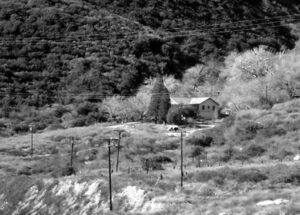
The other day I ran a photo of Hilda Wharton Schultz, and I thought a few memories of the area directly from Hilda would be appreciated. The photo, taken from the Blue Cut rock retaining wall, is of the Carlo home she mentioned.

HILDA’S STORY

By Hilda Wharton Schultz

Stories of Devore? Anyone who’s lived there could come up with pages of stories. My memories contain lots of stories of the Devore area.

My mother, Cora Wharton, was widowed young in West Virginia, and raising three daughters alone was difficult. We moved from a relative’s home in Arkansas to Fontana and from Fontana to Lenhardt’s 80 acres (now shown on Forestry maps as Ruddell Hill). We stayed there and took care of his many goats. After the 1938 flood, which trapped us on the hill for three weeks, we moved to Holcomb’s place in Verdemont. When we left in 1941, we lived for three years at the Obst place to watch their son Artie and care for the many goats. That place later became known as Anna Mill’s Freedom Acres across the canyon from Lenhardt’s, set back from Highway 66. Mr. Obst was the manager of Harris’s Department Store. (And Dr. Lenhardt, a veterinarian, had married Norma, the daughter of a Devore poultry farmer.

During the war (WWII), my sister Joanna and I used to go up to Clyde Ranch on Lone Pine Canyon Road. There was a tower there, and we used to spot airplanes for civil defense. I remember a little schoolhouse below Carlo’s big house that was washed out in the flood of 1938.

I remember election polls at Blue Cut. I remember that Kaylen’s place, the green house at Keenbrook, used to have a post office in it (that house has been replaced by a modular), and I remember the little post office on Cajon Blvd. later on. I remember hiking through the hills near Blue Cut (behind Gem Ranch up near the Heby place) and having my hackles rise when I realized something was following me. I never saw it, but I’m pretty sure it was a cougar.

I remember when Minnie Bradley, who bought my Keenbrook place, got her car stuck on the railroad tracks when it ran off the road a little. I could flag down the engineer, and he stopped in time and helped us move the car.

I remember the wide spot where the helper train engines could turn around to go back to town after making the grade. The turn-around was way past Cozy Dell, but on the other side of the wash. It was a big flat place where lots of tracks intertwined.

I remember when there were holding pens for cattle at the Summit and Ed Barnes’ unusual way of killing rattlesnakes- Fire probably is not the best tool for that job.

Hervey Bailey used to tell me some pretty interesting stories about living at Keenbrook. He used to ride the stagecoach from Keenbrook up to Victorville to eat at the Harvey House. He also enjoyed riding the 20-mule-team Borax wagons. He’s the one who homesteaded the Keenbrook area that included the place where I lived for a time.

I remember, after leaving Keenbrook for Verdemont (I lived at the Houghton place at the top of Palm), coming back to Devore almost every day to clean houses for people or care for their livestock while they were away. I worked for Kendall and Mary Rose Stone and Roger and Alice Hall. That’s where I learned never to trust a ram. I also worked for Superior Court Judge Edward P. and Jane Fogg in north San Bernardino.

Editors note: I met Hilda at my dad’s feed store in 1961. She started working for us during holidays and judging junkets in 1962. She was completely reliable and trustworthy and knew her livestock unbelievably well. We visited her both at her little bungalow tucked between the railroad tracks at Keenbrook and the Houghton place in Verdemont. I’ve always said that everyone needs a Hilda, and I miss having that kind of help since she retired.

The Man Who Dared to Cross the Ranges

Jedediah Smith

from; SOME FORGOTTEN HEROES AND THEIR PLACE IN AMERICAN HISTORY
BY E. ALEXANDER POWELL – 1922

As we ride westward across the mountain ranges to the Pacific with all the ease and luxury a twentieth-century limited train affords, few of us can imagine that those very ranges, now tunneled and spanned, once constituted barriers that the Spaniards in California never dreamed would be passed by trappers, prospectors, or settlers from the United States. This is the story of one of the first who dared to do that seemingly impossible thing —who risked the anger of the Spanish authorities in California, and on his return found the pass and blazed the trail across the Sierras, which later became the overland route to California.

About the word frontiersman, there is a pretty air of romance. The very mention of it conjures up a vision of lean, sinewy, brown-faced men, in fur caps and moccasins and fringed buckskin, slipping through virgin forests or pushing across sun-scorched prairies—advance guards of civilization. Hardy, resolute, taciturn figures, they have passed silently across the pages of our history and we shall see their kind no more. To them we owe a debt that we can never repay—nor, indeed, have we even publicly acknowledged it. We followed by the trails which they had blazed for us; we built our towns in those rich valleys and pastured our herds on those fertile hillsides which theirs were the first white men’s eyes to see.

The American frontiersman was never a self-seeker. His discoveries he left as a heritage to those who followed him. In almost every case he died poor and, more often than not, with his boots on. David Livingstone and Henry M. Stanley, the two Englishmen who did more than any other men for the opening up of Africa, lie in Westminster Abbey, and thousands of their countrymen each year stand reverently beside their tombs. To Cecil Rhodes, another Anglo-African pioneer, a great national memorial has been erected on the slopes of Table Mountain. Far, far greater parts in the conquest of a wilderness, the winning of a continent, were played by Daniel Boone, James Bowie, Kit Carson, Davy Crockett; yet how many of those who today enjoy the fruits of the perils they faced, the hardships they endured, know much more of them than as characters in dime novels, can tell where they are buried, can point to any statues of monuments which have been erected to their memories?

There are nearly three million people in the State of California, and most of them boast of it as “God’s own country.” They have more State pride than any people that I know, yet I would be willing to wager almost anything you please that you can pick a hundred native sons of California, and put to each of them the question, “Who was Jedediah Smith ?” and not one of them would be able to answer it correctly. The public parks of San Francisco and Los Angeles and San Diego and Sacra mento have innumerable statues of one kind and another, but you will find none of this man with the stern old Puritan name; they are starting a hall of fame in California, but no one has proposed Jedediah Smith as deserving a place in it. Yet to him, perhaps more than to any other man, is due to the fact that California is Ameri can; he was the greatest of the pathfinders; he was the real founder of the Overland Trail; he was the man who led the way across the ranges. Had it not been for the trail he blazed and the thousands who followed in his footsteps the Sierra Nevada might still mark the line of our frontier.

The westward advance of the population which took place during the first quarter of the nineteenth century far exceeded the limits of any of the great migrations of mankind upon the older continents. The story of the American onset to the beckoning West is one of the wonder-tales of history. Over the natural waterway of the great northern lakes, down the road to Pittsburg, along the trail which skirted the Potomac, and then down the Ohio, over the passes of the Cumberland into Tennessee, round the end of the Alleghanies into the Gulf States, up the Missouri, and so across the Rockies to the headwaters of the Columbia, or southwestward from St. Louis to the Spanish settlements of Santa Fe, the hardy pioneers poured in an ever-increasing stream, carrying with them little but ax, spade, and rifle, some scanty household effects, a small store of provisions, a liberal supply of ammunition, and unlimited faith, courage, and enterprise.

During that brief period, the people of the United States extended their occupation over the whole of that vast region lying between the Alleghanies and the Rockies—a territory larger than all of Europe, without Russia—annexed it from the wilderness, conquered, subdued, improved, cultivated, civilized it, and all without one jot of governmental assistance. Throughout these years, as the frontiersmen pressed into the West, they continued to fret and strain against the Spanish boundaries. The Spanish authorities, and after them the Mexican, soon became seriously alarmed at this silent but resistless American advance, and from the City of Mexico orders went out to the provincial governors that Americans venturing within their jurisdiction should be treated, whenever an excuse offered, with the utmost severity. But, notwithstanding the menace of Mexican prisons, of Indian tortures, of savage animals, of thirst and starvation in the wilderness, the pioneers pushed westward and ever westward, until at last their further progress was abruptly halted by the great range of the Sierra Nevada, snow-crested, and presumably impassable, which rose like a titanic wall before them, barring their farther march.

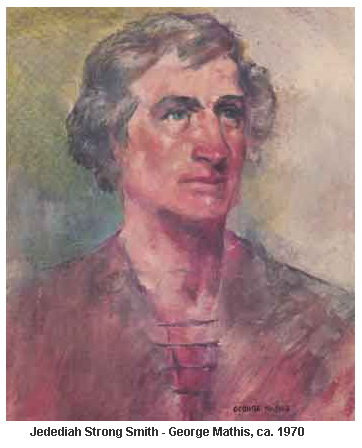
It was at about the time of this halt in our westward progress that Captain Jedediah Smith came riding onto the scene. You must picture him as a gaunt-faced, lean-flanked, wiry man, with nerves of iron, sinews of rawhide, a skin-like oak-tanned leather, and quick on his feet as a catamount. He was bearded to the ears, of course, for razors formed no part of the scanty equipment of the frontiersman, and above the beard shone a pair of very keen, bright eyes, with the concentrated wrinkles about their corners that come of much staring across sun-swept spaces. He was sparing of his words, as are most men who dwell in the great solitudes, and, like them, he was, in an unorthodox way, devout, his stern and rugged features as well as his uncompromising scriptural name betraying the grim old Puritan stock from which he sprang. His hair was long and black and would have covered his shoulders had it not been tied at the back of the neck by a leather thong. His dress was that of the Indian adapted to meet the requirements of the adventuring white man: a hunting-shirt and trousers of fringed buckskin, embroidered moccasins of elk hide, and a cap made from the glossy skin of a beaver, with the tail hanging down behind.

On hot desert marches, and in camp, he took off the beaver-skin cap and twisted about his head a bright bandanna, which, when taken with his gaunt, unshaven face, made him look uncommonly like a pirate. These garments were by no means fresh and gaudy, like those affected by the near-frontiersmen you see on motion picture screens; instead, they were very soiled and much worn and greasy and gave evidence of having done twenty-four hours’ duty a day for many months at a stretch. Hanging on his chest was a capacious powder-horn, and in his belt was a long, straight knife, very broad and heavy in the blade—a first cousin of that deadly weapon to which James Bowie was in after years to give his name; in addition, he carried a rifle, with an altogether extraordinary length of the barrel, which brought death to any living thing within a thousand yards on which its foresight rested. His mount was a plains-bred pony, as wiry and unkempt and enduring as himself. Everything considered, Smith could have been no gentle-looking figure, and I rather imagine that, if he were alive and ventured into a Western town today, he would probably be arrested by the local constable as an undesirable character. I have now sketched for you, in brief, bold outline, as good a likeness of Smith as I am able with the somewhat scanty materials at hand, for he lived and did his pioneering in the days when frontiersmen were as common as traffic policemen are now, added to which the men who were familiar with his exploits were of a sort more ready with their pistols than with their pens.

The dates of Smith’s birth and death are not vital to this story, and perhaps it is just as well that they are not, for I can find no record of when he came into the world, and only the Indian warrior who wore his scalp lock at his waist could have told the exact date on which he went out of it. It is enough to know that, as the nineteenth century was passing the quarter mark, Smith was the head of a firm of fur-traders, Smith, Jackson & Sublette, which had obtained from President John Quincy Adams permission to hunt and trade to the heart’s content in the region lying beyond the Rocky Mountains. It would have been much more to the point to have obtained the permission of the Mexican governor-general of the Californias, or of the great chief of the Comanches, for they held practically all of the territory in question between them.

Those were the days whose like we shall never know again, when the streams were alive with beaver, when there were more elk and antelope on the prairies than there are cattle now, and when the noise made by the moving buffalo herds sounded like the roll of distant thunder. They were the days when a fortune, as fortunes were then reckoned, awaited the man with a sure eye, a body inured to hardships, and unlimited ammunition. What the founder of the Astor fortune was doing in the Puget Sound country, Smith and his companions purposed to do beyond the Rockies; and, with this end in view, established their base camp on the eastern shores of the Great Salt Lake, not far from where Ogden now stands. This little band of pioneers formed the westernmost outpost of American civilization, for between them and the nearest settlement, at the junction of the Mississippi and Ohio Rivers, stretched thirteen hundred miles of savage wilderness. Livingstone, on his greatest journey, did not penetrate half as far into unknown Africa as Smith did into unknown America, and while the English explorer was at the head of a large and well-equipped expedition, the American was accompanied by a mere handful of men.

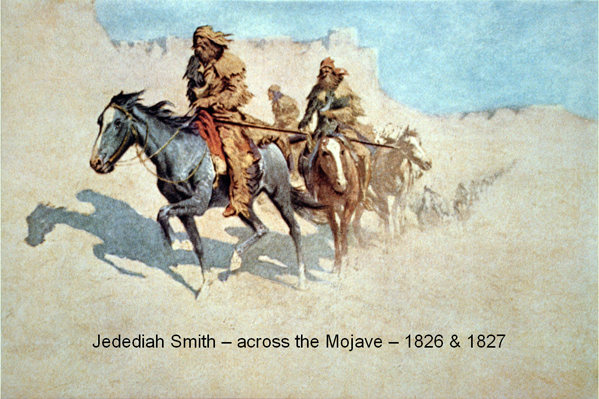
In August 1826, Smith and a small party of his hunters found themselves in the terrible Painted Desert, that God-forsaken expanse of sand and lava where the present states of Arizona, Utah, and Nevada meet. Water, there was none, for the streams had run dry, and the horses and pack-mules were dying of thirst and exhaustion; the game had entirely disappeared; the supplies were all but finished—and five hundred miles of the most inhospitable country in the world lay between them and their camp on the Great Salt Lake. The situation was perilous, indeed, and a decision had to be made quickly if any of them were to get out alive.

“What few supplies we have left will be used up before we get a quarter way back to the camp,” said Smith. “Our only chance—and I might as well tell you it’s a mighty slim one, boys—is in pushing on to California.” “But California’s a good four hundred miles away,” expostulated his companions, “and the Sierras He between, and no one has ever crossed them.”

“Then I’ll be the first man to do it,” said Smith. “Besides, I’ve always had a hankering to learn what lies on the other side of those ranges. Now’s my chance to find out.”

” I reckon there ain’t much chance of our ever seeing Salt Lake or California either,” grumbled one of the hunters, “and even if we do reach the coast the Mexicans’ll clap us into prison.” “Well, so fur’s I’m concerned,” said Smith decisively, “I’d rather be alive and in a Greaser prison than to be dead in the desert. I’m going to California or die on the way.” History chronicles few such marches. Westward pressed the little troop of pioneers, across the sun-baked lava-beds of southwestern Utah, over the arid deserts and the barren ranges of southern Nevada, and so to the foot-hills of that great Sierran range which rears itself ten thousand feet skyward, forming a barrier which had theretofore separated the fertile lands of the Pacific slope from the rest of the continent more effectually than an ocean. The lava-beds gave way to sand wastes dotted with clumps of sage-brush and cactus, and the cactus changed to stunted pines, and the pines ran out in rocks, and the rocks became covered with snow, and still, Smith and his hunters struggled on, emaciated, tattered, almost barefooted, lamed by the cactus spines on the desert, and the stones on the mountain slopes, until at last, they stood upon the very summit of the range and, like that other band of pioneers in an earlier age, looked down on the promised land after their wanderings in the wilderness. No explorer in the history of the world, not Columbus, nor Pizarro, nor Champlain, nor De Soto, ever gazed upon land so fertile and so full of beauty. The mysterious, the jealously guarded, the storied land of California lay spread before them like a map in bas-relief. Then the descent of the western slope began, the transition from snow-clad mountain peaks to hillsides clothed with subtropical vegetation amazing the Americans by its suddenness. Imagine how like a dream come true it must have been to these men, whose lives had been spent in the less kindly climate and amid the comparatively scanty vegetation of the Middle West, to suddenly find themselves in this fairyland of fruit and flowers!

“It is, indeed, a white man’s country,” said Smith prophetically, as, leaning on his long rifle, he gazed upon the wonderful panorama which unrolled itself before him. “Though it is Mexican just now, sooner or later it must and shall be ours.”

Heartened by the sight of this wonderful new country, and by the knowledge that they must be approaching some of the Mexican settlements, but with bodies sadly weakened from exposure, hunger, and exhaustion, the Americans slowly made their way down the slope, crossed those fertile lowlands which are now covered with groves of orange and lemon, and so, guided by some friendly Indians whom they met, came at last to the mission station of San Gabriel, one of that remarkable chain of outposts of the church founded by the indefatigable Franciscan, Father Junipero Serra. The little company of worn and weary men sighted the red-tiled roof of the mission just at sunset.

I doubt if there was a more astonished community between the -oceans than was the monastic one of San Gabriel when this band of ragged strangers suddenly appeared from nowhere and asked for food and shelter. “You come from the South—from Mexico?” queried the father superior, staring, half-awed, at these gaunt, fierce-faced, bearded men who spoke in a strange tongue.

“No, padre,” answered Smith, calling to his aid the broken Spanish he had picked up in his trading expeditions to Santa Fe, “we come from the East, from the country beyond the great mountains, from the United States. We are Americans,” he added a little proudly.

“They say they come from the East,” the brown-robed monks whispered to each other. “It is impossible. No one has ever come from that direction. Have not the Indians told us many times that there is no food, no water in that direction, and that, moreover, there is no way to cross the mountains? It is, indeed, a strange and incredible tale that these men tell. But we will offer them our hospitality in the name of the blessed St. Francis, for that we withhold from no man; but it is the part of wisdom to despatch a messenger to San Diego to acquaint the governor of their coming, for it may well be that they mean no good to the people of this land.”

Had the good monks been able to look forward a few score years, perhaps they would not have been so ready to offer Smith and his companions the shelter of the mission roof. But how were they to know that these ragged strangers, begging for food at their mission door, were the skirmishers for a mighty host which would one day pour over those mountain ranges to the eastward as the water pours over the falls at Niagara; that within rifle-shot of where their mission stood a city of a million souls would spread itself across the hills; that down the dusty Camino Real, which the founder of their mission had trudged so often in his sandals and woolen robe, would whirl strange horseless, panting vehicles, putting a mile a minute behind their flying wheels; that twin lines of steel would bring their southernmost station at San Diego within twenty hours, instead of twenty days, of their northernmost outpost at Sonoma; and that over this new land would fly, not the red-white-and-green standard of Mexico, but an alien banner of stripes and stars?

The four years which intervened between the collapse of Spanish rule in Mexico and the arrival of Jedediah Smith at San Gabriel were marked by political chaos in the Californias. When a governor of Alta California rose in the morning he did not know whether he was the representative of an emperor, a king, a president, or a dictator. As a result of these perennial disorders, the Mexican officials ascribed sinister motives to the most innocent episodes. No sooner, therefore, did Governor Echeandia learn of the arrival in his province of a mysterious party of Americans than he ordered them brought under escort to San Diego for examination. Though those present probably did not appreciate it, the meeting of Smith and Echeandia in the palace at San Diego was a peculiarly significant one.

There sat at his ease in his great chair of state the saturnine Mexican governor, arrogant and haughty, ruffled and gold-laced, his high-crowned sombrero and his velvet jacket heavy with bullion, while in front of him stood the American frontiersman, gaunt, unshaven, and ragged, but as cool and self-possessed as though he was at the head of a conquering army instead of a forlorn hope. The one was as truly the representative of passing as the other was of a coming race. Small wonder that Echeandia, as he observed the hardy figures and determined faces of the Americans, thought to himself how small would be Mexico’s chance of holding California if others of their countrymen began to follow in their footsteps.

He and his officials cross-examined Smith as closely as though the frontiersman was a prisoner on trial for his life, as, in a sense, he was, for almost any fate might befall him and his companions in that remote corner of the continent without anyone being called to account for it. Smith described the series of misfortunes that had led him to cross the ranges; he asserted that he desired nothing so much as to get back into American territory again, and he earnestly begged the governor to provide him with the necessary provisions and permit him to depart. His story was so frank and plausible that Echeandia, with characteristic Spanish suspicion, promptly disbelieved every word of it, for why he argued, should any sane man make so hazardous a journey unless he were a spy and well paid to risk his life? For even in those early days, remember, the Mexicans had begun to fear the ambitions of the young republic to the eastward. So, despite their protests, he ordered the Americans to be imprisoned—and no one knew better than they did that, once, within the walls of a Mexican prison, there was small chance of their seeing the outside world again. Fortunately for the explorers, however, it so happened that there were three American trading-schooners lying in San Diego harbor at the time, and their captains, determined to see the rights of their fellow countrymen respected, joined in a vigorous and energetic protest to the governor against this high handed and unjustified action. This seems to have frightened Echeandia, for he reluctantly gave orders for the release of Smith and his companions, but ordered them to leave the country at once, and by the same route by which they had come.

When the year 1827 was but a few days old, therefore, the Americans turned their faces northward, but instead of retracing their steps in accordance with Echeandia’s orders, they crossed the coast range, probably through the Tejon Pass, and kept on through the fertile region now known as the San Joaquin Valley, in the hope that by crossing the Sierra farther to the northward they would escape the terrible rigors of the Colorado desert. When some three hundred miles north of San Gabriel they attempted to recross the ranges, but a feat that had been hazardous in midsummer was impossible in midwinter, and the entire expedition nearly perished in the attempt. Several of the men and all the horses died of cold and hunger, and it was only by incredible exertions that Smith and his few remaining companions, terribly frozen and totally exhausted, managed to reach the Santa Clara Valley and Mission San Jose.

So slow was their progress that the news of their approach preceded them and caused considerable disquietude to the monks. Learning from the Indians that he and his followers were objects of suspicion, Smith sent a letter to the father superior, in which he gave an account of his arrival at San Gabriel, of his interview with the governor, of his disaster in the Sierras, and of his present pitiable condition. “I am a long way from home,” this pathetic missive concludes, “and am anxious to get there as soon as the nature of the case will permit. Our situation is quite unpleasant, being destitute of clothing and most of the necessaries of life, wild meat being our principal subsistence. I am, reverend father, your strange but real friend and Christian brother, Jedediah Smith.” As a result of this appeal, the hospitality of the mission was somewhat grudgingly extended to the Americans, who were by this time in the most desperate condition.

Hardships that would kill ordinary men were but unpleasant incidents in the lives of the pioneers, however, and in a few weeks they were as fit as ever to resume their journey. But, upon thinking the matter over, Smith decided that he would never be content if he went back without having found out what lay still farther to the northward, for in him was the insatiable curiosity and the indomitable spirit of the born explorer. But as his force, as well as his resources, had become sadly depleted, he felt it imperative that he should first return to Salt Lake and bring on the men, horses, and provisions he had left there. Accordingly, leaving most of his party in camp at San Jose, he set out with only two companions, recrossed the Sierra at one of its highest points (the place he crossed is where the railway comes through today), and after several uncomfortably narrow escapes from landslides and from Indians, eventually reached the camp on the Great Salt Lake, where he found that his people had long since given him and his companions up for dead.

Breaking camp on a July morning, in 1827, Smith, with eighteen men and two women, turned his face once more toward California. To avoid the snows of the high Sierras, he chose the route he had taken on his first journey, reaching the desert country to the north of the Colorado River in early August. It was not until the party had penetrated too far into the desert to retreat that they found that the whole country was burnt up. For several days they pushed on in the hope of finding water. Across the yellow sand wastes, they would sight the sparkle of a crystal lake and would hasten toward it as fast as their jaded animals could carry them, only to find that it was a mirage.

Then the horrors preliminary to death by thirst began: the animals, their blackened tongues protruding from their mouths, staggered and fell, and rose no more; the women grew delirious and babbled incoherent nothings; even the hardiest of the men stumbled as they marched, or tried to frighten away by shouts and gestures the fantastic shapes which danced before them. At last, there came a morning when they could go no farther. Such of them as still retained their faculties felt that it was the end—that is, all but Jedediah Smith. He was of the breed which does not know the meaning of defeat because they are never defeated until they are dead. Loading himself with the empty water bottles, he set out alone into the desert, determined to follow one of the numerous buffalo trails, for he knew that sooner or later it must lead him to the water of some sort, even if to nothing more than a buffalo-wallow.

Racked with the fever of thirst, his legs shaking from exhaustion, he plodded on, under the pitiless sun, mile after mile, hour after hour, until, struggling to the summit of a low divide, he saw the channel of a stream in the valley beneath him. The expedition was saved. Stumbling and sliding down the slope in his haste to quench his intolerable thirst, he came to a sudden halt on the riverbank. It was nothing but an empty watercourse into which he was staring—the river had run dry! The shock of such a disappointment would have driven most men mad. Only for a moment, however, was the veteran frontiersman staggered; he knew the character of many streams in the West—that often their waters run underground a few feet below the surface, and in a moment he was on his knees digging frantically in the soft sand. Soon the sand began to grow moist, and then the coveted water slowly began to filter upward into the little excavation he had hollowed.

Throwing himself flat on the ground, he buried his burning face in the muddy water—and as he did so a shower of arrows whistled about him. A war party of Comanches, unobserved, had followed and surrounded him. He had but exchanged the danger of death by thirst for the even more dreadful fate of death by torture. Though struck by several of the arrows, he held the Indians off until he had filled his water-bottles; then, retreating slowly, taking advantage of every particle of cover, as only a veteran plainsman can, blazing away with his unerring rifle whenever an Indian was incautious enough to show himself, Smith succeeded in getting back to his companions with the precious water. With their dead animals for breastworks, the pioneers succeeded in holding the Indians at bay for six-and-thirty hours, but on the second night the redskins, heavily reinforced, rushed them in the night, ten of the men and the two women being killed in the hand-to-hand fight which ensued, and the few horses which remained alive being stampeded. I rather imagine that the women were shot by their own husbands, for the women of the frontier always preferred death to capture by these fiends in paint and feathers.

How Smith, calling to his assistance all his craft and experience as a plainsman, managed to lead his eight surviving companions through the encircling Indians by night, and how, wounded, horseless, and provisionless as they were, he succeeded in guiding them across the ranges to  San Bernardino , is but another example of this forgotten hero’s courage and resource. Having lost everything that he possessed, for the whole of his scanty savings, had been invested in the ill-fated expedition, Smith, with such of his men as were strong enough to accompany him, set out to rejoin the party he had left some months previously at Mission San Jose. Scarcely had he set foot within that settlement, however, before he was arrested and taken under escort to Monterey, where he was led before the governor, who, he found to his surprise and dismay, was no other than his old enemy of San Diego, Don Jose Echeandia.

This time nothing would convince Echeandia that Smith was not the leader of an expedition that had territorial designs on California, and he promptly ordered him to be taken to prison and kept in solitary confinement as a dangerous conspirator. Thereupon Smith resorted to the same expedient he had used so successfully and begged the captains of the American vessels in the harbor of Monterey for protection. So forcible were their representations that Echeandia finally agreed to release Smith on his swearing to leave California for good and all.

To this proposal Smith willingly agreed and took the oath required of him, but, upon being released from prison, was astounded to learn that the governor had given orders that he must set out alone—that his hunters would not be permitted to accompany him. His and their protestations were disregarded. Smith must start at once and unaccompanied. He was given a horse and saddle, provisions, blankets, a rifle—and nothing more. It was a sentence of death that Echeandia had pronounced on this American frontiersman, and both he and Smith knew it. Without having committed any crime—unless it was a crime to be an American—Jedediah Smith was driven out of the territory of a supposedly friendly nation and told that he was at perfect liberty to make his way across two thousand miles of wilderness to the nearest American outpost—if he could.

Striking back into that range of the Sierras which lies southeast of Fresno, Smith succeeded in crossing them for the fourth time, evidently intending to make his way back to his old stamping-ground on the Great Salt Lake. Our knowledge of what occurred after he had crossed the ranges for the last time is confined to tales told to the settlers in later years by the Indians. While emerging from the terrible Death Valley, where hundreds of emigrants were to lose their lives during the rush to the goldfields a quarter of a century later, he was attacked at a water-hole by a band of Indians.

For many years afterward the Comanches were wont to tell with admiration how this lone paleface, coming from out of the setting sun, had knelt behind his dead horse and held them off with his deadly rifle all through one scorching summer’s day. But when nightfall came they crept up silently under cover of the darkness and rushed him. His scalp was highly valued, for it had cost the lives of twelve Comanche braves.

But Jedediah Smith did not die in vain. Tales of the rich and virgin country which he had found beyond the ranges flew as though with wings across the land; soon other pioneers made their way over the mountains by the trails which he had blazed; long wagon- trains crawled westward by the routes which he had taken; strange bands of horsemen pitched their tents in the valleys where he had camped. The mission bells grew silent; the monk in his woolen robe and the caballero in his gold-laced jacket passed away; settlements of hardy, energetic, nasal-voiced folk from beyond the Sierras sprang up everywhere. Then one day a new flag floated over the presidio in Monterey—a flag that was not to be pulled down. The American republic had reached the western ocean and thus was fulfilled the dream of Jedediah Smith, the man who showed the way.

from; SOME FORGOTTEN HEROES AND THEIR PLACE IN AMERICAN HISTORY
BY E. ALEXANDER POWELL – 1922