The Borax Machine

Borate, Marion, and Daggett are best understood not as separate curiosities, but as three parts of one late nineteenth-century borax machine. Borate was mined in the Calico district. Marion was the crushing and calcining plant that handled treatment and transfer. Daggett was the rail junction and shipping outlet where desert production met the wider market. That is why the formal railroad name remained the Borate and Daggett Railroad even though Marion stood near the operational center of the system. The California historic record identifies Marion as a Pacific Coast Borax crushing and calcinating plant established in 1898, while another historic registration summary describes the Borate and Daggett line as spanning about 11 miles, narrow gauge from Borate to Marion and standard gauge beyond.
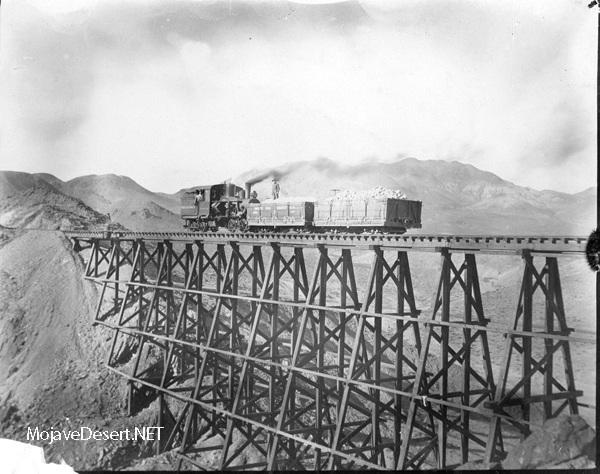
The system grew out of a transport problem. Once Francis Marion Smith shifted attention from the older Death Valley borax works to the richer colemanite deposits near Borate, ore had to be moved efficiently across difficult ground to a railroad outlet. Cindy Baker’s history of Daggett says Smith moved his operations from Harmony Borax Works to Daggett, opened mining at Borate, used twenty-mule teams to haul borax to the processing works at Daggett, and then replaced the mule haul with the Borate and Daggett Railroad. The same source describes Daggett during the borax years as a hub of shipping and transfer activity.

There is a small dating tension in the surviving sources, and it is worth keeping rather than smoothing over. Baker places the railroad in 1896, while the California Historical Record lists the Marion plant as built in 1898. The safest reading is that the Borate-Marion-Daggett rail and processing system took shape in the late 1890s, with the railroad and plant representing one integrated industrial build-out rather than three disconnected events. In historical writing, that is the cleaner way to respect both citations without forcing a false precision.

What makes the system important in Mojave terms is that it marks a transition from wagon-borax to rail-borax. The older heroic image of desert haulage did not disappear by legend alone; it was displaced by a tighter industrial corridor in which mine, mill, and junction were coordinated. Borate became the country’s chief producer of borax and boracic acid from 1890 to 1907, according to the Death Valley historic resource study, but the district was never the end of the story. As Smith’s attention turned toward the Lila C and the Tonopah and Tidewater reached Death Valley Junction in 1907, Borate was abandoned, and its equipment moved on.

Seen this way, Borate, Marion, and Daggett form a hinge point in Mojave industrial history. Borate supplied the ore, Marion gave the system its processing heart, and Daggett connected the entire enterprise to the transcontinental freight world. The line was short, but its historical value is larger than its mileage because it shows exactly how the Mojave’s extractive economy moved from freighting tradition into a coordinated rail industry.

Daggett

Barstow Area Mining

The history of mining in the Barstow area is closely tied to the extraction of various minerals and resources that played a significant role in the development of Southern California. Here’s a more detailed look at the history of mining in the Barstow area:

  1. Borax Mining: Borax mining was one of the earliest mining activities in the Barstow region. In the late 19th century, borax deposits, a valuable industrial mineral used in various applications, were discovered in the nearby Calico Mountains. The Pacific Coast Borax Company, owned by Francis Marion “Borax” Smith, was instrumental in developing borax mines in the area. This marked the beginning of significant mining operations in the region, with borax being a primary focus.
  2. Calico Mining District: The Calico Mining District, which includes the town of Calico, was a major center of mining activity in the Barstow area. Silver and silver-lead ores were the primary resources mined in this district. At its peak in the late 1800s, Calico had a population of over 3,000 people and was a bustling mining town.
  3. Calico Ghost Town: Calico, often referred to as Calico Ghost Town today, was once a thriving mining town. It featured numerous mines, including the Bismarck, Silver King, and Oriental Mines. Visitors to Calico can explore the well-preserved historic buildings, mines, and artifacts, gaining insight into the region’s mining history.
  4. Railroad Transportation: The expansion of railroads played a crucial role in facilitating the transportation of mined materials from the Barstow area to other parts of California and beyond. The Atchison, Topeka, and Santa Fe Railway was a key transportation link for the mining industry, enabling the efficient movement of ores and minerals.
  5. Variety of Minerals: While borax, silver, and silver-lead ores were among the most significant resources mined in the Barstow area, various other minerals were also extracted. These included gypsum, limestone, and barite. These minerals had industrial applications and were important for construction and manufacturing.
  6. Decline of Mining: As the easily accessible mineral deposits were depleted, mining activities in the Barstow area began to decline. Many mines were abandoned, and mining communities saw a decrease in population. The shift in economic focus led to the decline of mining as a major industry in the region.

Today, the mining history of the Barstow area is preserved through places like Calico Ghost Town, museums, and historical sites. These serve as reminders of the pioneering spirit of early miners and the role mining played in shaping the history of Barstow and the surrounding region.

Barstow Mining,Mojave Desert Mining,Mining History,Barstow Area Mines,Mojave Desert Geology,Mining Towns,Historic Mining Sites,California Mining History,Barstow Geology,Old Mines in Barstow,Desert Mining Operations,Gold Mining,Silver Mining,Mining Artifacts,Barstow Natural History,Mining Camps,Mineral Exploration,Abandoned Mines,Mining Technology,Mojave Desert Resources