Greenwater Railroad

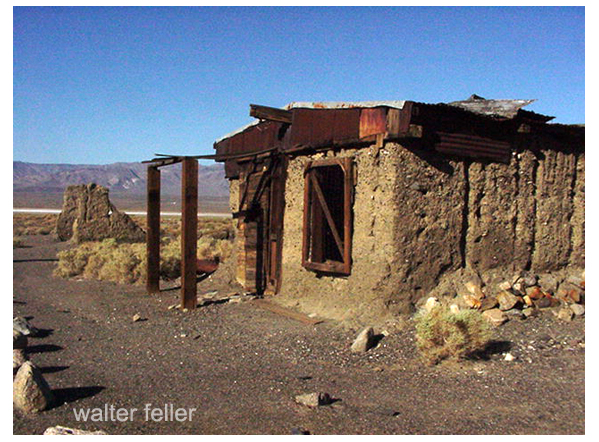
Greenwater, California, emerged during the 1905-1906 copper rush on the eastern edge of Death Valley, in the Funeral Mountains. Like many desert boom camps, it was not fixed in place. The first settlement developed near the claims but proved poorly suited for growth, with limited space and difficult access for freight and supplies.

Railroad access was the central driver. Moving the town onto the valley floor improved the possibility of a rail connection or, at a minimum, easier wagon haulage from nearby lines serving the Bullfrog and Rhyolite districts. In a region where water, fuel, and ore all depended on transport cost, proximity to a viable route could determine whether a camp survived.

As speculation intensified, promoters established a new townsite on more open ground and encouraged residents and businesses to relocate. This shift, sometimes identified with the Ramsey townsite, reflects a familiar pattern in the Mojave and Great Basin mining frontier: towns did not simply grow where they began – they repositioned themselves to match transportation logic.

Despite the optimism, the infrastructure never fully materialized at Greenwater. Water remained scarce, development was over-promoted, and many mining ventures proved speculative. By 1909, the boom collapsed, leaving behind scattered foundations and the imprint of a town that tried to move itself into viability.

Greenwater stands as a clear example of how transportation expectations shaped settlement patterns in the desert—sometimes even more than the resources that first drew people there.

https://digital-desert.com/greenwater

The Desert Character of Its People

1) Foundation: People shaped by limits

The earliest desert people were not simply residents; they were formed by the land itself. Groups such as the Mojave people and Southern Paiute lived within a system defined by scarcity, timing, and precision.

Water determined everything. Springs, washes, and seasonal flows organized movement. Knowledge was practical and inherited, not optional. A person needed to know where to go, when to move, and how to use what was available.

This produced a distinct human type:

  • Memory-based knowledge of place
  • Endurance and adaptability
  • Careful use of limited resources
  • Cultural continuity is tied directly to the landscape

The desert was not something to overcome. It was something to understand.


2) Transitional figure: The crosser and builder

In the 19th century, a different kind of person entered the desert: traders, soldiers, freighters, miners, ranchers, and surveyors. Routes like the Old Spanish Trail carried people across the region rather than within it.

These individuals did not have generations of accumulated knowledge, but they still had to respect the desert’s limits. Many adapted quickly; others did not last.

Their traits were different:

  • Practical, experience-driven learning
  • Willingness to take risks
  • Dependence on known routes and water points
  • Early shift toward ownership, extraction, and control

They began reshaping the desert, but they had not yet escaped its authority.


3) Industrial desert people: Workers of the corridor

With the arrival of large-scale infrastructure, the desert produced a different kind of person. Railroads such as the Atchison, Topeka, and Santa Fe Railway and the Southern Pacific Railroad, followed by highways like Route 66, transformed the region into a corridor.

The people of this phase were workers tied to systems: railroad crews, station agents, mechanics, miners, motel owners, and military personnel.

Their relationship to the desert shifted:

  • Less reliance on natural water and terrain knowledge
  • Greater reliance on infrastructure
  • Identity tied to function (rail hub, highway stop, base town)
  • Continued toughness, but within organized systems

The desert still mattered, but it mattered indirectly. The system stood between the person and the land.


4) Contemporary condition: Layered and divided identities

Today, desert populations are not uniform. In places like Victorville and Apple Valley, people of many types coexist, often with very different relationships to the land.

These include:

  • Long-time residents with inherited knowledge
  • Commuters tied to outside economies
  • Logistics and warehouse workers are connected to national systems
  • Retirees seeking space and climate
  • Recreational users (off-roaders, hikers, tourists)
  • Preservation-focused individuals
  • Developers and energy interests

These groups do not share a single understanding of what the desert is.

Modern traits tend to include:

  • Reduced dependence on local ecological knowledge
  • High mobility and population turnover
  • Identity is shaped by lifestyle rather than landscape
  • Fragmented sense of place

The desert person is no longer one type. It is a mix of overlapping roles.


5) Structural shift: From land-taught to system-supported

The core change can be stated clearly:

Desert people moved from being shaped by the land to being supported by systems that buffer them from it.

Earlier conditions:

  • Knowledge was necessary for survival
  • Mistakes had immediate consequences

Modern conditions:

  • Infrastructure absorbs risk (water systems, roads, services)
  • Direct knowledge of the land is no longer required for daily life

This shift did not remove the desert’s influence, but it reduced its direct control over behavior.


6) Continuities: What has not disappeared

Some traits persist where the desert still exerts pressure:

  • Toughness and endurance
  • Independence and skepticism of outside control
  • Improvisation under constraint
  • Strong attachment to space and openness

These qualities remain evidence of the older desert character, still present beneath modern conditions.


7) Cultural consequence: A divided meaning of the desert

The modern desert holds multiple meanings at once:

  • Home
  • Opportunity
  • Hardship
  • Scenery
  • Memory
  • Resource

Because people no longer depend on the land in the same way, they no longer share a single desert identity.


Bottom line

Desert people evolved through three broad stages:

  • Land-taught inhabitants shaped by necessity and knowledge
  • Transitional builders and workers balancing constraint and control
  • Modern system-supported populations living within a layered infrastructure

The deeper shift is this:

from direct dependence on the land
to mediate life within systems built across it

But the underlying desert remains unchanged, and it still quietly determines what is possible

Daggett — Rail Junction + Early Hub Node

Daggett occupies a decisive position in the Mojave rail system. While smaller in present appearance than nearby Barstow, its historical and structural role is foundational. It is the point where the trans-Mojave railroad, advancing eastward from Mojave, first established a stable desert operating base tied directly to the Mojave River corridor. Before Barstow emerged as the dominant classification center, Daggett served as the region’s early rail hub and the initial organizing node for eastward expansion toward the Colorado River.

The arrival of the Southern Pacific Railroad at Daggett in the early 1880s marked a transition from mountain-to-desert rail building into true trans-desert operation. From this point, construction continued east toward Needles, completing the Mojave crossing in 1883. At the same time, the broader competitive framework involving the Atlantic and Pacific Railroad and, later, the Atchison, Topeka, and Santa Fe Railway placed Daggett within a contested, strategically important rail geography.

Daggett’s importance is not just chronological, but geographic. It sits along the Mojave River, one of the few reliable water corridors in the desert. That placement made it viable as a servicing and staging point in an otherwise resource-scarce environment. Early railroad logistics depended heavily on water, fuel, and manageable grades, and Daggett offered all three within a workable alignment. In this sense, the town represents the moment when the railroad system fully adapted to desert conditions rather than simply crossing into them.

Structurally, Daggett operates as an intermediate junction and early hub, positioned between Mojave and Barstow. It does not replace either node but instead explains how the system developed between them. Mojave serves as the western pivot, and Barstow later becomes the dominant classification hub, but Daggett shows the earlier phase of organization when rail operations first stabilized in the central Mojave. It is also tied to branching industrial and mining lines, including connections associated with borax and desert resource extraction, which radiated outward from this corridor.

Within the Mojave system framework, Daggett belongs to several layers simultaneously. It is part of the Mojave-Needles trans-desert corridor, a node along the Mojave River spine, and an early operational anchor that predates Barstow’s later dominance. This layered identity makes it essential to explain not just where the railroad went, but also how it functioned during its formative period.

Owens Valley Mining Belt – East-Side Industrial System

Introduction

The east side of Owens Valley developed as more than a scattering of isolated mines. It became a connected industrial strip linking the mineralized slopes of the Inyo Mountains to wagon roads, lake-edge landings, smelters, and transfer points on the valley floor. In this system, ore did not simply come out of the mountains and disappear. It moved through a chain of infrastructure. Cerro Gordo and related districts supplied the resource base; Keeler, Swansea, and other shore-side points handled staging, transport, and processing; Owens Lake itself briefly functioned as an internal transport surface. What emerged was a compact but highly integrated extraction network, one shaped by topography, freight logic, and the temporary usefulness of the lake basin. Today, ruins, roads, slag, and abandoned townsites still mark that industrial layer across the east side of the valley.

Resource Zone – Inyo Mountains

The industrial system began in the Inyo Mountains, where ore bodies in the eastern wall of the valley drove the development of camps, roads, and freight routes. The best-known node in this belt is Cerro Gordo, whose silver and lead production made it one of the dominant extraction centers tied to Owens Valley. Other mountain-side sites and supporting works formed part of the same general pattern: mineral wealth concentrated in the range, but movement and processing depended on infrastructure below.

This creates the first rule of the mining belt:
mountains produce, valley systems move.

Descent to the Valley Floor

Ore had to descend from steep mountain districts to usable transfer points on the valley floor and lake margin. That required wagon roads, freight teams, landing sites, and service settlements positioned where mountain output could enter a broader transport chain. In structural terms, the east face of Owens Valley was not just a scenic boundary. It was an industrial wall, feeding material down into a narrow working strip between mountain front and lake.

This descent zone linked extraction to infrastructure. Without it, the mines remained isolated. With it, they became part of a valley-wide industrial system.

Lake-Edge Processing and Transfer System

Once ore reached the lower basin, it entered the lake-edge belt. This is where sites such as Keeler, Swansea, and the Keeler smelter become central. These were not random settlements. They were functional nodes positioned to receive mountain output, process material, and pass it along.

Keeler operated as one of the principal lake-edge settlements tied to the Cerro Gordo system. Swansea formed part of the same industrial shoreline logic. Smelting and staging at the lake margin turned raw extraction into a more organized production chain. The shoreline became a working interface between mountain mining districts and wider transport systems.

Owens Lake Transport Layer

One of the most distinctive parts of the east-side industrial system was the temporary use of Owens Lake as transport infrastructure. Steamers and barges turned the lake into a connective surface, allowing freight and materials to move across the basin more efficiently than they could by rough overland detours around the shoreline.

This matters because it shows that Owens Lake was not only a natural terminal basin. For a time, it was also an industrial tool. The lake helped compress distance inside the valley and linked separate industrial nodes into a more coherent operational system.

That is one of the defining insights of the mining belt:
the lake itself became part of the machinery.

Industrial Decline

The system was never permanent. Its stability depended on ore production, freight economics, and the continued usefulness of lake-based transport and shoreline industry. As mining output declined, transport patterns changed, and new rail and road systems altered regional logistics, the lake-edge industrial network weakened.

Later hydrologic change deepened the collapse. The transformation of Owens Lake from a standing terminal lake into a largely dry playa stripped away the basin condition that had once helped support this industrial pattern. What remained were fragments: declining towns, abandoned works, smelter traces, and disrupted industrial relationships.

Residual Landscape

The east side of Owens Valley still preserves the remains of this system in visible form. Keeler survives as a diminished settlement with a strong ghost-town character. Swansea persists as a ruin field and historical footprint. Smelter remains, road traces, cemetery landscapes, lake-edge industrial scars, and mountain freight alignments all continue to mark the old belt.

These remnants should not be treated as isolated curiosities. Together they form a legible industrial landscape – one that still explains how the valley once functioned as an extraction corridor.

Corridor Integration

This industrial layer fits directly into your Owens Valley system:

  • Bishop anchors the upper valley service and support layer, though the principal east-side mining belt intensifies farther south.
  • Independence helps stabilize the central valley and provides administrative context for the industrial corridor.
  • Lone Pine ties into the southern part of the valley system and helps frame the broader movement network connected to mining and freight.
  • Olancha-Haiwee marks the point where the Owens Valley corridor transitions away from the main east-side industrial belt and toward Mojave-facing systems.
  • The hydrology spine is inseparable from this story, because Owens Lake was once part of the industrial transport system and later, in altered form, became evidence of the valley’s transformed condition.

Significance

The Owens Valley east side was not just mined. It was systematically industrialized using the mountain front, valley floor, and lake basin as linked infrastructure. Ore came out of the Inyo Mountains, descended to transfer points, crossed or skirted the lake system, and moved through smelters and shoreline settlements in a connected chain. That makes the mining belt one of the clearest human-use layers in the valley: a short-lived but highly integrated extraction network built directly on geographic structure.

One-line Summary

The Owens Valley Mining Belt is the east-side industrial system where mountain ore, lake transport, and valley infrastructure combined into a tightly linked extraction network.

What was done: Built the Owens Valley Mining Belt as a unified industrial-layer page connecting Cerro Gordo, the Inyo Mountains, Keeler, Swansea, smelting, lake transport, and decline into one causal system.

John Hockaday and the Study of Cajon Pass

John Hockaday spent much of his life in the Lytle Creek and Cajon Pass area, where he developed a deep familiarity with one of Southern California’s most important geographic corridors. He often described himself simply as “just an old construction worker who likes history,” but over time, that interest grew into a sustained, methodical study of the pass and its role as a gateway between the San Bernardino Valley and the Mojave Desert.

For more than four decades, Hockaday worked directly with the landscape. He walked abandoned road grades, traced alignments across hillsides and washes, compared historic maps with what remained on the ground, and photographed features that marked earlier phases of travel. His research was not confined to archives. It was built in the field, where physical evidence could be tested against historical records. He also collected oral histories from residents and families connected to the Route 66 and railroad eras, preserving local knowledge that might otherwise have been lost.

His work centers on Cajon Pass as a layered transportation corridor. Long before modern highways, the pass carried Native travel routes linking desert and valley systems. These pathways were later incorporated into the Old Spanish Trail and related trade routes. During the nineteenth century, the same corridor was used by Mormon migrants, emigrant parties, and freight operators moving goods between inland settlements and the coast. Wagon roads and toll roads formalized these routes, leaving behind cuts, benches, and grades that can still be seen today.

With the rise of automobile travel, Cajon Pass became part of the National Old Trails Road and later U.S. Route 66. Hockaday devoted particular attention to identifying the multiple alignments of Route 66 through the pass, distinguishing early grades from later improvements and documenting segments that have since been abandoned or erased. His work also extends into the transition to Interstate 15, showing how modern infrastructure continues to follow the same fundamental corridor established by earlier routes.

Working with his wife, Sandy Hockaday, he published the Trails & Tales of the Cajon Pass series. These books combine narrative history with maps, photographs, and firsthand accounts, offering one of the most complete modern records of travel through the pass. He also contributed to the National Park Service Old Spanish Trail mapping project, assisting in the identification of route segments and related features within the Cajon Pass region.

Among Southern California historians, Hockaday is best understood as a field historian. His approach emphasizes direct observation and verification, using the landscape itself as primary evidence. Rather than relying solely on written sources, he worked to confirm where routes actually ran, how they shifted over time, and what physical traces remained. This method allowed him to document not only the idea of a route but also its actual position on the ground.
His work helped preserve knowledge of early wagon road alignments, Route 66 grades, Camp Cajon, and the early automobile travel era, and the broader development of rail and highway systems through the pass. As development, erosion, and time continue to erase older features, that record has become increasingly important.

Cajon Pass has always functioned as a gateway, shaped by geography and repeatedly reused by successive generations. Hockaday’s work clearly demonstrates continuity. By documenting the corridor at ground level, he showed how each layer of travel builds on the last, forming a continuous thread from Native footpaths to modern interstate highways.

Uneasy History

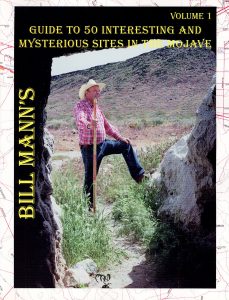
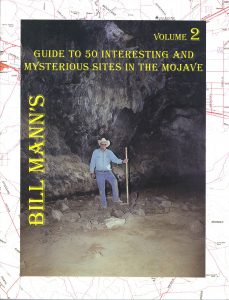
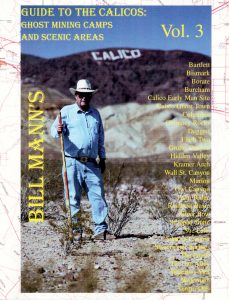
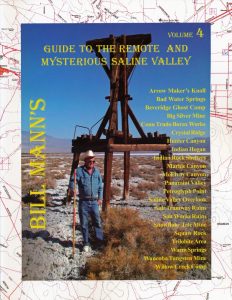
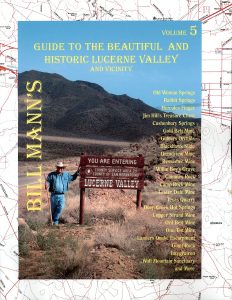
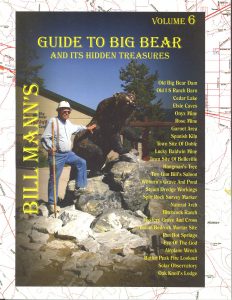
Bill Mann’s books occupy an uneasy place in Mojave Desert history. They are valued by many readers because they preserve a kind of field knowledge that was once passed from explorer to explorer, prospector to prospector, and local historian to local historian. His guidebooks were published by the Mojave River Valley Museum, and the series was built around little-known desert places in the Mojave, the Calicos, Saline Valley, Lucerne Valley, and Big Bear regions. Museum listings and booksellers describe the books as guides to “interesting and mysterious” sites, with coverage of remote backcountry places and, in some editions or descriptions, GPS coordinates and vehicle requirements.

That is also where the controversy begins.

The issue is not that Bill Mann became the center of a single famous scandal. The controversy is structural. His books belong to a long-running desert argument over whether publishing directions to obscure places is a form of preservation or exposure. When guidebooks identify fragile ruins, mining camps, rock formations, or little-known historic sites, they can preserve memory and broaden public knowledge. At the same time, they can increase traffic to places that had previously been protected by distance, obscurity, or the simple difficulty of finding them. The books themselves were marketed around places that “few people know about,” which makes that tension especially clear.

In the older field-guide era, that risk was partially limited by friction. A reader still had to acquire the book, interpret the directions, read the landscape, and navigate difficult terrain. Printed guidebooks did not behave like digital information does today. They spread more slowly, required more effort, and usually reached a narrower audience. In that older setting, a desert guide could reveal a place without instantly turning it into a widely circulated waypoint. That does not mean there was no danger, only that the rate and scale of disclosure were different. This is why Mann’s books can be understood as part of a pre-digital field-guide tradition rather than as modern mass-access publishing. The surviving descriptions of the series consistently frame them as backcountry exploration guides rooted in firsthand desert travel.

A second source of controversy is methodological. Mann’s books are useful, but they are not usually treated as academic works. Reviews and summaries describe them as broad, eclectic field guides covering mining ruins, homesteads, curiosities, scenic areas, and oddities across the desert. That kind of book can be rich in leads, local knowledge, and exploratory value, but it does not carry the same authority as a tightly sourced historical monograph or archaeological report. The result is that researchers may respect the books as guide-layer material while still feeling the need to verify individual claims, route logic, or site identifications against other records.

So the real controversy around Bill Mann’s books is best described in three parts. First, they disclose obscure places. Second, some of those places may be fragile. Third, the books sit in a gray area between field exploration, local history, and public site-sharing. For readers who value openness, these books are generous and important. For readers concerned with site protection, that same quality can seem careless or outdated. Both reactions come from the same fact: the books were designed to help people find places that were not widely known.

In that sense, the controversy is larger than Bill Mann himself. His books are evidence of a transition in desert culture. They come from a period when local knowledge was beginning to move from oral tradition and private notes into wider print circulation. Today, in a digital environment, that same kind of site-sharing raises sharper ethical questions because information can be copied, mapped, reposted, and amplified far beyond the original context. What once functioned as a field guide can now operate like a distribution system. That is why Mann’s books remain historically valuable, but also why modern public-facing desert projects often handle this kind of source material with more caution than earlier guide writers did.

For Mojave work today, the fairest reading is this: Bill Mann’s books matter because they preserved a layer of desert knowledge that might otherwise have been lost. The controversy is that preserving such knowledge in public form can also place vulnerable sites at risk. That tension, more than any personal scandal, is what defines the debate around his books.

The Quiet Disappearance of History in the Digital Age

The internet was once treated as a kind of open archive – a distributed record of human activity where information, once published, was expected to remain accessible. That expectation has proven unreliable. Increasingly, history online is not being preserved. It is being lost, displaced, edited, or buried.

This is not a single process. It is the result of several overlapping forces, some structural, some deliberate.

The most basic cause is decay. The internet is not built like a library; it is built like a marketplace. Content exists so long as it generates value, whether through traffic, advertising, or institutional relevance. When that value declines, maintenance stops. Domains expire, file structures change, images disappear, and links break. Over time, entire layers of information collapse into what is now commonly called “link rot.” What appears stable is often temporary.

This alone accounts for a significant portion of historical loss. Independent websites, early digital archives, and personal research pages – once the backbone of the early web – are particularly vulnerable. These were often maintained by individuals or small groups without long-term institutional support. When the creator moves on, retires, or dies, the site often follows.

A second force is centralization. Over the past two decades, much of the internet’s content has migrated from independent domains into large, privately controlled platforms. Social media, hosting services, and content networks now hold vast amounts of material that once would have existed in open, self-managed spaces. These platforms are not designed for permanence. They are governed by changing policies, legal exposure, and commercial priorities. Content can be removed, hidden, or deprioritized without warning. When a platform declines or shifts direction, the historical material contained within it can disappear just as quickly.

A third factor is legal pressure. Preservation is not always aligned with ownership. Copyright law, licensing restrictions, and institutional control limit what can be archived and how it can be shared. Organizations dedicated to preservation operate within increasingly narrow constraints, while deletion remains straightforward. The imbalance is structural: it is easier to remove information than to preserve it.

A fourth force is institutional revision. Governments, agencies, and organizations routinely update their public-facing material. This has always been true, but digital systems accelerate the process and obscure the record of change. Earlier versions are often overwritten rather than preserved. What remains is not necessarily a complete record, but the most recent version deemed acceptable.

The National Park Service provides a clear modern example of this process in action. As one of the primary interpreters of American history at the landscape level, the NPS shapes how millions of visitors understand the past. Its role extends beyond land management into narrative construction – deciding how events, people, and places are presented.

Under directives to remove or revise material considered “disparaging,” park staff were asked to review interpretive content addressing subjects such as slavery, Indigenous displacement, civil rights struggles, and other difficult aspects of American history. The term itself was vague, but its application was concrete. Content could be flagged not because it was inaccurate, but because it presented the past in a way that conflicted with a preferred narrative.

This does not require wholesale deletion to be effective. A paragraph rewritten, a label softened, a reference removed, or a subject narrowed can significantly alter interpretation. In some cases, exhibits were modified or removed. In others, language was adjusted to reduce emphasis on conflict or injustice. The sites themselves remain unchanged, but the meaning attached to them shifts.

This is not a new phenomenon. Institutions have always shaped historical narratives. What is different is the speed and invisibility of the process. A webpage can be revised instantly. An earlier version can disappear without a trace unless it has been independently archived. The revision becomes the record.

There is also a more subtle mechanism at work: burial. Even when historical material is not deleted, it can be effectively lost beneath the volume of modern content. The contemporary web is saturated with low-value, automated, and algorithmically amplified material. Search systems prioritize engagement, recency, and optimization. Older, less structured, or less commercially viable sources are pushed down, becoming increasingly difficult to locate. In practice, obscurity can function as a form of erasure.

Taken together, these forces produce a fundamental shift. The internet is no longer a reliable long-term repository of history. It is a dynamic system where information persists only if it is actively maintained, protected, and surfaced.

This has implications beyond convenience. Historical understanding depends on continuity – the ability to trace ideas, events, and places across time. When earlier records disappear or are altered without context, that continuity breaks. What remains is not necessarily false, but it is incomplete.

In this environment, independent archives, local history projects, and personally maintained research collections take on increased importance. They function as deliberate acts of preservation within a system that does not naturally preserve. Small sites, scanned documents, field notes, and long-form research – often overlooked in favor of larger platforms – frequently contain the most durable records.

The earlier web operated more like a network of homesteads, each site maintained as a personal or institutional record. The modern web operates more like a commercial grid, where content is inventory and visibility is negotiated through algorithms and policy. The shift is not inherently malicious, but it is consequential.

History is not disappearing from the internet in a single, coordinated act. It is being lost through neglect, reshaped through policy, constrained by law, and buried under volume. The effect, however, is similar. Without active effort, the record narrows.

What remains, increasingly, is what someone chose to keep.
Intrusion

The idea of “intrusion” in the Mojave Desert is less straightforward than it first appears. On the surface, the landscape feels vast, empty, and available—an open field where one might expect solitude and personal dominion. Spend enough time out there, learn its routes, its quiet places, its rhythms, and it is easy to begin thinking of certain areas as your own. Not in a legal sense, but in a lived, experiential one. Familiarity builds attachment, and attachment can drift into a sense of claim.

But the Mojave resists that kind of ownership.

What feels like an intrusion is often just an overlap. The same qualities that draw you in—remoteness, stark beauty, a sense of separation from the rest of the world—draw others as well. Old mining roads, dry lake crossings, washes, and ridgelines are not random; they are part of a long-standing network of movement. Indigenous travelers, explorers, freighters, prospectors, ranchers, off-roaders, and hikers—all have used and continue to use these same pathways. What seems like a private discovery is often a rediscovery of something that has been in circulation for generations.

This creates a tension between expectation and reality. The expectation is solitude, perhaps even exclusivity. The reality is that the desert is a shared system, and access—whether formal or informal—is part of its structure. When someone else shows up in a place you’ve come to think of as yours, it can feel like a disruption, even a violation. But in most cases, they are participating in the same pattern you are: moving through a landscape that has never belonged to any single user.

There is also a practical dimension to this. The Mojave is not just open space; it is a network of limited resources. Water sources, shade, reliable routes—these are scarce and widely known, whether through maps, word of mouth, or simple observation. People tend to converge on the same nodes because there are only so many viable options. What feels like an intrusion is sometimes just inevitability.

Attempts to control or exclude others rarely hold up over time. The desert is too large, the access points too numerous, and the traditions of movement too deeply rooted. Fences can be built, routes can be obscured, and information can be withheld, but none of these measures fully resolve the issue. They often create more friction than they prevent.

A more durable approach is to shift the frame. Instead of treating the desert as something to possess, it can be understood as something to participate in. That means recognizing that others will be present, even in places that feel remote, and adjusting expectations accordingly. Solitude becomes something you find in moments rather than something you permanently secure.

In practice, this often leads to quieter strategies. People who spend a great deal of time in the desert learn where and when others are likely to appear. They seek out less obvious routes, travel at off-peak times, or move deeper into areas that require more effort to reach. They do not eliminate intrusion; they work around it.

In the end, the Mojave does not reward attempts at control. It favors those who understand its scale, its history, and its shared nature. The space you find there is real, but it is never exclusively yours—and trying to make it so usually works against the very experience you’re looking for.

Synthesis of Research Access

The Mojave System organizes a vast body of desert research into a unified, accessible framework. By linking geography, history, ecology, and human activity across corridors, basins, and nodes, it provides structured entry points for exploration, interpretation, and deeper study of the Mojave Desert landscape.

“Mojave System”

They immediately see:

  • Top 100 Nodes
  • Corridor Network
  • Basin & Hydrology
  • System Diagrams

This tells them:

“This is a working tool.”

Step 2 — Start With a Node (BARSTOW)

They search or click:

Barstow

Now the node page is more advanced than Tier 1.

Node: Barstow (Tier 2 View)

Includes:

  • Type: Corridor Convergence Node
  • Connected Corridors:
    • Mojave River Corridor
    • 35th Parallel Corridor
    • Cajon Pass Corridor
  • Linked Nodes:
    • Daggett
    • Afton Canyon
    • Needles
  • Functional Role:
    • rail classification hub
    • highway junction
    • desert logistics center

Now they’re not just reading—they’re seeing relationships.

They click:

Trace Corridor


https://www.route66roadtrip.com/images/photos-california/route-66/map-route66-needles-to-barstow-california.jpg
https://www.americanroads.us/forum_files/ACSC_227A_Danby-Needles_1934_300dpi.jpg
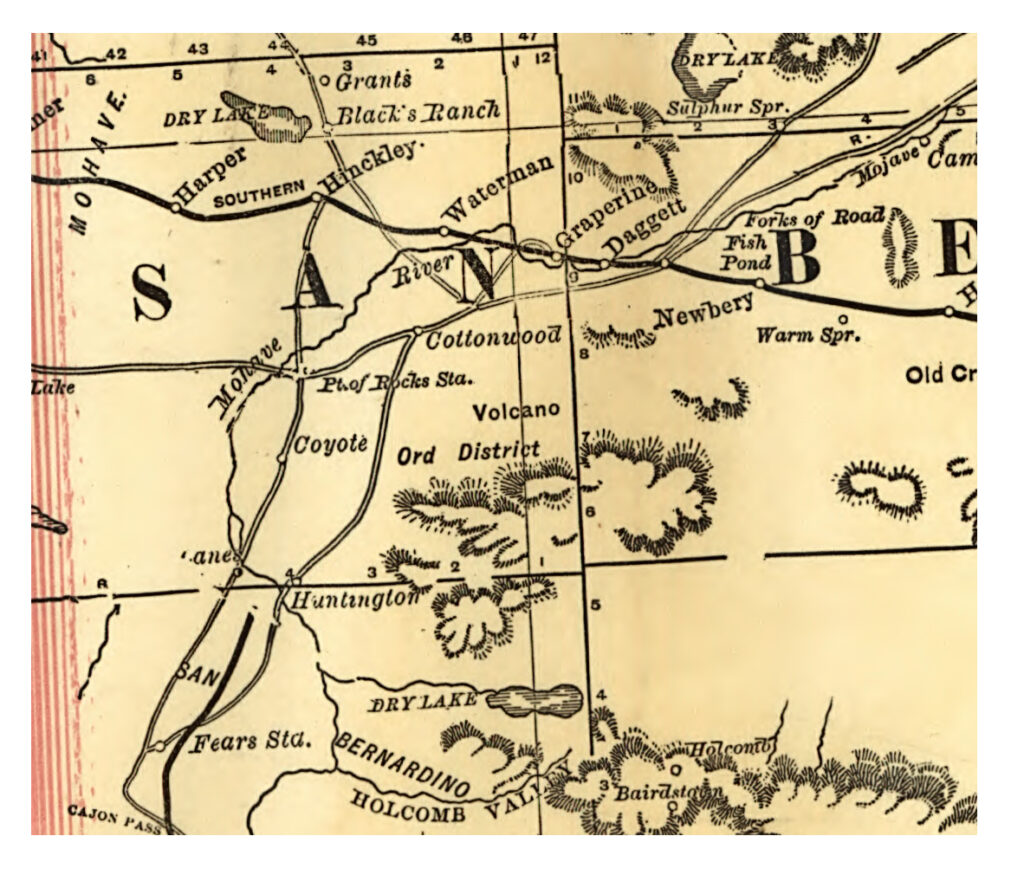
https://d9-wret.s3.us-west-2.amazonaws.com/assets/palladium/production/s3fs-public/thumbnails/image/Mojave-River_thumbnail.png

4

They open:

“35th Parallel Corridor (Needles – Barstow – Mojave)”

Now they see:

  • Node chain:
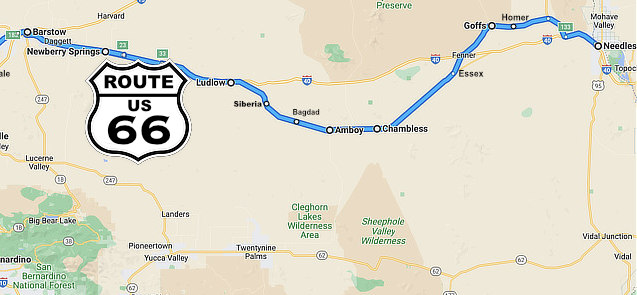
    • Needles -> Goffs -> Essex -> Ludlow -> Daggett -> Barstow
  • Infrastructure layers:
    • railroad (1883)
    • Route 66
    • I-40
  • Function:
    • transcontinental movement

They notice:

Daggett + Afton Canyon appear tied to water

They click:

View Basin / Hydrology

Step 4 — Basin & Hydrology Layer (This is your edge)

https://d9-wret.s3.us-west-2.amazonaws.com/assets/palladium/production/s3fs-public/thumbnails/image/Mojave-River_thumbnail.png
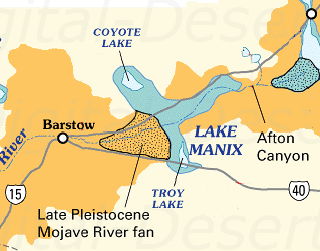
https://digital-desert.com/natural-mojave-river/320-manix.gif
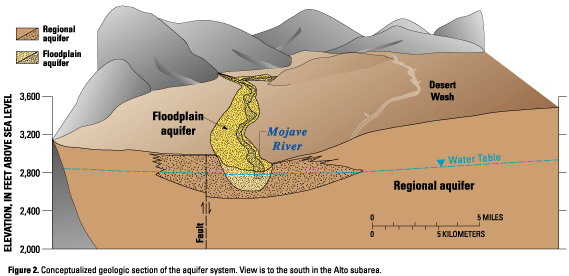
https://pubs.usgs.gov/fs/fs-122-01/fig2.gif

4

They open:

“Lake Manix & Mojave River System”

Now they see:

  • ancient lake (Lake Manix)
  • overflow event
  • formation of Afton Canyon
  • subsurface river flow

Key realization:

“Afton Canyon exists because the lake breached—and the river still follows that path.”

Now Barstow, Daggett, and Needles are no longer random:

  • Barstow = corridor convergence
  • Daggett = water + rail junction
  • Afton Canyon = forced water outlet

This is deep structural understanding.


Step 5 — Cross-System Comparison

Now they test the system.

They ask:

“Is this similar to Tecopa / Death Valley?”

They click:

Tecopa Basin

They see:

  • Lake Tecopa overflow
  • Amargosa River
  • connection into Death Valley

Now they recognize a pattern:

“Closed basin -> overflow -> corridor formation”

This is advanced understanding most people never reach.


Step 6 — System Diagram (Validation)

They open:

Mojave System Map

They now visually confirm:

  • basins
  • corridors
  • nodes

Everything they just learned lines up.


Step 7 — Outcome

At the end of this session, the user now understands:

  • why Barstow exists
  • why Afton Canyon is where it is
  • how water shaped transportation
  • how basins control movement

That is not casual knowledge.
That is working knowledge.

Hexagonal Geometry in Nature and Spatial Systems

Hexagonal geometry appears repeatedly in both natural systems and human-designed spatial models. From honeycombs and basalt columns to mapping grids and ecological simulations, the hexagon emerges because it balances efficiency, symmetry, and structural stability. This recurring pattern is strong evidence of underlying physical and mathematical principles that govern how matter organizes itself.

Understanding why hexagons appear so often requires examining three related factors: tessellation of space, structural efficiency, and directional symmetry.


Geometric Foundations

A regular hexagon contains six equal sides and six interior angles.

120^\circ

Three hexagons meeting at a point form a complete circle around that vertex:

120 + 120 + 120 = 360 degrees

This property allows hexagons to tile a surface perfectly without gaps or overlaps. Only three regular polygons can accomplish this:

  • Equilateral triangles
  • Squares
  • Hexagons

Among these, hexagons provide the most efficient enclosure of space for a given perimeter.


The Honeycomb Efficiency Principle

One of the most famous examples of a hexagonal structure appears in bee honeycombs.

Worker bees construct wax cells that store honey and house larvae. The hexagonal shape is not arbitrary; it is the most efficient way to divide a plane into equal storage cells while minimizing the amount of construction material.

Mathematically, this principle is known as the Honeycomb Conjecture, which was proven in 1999 by the mathematician Thomas Hales. The theorem demonstrates that a hexagonal tiling encloses the maximum area for a given perimeter among regular tilings.

For bees, this efficiency means:

  • Less wax is required for construction
  • stronger structural walls
  • maximum storage volume

The result is a highly optimized natural architecture.


Basalt Columns and Cooling Lava

Hexagonal patterns also appear in geological formations created by cooling lava flows. Famous examples include Devil’s Postpile in California and the Giant’s Causeway in Northern Ireland.

When lava cools, it contracts. The contraction produces internal stress that eventually fractures the rock. These fractures propagate outward simultaneously from many points.

Physical systems tend to minimize stress energy, and the most stable crack geometry forms junctions with angles near 120 degrees. As fractures spread through the cooling lava, polygonal columns develop, often forming hexagonal cross-sections.

This process creates striking landscapes composed of tall basalt pillars, many of which are six-sided.


Soap Films and Foam Geometry

Another example of a hexagonal structure occurs in foams and soap bubbles.

Thin films between bubbles rearrange themselves to minimize surface energy. The rules governing these surfaces are described by Plateau’s laws. When bubbles pack together in two dimensions, the boundaries often form hexagonal patterns because this configuration balances the surface tension.

The same principle occurs in:

  • soap bubble clusters
  • cellular foams
  • liquid films

The hexagonal pattern represents a stable compromise between competing surface forces.


Insect Compound Eyes

Many insects possess compound eyes made up of hundreds or thousands of visual units called ommatidia. These units pack together in a hexagonal arrangement.

Hexagonal packing allows the maximum number of lenses to fit within a curved surface while minimizing gaps between units. The arrangement produces nearly uniform visual coverage across the insect’s field of view.

This pattern appears in:

  • bees
  • dragonflies
  • flies
  • many crustaceans

The hexagonal structure improves optical efficiency and spatial coverage.


Snowflakes and Crystal Symmetry

Snowflakes demonstrate another form of hexagonal geometry. The structure of ice crystals is determined by the arrangement of water molecules in a hexagonal lattice.

As snow crystals grow in cold clouds, molecules attach along preferred directions determined by this lattice structure. The result is the familiar six-fold symmetry seen in snowflakes.

While individual snowflakes develop complex branching forms, their fundamental geometry remains hexagonal.


Hexagonal Grids in Spatial Modeling

Hexagonal patterns are not only natural; they are also useful in human-designed systems.

Hexagonal grids are widely used in:

  • ecological modeling
  • wildfire spread simulations
  • geographic information systems
  • military mapping
  • strategy games

Unlike square grids, hexagonal grids distribute movement directions evenly around each cell. Every neighboring cell lies at the same distance from the center.

This property reduces distortion when modeling radial expansion, such as:

  • spread of fire
  • animal movement
  • water flow
  • diffusion processes

The hex grid, therefore, approximates a circular spread more accurately than square grids.


Directional Symmetry

Square grids produce four primary directions separated by right angles. Diagonal movement introduces distance distortion.

Hexagonal grids provide six directions evenly spaced around a point, each separated by 60 degrees. This more balanced geometry helps simulate natural processes in which movement spreads uniformly outward.

In many scientific simulations, hex grids therefore produce results closer to real-world spatial patterns.


Why Hexagons Reappear in Nature

Across many different systems, hexagons emerge because they balance several competing demands:

Efficient packing
Hexagons fill space while enclosing large areas relative to their perimeter.

Energy minimization
Physical systems often settle into configurations that reduce internal stress or surface energy.

Directional balance
Six directions distribute forces or movement more evenly than four.

Structural stability
Hexagonal networks resist deformation while maintaining flexibility.

These advantages make the hexagon a recurring solution in both natural structures and engineered systems.


Conclusion

The hexagon is not simply a geometric curiosity. It represents a natural solution to problems involving packing, efficiency, and structural balance. From the wax architecture of honeybees to volcanic basalt columns and the molecular symmetry of snow crystals, hexagonal patterns arise wherever physical systems seek stability and efficiency.

Because of these properties, the same geometry that shapes natural landscapes also appears in modern scientific models and mapping systems. The hexagon stands as one of the most elegant and practical shapes in both mathematics and the natural world.