Scientific name: Fremontodendron californicum
Family: Malvaceae, the mallow family
Common names: California flannelbush, flannelbush, California fremontia
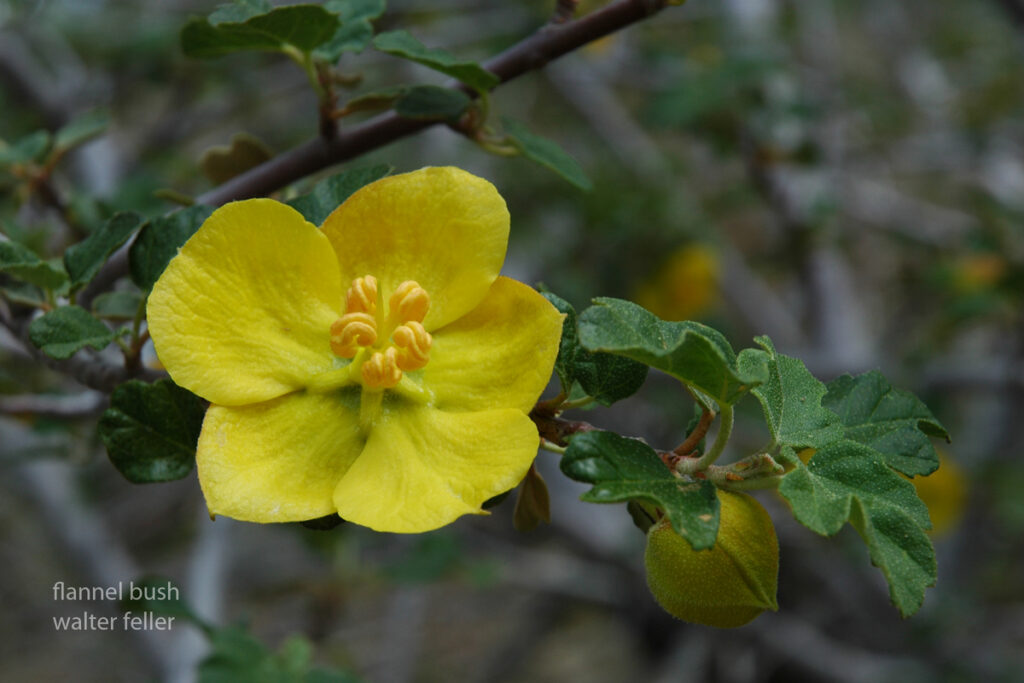
Flannelbush is an evergreen, loosely branched shrub or small tree. It usually grows 5 to 16 feet tall, though older plants in favorable places can reach about 20 feet. The bark becomes rough, fissured, and scaly; its inner bark is mucilaginous, a trait shared with many members of the mallow family.
Its leaves are alternate, leathery, and usually palmately lobed, with several main veins beginning near the base. Both leaves and young stems carry dense star-shaped hairs, called stellate hairs. The lower leaf surface is especially felted and grayish. These hairs give the plant its flannel-like appearance, but they can irritate skin, eyes, and breathing passages.
The large, open yellow flowers are distinctive. What appear to be petals are actually five enlarged, petal-like sepals; flannelbush has no true petals. Flowers are commonly yellow, sometimes marked reddish or coppery near their bases. They generally bloom from April through July.
The fruit is a bristly, five-valved capsule. When ripe, it releases several hard seeds. The seeds have small food bodies, or elaiosomes, that attract ants, which can carry them short distances.
In the Mojave region, flannelbush is chiefly a plant of desert chaparral and nearby pinyon-juniper woodland, especially on dry mountain slopes, canyon walls, rocky crevices, and coarse or nutrient-poor soil. It is found on the desert-facing slopes of the San Gabriel and San Bernardino mountains, at the upper edge of the Mojave Desert. Fire stimulates germination, and established plants may also resprout from the root crown or roots after being top-killed.
USDA Forest Service species review