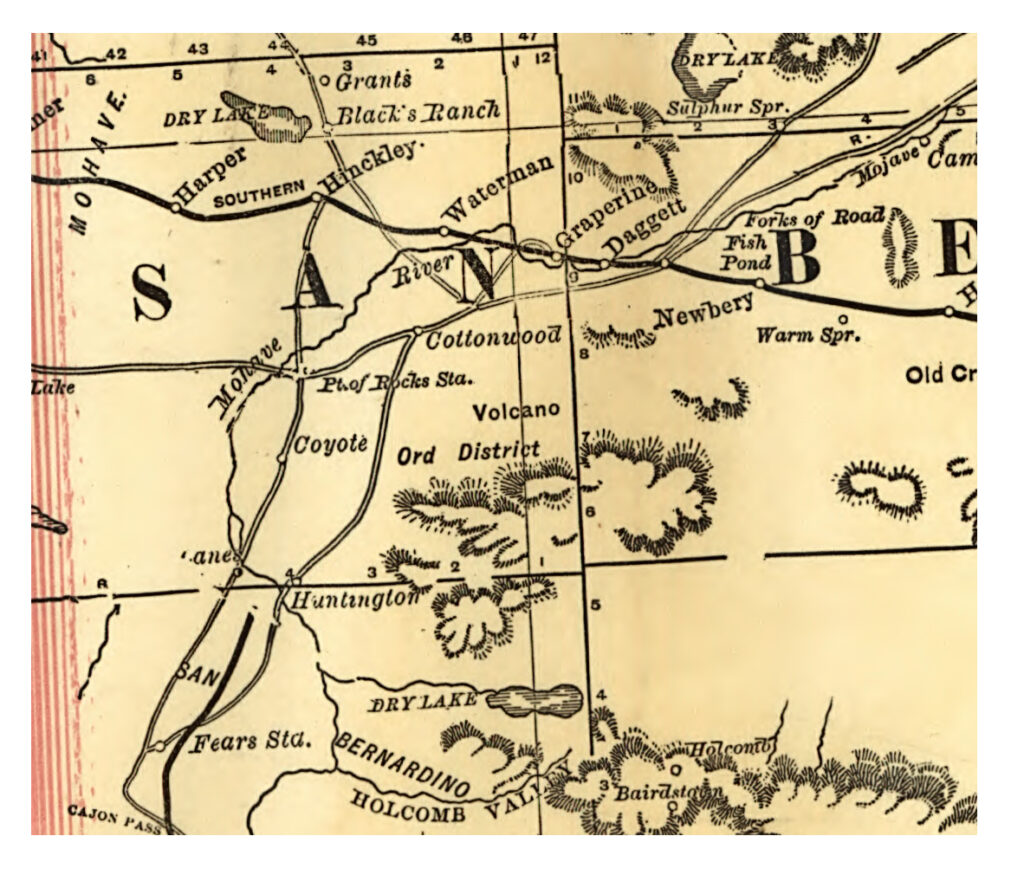
Daggett occupies a decisive position in the Mojave rail system. While smaller in present appearance than nearby Barstow, its historical and structural role is foundational. It is the point where the trans-Mojave railroad, advancing eastward from Mojave, first established a stable desert operating base tied directly to the Mojave River corridor. Before Barstow emerged as the dominant classification center, Daggett served as the region’s early rail hub and the initial organizing node for eastward expansion toward the Colorado River.
The arrival of the Southern Pacific Railroad at Daggett in the early 1880s marked a transition from mountain-to-desert rail building into true trans-desert operation. From this point, construction continued east toward Needles, completing the Mojave crossing in 1883. At the same time, the broader competitive framework involving the Atlantic and Pacific Railroad and, later, the Atchison, Topeka, and Santa Fe Railway placed Daggett within a contested, strategically important rail geography.
Daggett’s importance is not just chronological, but geographic. It sits along the Mojave River, one of the few reliable water corridors in the desert. That placement made it viable as a servicing and staging point in an otherwise resource-scarce environment. Early railroad logistics depended heavily on water, fuel, and manageable grades, and Daggett offered all three within a workable alignment. In this sense, the town represents the moment when the railroad system fully adapted to desert conditions rather than simply crossing into them.
Structurally, Daggett operates as an intermediate junction and early hub, positioned between Mojave and Barstow. It does not replace either node but instead explains how the system developed between them. Mojave serves as the western pivot, and Barstow later becomes the dominant classification hub, but Daggett shows the earlier phase of organization when rail operations first stabilized in the central Mojave. It is also tied to branching industrial and mining lines, including connections associated with borax and desert resource extraction, which radiated outward from this corridor.
Within the Mojave system framework, Daggett belongs to several layers simultaneously. It is part of the Mojave-Needles trans-desert corridor, a node along the Mojave River spine, and an early operational anchor that predates Barstow’s later dominance. This layered identity makes it essential to explain not just where the railroad went, but also how it functioned during its formative period.