Between here and there
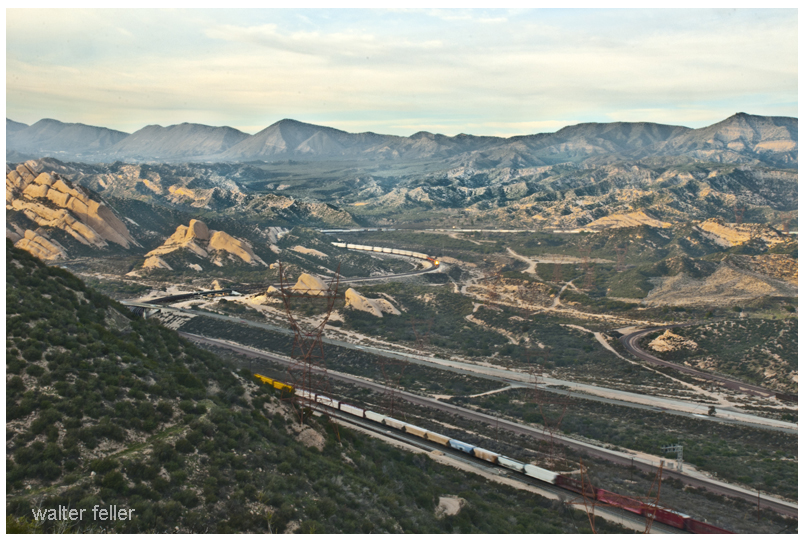
“Corridor archaeology” is an approach to archaeology that treats a route—and the landscape people moved through along it—as the primary unit of study, rather than focusing solely on a single site (a village, a mine, a camp, a ruin).
Instead of asking “What happened at this one place?”, it asks questions like: How did movement happen here over time? Where were the dependable resources (water, forage, stone, shelter) that structured travel? What were the choke points, forks, and bottlenecks? How did different eras reuse, overwrite, or abandon earlier paths?
Core idea. A corridor is a strip or network through the landscape (a river valley, pass, canyon, shoreline, ridge, or desert trail system) that concentrates movement. Corridor archaeology examines the material traces of that movement—both the “hard” evidence (artifacts, features, datable deposits) and the “soft” patterning (spacing, visibility, access, risk, seasonality).
What it typically studies (common evidence types).
- Route traces and wayfinding: trail braids, wagon ruts, cairns, cutbanks, switchbacks, “shortcuts” that grow into new alignments.
- Water and provisioning nodes: springs, seeps, tinajas, wells, river crossings, camps near dependable water, and the scatter patterns that form around them.
- Task- and stop-related features: hearths, rock alignments, windbreaks, temporary corrals, caches, packet scatters, repair debris.
- Artifact distributions: lithic scatters, ceramics, metal, glass, can dumps, horseshoe nails—often more informative as spatial patterns than as isolated finds.
- Overlapping time layers: Indigenous travel corridors, later trade routes, wagon roads, rail grades, highways—each leaving different signatures but often occupying the same logic of terrain.
How it differs from “site archaeology.” Traditional site work tends to privilege bounded places and discrete occupations. Corridor archaeology is comfortable with “low-density” archaeology: long, thin, messy distributions that don’t look like a classic site boundary, but still carry strong information when mapped and analyzed as a system.
Typical methods (the toolkit).
- Transect survey and systematic recording along a corridor width (not just a line).
- GIS / spatial statistics: least-cost path modeling, viewsheds, catchments to water, slope/aspect risk, node spacing.
- Geoarchaeology: figuring out whether deposits were buried, eroded, reworked, or deflated—critical in deserts and river corridors.
- Chronology building across nodes: relative dating from artifact typologies + targeted absolute dating where feasible.
- Network thinking: nodes (stops), links (segments), and changing “friction” (terrain difficulty, security, policy, technology).
Why it matters. Corridors are where daily life happens at scale: travel, trade, seasonal rounds, herding, migration, mail routes, military movement, tourism. If you only study the famous “dots on the map,” you miss the connective tissue that explains why those dots exist where they do.