-.-
Valley of Sunshine
Romance and Drama in the Valley of Sunshine: Being a Story of Old Palmdale
Published by Palmdale Fruitland Company, Los Angeles, 1914. The dedication gives the author only as "W. C. P."
I. Front matter Pages 1-4
Title, copyright, publisher, and dedication to the Antelope Valley.
II. Poetic introduction: "In the Kingdom of the Sun" Page 5
A romantic promotional poem presenting the Antelope and Victor valleys as a sunny, healthful, inviting desert kingdom. It uses older place-language such as Mojave, Tejon, Santa Ana, and "Los Gaceles."
III. Part One: Dreamers, deserts, and the Imperial Valley comparison Pages 6-7
The author begins with Dr. Wozencraft and his dream of bringing Colorado River water to the desert. Imperial Valley is used as the model: once doubted, later productive. The Antelope Valley is then introduced as another misunderstood desert region waiting for its own transformation.
IV. Antelope Valley setting and communities Page 7
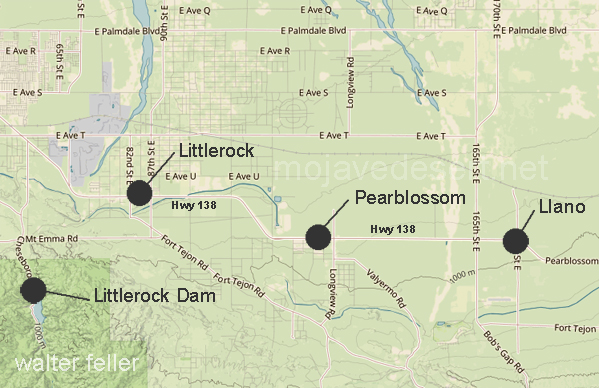
The pamphlet places Antelope Valley between the Mojave River and the Tejon/Coast Range area. Lancaster, Littlerock, and Palmdale are presented as the principal settlements, with Lancaster described as dairying country and Littlerock/Palmdale as fruit country.
V. Part Two: Geography behind the San Gabriel/Sierra Madre wall Pages 7-8
The author describes the mountain wall north of Pasadena, the railroad route through Soledad Canyon, and Palmdale as the "gateway" to Antelope Valley. The surrounding mountains are portrayed as wild country of canyons, streams, deer, lions, wildcats, quail, and other animals.
VI. Early roads, bandits, and old travel routes Page 8
The old Fort Tejon stage line is described as running along the foothill belt from San Bernardino toward Tejon Pass and beyond. The pamphlet also connects the Elizabeth Lake to Big Rock Creek region with Tiburcio Vasquez and his lieutenant Chaves.
VII. Early settlement failures Pages 8-10
Settlers arrived on the yucca, bunch grass, and sagebrush plains before gasoline engines and practical pumping plants. Hand-dug wells supplied drinking water but not crops. Almonds and prunes were planted near Littlerock, but frost and altitude made them unreliable. Litigation over water and land titles also discouraged settlement.
VIII. Railroad land litigation and title problems Pages 9-10
The pamphlet discusses the long conflict between the federal government and the Southern Pacific over alternate-section railroad lands. It says this dispute clouded title and discouraged investment until the matter was settled in 1912.
IX. Warning: Antelope Valley was "not a poor man's land" Pages 9-10
The author repeatedly argues that success required capital. Land had to be cleared, planted, irrigated, and improved with wells or water systems. The pamphlet criticizes earlier promoters who led undercapitalized settlers into failure.
X. Littlerock's pear and apple success Page 11
A few settlers remained at Littlerock after earlier failures. Pear and apple trees reportedly performed well, with the pamphlet claiming high returns from mature orchards. Littlerock is presented as proof that the correct crop, water, and location could make the foothill belt profitable.
XI. Palmdale's early stagnation and survival Pages 11-12
Old Palmdale is described as having a depot, board houses, and hopes. The Big Horn mine later shipped ore through Palmdale, and gypsum mills briefly operated nearby. After the gypsum business faded, Littlerock fruit shipments helped keep Palmdale active.
XII. Part Three: New Palmdale development Pages 12-13
Capital enters the story. The pamphlet describes a reinforced canal from Littlerock Creek, water carried westward to a reservoir at Alpine/Harold, and plans for orchard irrigation. It also mentions a domestic pumping plant, cement sidewalks, street trees, and new pear and apple plantings in 1913.
XIII. Old Palmdale versus new Palmdale Page 13
The author contrasts old shanties, jack rabbits, and weather-beaten buildings with new sidewalks, orchards, water systems, and planned development. Littlerock is used as the example of what Palmdale may become.
XIV. Riverside and Imperial Valley comparisons Pages 13-15
The pamphlet compares Palmdale's prospects to Riverside and Imperial Valley. Both places were doubted in their early stages, then later became successful. The author uses these comparisons to argue that critics of Antelope Valley are repeating an old mistake.
XV. Climate, wind, cold, and health claims Pages 15-16
The pamphlet describes summer heat, dry air, afternoon breezes, winter cold, occasional snow, and the suitability of the area for pears and apples rather than citrus. It also makes period health-resort claims for lung, throat, asthma, catarrh, rheumatism, and similar ailments.
XVI. Part Four: Future county and regional ambition Pages 16-17
The author predicts that the desert country may one day deserve separate county government, possibly stretching from Tejon Pass to the Mojave River and even beyond. This reflects booster-era ambition more than a settled political reality.
XVII. Capital, loans, and rural investment Pages 16-20
The pamphlet argues that capital should move into Antelope Valley agriculture rather than only city real estate. Orchard land with reliable water is presented as safe security. The author recommends improvement loans tied to actual development of the land.
XVIII. Water systems and underground water Pages 18-19
The pamphlet describes the Palmdale Water Company, Littlerock Creek Irrigation District, reservoir storage, gravity water, and pumped groundwater. It claims that a large underground water supply exists beneath parts of the valley.
XIX. Final sales argument Pages 19-20
The closing prose repeats the pamphlet's main themes: Antelope Valley requires capital, work, good judgment, water, and the right crops. Lancaster is recommended for alfalfa and livestock; Palmdale and Littlerock for pears and apples; the valley generally for sunshine, health, and rural opportunity.
XX. Closing poem: "Tomorrow (In the Antelope Valley)" Page 21
The final poem imagines gray sage and yucca giving way to water, orchards, farms, homes, and green cultivated land. It is the emotional close of the pamphlet's development argument.
Overall, the PDF is best read as a 1914 land-and-water promotional pamphlet for Palmdale, Littlerock, and the Antelope Valley foothill belt. It contains useful historical references, but its purpose is persuasion: to turn a difficult desert farming history into a story of coming success.
Antelope Valley


Big Horn Mine
Big Rock Creek

Colorado Desert
Colorado River

El Rio del Llano
Elizabeth lake
Elizabeth lake country
Fort Tejon

Inyo county

Kern county
Kingdom of the Sun
Lancaster
Lancaster country
Littlerock
Littlerock creek
Los Angeles county

Mojave Desert
Mojave River
Mormon Trail

Old Baldy
Old Palmdale

Palmdale

San Bernardino, CA
San Bernardino County
San Bernardino county

Sierra Madre
Sierra Madre mountains
Soledad canyon
Southern California
Tehachapi range
Tejon
Tejon pass

Valley of Death
Valley of Sunshine
Victor valley
Vincent
Yerba Buena