Introduction
Physiography
Weather Data
Geologic History
Changing Climates
Weathering & Erosion
Carbonate Rocks
Granitic Rocks
Volcanic Rocks
Faults
Pediments
Stream Channels
Stream Terraces
The Mojave River
Playas
Sand Dunes
Human Impacts
References
-.-
Carbonate Rocks and Associated Landforms
In the Mojave National Preserve, carbonate sedimentary rocks of
Proterozoic and Paleozoic age (consisting of limestone and dolostone) crop
out throughout the Clark Mountains, the Mescal Mountains, in the northern
Ivanpah Range, in the central portion of Providence Mountains, and
elsewhere. Carbonate rocks originally form from limey sediments consisting
of the calcareous skeletal remains of algae and invertebrate shell
material or precipitates directly from agitated, warm seawater (as on a
shallow continental shelf in a warm climate). Most ancient limestones
formed from planktonic algae, but in late Paleozoic time coralline reefs
became significant producers of carbonate sediments. Limestone consists
dominantly of the mineral Calcite-CaCO3, whereas dolostone consists
dominantly of the mineral dolomite-CaMg(CO3)2. Dolomite is typically a
secondary mineral replacement of original calcite material. Ancient
carbonate rocks like those in the Mojave region tend to be enriched in
dolomite. Below are examples of common fossiliferous carbonate rocks of
Paleozoic age from the Mojave region.
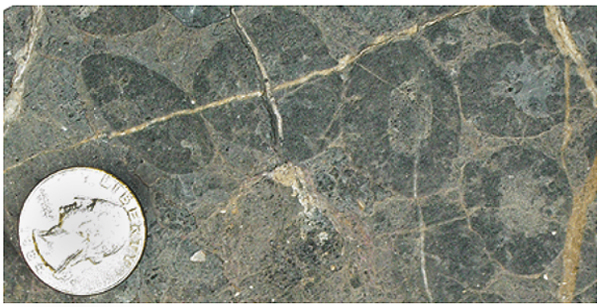
NPS photo
Oncolites (algal limestone balls) float in a carbonate-mud
matrix in the Cambrian-age Chambless Formation. This
easy-to-recognize oncolite-bearing limestone formation crops out in
many areas throughout the Mojave National Preserve region. These
nearly spheroidal oncolites formed by algae and/or cyanobacterial
growth in shallow warm marine waters of a carbonate platform
environment.
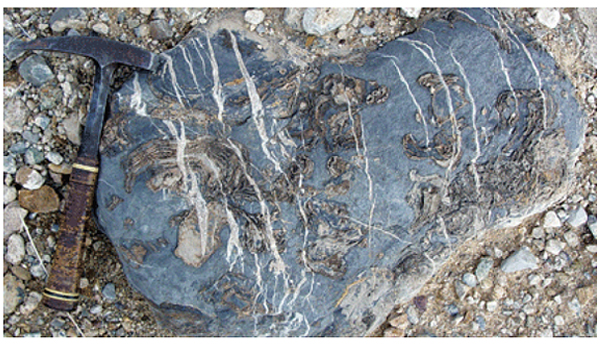
NPS photo
A boulder of a fossiliferous limestone displays stromatoporoids
and corals of early Devonian age (Sultan Formation). Boulders like
this one are not uncommon in alluvial fans downstream from the
Paleozoic age sedimentary rock belt exposed in the Providence Range.
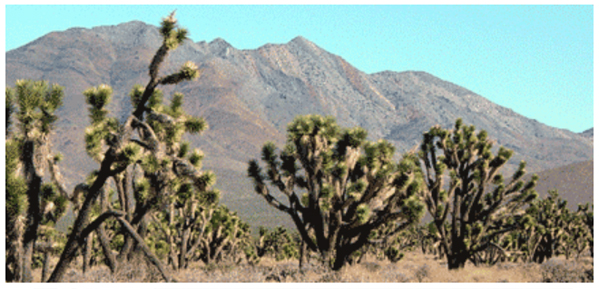
NPS photo
An expansive
Joshua-tree forest
covers a pediment surface (along
Cima Road). In the distance, steeply dipping and folded sedimentary
rocks (mostly limestone and dolomite) of late Proterozoic and
Paleozoic age crop out throughout the Mescal
Range.
In contrast to other types of rocks, carbonate rocks tend to be fairly
resistant to erosion in arid climate conditions. The ancient carbonate
rocks in the Mojave region are typically both dense and brittle and tends
to be heavily fractured at the surface. At depth, fractures in carbonate
tend to heal over time as the rock gradually flows under extreme pressure,
and as calcite and other minerals precipitate in crevasses over time.
Throughout the desert southwest, deep canyons carved into carbonate rock
display collapse breccia, which are massive surficial deposits that
consist of broken fragments of limestone and dolostone tightly cemented in
a carbonate matrix.
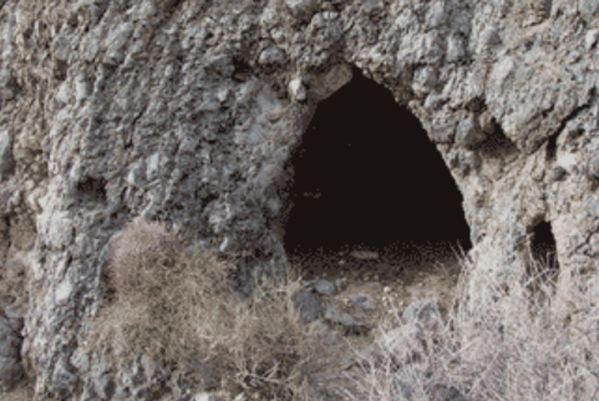
NPS photo
A small cavern occurs in brecciated carbonate rocks that crop
out along an unnamed wash draining from the western Providence
Mountains (8 miles directly east of Kelso Depot). "Collapse
breccias" like this are prevalent in the
Bonanza King Formation.
This formation is nearly 300 meters thick and consists of algal
limestone and dolomite of Middle Cambrian age (around 550 million
years). The age of the "collapse" is unresolved, but may actually be
an active physical-chemical process that affects large carbonate
units in the desert surface environment. They may actively be
"flowing" down slope under the force of gravity. This breccia is
probably an early Quaternary-age landslide deposit that has been
reconsolidated (cemented) by groundwater interaction with the
carbonate rock.
Carbonate rocks dissolve in freshwater, with calcite being more soluble
than dolomite. With each precipitation event, traces of carbonate material
will dissolve and migrate with flowing water. Dissolution occurs along
fractures in the subsurface producing caverns. As water evaporates at the
surface, calcite will precipitate again, cementing sediments on alluvial
fans to form a durable calcareous crust (called caliche). Calcite
is a major component of playa mud deposits. Varieties of freshwater
limestone deposits called tufa and travertine form around springs and in
former wave-influenced lake shore zones. In caverns, travertine deposits
are called speleothems (which include stalagmites, stalactites, columns,
flowstone, and other features).
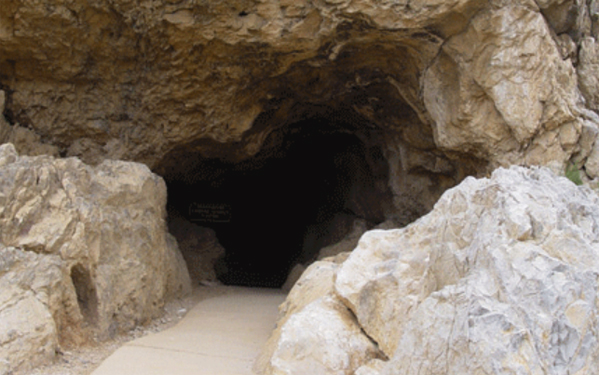
NPS photo
Mitchell Caverns
in the Providence Mountains State Recreation
Area has been developed for commercial visitation. The cavern formed
in limestone of Late Paleozoic age (Pennsylvanian- and Permian-age
Bird Springs Formation). The cavern formed long ago when the bedrock
was constantly exposed to groundwater, allowing dissolution of the
limestone to occur. Today, the cavern is high and dry; it is more
than 500 meters above the valley floor and a constant supply of
groundwater.
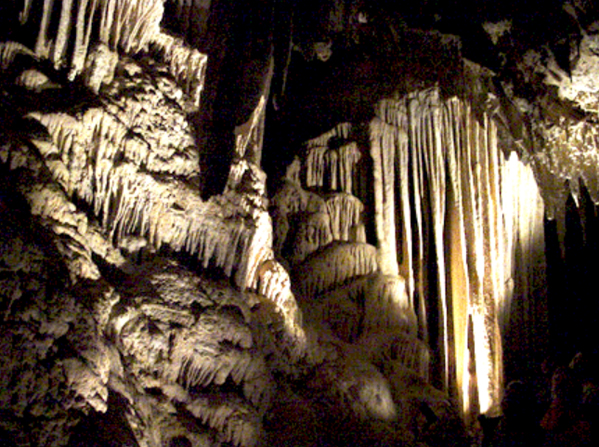
NPS photo
Travertine tapestries, flowstone, and other speleothems
gradually form where groundwater enters the cavern and evaporates,
leaving behind calcium carbonate. Features like this one probably
took many thousands of years to form. Only a small percentage of the
speleothems in Mitchell Caverns are actively forming.
In the Mojave region, alluvial deposits derived from areas with
carbonate bedrock tend to consist of blocky, unevenly sorted sediments. In
many areas chert layers and metasandstone layers occur interbedded within
the bedrock. These more siliceous materials tend to be more resistant to
both mechanical and chemical weathering forces, and as a result, alluvial
surfaces and sediments down slope from carbonate rock source areas tend to
be enriched in these associated siliceous materials. Carbonate mountains
are the highest and steepest without exception. These areas are prone to
stronger flood forces, bigger canyons, more precipitation, coarser fans,
steeper fans, and hense, greater risk for debris flow activity.
Next > Granitic Rocks
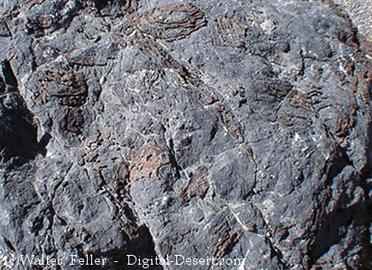
Tin Mountain Limestone - Death Valley
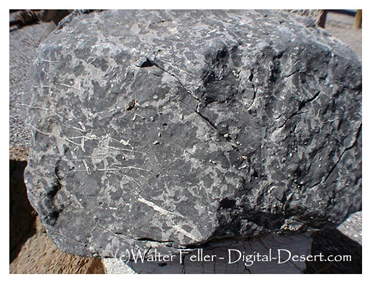
Bonanza King Formation - Death Valley
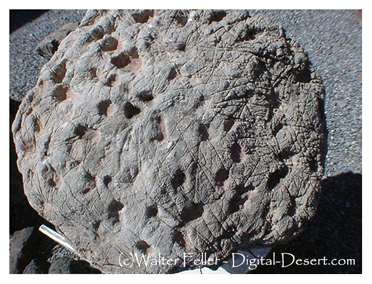
Noonday Dolomite - Death Valley
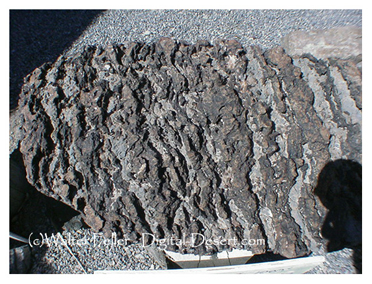
Beck Spring Dolomite - Death Valley