1870 - 1905 -- Soda Station
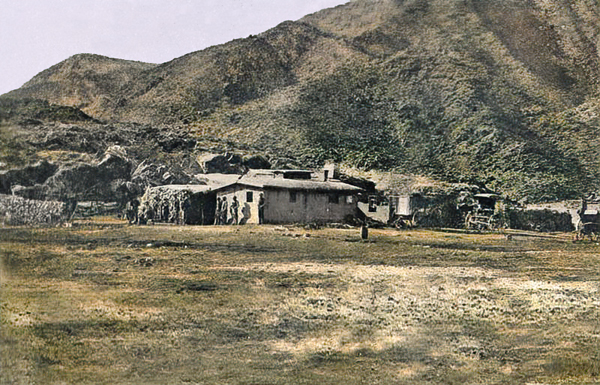
Soda Station 1874
Soda Springs: From Way Station to Soda Works
Long before the name Zzyzx was invented, Soda Springs was a dependable desert water place at the western edge of Soda Lake. Native people used the springs for generations. By the mid-1800s, explorers, soldiers, mail carriers, emigrants, and miners traveling the Mojave Road also depended on the oasis. [1]
The Army established Hancock's Redoubt at Soda Springs in 1860 to protect travelers and government supplies. A later outpost, maintained in 1867 and 1868 as a dependency of Camp Cady, was commonly called Soda Station or Fort Soda. From there, soldiers escorted stages and United States mail carriers along the Mojave Road. After the Army withdrew, civilian stationkeepers used the place from time to time. [2]
Soda Lake Station was functioning in 1874, when San Bernardino County tax records list Smith Haile as its stationkeeper. George Hetzel later operated the station for about eight months. An August 1882 notice reported that he had left because the sparse travel did not make the business pay.
In 1885, prospectors working the nearby Soda Lake mining district called their camp Shenandoah Camp. This was not a formal renaming of Soda Springs. It was the name used by a short-lived mining camp at the springs. A visitor that year described a continually flowing warm mineral spring beside the cabin and a bathing pool large enough for five or six people. The water was useful, but strongly mineralized and not always pleasant to drink. [3]
Looking across Soda Lake toward Devil's Playground and Kelso Dunes
The surviving records show why Soda Springs mattered: it combined water, shelter, and a recognizable landmark on a difficult road. In 1909, U.S. Geological Survey geologist Walter C. Mendenhall described Government Well at Soda Lake as a troop-dug well beside the old emigrant road. He found a stone-lined pool about five by eight feet and three feet deep near tule growth and the ruins of adobe and stone buildings. He identified its water as part of the underflow of the Mojave River. [4]
Frank and Sarah Riggs were active in the Soda Lake mining district from the late 1880s. Their claims refer to improvements at Soda Lake Station, and in 1898 they filed a water claim north of the springs at Upper Badger Holes. An arrastra was later found near Zzyzx Road, and the Riggses' water and mill-site claims suggest that they may have refined ore in the area. The evidence does not establish that they built the arrastra, however, or that steel balls were used there. An arrastra normally crushed ore with a heavy stone muller. [3]
By about 1900, permanent residence at Soda Springs appears to have lapsed again. The older wagon-road traffic had declined after railroads crossed the Mojave Desert. Yet railroad access soon brought a different kind of activity. The Tonopah and Tidewater Railroad reached Soda Lake in 1906 and established a siding. In 1907-08, a soda-extraction enterprise built evaporation ponds, a small narrow-gauge railroad, and a plant to recover sodium minerals from the lakebed. The work did not last. By the early 1910s the project had failed, leaving grades, ponds, and scattered remains beside the old station site. [3][5]
Soda Springs was never an ordinary town. Its importance came from water in a country where water governed travel, work, and survival. The place changed names and uses - military outpost, station, mining camp, railroad stop, and soda works - but its value remained the same: it was a dependable pause on a hard desert crossing.
Sources and further reading
[1] National Park Service, "Zzyzx History." https://www.nps.gov/moja/learn/historyculture/zzyzx.htm[2] Danette Woo and Debra Hughson, "Zzyzx Mineral Springs--Cultural Treasure and Endangered Species Aquarium," 2003 Proceedings, p. 84. https://www.lewiscenter.org/documents/websites/chub%20resources/0320woo.pdf
[3] Anne Q. Duffield-Stoll, Zzyzx: History of an Oasis, San Bernardino County, California (1994), pp. 29-43. https://www.fullerton.edu/dsc/research/Duffield-Stoll%20AQ%201994%20Zzyzx_History%20of%20an%20Oasis.pdf
[4] Walter C. Mendenhall, Some Desert Watering Places in Southeastern California and Southwestern Nevada, U.S. Geological Survey Water-Supply Paper 224 (1909), p. 62. https://data.nbmg.unr.edu/public/Geothermal/GreyLiterature/Mendenhal_DsrtWtringPlaces_SWNVandECA_1909.pdf
[5] Larry M. Vredenburgh, "Curtis Howe Springer and Zzyzx," 2023 Desert Symposium Proceedings, pp. 154-55. https://www.academia.edu/129438623/Curtis_Howe_Springer_and_Zzyzx
Mojave Road for about 30 years. Its name was changed temporarily to "Shenandoah Camp" in 1885 but was soon named "Soda Station" bit its operator, George Hertzel. He built the outpost into a trading post, commonly called a "way station." Similar to rest stops along modern freeways, Hertzel's way station offered welcome relief to travelers crossing the desert.
To make the springs more usable, Hertzel lined a pool with rocks. Water at Soda Springs reaches the surface at a constant 76F, providing a refreshing dip in summer and welcome warmth during the winter.
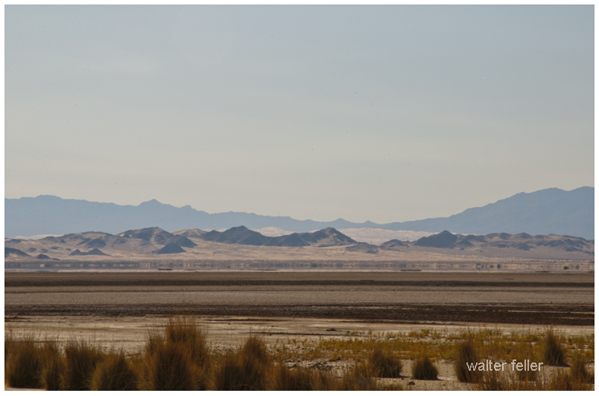
Looking across Soda Lake to Devil's Playground and Kelso Dunes
< Previous < · > Next >
1776 - 1830 -- Early Explorers
1830 - 1860 -- Pioneers & Settlers
1860 - 1870 -- Army Outpost
1870 - 1905 -- Soda Station
1905 - 1916 -- The Soda Works
1916 - 1944 -- Abandonment
1944 - 1974 -- Zzyzx Mineral Springs
1974 - Present -- The DSC