History of Soda Springs and Zzyzx
1776-1831: Early Explorers and the Desert Crossing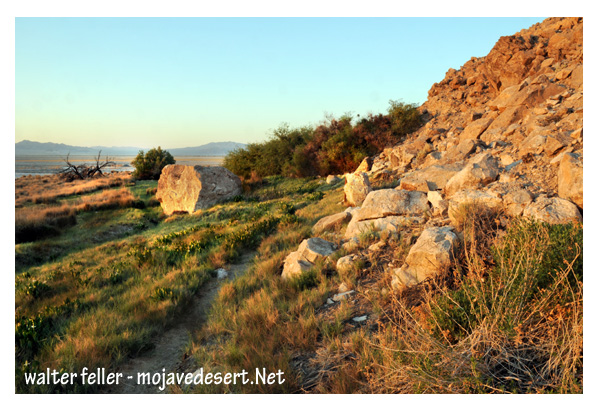
Soda Springs at dawn
Long before it was called Zzyzx, Soda Springs was a water place at the western edge of Soda Lake. The location lay in the low desert country near the terminus of the Mojave River, where water that usually traveled underground helped sustain springs, marshy ground, and occasional pools.
The springs were part of a much older network of Native travel and trade routes. Mojave and Chemehuevi people knew the water sources, passes, and trails that connected the Colorado River, the Mojave River, the mountains, and the coastal country. To later travelers, Soda Springs was an important stop. To the people who had long lived and traveled in the desert, it was one useful place within a well-known landscape.
In the late eighteenth and early nineteenth centuries, the routes through this country became known to Spanish missionaries, American trappers, and traders. They did not create the route. They followed paths that had already served desert people for generations.
Francisco Garces
In 1776, Alta California was a northern province of New Spain. Spanish authorities were working to strengthen their distant settlements in California, while Juan Bautista de Anza led a colonizing expedition toward the coast and San Francisco Bay.Franciscan missionary Francisco Garces traveled separately through the interior. After moving north along the Colorado River, Garces met Mojave people who agreed to guide him west toward Mission San Gabriel. On March 4, 1776, he left the Colorado River country with Mojave guides and began the long crossing of the desert.
Garces followed an established Native trail system through a land that was unfamiliar to him but not unknown to his guides. Later efforts to reconstruct his route place his party in the Soda Lake country during the journey west. He reached Mission San Gabriel about twenty days after leaving the Colorado River.
Garces is generally regarded as the first documented European to cross the Mojave Desert by this route. His passage showed Spanish officials that a route existed between the Colorado River and coastal California, but it remained difficult, dry, and dependent on reliable water.
Jedediah Strong Smith
Half a century later, in 1826, trapper and horse trader Jedediah Strong Smith led a small party west from the Colorado River. Smith and his men followed Native trails through the Mojave Desert, passing the Soda Lake and Mojave River country on their way to the San Bernardino Valley and Mission San Gabriel.Smith's party arrived tired, short of supplies, and deeply aware of the importance of water and grass for their horses. Their journey made Smith the first documented American to reach California overland by this southern route.
Smith traveled through the desert country again in 1827 during another expedition to California. His travels, and the reports that followed, helped spread knowledge of the southern route among trappers, traders, and other Americans moving toward California.
Kit Carson and the Trappers
In 1829, Christopher "Kit" Carson joined Ewing Young's trapping expedition to California. Carson was still a young man beginning the career that later made him famous as a scout and guide. Young's party traveled from New Mexico by the Gila and lower Colorado rivers, then crossed the Mojave Desert toward the California missions.The expedition reached California in 1830. Its members trapped, traded, and moved through a country where water and grazing land governed every decision. The Soda Lake and Mojave River corridor was one of the practical routes through the desert, and Soda Springs was one of the dependable places where travelers could stop and recover.
Other parties followed. In 1831, George Yount and William Wolfskill led a separate group across the desert toward California. These early travelers helped turn older Native routes into increasingly used paths for trade, trapping, migration, and, later, military travel.
Soda Springs was not yet a town, station, or resort. It was simply what the desert required: a known water place, a resting point, and a landmark on a hard crossing.
Timeline
1776 - Francisco Garces, guided by Mojave people, crosses the Mojave Desert toward Mission San Gabriel.1826 - Jedediah Strong Smith's party crosses the Soda Lake and Mojave River country on the way to California.
1827 - Smith travels through the desert region again during another California expedition.
1829-1830 - Kit Carson travels to California with Ewing Young's trapping party.
1831 - George Yount and William Wolfskill lead a separate party across the Mojave Desert toward California.
> Next >
1776 - 1830 -- Early Explorers
1830 - 1860 -- Pioneers & Settlers
1860 - 1870 -- Army Outpost
1870 - 1905 -- Soda Station
1905 - 1916 -- The Soda Works
1916 - 1944 -- Abandonment
1944 - 1974 -- Zzyzx Mineral Springs
1974 - Present -- The DSC
Father Francisco Garces
Colorado River
Mohave tribesmen
Jedediah Smith
Ewing Young
Yount-Wolfskill group was among those guided by frontier scout
Kit Carson.