Collared Lizard
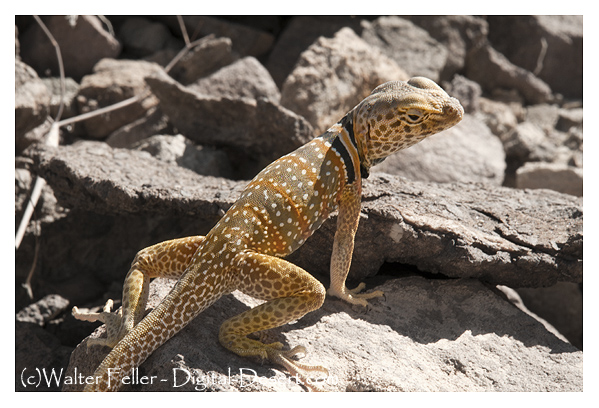
Crotaphytus bicinctores
Crotaphytus collaris
Crotaphytus insularis
Family: Crotaphytidae Order: Squamata Class: Reptilia
DISTRIBUTION, ABUNDANCE, AND SEASONALITY
The collared lizard is widely distributed throughout the arid and semiarid
regions of the Mojave, Sonoran, and Southeastern Great Basin deserts. It is generally
restricted to areas with rocky substrates, slopes, gullies, washes, canyons, and sometimes
rock piles, although occasionally can be found up to a mile from extensive rocky habitat
(McGuire 1996). It is most common in
desert succulent shrub,
desert scrub, and
desert wash
habitats. The collared lizard is active in the spring and summer and to a lesser
extent in the early fall. Southern populations are active earlier than northern populations,
and remain active later in the year. It probably exhibits considerable variation in habits over
its range (Johnson et al. 1948, Stebbins 1985, Fitch 1956, Legler and Fitch 1957, Yedlin and
Ferguson 1973, Sanborn and Loomis 1979).
SPECIFIC HABITAT REQUIREMENTS
Feeding:
The diet of this species consists largely of arthropods and small vertebrates
(Stebbins 1985, McGuire 1996). Arthropods include orthopterans, coleopterans, hemipterans,
hymenopterans, lepidopterans, and arachnids. Vertebrates include Uta, Sceloporus,
Cnemidophorus, Phrynosoma, and Xantusia. Plant material is also occasionally consumed.
Cover: This species prefers rocky areas and seeks cover under rocks and in cracks and
crevices and rodent holes (Stebbins 1985), occasionally bounding bipedally from stone to stone
when disturbed (McGuire 1996).
Reproduction:
The collared lizard lays eggs and presumably constructs its
own nest but there are no reports. The closely related C. collaris nests in rocky areas (Yedlin
and Ferguson 1973) and sometimes lays eggs in tunnels under rocks (Fitch 1956). Friable, well
drained soil is probably required for nesting.
Water:
No information on water requirements. Probably does not require water, as it
occurs in arid habitats.
Pattern:
The collared lizard occupies slopes, rock outcrops, gullies, washes
and other areas with small vertical perches. It often sits on rock perches and watches for
prey,
predators, or perhaps conspecifics.
SPECIES LIFE HISTORY
Activity Patterns:
This species is
diurnal,
active all day when temperatures are moderate
or warm, and showing a bimodal or morning activity when temperatures are high (Stebbins
1985). It hibernates in winter, and may aestivate. It may become active as early as 17 April
in the north (McGuire 1996).
Seasonal Movements/Migration:
This lizard is not known to migrate..
Home Range:
Nothing is known about the size of home ranges of the Great Basin
collared lizard. There are no reports of abundance but it is often possible to see as many as
5 individuals in 1 ha (2.5 ac).
Territory:
This lizard is aggressive; adult males behave aggressively toward each other but
will tolerate subordinate males (Stebbins 1985).
Reproduction:
Courtship occurs in early spring. Eggs are laid in June and July; neonates
have been observed in eastern Oregon in August (Brooking 1934). In Utah, females reached
reproductive maturity at 85 mm SVL (Andre and MacMahon 1980). Mean clutch size was 5.4,
and ranged from 3 to seven. Larger females produced larger clutches. Occasionally 2
clutches are laid (Johnson et al. 1948, Stebbins 1985).
Niche:
Collared lizards are probably eaten by
Masticophis, avian predators,
and perhaps mammalian predators. The young are taken by
loggerhead shrikes.
General Comments:
This species has been subject to taxonomic confusion for several
decades. McGuire (1996) revised the taxonomy of the Crotaphytidae based on morphological
and genetic data, elevating C. bicinctores to specific status, separate from C. vestigium of the
Peninsular range of southern California and C. collaris that occures further east.
Source:
CDFW California Wildlife Habitat Relationships. Accessed [N/A]
https://wildlife.ca.gov/Data/CWHR
|
The Desert Food Chain * Everything has its niche. Who eats what, and what eats who in the desert? Click here to find out what more. |
Mojave Collared Lizard
Description:
Size: 2.75-4.57 in (6.9-11.6 cm)
Distinguishing characters: A large-bodied species with a broad head, short snout, granular scales, and two distinct black collar markings; collar markings separated at dorsal midline by no more than 12 pale scales; tan to olive colored; light lines and spots and yellowish to orangish crossbands on body.
Juveniles: Similar to adults, more distinct banding.
Dimorphism: Male has enlarged postanal scales, blue-grey throat and large dark blotches on flanks.
Similar species: Crotaphytus vestigium: Black collars separated by more than 12 light scales. Gambelia copei, Gambelia wislizenii: Lack black collars.
Additional notes:
Very uncommon. Powerful runner; bipedal. Adults can inflict painful bite. Prefers rocky areas, particularly washes.
Collared lizards like to bask in the sun on boulders looking for prey. They are carnivores who aside from eating other lizards and insects will occasionally eat small amounts of flowers and leaves.
They have an extremely long tail which will break away easily in order to escape predators. They are very fast, running on their two hind legs to reach top speeds.
Black collared lizards can be found in rocky, sparsely vegetated canyons and washes.