Loggerhead Shrike
Lanius ludovicianusFamily: Laniidae Order: Passeriformes Class: Aves
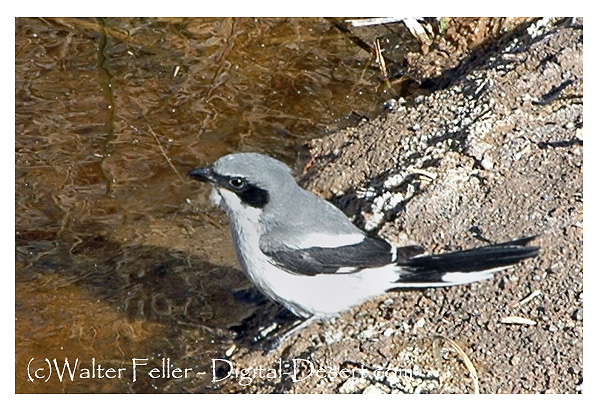
DISTRIBUTION, ABUNDANCE, AND SEASONALITY
A common resident and winter visitor in lowlands and foothills throughout California. Prefers open habitats with scattered shrubs, trees, posts, fences, utility lines, or other perches. Highest density occurs in open-canopied valley foothill hardwood, valley foothill hardwood-conifer, valley foothill riparian, pinyon-juniper, juniper, desert riparian, and Joshua tree habitats. In the Great Basin, from Inyo Co. north, population declines markedly from November through March. Sometimes uses edges of denser habitats.
SPECIFIC HABITAT REQUIREMENTS
Feeding: Eats mostly large insects; also takes small birds, mammals, amphibians, reptiles, fish, carrion, and various other invertebrates. Searches for prey from a perch at least 0.6 m (2 ft) above ground, often much higher. Usually flies directly to prey on ground or in a shrub; sometimes hovers. Frequently skewers prey on thorn, sharp twig, wire barb, or forces it into a crotch to feed on or to cache for feeding later. Sometimes hawks aerial insects.
Cover: Often uses shrub or small tree.
Reproduction: Builds nest on stable branch in densely-foliaged shrub or tree, usually well-concealed. Nest height 0.4 to 15 m (1.3 to 50 ft) above ground, occasionally higher. Nearly all of 77 nests found in Colorado were below 4.5 m (15 ft).
Water: Not reported drinking in desert areas, although often seen near water. Drinks and bathes in captivity, although captives can live on a meat diet without water.
Pattern: Frequents open habitats with sparse shrubs and trees, other suitable perches, bare ground, and low or sparse herbaceous cover.
SPECIES LIFE HISTORY
Activity Patterns: Yearlong, diurnal activity.
Seasonal Movements/Migration: A large portion of population in Great Basin, south to Inyo Co., departs for winter. In areas of residence, winter numbers augmented by visitors from north, and species is even more widespread than when breeding.
Home Range: Apparently same as territory. Forages within territory year-round.
Territory: Ten territories in open shrubland in Contra Costa and Kern cos. averaged 7.6 ha (18.7 ac), and varied from 4.5 to 16 ha (11-40 ac) (Miller 1931). A central or "headquarters" area within each territory, containing lookout perches, feeding areas, and a roost site, was defended vigorously. Territory defended by solitary individuals through nonbreeding season. Breeding territory usually a winter territory of parents. It has also been observed that territory is defended aggressively year-round. In Colorado, 77 nests were at least 400 m (1300 ft) apart, and territory was much smaller in diameter.
Reproduction: In California, lays eggs from March into May, and young become independent in July or August. A monogamous, solitary nester; clutch size 4-8. May be double-brooded. Incubation lasts 14-15 days. Altricial young tended by both parents and leave nest at 18-19 days. Young may be driven off parents' territory 2-3 mo later. Probably breeds first at 1 yr.
Niche: In Idaho sagebrush, substantially reduced density of nesting passerines by harassing and preying on adults and nestlings. Largest source of nest failure is predation, probably by magpies.
Comments: Although populations have declined elsewhere, they have remained fairly stable in the Pacific states.