Joshua Tree National Park < South Mojave Desert
features - ecology: wildlife - plants - places - region map - map/sat - roads & trails - wilderness - video - aerial - 360 - old west - communities - books - lodging -
route 66 - ghost towns - gold mines - parks & ... - joshua tree - death valley - mojave preserve - native culture - history - natural features - geology - glossary -
JOSHUA TREE > ABOUT THE PARK TRAILS & BACKROADS MOJAVE ECO-ZONE COLORADO ECO-ZONE AERIAL PHOTOS 360° PHOTOS
About < Joshua Tree National Park
Index > The Desert - Ecosystems - Geologic Displays - Temporary Phenomenon - Life Force - Variety and Complexity

The Desert

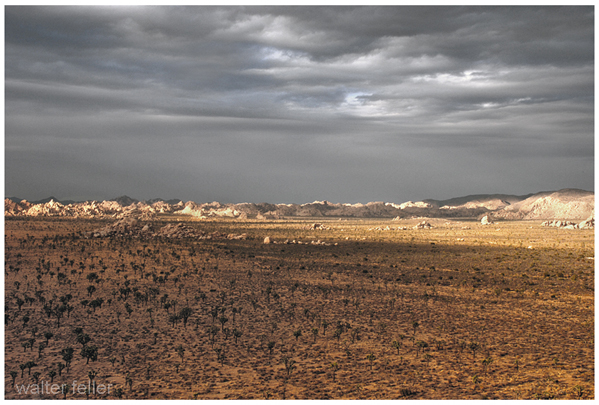
The desert is immense and infinitely variable, yet delicate and and fragile. It is a land shaped by sudden torrents of rain and climatic extremes. Rainfall is sparse and unpredictable. Streambeds are usually dry and water holes are few. This land may appear lifeless, but within its parched environment are intricate living systems, each fragment depending on the whole system for survival.

Joshua Tree National Park is located in southern California on the eastern end of the broad mountainous belt called the Transverse Ranges, which stretch from Point Arguello, 50 miles west of Santa Barbara, eastward for nearly 300 miles to the Eagle Mountains in the Mojave Desert. Unlike most mountain ranges in North America that run north-south, the Transverse Ranges lie on an east-west axis.

The area of southeastern California is a rain shadow desert. The rain shadow effect is produced by the high mountains on the west, which block the movement of wet winter storms. Coastal storms moving east collide with Mount San Jacinto (10,804 ft.) and Mount San Gorgonio (11,502 ft.) dropping most of their moisture on the west sides of these mountains. Land on the east side receives much less rain, which results in a desert environment.

During late August or September occasional tropical storms move into southern California from the south. These storms end up on the east side of the Peninsular Ranges and can dump a considerable amount of water in a short time. Some five to 10 inches of rain may fall in a few hours, representing a large portion of Joshua Tree’s annual precipitation.


White Tank Natural Arch area slideshow
Index > The Desert - Ecosystems - Geologic Displays - Temporary Phenomenon - Life Force - Variety and Complexity

JOSHUA TREE > ABOUT THE PARK TRAILS & BACKROADS MOJAVE ECO-ZONE COLORADO ECO-ZONE AERIAL PHOTOS 360° PHOTOS
features - ecology: wildlife - plants - places - region map - map/sat - roads & trails - wilderness - video - aerial - 360 - old west - communities - books - lodging -
route 66 - ghost towns - gold mines - parks & ... - joshua tree - death valley - mojave preserve - native culture - history - natural features - geology - glossary -
Wrightwood Real Estate
MOUNTAIN HOMES & CABINS
Vacation Rentals & Homes for Sale
Log Cabin Furnishings
Lodgepole Pine Log Furniture
Rustic Decor & Silhouette Metal Art
HighDesertRED.com
High Desert Real Estate Directory
--
Google
 
Search:
Keywords:
Check out our...
>> RECOMMENDED BOOK LISTS <<
Digital-Desert
Abraxas Engineering
privacy
Copyright ©Walter Feller. All rights reserved.
Respect U.S and international copyright statutes and our right to own and control our work
- DO NOT LINK TO THESE IMAGES FROM WEB PAGES, FORUMS OR BLOGS -
Desert Gazette