-.-
Calico Ghost Town
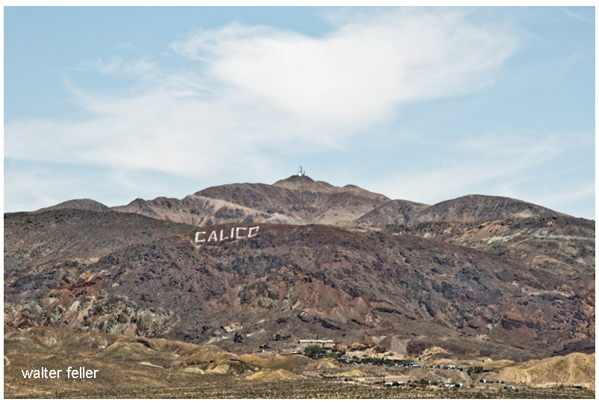
Calico
Calico, California
Calico stands against the colorful slopes of the Calico Mountains northeast of Barstow. The town began with silver, grew rapidly during the 1880s, and declined when its mines could no longer support it. Today, Calico preserves part of the story of mining, transportation, business, and daily life in the Mojave Desert.
Silver was discovered in the mountains in April 1881. S. C. Wardan, Hues Thomas, and John C. King located claims that became the Silver King Mine. The surrounding hills, streaked with shades of red, brown, gray, and yellow, gave the district and town the name Calico. News of the discovery spread quickly, bringing prospectors, miners, merchants, and investors into the district.[1]
Calico was not simply a collection of miners' cabins. As the mines expanded, an organized town appeared along the slopes and in Wall Street Canyon. It had stores, hotels, boardinghouses, saloons, restaurants, a post office, a school, and a weekly newspaper called the Calico Print. Families lived alongside single miners, and the population included immigrants from several countries. Chinese residents operated businesses and performed difficult work but faced the discrimination common throughout California at the time.
Life at Calico depended upon the mines. The Silver King was the best-known early producer, while the Waterloo became another major operation. Other mines included the Oriental, Bismarck, Burning Moscow, and Garfield. Hundreds of claims were recorded across the district, although many never became productive mines.
Mining in the Calico Mountains was difficult and expensive. Ore had to be removed from tunnels, sorted, transported, crushed, and treated before its silver could be recovered. Water and timber were scarce, and nearly everything needed by the town had to be brought in from elsewhere. Daggett, on the railroad near the Mojave River, became Calico's supply and milling center.
At first, wagons and mule teams carried ore between the mines and the mills near Daggett. A narrow-gauge railroad later connected the Waterloo Mine and Calico area with the Waterloo mill at Elephant Mountain. The railroad reduced transportation costs and allowed larger amounts of ore to be handled. It also tied Calico more closely to Daggett and the main railroad lines crossing the desert.[2]
The district reached its greatest silver production around 1890. Population estimates vary because miners and laborers came and went rapidly, but Calico probably held about 1,200 permanent residents during its strongest years. The wider mining district may have contained as many as 3,000 people. Contemporary production estimates also differ, but the district produced millions of dollars in silver.[3]
The boom did not last. Some of the richest ore was exhausted, operating expenses remained high, and the market price of silver declined. The federal government's repeal of the Sherman Silver Purchase Act in 1893 contributed to falling confidence in silver mining. The Waterloo closed as a major silver producer, and profitable silver mining in the district had largely ended by 1896.[3]
Calico did not disappear immediately. Borate minerals had also been discovered in the surrounding district. Borax mining continued after the main silver boom and supported nearby camps, transportation lines, and processing works. The Borate and Daggett Railroad carried borate ore from the mines to the railroad and mills near Daggett. By about 1907, however, large-scale mining in the Calico district had nearly ended. Buildings were abandoned, moved, dismantled, or slowly damaged by desert weather.
A few residents remained. Among the best remembered was Lucy Bell Lane, who came to Calico as a child and preserved stories and objects from the town's mining years. Such residents provided an important connection between the original community and later efforts to preserve its history.
Walter Knott purchased Calico during the 1950s and began restoring the town. Knott had family connections to its mining history and believed that the story of the old West should be preserved. Only a small number of original buildings remained, so much of Calico was repaired, reconstructed, or recreated to suggest its appearance during the 1880s. This saved the townsite, although visitors should understand that present-day Calico is a mixture of original remains, restored structures, reconstructions, and later attractions.[4]
Knott donated Calico to San Bernardino County in 1966. It is now operated as Calico Ghost Town Regional Park, its modern official designation. The Calico Mining District is California Historical Landmark No. 782, and in 2005 Calico was proclaimed California's Silver Rush Ghost Town.[4]
Calico matters because it represents more than a brief silver strike. Its history shows how a Mojave Desert mining community depended upon geology, labor, water, transportation, outside capital, and changing mineral prices. The painted hills, mine openings, building remains, and restored town preserve evidence of both the excitement of the silver boom and the uncertainty of life in a desert mining district.
References
Digital-Desert, "Calico, California - 1880s Silver Boomtown" and MojaveDesert.Net, "Calico Mining History".San Bernardino County, "Calico History Q&A". Includes information about the Waterloo Mining Company Railroad and Borate and Daggett Railroad.
T. W. Dibblee Jr., "Geologic Map of the Daggett Quadrangle, San Bernardino County, California", U.S. Geological Survey, 1970. The report places peak silver production in 1890 and the principal decline in 1896.
Calico Ghost Town Regional Park, San Bernardino County Regional Parks.
Additional Reading
Douglas W. Steeples. Treasure from the Painted Hills: A History of Calico, California, 1882-1907. Greenwood Press, 1999.David F. Myrick. Railroads of Nevada and Eastern California, Volume II: The Southern Roads. University of Nevada Press, 1992.
California Historical Landmark No. 782, Calico Mining District landmark inscription.
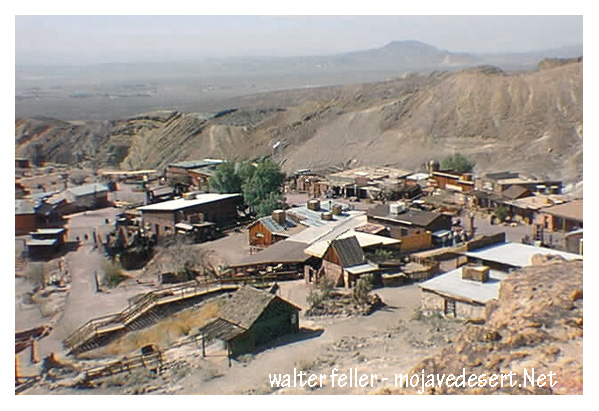
Calico
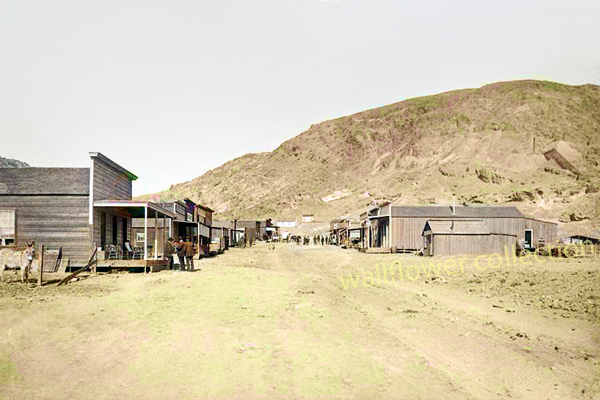
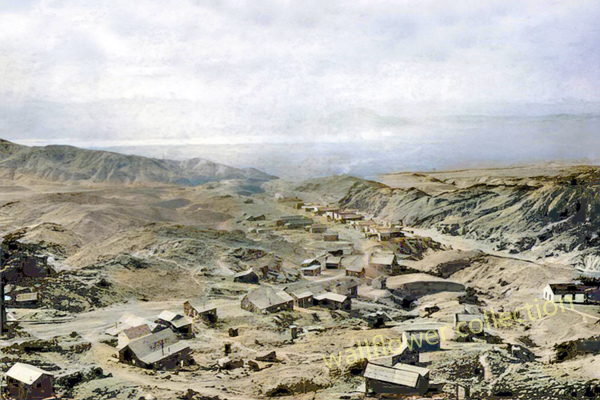
Calico - 1884