| Digital-Desert : Mojave Desert |
Desert Gazette True Facts, Legends & Lies |
| features - ecology: wildlife - plants - places - region map - map/sat - roads & trails - wilderness - video - aerial - 360 - old west - communities - books - lodging |
| route 66 - ghost towns - gold mines - parks & ... - joshua tree - death valley - mojave preserve - native culture - history - natural features - geology - glossary - comments |
|
Wildlife >
Reptiles >
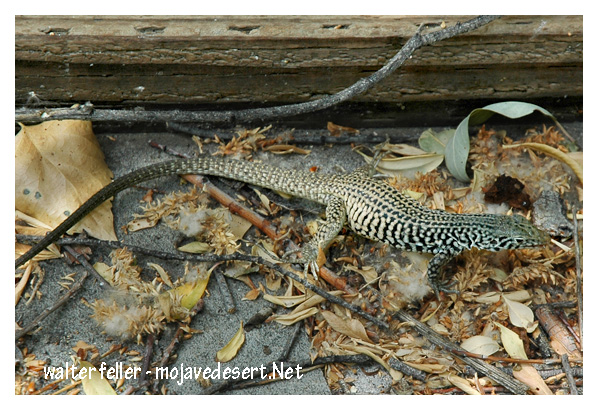
Lizards Western Whiptail Lizard Aspidoscelis tigris Family: Teiidae Order: Squamata Class: Reptilia DISTRIBUTION, ABUNDANCE, AND MSEASONALITY
The western whiptail is widely distributed but uncommon over much of its range in
California, except in desert regions where it is abundant in suitable habitats. The species
is found throughout the state except in the humid northwest, along the humid outer Coast
Ranges, or mountainous regions above 2290 m (7500 ft). Also absent from much of the
northern part of the Central Valley (Montanucci 1968). The western whiptail occurs
in a variety of habitats including valley-foothill hardwood, valley-foothill hardwood-conifer,
valley-foothill riparian, mixed conifer,
pinyon-juniper,
chamise-redshank chaparral, mixed
chaparral,
desert riparian,
desert scrub,
desert wash,
alkali scrub,
and annual grassland.
Johnson, C. R. 1969. Observations on northern california populations of cnemidophorus tigris (Sauria: Teiidae). Herpetologica 25:316-318. Jorgensen, C. D., and W. W. Tanner. 1963. The application of the density probability function to determine the home ranges of uta stansburiana stansburiana and cnemidoporus trigris tigris. Herpetologica 19:105-115. Milstead, W. W. 1957. Observations on the natural history of four species of the whiptail lizard, cnemidophorus (Sauria: Teiidae) in Trans-Pecos Texas. Southwest Nat. 2:105-121. Montanucci, R. R. 1968. Notes on the distribution and ecology of some lizards in San Joaquin Valley, California. Herpetologica 24:316-320. Ohmart, R. D. 1973. Observations on the breeding adaptations of the roadrunner. Condor 75: 140-149. Parker, W. S. 1972. Ecological study of the western whiptail lizard, cnemidophorus tigris gracilis in Arizona. Herpetologica 28:360-369. Pianka, E. R. 1970. Comparative autecology of the lizard cnemidophorus tigris in different parts of its geographic range. Ecology 51:703-720. Stebbins, R. C. 1954. Amphibians and reptiles of western North America. McGraw-Hill, New York. 536pp. Tanner, W. W., et al. 1969. Vitt, L. J., and R. D. Ohmart. 1977. Ecology and reproduction of lower colorado river lizards: ii. Cnemidophorus tigris (Teiidae), with comparisons. Herpetologica 33:223-234. California Department of Fish and Game. California Interagency Wildlife Task Group. 2005. California Wildlife Habitat Relationships version 8.1 personal computer program. Sacramento, California. Cnemidophorus tigris multiscutatus - USGS Western Ecological Research Station, San Diego Ca. |
![]() Whiptail Lizard (Cnemidophorus tigris tigris) Size: 2.4-4.6 in (6.0-11.7 cm) Distinguishing characters: A species with eight light-colored stripes that are often very indistinct, with crossbars in adults suggesting checkered appearance; dark markings on dorsum with yellow, tan or brown background; throat pale with black spots; long tail; enlarged, square scales on venter; dorsal scales fine and granular; tongue is forked and flicked continually. Juveniles: Similar to adults, with distal portion of tail bright blue-green; in Orange and Riverside Counties they are striped. Dimorphism: Enlarged femoral pores in males. Similar species: Cnemidophorus hyperythrus: Striping more distinct; does not appear checkered or spotted; legs and tail cobalt blue in juveniles. Additional notes: A distinctive species with a jerking gait, rarely sits still. Adults are surprisingly strong when handled and have very sharp claws. -- Whiptails belong to a large family of New World lizards, distributed throughout the West Indies and South America. Only fourteen species of the genus Cnemidophorus reach into the United States, so we are very much at the edge of their range. They eat insects, spiders and other small animals. Some whiptails are very unusual in that their population consist entirely of females. The females lay viable but unfertilized eggs, that develop into genetically identical females.
|
| features - ecology: wildlife - plants - places - region map - map/sat - roads & trails - wilderness - video - aerial - 360 - old west - communities - books - lodging |
| route 66 - ghost towns - gold mines - parks & ... - joshua tree - death valley - mojave preserve - native culture - history - natural features - geology - glossary - comments |
|
Wrightwood Real Estate MOUNTAIN HOMES & CABINS Vacation Rentals & Homes for Sale |
Log Cabin Furnishings Lodgepole Pine Log Furniture Rustic Decor & Silhouette Metal Art |
HighDesertRED.com High Desert Real Estate Directory -- |
|
Digital-Desert Abraxas Engineering privacy |
Copyright ©Walter Feller. All rights reserved. Respect U.S and international copyright statutes and our right to own and control our work - DO NOT LINK TO THESE IMAGES FROM WEB PAGES, FORUMS OR BLOGS - |
Desert Gazette |