Western Diamond-backed Rattlesnake
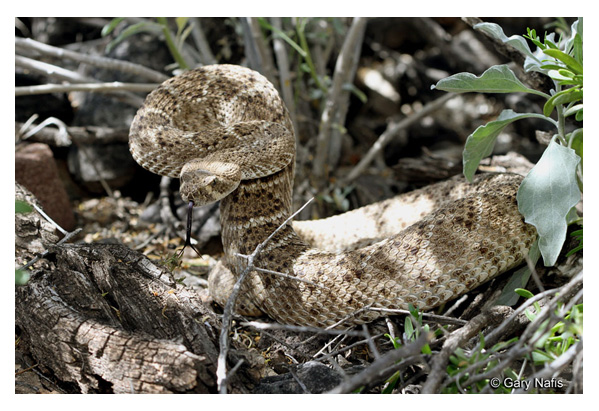
Photo - Gary Nafis - CaliforniaHerps.com
Crotalus atrox
Family: Viperidae Order: Squamata Class: Reptilia
DISTRIBUTION, ABUNDANCE, AND SEASONALITY
The western diamondback rattlesnake is widely distributed in the Colorado Desert of
California up to 600 m (2000 ft) in elevation, and perhaps higher in a few isolated locations. In
other parts of its range it reaches an elevation of 3000 m (10,000 ft). It occurs in a wide
variety of
desert habitats,
both on flats and in foothills, and prefers brushy areas. It is often
common in riparian habitats. In California this snake is not as common as in the eastern parts
of its range. A frequently nocturnal species, the western diamondback can be active any
month of the year when temperatures are mild to warm, but is most active in spring and
summer (Stebbins 1954, Klauber 1972).
(Habitat example: Desert Riparian)
SPECIFIC HABITAT REQUIREMENTS
Feeding: The prey are struck and envenomated. Death follows rapidly and the prey is
consumed. This snake takes small- to medium-sized vertebrate prey, such as rabbits,
rodents, birds and lizards (Gloyd 1940, Stebbins 1954). This snake is usually found in brushy
habitats, where these prey items are most numerous.
Cover: Heavy brush is the most commonly used cover, but other objects such as logs,
rocks and debris are used. Rodent burrows are often used for refuge. Boulder piles and rock
outcrops are occasionally frequented (Stebbins 1954, Klauber 1972).
Reproduction: Young are born live and thus a quiet, protected place is required such as a
rodent burrow.
Water: Free water is probably not required.
Pattern: This species is widely distributed in brushy lowlands where larger vertebrate prey
(rabbits, rats, etc.) can be obtained. It occurs in smaller numbers at higher elevations, on
drier flats and in sparser vegetation .
SPECIES LIFE HISTORY
Activity Patterns: When temperatures are mild this species can be active during the day,
especially in the morning. When temperatures are higher it is more frequently encountered at
dusk and at night. It can be active any month when temperatures are mild to warm, but spring
and summer are the periods of greatest activity (Stebbins 1954, Klauber 1972).
Seasonal Movements/Migration: In the eastern United States, rattlesnakes are known to
migrate between hibernacula and spring-summer ranges. The western diamondback has not
been observed to migrate, but it is a poorly known species, and migration may occur.
Home Range: Nothing is known concernlng the home range of this species, but other
rattlesnakes are known to move considerable distances.
Territory: No data.
Reproduction: Western diamondbacks mate as early as late March and sometimes again
in the fall. The young are born in late summer. They are born alive and broods range from 6
to 23 young, averaging 9 (Klauber 1972).
Niche: This species is probably taken by
roadrunners,
eagles, other avian predators, and
possibly by
mammalian predators.
Kingsnakes
may take young diamondbacks. Droughts
that reduce
prey
probably have a negative impact on this species. Ground squirrel
eradication programs are probably deleterious because of the removal of prey and their
burrow systems, which are used for reproduction and cover.
General Comments: This snake is large, aggressive, has a complex venom and,
therefore, is considered one of the most dangerous snakes in North America. Extreme
caution should be exercised in handling this snake.
Source:
CDFW California Wildlife Habitat Relationships. Accessed [N/A]
https://wildlife.ca.gov/Data/CWHR
Also see:
Snakes - Mojave Desert Wildlife
Western diamond back rattlesnake -- Fangs over 1/2 inch in length. Venom highly hemorrhagic. 53% of the enzymes cause breakdown of the circulatory system, ...
Grand Canyon Wildlife - Reptiles
The other four rattlesnakes are subspecies of the Western Diamondback rattlesnake complex: the Grand Canyon pink rattlesnake, Great Basin rattlesnake, ...
Riparian Habitat of Grand Canyon Wildlife
The other four rattlesnakes are subspecies of the Western Diamondback rattlesnake complex: the Grand Canyon pink rattlesnake, Great Basin rattlesnake, ...
Mojave Rattlesnake - Desert Wildlife
It looks similar to a diamondback rattlesnake, having diamond shapes along its back. It’s color will vary from ... Western Brush Lizard Birds - Predators ...
Joshua Tree National Park Wildlife
Western Diamondback Snake Crotalus atrox Areas with fairly thick vegetation; ... Southwestern Speckled Rattlesnake Crotalus mitchelli pyrrhus ...