Mojave Desert Desert Gazette
top >> mojave << features - wildlife - places - region map - map/sat - roads & trails - wilderness - video - aerial - 360 - old west - communities - books - lodging -
route 66 - ghost towns - gold mines - parks & ... - joshua tree - death valley - mojave preserve - plants - native culture - history - natural features - geology - glossary -
Wildlife > Reptiles > Snakes

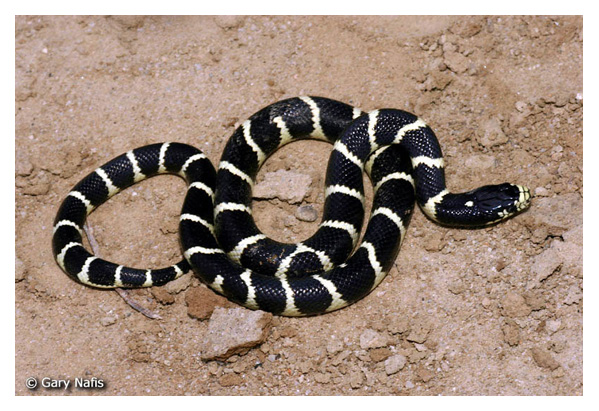
Common Kingsnake
Lampropeltis getula

Family: Colubridae Order: Squamata Class: Reptilia

DISTRIBUTION, ABUNDANCE, AND SEASONALITY

Scarce to abundant, the common kingsnake is found throughout California including Santa Catalina Island off the southern coast. It is absent only from the high mountains of the Sierra Nevada and from the extreme northwestern and northeastern portions of the state. Widely distributed, and occurring in nearly all habitats (exclusive of high mountains), the common kingsnake is most abundant in valley-foothill riparian situations and in other habitats occurring in the vicinity of irrigated agriculture. Elevation sea level to 2100 m (7000 ft).

SPECIFIC HABITAT REQUIREMENTS

Feeding: Kingsnakes feed on the ground, in mammal burrows, and under surface objects. Primary foods appear to be lizards and snakes (rattlesnakes exhibit a distinctive defensive postural response when in the presence of kingsnakes; see Carpenter and Gillingham 1975). Large numbers of small rodents, birds, and bird eggs are also taken. Kingsnakes have also been reported to swallow their own shed skins (Keown 1973).

Cover: When inactive, kingsnakes seek cover in rodent burrows and under surface objects such as flat rocks, logs, and boards. At montane localities with cold winters, individuals hibernate in rodent burrows and in deep fissures in rock accumulations.

Reproduction: The eggs of the common kingsnake are thought to be laid in loose well-aerated soil. Cavities in stable talus, abandoned rodent burrows, and rotten logs may also be used as nest sites.

Water: No information on water requirements. In California this kingsnake is most abundant near streams and rivers, and in the vicinity of irrigated agriculture.

Pattern: Often found in the vicinity of rock outcrops and clumps of vegetation.

SPECIES LIFE HISTORY

Activity Patterns: Common kingsnakes may be active whenever temperatures are favorable. During the cooler periods of spring and fall most activity occurs mid-day, but when summer days are hot most activity is restricted to early morning, and late afternoon and early evening. Winter inactivity occurs at all localities.

Seasonal Movements/Migration: Predictable seasonal movements have not been reported for this species in California. It is possible that individuals from montane localities make annual migrations to and from known hibernacula. Elsewhere individuals apparently spend periods of winter inactivity in or near the area of their warm-season activity.

Home Range: The nature of the home range of this species in California is unknown.

Territory: No evidence for the territorial defense of resources has been reported for this species in California. It is probable that males occasionally "fight" during the breeding season. Male combat has been observed within the genus (Shaw 1951, Moehn 1967).

Reproduction: Clutch sizes range from 2 to 12 (usually 9). Egg-laying usually occurs in June or July after the mating season, which extends from March to June. Courtship in kingsnakes is somewhat elaborate and in males involves neck-biting behavior (Leweke 1979). Eggs hatch in about 70 days.

Niche: Because of their activity patterns and local abundance, common kingsnakes are taken by a wide variety of predators (in spite of the release of a noxious musk from the postanal glands of disturbed individuals). Predators include mammals, predatory birds, especially hawks, and other snakes. The nature of competitive interactions between common kingsnakes and other species with which they coexist is unknown.


Also see:

Wildlife of Yosemite National Park
Wildlife species typically found in these habitats include black bear, bobcat, gray fox, mountain kingsnake, Gilbert's skink, white-headed woodpecker, ...

Joshua Tree National Park Wildlife
California Kingsnake Lampropeltis getula californiae Found in all communities; most common in canyons with water (common) Red Coachwhip ...

Side-blotched Lizard - Desert Wildlife
Snake predators include rattlesnakes and sidewinders, coachwhips racers, gopher snakes, kingsnakes, patch-nosed snakes, long-nosed snakes and night snakes. ...

Ash Meadows
Some snakes and larger lizards begin emerging from hibernation including gopher snake, common kingsnake, desert spiny, western whiptail, and zebra-tailed ...

Carnivores - Desert Wildlife
Mountain Kingsnake · Roadrunner ...

REFERENCES

Carpenter, C. C., and J. C. Gillingham. 1975. Postural responses to kingsnakes by crotaline snakes. Herpetologica 31:293-302.

Keown, G. L. 1973. A case of keratophagy in Lampropeltis getulus californiae (Blainville). J. Herpetol. 7:312-315.

Leweke, R. E. 1979. Neck-biting and other aspects of reproductive biology of the Yuma kingsnake (Lampropeltis getulus). Herpetologica 35:154-157.

Moehn, L. D. 1967. A combat dance between two prairie kingsnakes. Copeia 1967:480- 481.

Shaw, C. E. 1951. Male combat in American colubrid snakes with remarks on combat in other colubrid and elapid snakes. Herpetologica 7:149-168.

Stebbins, R. C. 1954. Amphibians and reptiles of western North America. McGraw-Hill, New York. 536pp.

EXTERNAL LINKS

Lampropeltis getula californiae - California Kingsnake
pictures of the more common banded form of CA Kingsnake, plus a range map, information, and links to more information. ...

Lampropeltis zonata - California Mountain Kingsnake
A California Mountain Kingsnake resting in a crack in a large boulder. Often this is all you will see of a snake before it retreats deeper into the rock. ...

Prairie Kingsnake
Provides color photographs and information about the size, color, habitat, behavior, and life cycle.

Common King Snake Fact Sheet - National Zoo
Eastern king snakes hide under things. As a defense they give off a smelly musk when captured and may bite. Brought to you by the National Zoo| FONZ.

Tarahumara Mountain Kingsnake
Tarahumara or Chihuahua Mt Kingsnake is my other subspecies (knoblocki). Their range is strictly in Mexico. All of the pyromelana come from higher ...

Lampropeltis getula, the California Kingsnake
California Kingsnake: Scientific name: Lampropeltis getula californiae California Kingsnake: Banded ...

Eastern Kingsnake
Kingsnakes are arguably one of the most handsome of all serpents. These snakes get very big with some individuals ...

Lampropeltis
If you have ever wondered how big adult Kingsnakes and Milksnakes get and what ... Lampropeltis calligaster calligaster, Prairie Kingsnake, 42 inches, Photo ...

HerpNet.net - Iowa Reptiles and Amphibians - Prairie Kingsnake
...Reptiles and Amphibians of Iowa and Minnesota with detailed descriptions, range maps and photographs of every species of snake, lizard, turtle, frog, ...

eNature.com Nature Guides
A large chocolate brown to black kingsnake with a highly variable back and belly pattern. Light-centered scales may form distinct crossbands, "chainlinks ...

King Snakes
Offers king snake information and photos. ... king snake, name for a number of species of the genus Lampropeltis, nonvenomous, egg-laying, ...

kingsnake.com - the information portal for reptile and amphibian
...Information on reptile and amphibian related husbandry and reproduction.

Common Kingsnake (DesertUSA)
All about the Common Kingsnake, its scientific names, common names, description, behavior, range, habitats and life cycle.

Kingsnake - Wikipedia
The majority of kingsnakes have quite vibrant patterns on their skin. Kingsnakes use constriction to kill their prey and tend to be opportunistic when it ...

California King Snake: WhoZoo
The California Kingsnake varies in its color and patterns from one snake to another. There are many variability in morphology (appearance). ...


Common Kingsnake
Photo by Chris Brown


Common Kingsnake
Photo by Jim Rorabaugh


Additional information:

Scientific name: Lampropeltis getula californiae

Common name: California Kingsnake

Size: 19.7-43.8 in (50-111 cm)

Distinguishing characters: A polymorphic species with various color and pattern phases consisting primarily of alternating bands of black or brown, and white or yellow (banded phase) or longitudinal stripes of these same colors (striped phase); some individuals exhibit partial patterns of both and can appear marbled, spotted, or blotched; scales smooth and glossy; snout light colored; single anal scale.

Juveniles: Similar to adults.

Dimorphism: None

Additional notes: Individuals may excrete musk, vibrate tail, and bite when handled. Widespread in many habitats.


top >> mojave << features - wildlife - places - region map - map/sat - roads & trails - wilderness - video - aerial - 360 - old west - communities - books - lodging -
route 66 - ghost towns - gold mines - parks & ... - joshua tree - death valley - mojave preserve - plants - native culture - history - natural features - geology - glossary -
Wrightwood Real Estate
MOUNTAIN HOMES & CABINS
Vacation Rentals & Homes for Sale
Log Cabin Furnishings
Lodgepole Pine Log Furniture
Rustic Decor & Silhouette Metal Art
Victorville - Hesperia
~ HOMES FOR SALE ~
New Life Financial Services Realty
Google
 
Search:
Keywords:
Check out our...
>> RECOMMENDED BOOK LISTS <<
Mojave Desert & Mountains Communities:
Victorville - Hesperia - Apple Valley - *Adelanto - Baker - Barstow - *Lucerne Valley - Big Bear - Lake Arrowhead - Yucca Valley - Joshua Tree - Twentynine Palms - Palmdale - Lancaster - Mojave - Tehachapi - California City - *Boron - Ridgecrest - *Randsburg - Nipton - Shoshone - Tecopa - Death Valley Junction - Needles - Lone Pine - Big Pine - Bishop - Independence - Trona -
Digital-Desert
Abraxas Engineering
privacy
Copyright ©Walter Feller. All rights reserved.
Respect U.S and international copyright statutes and our right to own and control our work
- DO NOT LINK TO THESE IMAGES FROM WEB PAGES, FORUMS OR BLOGS -
Desert Gazette