|
|
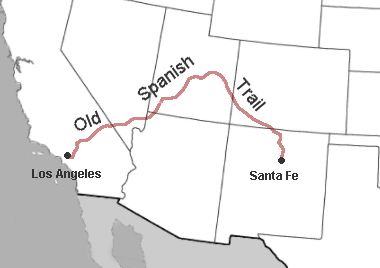
Old Spanish Trail
The Old Spanish National Historic Trail was designated as
part of the National Trails System in 2002. The trail
connected New Mexico’s frontier colonies to their
counterparts in southern California in the early 19th century.
There was money to be made in transporting New Mexico
serapes and other woolen goods to Los Angeles, and in
wrangling California-bred horses and mules back to Santa Fe.
But a viable overland route across the remote deserts and
mountains of Mexico’s far northern frontier had to be found.
Spain’s colonists had sought an overland route between New
Mexico and California for more than 50 years.
Mexican trader Antonio Armijo led the first commercial
caravan from Abiquiú, New Mexico, to Los Angeles late in
1829. Over the next 20 years, Mexican and American traders
traveled variants of the route that Armijo pioneered,
frequently trading with
Indian tribes
along the way.
The complex network known today as the Old Spanish Trail
evolved from a combination of indigenous footpaths, early
trade and exploration routes, and good pasture and water for
the pack trains and stock drives. After the United States took
control of the Southwest in 1848, other routes to California
emerged, and use of the Old Spanish Trail sharply declined.
The Old Spanish Trail was primarily a
horse
and
burro
pack route between Santa Fe and Los Angeles,
which developed partly from a network of American Indian and Hispanic trade routes. Although
primarily a trade thoroughfare, it also was used by
explorers,
trappers,
prospectors, and
immigrants. In
1847, Mormons initiated wagon travel along the western half of the trail while traveling between Salt
Lake City and Los Angeles. The Mormon wagon route replicated or paralleled the Old Spanish Trail for
most of the distance between the present-day communities of Paragonah, Utah, and San Bernardino,
California.
Two main routes emerged—the Armijo (Southern) Route and the Northern Route. The North Branch of
the Old Spanish Trail through the San Luis Valley and Gunnison River country of Colorado and eastern
Utah was a variant of the Northern Route. Fur trappers were the predominant users of the North Branch.
It is commonly said that the Old Spanish Trail was neither “old” nor “Spanish.” The first documented
use of the name came from
John C. Frémont
in the 1840s, and the name was picked up and used by
others, principally Anglo-American travelers. Nineteenth-century Mexican traders in New Mexico
referred to it as the "Camino de California," and Californios referred to it as the "Camino de Santa Fe"
HISTORICAL OVERVIEW
American Indian groups have lived for thousands of years throughout what is now the American
Southwest. These groups developed an extensive network of routes for travel and trade. As with other
western trails, it is likely that segments of the Old Spanish Trail follow some earlier trails and trade
routes. Trade and travel along the route, or portions of it, included use by Ute, Paiute, Comanche, and
Navajo peoples.
In 1769, Spain established settlements in southern California to prevent ongoing Russian and English
encroachments. Supplying these settlements by sea was difficult because of unfavorable winds and
ocean currents. The first land route to southern California was extended from La Paz in Baja, California,
to San Diego in 1769. In 1775 and 1776, Juan Bautista de Anza led settlers north into California from
Sonora, Mexico.
Spain also was interested in establishing a viable overland link between her northern holdings in
California and New Mexico. Parts of what would become the Old Spanish Trail were explored from the
west when
Father Francisco Hermengildo Garcés
set out from the Yuma villages along the Gila River in
southern Arizona to explore a path to the California missions beginning in 1774. To get there, Garcés
traveled north to the friendly
Mohave Indian
villages along the
Colorado River.
There, he was offered four
guides, who led him along indigenous trails to the
Mojave River.
Garcés followed the Mojave for
several days, reaching Misión San Gabriel via the
San Bernardino
-
San Gabriel
Ranges. Some of the
indigenous routes that Garcés traveled through the Mojave Desert later became part of the western
portion of the Old Spanish Trail.
Spanish colonial interest in trade with the Utes began in the seventeenth century. Fearing renewed
hostilities caused by unfair trade practices, eighteenth-century Spanish officials prohibited trade with the
Utes. Flaunting the law, traders from New Mexico followed pathways to the land of the Utes. Each
illegal expedition invariably furnished knowledge of Ute country. As Spanish frontiersmen ventured
beyond western Colorado, they learned different ways to get to the Great Basin. Later, the more
experienced served as guides on official expeditions to western Colorado and Utah.
Three officially sanctioned expeditions from New Mexico into Ute country, composed partially of men
who had previously traded illegally with the Utes, reflected renewed Spanish interest in Ute country. In
1765, Juan María Antonio Rivera led two parties to explore southwestern Colorado and southeastern
Utah. Eleven years later, in 1776, a third official expedition left Santa Fe following Rivera’s route to the
Uncompahgre Plateau and beyond to the Great Basin in western Utah. This expedition, led by two
Franciscan priests, Francisco Atanasio Domínguez and Francisco Silvestre Vélez de Escalante, was
intended to establish a route between Santa Fe and Monterey in California. Although their expedition
failed in its objective to reach the coast of the Pacific Ocean, they succeeded in providing more
information about the interior land and its people.
In the mid-1820s, Hispanic New Mexicans and Anglo-Americans expanded their trade in Ute country.
Anglo-American fur trappers, in particular, were interested in meeting European demand for beaver hats
with new sources of fur in the Rocky Mountains. While trapping for beaver, these men explored the
region. In 1825-1826 Antoine Robidoux built Fort Uncompahgre (Fort Robidoux) near present-day
Delta, Colorado. This fort was a centralized trading area where various Indian groups brought furs to
trade; these furs were then transported to Santa Fe or Bent’s Old Fort over routes that later became part
of the Old Spanish Trail. Robidoux later built another fur-trade post, Fort Uintah, in northeastern Utah.
Occasionally, the North Branch of the Old Spanish Trail was used to supply these trading posts.
In late summer of 1826
Jedediah S. Smith
led a small party of trappers westward from the rendezvous at
Cache Valley, Utah, utilizing portions of what would become the Old Spanish Trail as he headed
southwest toward California. After wintering among the californios, Smith and some of his party made
their way to the 1827 rendezvous at Bear Lake near the Utah-Idaho boundary. Leaving that rendezvous
in July, Smith again headed for California, generally retracing his steps of a year before, but this time
several of his men died in a bloody clash with Mohave Indians when they attempted to cross the
Colorado River at a Mojave village.
Beginning in the 1820s, several groups of fur trappers made their way from New Mexico to California
via various routes through Arizona. Collectively, these routes are sometimes called the Gila Route
because most travelers trapped along the Gila River en route. In 1827, Richard Campbell led 35 men to
San Diego. While it is sometimes assumed that he went south along the Gila, he later remembered
taking a more northerly route using the Crossing of the Fathers and then going north of the Grand
Canyon. In 1827, Sylvester Pattie led a group along the Gila to Baja California, where they were
imprisoned by Mexican officials and taken to San Diego. Two members of this party, Isaac Slover and
William Pope, escaped and returned to New Mexico. They later followed the Old Spanish Trail to live
in California. Ewing Young led a group that included Kit Carson—via Zuni and the Salt River and then
trapped along the Virgin River in Utah before heading to California in 1830. Some members of these
groups, as well as members of other groups traveling via southern routes, stayed in California.
In 1829, Mexican trader Antonio Armijo departed from Abiquiú in command of a commercial caravan
of 60 men. Armijo successfully established a route to Los Angeles, where he traded serapes and other
New Mexican goods for horses and mules. Following known American Indian and Spanish paths,
Armijo traveled west through Navajo and Paiute territory, and forded the Colorado River at the
Crossing of the Fathers—an indigenous crossing used by Domínguez and Escalante in 1776. Thence,
Armijo generally followed the present state boundary between Arizona and Utah until he reached the
Virgin River. From the Virgin River, based on the advice from his guide, he passed south of present-day
Las Vegas on his way to the Amargosa River.
William Wolfskill and George C. Yount first established the Northern Route of the Old Spanish Trail as
they passed through central Utah in 1831. With a party of approximately 20 men, Wolfskill and Yount
departed Abiquiú in the winter of 1830, and went to California by a route that Wolfskill would later
describe as being “farther north than that adopted by the Spaniards in traveling between California and
New Mexico.” The Wolfskill-Yount route headed northwest to a crossing of the Colorado River, then
west and southwest through Utah. They returned to the Colorado River and followed it to the Mojave
villages, where they rested and fed their animals and traded with the Mojave. The party then proceeded
west to Los Angeles.
A major variation of the Old Spanish Trail was established by traders and trappers using American
Indian and Spanish colonial routes from Santa Fe and Taos into the San Luis Valley of Colorado, and
then west to Cochetopa Pass and the Gunnison River Valley. It provided a corridor into eastern Utah.
The route through the San Luis Valley included the main road from Taos and also a western fork that
came into greater use after 1848. These trails collectively formed a route that became known as the
North Branch of the Old Spanish Trail. In his 1870 book about life in the West, John C. Van Tramp
cites a letter he received from trapper, Antoine Leroux. Leroux identifies the North Branch as an
alternate route to California from Taos. Its greatest attraction to the trail travelers was the Cochetopa
Pass. Leroux reported that “There is not much snow in this pass, (the Coochetope,) and people go
through it all the winter. And when there is much snow on the mountains on the Abiquiu route, (which
is the old Spanish trail from Santa Fe to California,) the people of Taos go round this way, and get into
that trail in the forks of the Grand and Green rivers.”
As use of Old Spanish Trail segments continued, travelers established numerous other variations to take
advantage of better water sources and to shorten the length and time of travel. By 1848, travelers had
developed several variations of the route to the Sevier River in order to avoid the Sawtooth Narrows of
Salina Canyon. Another variation, developed later still, was the Kingston Cutoff, which led travelers
southwest from Mountain Springs, Nevada, to Silurian Lake, California.
As the trail network evolved, partly from indigenous footpaths and partly from newly blazed routes, into
a horse and mule trail, and later into a wagon road, several variants were opened through Cajon Pass,
north of San Bernardino. Some traffic went over Cajon Pass following what is now California State
Highway 152 up to the summit, and descended into the San Bernardino Valley through the area now
occupied by the California State University campus. However, the route chosen probably depended on
several factors, including party composition, the amount and type of load carried, whether weather was wet
or dry, the time of year, and the presence of government inspectors.
The major reason for travel on the Old Spanish Trail was trade between New Mexico and California,
primarily by New Mexican trade caravans, which traveled between Santa Fe and Los Angeles between
1829 and 1848. Caravans usually left on the three-month journey in the fall, primarily carrying woolen
goods produced in New Mexico. They returned the following year, having traded their goods for horses
and mules.
The size of caravans seems to vary from year to year. Some of the documented trading parties include:
Antonio Santiesteban and 30 men in 1831; José Avieta and 124 men in 1833-1834; José Antonio
Salazar and 75 men in 1839-1840; Francisco Estevan Vigil and 35 men and others (possibly about 134
people) in 1841; Tomás Salazar and 170 men in 1843; and Francisco Estevan Vigil and 209-225 men in
1847. Little or no information seems to be available as to the size of the caravans in 1838, 1840, and
1845. There are no annual trade caravans identified for 1834-1835, 1835-1836, or 1846. There were
other travelers, such as Santiago Martín, who went to California with 15 men in 1832 for personal
reasons rather than trade.
Overall, the available information on the size of caravans, and to a greater extent the quantity of
merchandise carried to California tends to be vague. The 1841 Vigil group was reported by a
Frenchman, Duflot du Mofras, as consisting of 200 New Mexicans and 60 or more North Americans.
Duflot suggested that the annual caravans routinely consisted of 200 men, and they returned to New
Mexico with about 2,000 horses. However, the known information as to caravan size (see preceding
paragraph) suggests that the size of the caravans and the numbers of livestock (see below) brought back
varied from year to year. In some years, the documented number of livestock was more than twice du
Mofras’ estimate and in others only a fraction of that amount.
There was considerable legal trade in horses and mules between California and New Mexico. However,
data can only be found for some of the years in which trade caravans operated. The numbers vary from
year to year. Some of the known groups include Armijo, with 100 animals in 1830; José Antonio
Salazar, with an estimated 2,500 animals in 1839; Francisco Estevan Vigil, with 4,141 animals in 1842;
John Rowland, with 300 animals in 1842; a group, with 252 animals in 1843; a Frenchman called Le
Tard with 231 animals in 1848; and Francisco Estevan Vigil, again, with 4,628 animals in 1848.
Horse and mule theft was common, both by regular traders and adventurers. Americans claiming to be
beaver trappers, fugitive Indians from the missions, Indians from the frontiers, and New Mexicans were
teaming together to gather horses and mules for the drive to New Mexico. This illegal trade was of great
concern in California and resulted in laws to restrict access by New Mexican traders.
In addition to general reports of livestock theft, there are numbers reported for some incidents. The
following are some reports of animals stolen and taken to New Mexico: In 1833, Jesus Uzeta and others
stole 430; in 1837, Jean Baptiste Chalifoux and his men stole 1,400-1,500 mules and horses; in 1842,
John Rowland took 300 stolen animals; In 1844, Jim Beckwourth, according to his claim, took 1,800
horses from California to Bent’s Old Fort in 1844; and in 1846,
Joseph Walker
took 400-500 horses and mules from California, presumably following the Old Spanish Trail into Utah
and then north to Fort Bridger and across the immigrant route and south to Bent’s Fort. In 1848, Miles Goodyear left
California with 231 legally obtained animals, but reportedly drove an estimated 4,000 animals to Utah
and east to Missouri, where he found declining prices due to increased supply and a decrease in
emigration. He returned with the horses to California via the Humboldt River route, where he sold them
at a handsome profit due to increased demand as a result of the Gold Rush of 1849.
Mountain men such as Beckwourth, Pegleg Smith, and others, and New Mexican traders encouraged
Yokuts and other Indians of the California interior to steal horses from the ranchos for resale in New
Mexico. The Yokuts, who had already begun stealing horses for food, now stole them for trade. In
California the wide-ranging Utes, the Yokuts of the Central Valley, and other Indians struck the
ranchos.
Some of the vast fur trade in the West used the Old Spanish Trail. American travelers along the Old
Spanish Trail, Gila (Arizona) routes, and other land routes to California were involved in the fur trade.
Many travelers were trapping for furs as they went. William Wolfskill and others who stayed in
California gave up beaver trapping to hunt sea otters, at least for a while, before becoming landowners.
Furs could also be traded for horses and mules. Antoine Robidoux built two fur trade forts, Fort Uinta
and Fort Uncompaghre, and used the North Branch as a route to supply the forts. The fur trade activity
along the Old Spanish Trail was part of a massive whole extending across the western half of the
continent.
Sheep and wool trade was a major economic industry in New Mexico. New Mexico weavers provided
the woolen goods that were carried over the Old Spanish Trail to California. Wool was also shipped east
on the Santa Fe Trail. Many thousands of sheep were traded south along the Camino Real to Chihuahua
and Durango during the peak years of 1821-1846. The trade languished during the Mexican-American
War, but with the discovery of gold in California and its accompanying population boom, a new market
was opened. In 1849, a gold-seeker named Roberts bought 500 sheep in New Mexico for $250, and took
them to California through southern Arizona, where he sold them for $8,000. By 1850, rumors of the
new market were common in Santa Fe. William Angney bought 6,000 sheep in 1850 and took them to
California via the Old Spanish Trail. In 1852, Richens Lacy “Uncle Dick” Wootton took 9,000 sheep
along the North Branch of the Old Spanish Trail, on to Salt Lake City, and then west to Sacramento
along a California Trail route.
Old Spanish Trail traders also became involved in the ongoing trade in American Indian slaves.
Stronger tribes would raid weaker tribes and take captives for sale to the Spanish, and later Mexicans.
The Southern Paiutes were the principal victims of the slave trade, which, early in the nineteenth
century, is presumed to have used the eastern segments of the later Old Spanish Trail in New Mexico
and Utah. Southern Paiutes may have been slaves in Santa Fe and surrounding communities as early as
the late 1700s, and the practice continued as late as the 1860s in some parts of Colorado and Utah.
This trade was illegal, hence written accounts were seldom kept and official records are largely lacking.
There is limited documentation of the extent of the involvement of Old Spanish Trail trade caravans
with the slave trade. The main market for slaves was New Mexico, and a number of travelers into the
Utah country reported on Mexicans engaged in slave trading. Some Indian slaves were taken to
California to be sold.
Hispanic New Mexican families, Anglo-Americans from the U.S., and others immigrated to California
on the Old Spanish Trail.
Some New Mexicans accompanied American immigrants, such as the Rowland-Workman party. Others
accompanied Mexican trade caravans; and some traveled on their own. Historical references may
sometimes only refer to the number of families and not to the number of individuals.
In 1837, José María Chávez and his brother Julian Chávez, with family members and several others,
escaped New Mexico by way of Utah to California. They had been singled out for execution for siding
with Governor Albino Pérez, who was slain in the New Mexico Rebellion of 1837. In California, they
joined the rebellion and were captured by government forces under General José Castro. They were later
released. José María returned to New Mexico but Julian remained, settling in Chávez Ravine in Los
Angeles. In 1838, Lorenzo Trujillo and six other New Mexicans left New Mexico for California. En
route, Manuelita Renaga gave birth at Resting Springs on the Old Spanish Trail. These eight individuals
became the first settlers in the San Bernardino area. In 1839, 75 New Mexicans arrived in California and
settled near Rancho de San José. Several groups arrived in 1842, including a party of 40 from Abiquiú,
New Mexico, who settled at Agua Mansa and Politana, and a group of 19 families who eventually
settled in San Luis Obispo. In 1843, 10 families accompanied the regular caravan; another 10 families
possibly accompanied a group under John Rowland; and five families arrived at Agua Mansa in 1844.
Beginning with the Wolfskill-Yount party in 1830, a number of Americans following the Old Spanish
Trail also stayed in California. Approximately 28 Americans (about 21 adult males and eight family
members) are known to have immigrated along the Old Spanish Trail between 1830 and 1838. William
Pope and Isaac Slover, who led a group in 1837, had previously been to California via the Gila Route.
In 1841, the Rowland-Workman party immigrated on the trail. Most of the 26 men in this group were
Americans, while several were native New Mexicans. Two of the New Mexicans brought their families.
Nine members of the Rowland party did not stay in California. In 1844, Louis Robidoux and Jean
Jeantet immigrated to California after traveling with a Mexican trade caravan, possibly along the Old
Spanish Trail.
Americans and other foreigners who immigrated to California engaged in a variety of businesses.
Although 1828 regulations opened California to settlement by foreigners, there was little land available,
and Mexican officials were not supportive of grants to foreigners. With the secularization of the
missions in 1834, lands that had been previously closed to settlement became available. In the 1840s,
Mexican officials opened large amounts of land to private development, and foreigners were permitted
to purchase land in California. Many became owners of large holdings. About one-third of the land in
California went to Anglo-Americans. The secularization of the missions also meant that thousands of
Indians from those missions were now available as a source of cheap labor. And an outside market
existed for products of California ranches, primarily hides and tallow. These factors set off a land rush
among Mexicans and foreigners.
Additionally, people were drawn to California as a result of numerous boosters who had written about
the area, beginning as early as 1808 with the journal of a sea-otter trader, Captain William Shaler; Hall
Jackson Kelley’s 1839 report to Congress; Richard H. Dana’s Two Years before the Mast,” and others.
Tales heard from fur trappers and the published words of hide and tallow traders and travelers who
wrote of California helped fuel the American appetite for expansion. Others, such as John Marsh and
John Sutter, were also active in luring overland travelers to California.
Some of those who immigrated to California on the Old Spanish Trail became involved in the American
underground that worked to hasten the takeover of California. This takeover was generally a goal of the
various boosters. John Rowland and William Workman had been involved in the Republic of Texas’
failed 1841 invasion of New Mexico. They became active in annexationist intrigues, joining with many,
such as Abel Stearns, who were already in California. Both, along with other members of their
immigrant party, were involved in the military uprising in 1845 against Governor Micheltorena, as well
as later uprisings.
Soon after settling in the Salt Lake area, the Mormons under Brigham Young began expanding
southward with the intent of establishing an outlet to the sea. A series of settlements were established in
the late 1840s and early 1850s along the “Mormon Corridor,” including Parowan and Cedar City, which
were near beds of iron and coal. In 1852, Young sent a company of 300 settlers, who followed the
western part of the Old Spanish Trail to southern California, where they established a city called San
Bernardino. In 1855, the Mormons built a fort at the site of present-day Las Vegas, Nevada, and another
group followed part of the Old Spanish Trail to settle Moab, Utah. In 1857, fearing an invasion of Utah
by the U.S. Army, the colonists from San Bernardino and other outposts left their settlements and
returned to help defend against the potential invaders.
Over the years, a number of
military groups and expeditions
followed portions or all of the Old Spanish
Trail.
At the forefront of exploration of the West was the U.S. Army Corps of Topographic Engineers—and
the most famous member of that group was John C. Frémont. Like most of his colleagues, Frémont was
a firm believer in manifest destiny. Already renowned for his earlier explorations, Frémont led a wideranging
expedition across the West in 1843-1844. His primary objective was to travel from Missouri to
Oregon. When he reached Fort Vancouver, his official duty was done, but he chose to head south into
California, exploring along the way. In southern California the expedition picked up the Old Spanish
Trail. It left the trail in southwest Utah, continued north to Utah Lake, went east along the Uinta
Mountains and into Colorado, south to Pueblo, and then east back to St. Louis. In his writings, Frémont
referred to the trail as the “Spanish Trail,” a designation that was picked up by others, thus leading to
the popular name for the trail. Frémont published maps and detailed descriptions of the
Amargosa River
variant of the Old Spanish Trail.
Kit Carson
carried military dispatches on several trips, some of them along the Old Spanish Trail. In late
1847, he carried dispatches west along the Old Spanish Trail. In 1848, Carson again traveled with
dispatches east from Los Angeles along the Old Spanish Trail to Santa Fe and on to Washington, D.C.
George Brewerton, who accompanied Carson, kept an account of the trip, which contains some of the
most detailed stories of travel along the trail.
With the American takeover of California, there was a strong interest in completing a railroad
connection to the Pacific, and competition between proponents of different routes to make that
connection. A number of expeditions followed various northern, southern, and central routes. In 1853,
Congress authorized a government survey of all the principal routes under the direction of Secretary of
War Jefferson Davis, who was to submit his report in January 1854.
Lieutenant Edward Fitzgerald Beale
led a group along the North Branch and then down the main Old
Spanish Trail to California in 1853. Beale had been appointed as Indian Commissioner to California.
Senator Thomas Hart Benton secured Beale’s appointment and the funding for his trip. Gwinn Harris
Heap, Beale’s cousin and a newspaperman, wrote a widely distributed account of the trip, which was
very favorable to the route through Cochetopa Pass.
In 1853, Captain John Williams Gunnison led an expedition to explore a possible 38th parallel railroad
route across Cochetopa Pass. After entering the San Luis Valley in Colorado, the group followed the
North Branch of the Old Spanish Trail into western Colorado. In Utah, the group followed parts of the
Old Spanish Trail. On October 26, after leaving the Old Spanish Trail, a group from the expedition was
attacked, reportedly by Paiute Indians; Gunnison and others were killed, leaving only four survivors.
The main party reached the scene two days later, and First Lieutenant Edward G. Beckwith led them to
Salt Lake City.
Senator Thomas Hart Benton of Missouri, who was a strong proponent of the 38th parallel route for the
railroad, secured private funding and sent a survey party led by
John C. Frémont
behind Gunnison.
They followed Gunnison’s tracks on the North Branch and continued into Utah, following parts of the
Old Spanish Trail. Entering the Rocky Mountains in December 1853, the group encountered difficulties,
forcing them to first walk while the animals carried their supplies, and then to cache all but their most
important baggage in order to ride. Eventually, as the animals gave out, they were eaten and their riders
had to walk. The travelers suffered severe hardships and one man died. Solomon Carvalho, who wrote
the account of the trip, lost 44 pounds. The party finally reached Parowan, Utah. Frémont had also led a
previous expedition in 1848 for Benton exploring a 38th parallel route for the railroad in Colorado,
which was not on the Old Spanish Trail, and which ended in the deaths of many of the party when the
group encountered severe weather and heavy snow.
From November 1857 to January 1858, Captain Randolph B. Marcy’s party of 40 soldiers and 25
mountain men traveled a portion of the North Branch of the Old Spanish Trail en route from Fort
Bridger to New Mexico to procure supplies for Army troops under General Albert Sidney Johnson, who
was poised to suppress a possible insurrection in Salt Lake City. Marcy’s group suffered from severe
winter weather and lack of food. After reaching Fort Union, they obtained supplies and returned via a
longer, safer route.
In the summer of 1858, Colonel William W. Loring and 300 men with 50 wagons used part of the Old
Spanish Trail and the North Branch to return from Camp Floyd in Utah to Fort Union.
Captain John N. Macomb led an exploration into southeastern Utah in 1859. The expedition was
looking for a military road and seeking the confluence of the Green and Grand Rivers. They followed a
section of the Old Spanish Trail and then deviated from that route, rejoining it farther along. The
expedition entered Utah near present-day Monticello and set up a base camp. They returned to Santa Fe
across the San Juan Basin. A major accomplishment of the expedition was the scientific observations of
geologist John S. Newberry.
In 1860, several civilians were killed, and the Paiute Indians were blamed for the deaths, although the
identity of the killers and their tribes was actually unknown.
Brevet Major James H. Carleton
was put in
command of a military unit sent forth to punish the Paiute. The troops reached the
Mojave River
on
April 19, and scouted for Indians in the area and along parts of the Old Spanish Trail until July 3. Two
groups of Indians were found and five individuals were killed. The troops found evidence of the
Timbisha Shoshone
tribe but did not encounter them.
Overall, use of much of the Old Spanish Trail, especially the eastern half, diminished after 1848, as
travelers began using other trails such as the California Trail and routes through Arizona. While later
wagon roads, and eventually highways, often replicated segments of the Old Spanish Trail, other
sections received limited, often local use after about 1850. The establishment of the Intercontinental
Railroad in 1869 and other rail routes also resulted in the gradual displacement of many old trails as
immigration and commercial routes.
|
Old Spanish Trail Map

Along the Old Spanish Trail
Photo Tours of Points of Interest along the trail in California and Nevada
Red Rock Canyon
Shoshone
Dublin Gulch
Mud Hills
Tecopa Hot Springs
Dumont Dunes
Amaragosa River
Zzyzx
Afton Canyon
Petroglyphs
Helendale Bluffs
Mojave River Narrows
Mojave River
Cajon Pass
Also see:
Expedition Cronology between New Mexico and California
& Old Spanish Trail - Related Pages

Trees surround waterhole east of Barstow, California near Mojave River.

Mule train trail can be identified by track approximately 36 inches wide.

Wagon trail track is about 6 feet wide.

Forks in Road, east of Barstow. Road on left branches to Utah. Road on right follows Mojave Road to Needles and points beyond.

Mule train track looking west across playa toward Yermo.

Wagon track trail looking east toward Alvord Mountains.

Impassable Pass at Alvord Summit.

Wagon trail winds north and east from Alvord Summit toward Bitter Spring on Fort Irwin.

Looking down Spanish Canyon from Alvord Summit at the top of Impassable Pass
MOJAVE DESERT
Ghost Town Books
Gold Dust & Gold & Dust
Towns that didn't make it
|
|
|