Digital-Desert : Mojave Desert
Intro:: Nature:: Map:: Parks:: Points of Interest:: Ghosts & Gold:: Communities:: Roads & Trails:: People & History:: BLOG:: Weather:: :?:: glossary
Old Spanish Trail

Old Spanish Trail Historical Overview
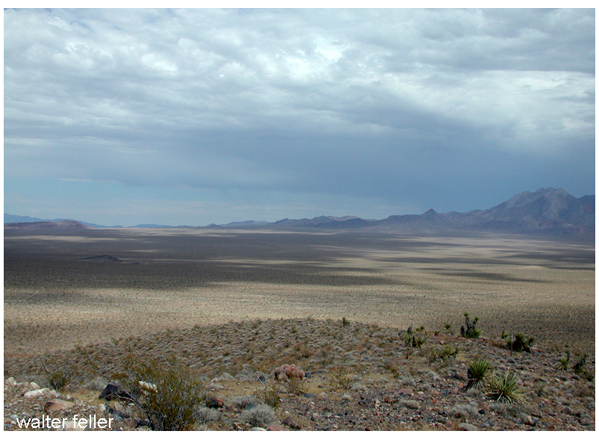

Chicago Valley - Emigrant Pass

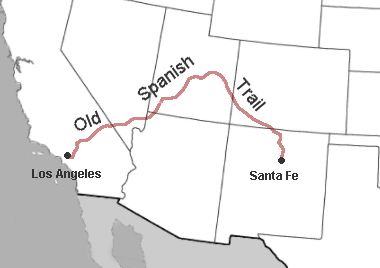
The Old Spanish National Historic Trail passes through Arizona, California, Colorado, Nevada, New Mexico, and Utah. It opened a land route across 19th century Mexico between the Tierra Adentro, the fabled, yet isolated place that would become New Mexico, and California's missions and burgeoning settlements. When he left Abiquiu, New Mexico for California in 1829 with 40 men and 200 pack mules, Antonio Armijo blazed a trail between the two colonies that had frustrated explorers for over a century. The Abiquiu party's woolen blankets and tanned hides were welcomed in textile-starved California. In return, the horses and mules Armijo and his followers on the trail brought east would become the working stock for miners, American and Mexican military, and farmers from northern Mexico to the east coast of the United States.


Old Spanish Trail/Salt Lake Road

Continuous Historical Overview

American Indian groups lived for thousands of years across the region now known as the American Southwest. Their networks of paths, based on water, forage, and seasonal travel, shaped many later routes. Portions of the Old Spanish Trail followed these older lines. Ute, Paiute, Comanche, and Navajo peoples used parts of the corridor long before traders and explorers. In 1769, Spain established settlements in southern California to counter foreign encroachment. Supply by sea was difficult, so land routes became important. In 1774, Father Francisco Garces traveled north from the Gila River to the Mohave villages on the Colorado and was guided west along indigenous trails to the Mojave River and on to Mission San Gabriel. These early passages formed the backbone of the western Old Spanish Trail.

Spanish interest in Ute country grew in the seventeenth and eighteenth centuries. Although trade was restricted, New Mexican traders ignored the laws and traveled illicitly into Ute territory, learning new routes. In 1765, Juan Maria Antonio Rivera explored southwestern Colorado and southeastern Utah. In 1776, the Dominguez and Escalante expedition attempted to find an overland route from Santa Fe to Monterey. Though they did not reach the Pacific, they mapped and described important interior lands and peoples.

In late summer 1826, Jedediah Smith used parts of what would later be the Old Spanish Trail as he traveled southwest toward California. His return trip in 1827 brought a violent clash with Mojave people at the Colorado River. During the same period, trappers and traders used several paths between New Mexico and California, often grouped as the Gila Route. Richard Campbell, Sylvester Pattie, Isaac Slover, William Pope, and Ewing Young all traveled these lines before 1830. Some settled in California; others returned eastward along developing routes.
In 1829, Antonio Armijo led a commercial caravan of about sixty men from Abiquiu to Los Angeles. Following Native and Spanish paths, he crossed the Colorado at the Crossing of the Fathers and continued west along the Arizona–Utah line to the Virgin River, then south of present-day Las Vegas to the Amargosa. His successful round trip established a practical trade route.

In 1830 and 1831, William Wolfskill and George C. Yount developed what became known as the Northern Route. Their line passed northwest from Abiquiu, crossed the Colorado, moved through central Utah, then followed the Colorado southward to the Mojave villages. From there the party traveled west to Los Angeles. This route became a major alternative to the Armijo line.

A major variation, later called the North Branch, formed along the corridor from Santa Fe and Taos into the San Luis Valley of Colorado, across Cochetopa Pass, and into the Gunnison River country. Antoine Leroux described Cochetopa Pass as dependable in winter and a reliable alternative when snow blocked the Abiquiu line. By 1848 travelers had also created new paths to avoid difficult narrows and added later cutoffs such as the Kingston Cutoff from Mountain Springs, Nevada, to Silurian Lake, California.
As travel increased, multiple approaches through Cajon Pass developed, roughly aligning with the modern Interstate 15 corridor. The chosen path depended on party size, load, season, and weather.

The major reason for travel on the Old Spanish Trail was commercial exchange between New Mexico and California. Caravans left Santa Fe in the fall on the three-month journey carrying New Mexican woolen goods. They returned the following year with horses and mules. Caravan size varied widely: Santiesteban in 1831, Avieta in 1833–34, Salazar in 1839–40, Vigil in 1841 and 1847, and others. Evidence is incomplete, and totals differ from year to year.

Legal trade in livestock was substantial. Documented drives ranged from Armijo’s 100 animals in 1830 to Vigil’s more than 4,600 in 1848. Illegal gathering of horses and mules was equally common. Mixed groups of trappers, adventurers, fugitives, and New Mexicans stole livestock from California ranchos for resale in New Mexico. Reports include thefts by Jesus Uzeta in 1833, Jean Baptiste Chalifoux in 1837, John Rowland in 1842, Jim Beckwourth’s claimed drive in 1844, Joseph Walker’s drive in 1846, and the large, mixed operation undertaken by Miles Goodyear in 1848. Mountain men and New Mexican traders encouraged Yokuts and other interior groups to raid ranchos; the practice became widespread.

The trail also carried part of the western fur trade. Trappers used the Old Spanish Trail, the Gila routes, and other paths while hunting for beaver and other furs. Some, including Wolfskill, later shifted to sea otter hunting. Robidoux supplied Fort Uintah and Fort Uncompahgre by way of the North Branch. At the same time, New Mexico’s sheep and wool trade was thriving. Woolen goods went west to California. Raw wool went east on the Santa Fe Trail. Thousands of sheep moved south along the Camino Real during the peak years of 1821 to 1846. The Gold Rush opened a new market. Roberts, Angney, and Wootton drove large flocks westward to take advantage of soaring prices.

Trade in American Indian captives also moved along portions of the corridor, though the practice was illegal and documentation is scarce. Southern Paiutes were the most frequent victims. Captives were sold in New Mexico and sometimes in California. The trade persisted in parts of the region into the 1860s.

Hispanic New Mexican families, Anglo-Americans, and others immigrated to California along the Old Spanish Trail. Some came with caravans; others came independently. In 1837 the Chavez brothers fled New Mexico for California. In 1838, Lorenzo Trujillo’s small group reached California, becoming foundational settlers in the San Bernardino area. In 1839, seventy five New Mexicans settled near Rancho de San Jose. In 1842, parties from Abiquiu settled Agua Mansa, Politana, and points north.
Americans also arrived: Wolfskill and Yount in 1830; Pope and Slover in 1837; and the Rowland–Workman party in 1841. By 1844, Louis Robidoux and Jean Jeantet were also in California.

Americans and other foreigners entered California in increasing numbers after secularization. Lands formerly tied to the missions became available. Foreigners were permitted to buy property, and about one third of all land grants went to Anglo-Americans. Former mission Indians were drawn into ranch labor, and hides and tallow found ready markets. Promotional writings by William Shaler, Hall J. Kelley, Richard Henry Dana, and others encouraged immigration. Men such as John Marsh and John Sutter actively drew settlers west. Some newcomers became involved in annexationist politics, including members of the Rowland–Workman party.

The Mormons expanded southward from Salt Lake after 1847, establishing settlements in Parowan, Cedar City, and later San Bernardino. A fort was built at Las Vegas in 1855, and another group settled Moab. In 1857, fearing U.S. military action, Mormon settlers withdrew from San Bernardino and returned to Utah.

With the American takeover of California came serious interest in a railroad to the Pacific. Multiple survey expeditions followed various potential lines. In 1853 Congress authorized a full examination of principal routes under Secretary of War Jefferson Davis.
Lieutenant Edward F. Beale traveled the North Branch and main route of the Old Spanish Trail that same year. Heap’s account praised Cochetopa Pass. Also in 1853, Captain J. W. Gunnison surveyed a possible 38th-parallel route. His party followed parts of the Old Spanish Trail before an attack in Utah killed Gunnison and several men. Edward G. Beckwith led the survivors to safety. Senator Thomas Hart Benton then financed another survey under Fremont. Severe conditions forced the party to abandon most supplies; hardships were extreme, and one man died. Carvalho described the ordeal in detail. Fremont had earlier attempted a similar survey in 1848 with disastrous results.

From 1857 to 1858, Captain Randolph B. Marcy used part of the North Branch to carry supplies for the Utah Expedition. In 1858, Colonel William W. Loring and 300 men with fifty wagons also used segments of the trail. In 1859, Captain John N. Macomb explored southeastern Utah, following part of the Old Spanish Trail before deviating to search for the confluence of the Green and Grand rivers. His expedition contributed major scientific observations through the work of geologist John S. Newberry.
In 1860, after civilian killings were blamed on Paiute people, Major James H. Carleton patrolled portions of the Old Spanish Trail along the Mojave River. His force located two groups of Indians and killed five individuals. They also found evidence of the Timbisha Shoshone.

Overall use of the Old Spanish Trail, especially the eastern half, declined after 1848 as travelers shifted to new routes through Nevada, Arizona, and along the California Trail. Later wagon roads and highways reused some segments but bypassed many others. The transcontinental railroad of 1869 and later rail lines replaced most long-distance overland travel. Jefferson Hunt in 1849 and Parley Pratt in 1851 traveled routes used by Fremont and Wheeler, linking the Northern Route and Armijo Route as they approached the Muddy River crossing. Nearly all western lines converged near Yermo and Daggett, then followed the Mojave River and crossed Cajon Pass into the San Bernardino–Los Angeles basin. The route was known historically as the Camino de California or Camino de Nuevo Mexico. The name Old Spanish Trail, first used by Fremont, eventually became the accepted title.


.


Revised and adapted from:

Draft National Historic Trail Feasibility Study and Environmental Assessment
July 2000 OLD SPANISH TRAIL New Mexico - Colorado - Utah - Arizona - Nevada - California United States Department of the Interior - National Park Service
Intro:: Nature:: Map:: Parks:: Points of Interest:: Ghosts & Gold:: Communities:: Roads & Trails:: People & History:: BLOG:: Weather:: :?:: glossary
Digital-Desert : Mojave Desert
Country Life Realty
Wrightwood, Ca.
Mountain Hardware
Wrightwood, Ca.
Canyon Cartography
G.A. Mercantile


Grizzly Cafe
Family Dining


Abraxas Engineering
privacy

Disclaimer: Some portions of this project were developed with assistance from AI tools to help reconstruct historical contexts and fill informational gaps. All materials have been reviewed and fact-checked to ensure accuracy and reliability, though complete precision cannot be guaranteed. The aim is to provide dependable starting points and distinctive perspectives for further study, exploration, and research.

These materials are historical in nature and intended for educational use only; they are not designed as travel guides or planning resources.
Copyright - Walter Feller. 1995-2025. All rights reserved.
[an error occurred while processing this directive]