Introduction
While one-quarter to one-third of the world's deserts are covered with sand, little research has taken place in ergs (sand-covered desert areas) relative to non-sandy areas. The great distances and hardships involved in reaching sandy areas, the general lack of wind data and other meteorological records, the almost total lack of human activity in ergs, and the difficulty of getting a macro-scale view of sand seas from the surface have all contributed to the lack of knowledge of the movement and accumulation of sand in deserts (McKee, 1979).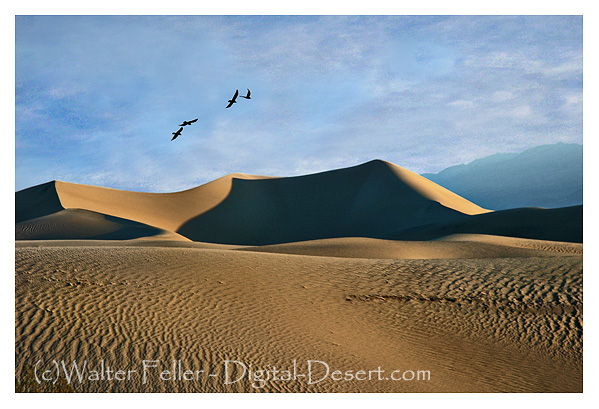
Mesquite Flats Dunes, Death Valley
The single major work on sand dune formation was written by R. A. Bagnold and published in 1941. Bagnold used wind tunnel experiments to make quantitative predictions about sand movement and accumulation and then successfully corroborated most of those predictions in field tests in the Libyan desert. He also speculated about some of the larger-scale phenomena that he was not able to test in his wind tunnel. Despite the fact that Bagnold's work is over forty years old, it is still the most widely quoted source on eolian sand deposits. According to a modern-day student of sand dunes, Bagnold's work "with relatively few modifications, has stood the test of checking since publication" (McKee, 1979, p.5).
Since Bagnold, additional important contributions to the study of eolian sands have been made in the field by Sharp (1963; 1966; 1978) and McKee (1979), among others. Important work has also been done in the application of aerial photography (Smith, 1968) and Landsat imagery (Fryberger and Dean, 1979; Breed and Grow, 1979) in the study of erg morphology. This paper will summarize the findings of research carried out in inland (non-coastal) desert eolian sand deposits.