-.-
Natural Bridge
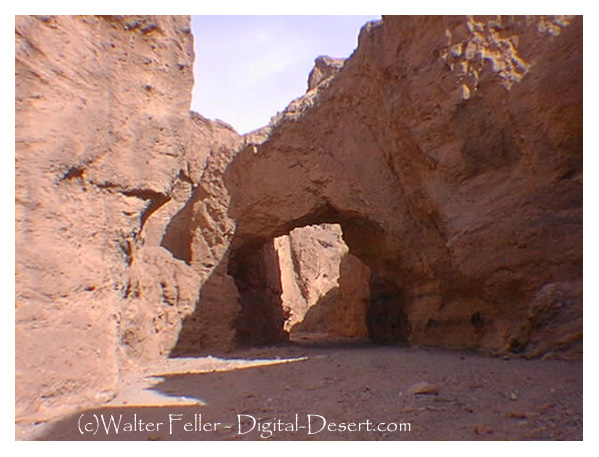
Natural Bridge in Death Valley formed as floodwater cut through cemented deposits of rock fragments, gravel, sand, and finer sediment. These materials washed down from nearby mountains and accumulated along the mountain front. Over time, the deposits became cemented, forming the coarse sedimentary rock exposed in the bridge and canyon walls.
The surrounding landscape reflects the faulting that shaped Death Valley. Fault movement helped establish the steep western face of the Black Mountains and the adjoining basin. Erosion carried debris from the mountains, while the difference in elevation provided a downhill gradient for runoff. Natural Bridge Canyon marks the northern end of the Badwater turtleback, a broad, sloping bedrock surface along the mountain front.
According to the National Park Service, the bridge developed through changes in the drainage route. Water temporarily followed a channel just north of the present bridge, lowering the canyon floor upstream. When flow returned to its original, straighter course, it cut an opening beneath the intervening rock. Continued erosion deepened the wash, leaving a section of the older deposit spanning the canyon.
Although Death Valley receives little rain, occasional flash floods carve its canyons. Dry waterfalls, vertical chutes, and hanging side canyons farther upstream provide additional evidence of erosion by flowing water. Natural Bridge records a change from sediment accumulation to erosion: the deposits formed first, and the opening developed later as water cut through them.
The National Park Service describes canyon erosion over thousands of years but assigns no precise age to the bridge opening. Natural Bridge remains within an active drainage where occasional floods continue to reshape the canyon.
References
National Park Service. "Natural Bridge." Death Valley National Park. Updated October 10, 2024. Describes the cemented alluvial deposits, drainage changes, bridge formation, and nearby erosional features.National Park Service. "Geology." Death Valley National Park. Updated January 9, 2022. Explains regional faulting, basin subsidence, erosion, and sediment deposition.
Machette, Michael N., Mary L. Johnson, and Janet L. Slate, editors. 2001. Quaternary and Late Pliocene Geology of the Death Valley Region: Recent Observations on Tectonics, Stratigraphy, and Lake Cycles. U.S. Geological Survey Open-File Report 01-51. Identifies Natural Bridge Canyon at the northern end of the Badwater turtleback.
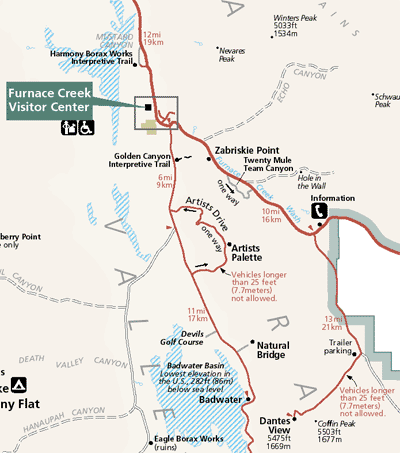
Map of Furnace Creek Area
 This
natural bridge
spans 46 feet and was created by
flash floods
running through the
wash.
Day Hikes in Death Valley
-
Length : 1 mile to end of canyon, .5 mile to natural bridge.
Difficulty : easy
Description : Uphill walk through narrow canyon. Large natural bridge at .5 mile. Trail ends at dry waterfall.
Start : Natural Bridge parking area. 1.5 miles off Badwater Road on gravel road, 13.2 miles south of Hwy 190.