-.-
Lake Los Angeles
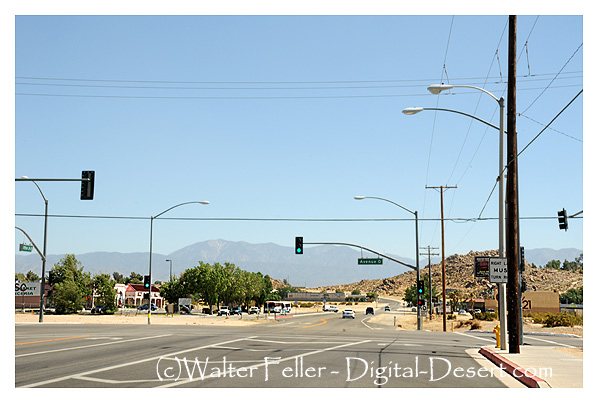
"The Community Under the Stars. Nestled among the scenic buttes a few miles east of Palmdale, California you will find Lake Los Angeles."
Lake Los Angeles Chamber of Commerce
The name catches many visitors by surprise.
People arriving in Lake Los Angeles often expect to find a broad lake shimmering beneath the desert sun. Instead, they discover something altogether different. The area is an expansive landscape of open valleys, distant mountains, granite buttes, Joshua trees, and skies that seem almost impossibly large. There is no natural lake here. The artificial one that inspired the community's name disappeared many years ago. Yet the name remains. It carries the optimism of an earlier generation and tells the story of one of Southern California's most ambitious desert communities.
Located about 17 miles east of Palmdale in the Antelope Valley, Lake Los Angeles occupies a quiet corner of the western Mojave Desert. Here, the pace of life is shaped more by seasons, weather, and landscape than by the bustle of nearby cities. To some, it is simply another High Desert town. To others, it is a place of wide horizons, brilliant sunsets, and star-filled nights-reminders of how much of California remains open and undeveloped.
However, the story of Lake Los Angeles begins long before its streets were surveyed or houses were built.
For thousands of years, Native Americans crossed these valleys. They stopped at dependable springs, gathered seeds, hunted game, and traveled between the mountains and the desert beyond. They understood where water could be found and how the seasons changed the landscape. They knew how to live within the limits of an arid environment. Their camps, tools, and archaeological sites remain. These represent the oldest chapters in the region's history.
Later came Spanish explorers, then Mexican stockmen, American ranchers, homesteaders, and finally dryland farmers. As time passed, windmills slowly appeared across the valley. Wells reached into underground aquifers, and scattered ranch houses broke the horizon. The desert demanded patience and ingenuity. People had to accept that water-not land-would always determine where they could live and prosper.
In the years after World War II, developers looked across this valley and imagined something new. Meanwhile, Southern California was growing rapidly: families searched for affordable homes, highways reached farther into the desert, and the aerospace industry transformed the Antelope Valley into one of the nation's centers for aviation research and manufacturing. Against this backdrop, on the broad desert floor east of Palmdale, planners envisioned a modern residential community built around an artificial recreational lake.
Advertising promoted clean air, mountain views, and open space. It promised a relaxed desert lifestyle. The slogan "The Community Under the Stars" celebrated remarkably dark night skies, far from Los Angeles's bright lights. Buyers purchased thousands of lots. Schools and businesses followed. A new community began to take shape.
The lake itself eventually disappeared. Keeping a permanent body of water in the Mojave Desert proved difficult and expensive. Changing economic realities ended that chapter. Yet the community stayed. Families continued to build lives here, adapting to the desert as earlier generations had done, though in very different circumstances.
Today, Lake Los Angeles is neither a failed dream nor merely a subdivision with an unusual name. It is a living community. Its history reflects many of the larger themes that have shaped the Mojave Desert: the search for water, the promise of inexpensive land, the influence of transportation and technology, the growth of Southern California, and the enduring appeal of open spaces.
The surrounding landscape offers more than quiet neighborhoods. Within a few miles are Lovejoy Buttes' granite domes, Lovejoy Springs, Saddleback Butte State Park, the Antelope Valley Indian Museum, and filming locations Four Aces Movie Ranch and Club Ed. These places reveal a landscape where natural history, archaeology, popular culture, and community life coexist.
To understand Lake Los Angeles, look beyond its streets and neighborhoods. The community cannot be separated from the desert that surrounds it. Its location, history, and even its name all come from the Antelope Valley itself. This landscape was shaped over millions of years by geologic forces, sustained by limited water, and reimagined by the people who have called it home.
This is the story of that landscape, the people who adapted to it, and the community that grew beneath one of California's greatest natural treasures: the stars.
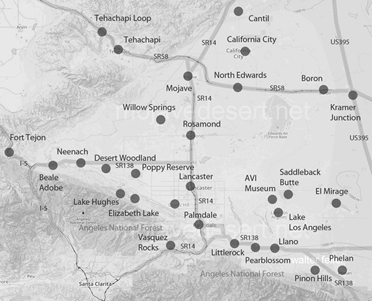
Antelope Valley Map
Four Aces Motel
Easy Rest Inn
Antelope Valley Indian Museum
Saddleback Butte State Park
Hi Vista Church
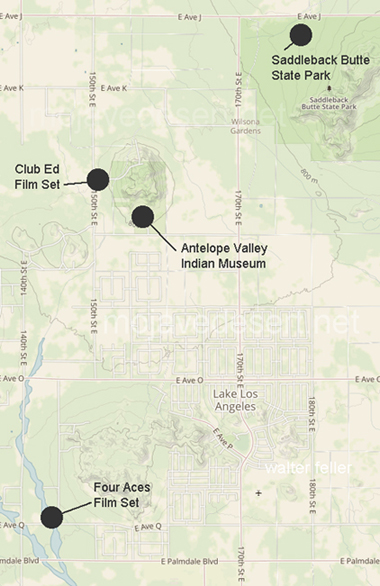
Lake Los Angeles Area Map