Owens Valley
Keeler, California
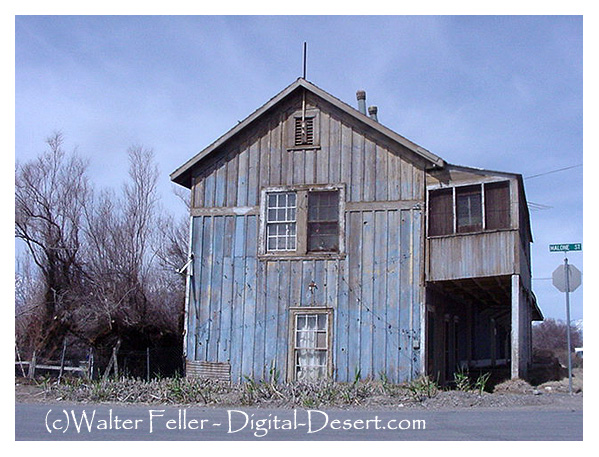
Julius M. Keeler arrived in the Owens Valley during the winter of 1879–1880 as an agent for D. N. Hawley and the Owens Lake Mining and Milling Company. The company had acquired the Union Consolidated mining properties at Cerro Gordo and planned to construct a new reduction mill on the eastern shore of Owens Lake.
In March 1880, Keeler began laying out a town and mill site near the Cerro Gordo landing. The settlement was initially called Hawley, evidently for D. N. Hawley, but was later renamed Keeler in honor of the company superintendent. The mill was intended to process ore from Cerro Gordo and establish a new industrial and shipping center near the remains of Swansea. It began operating in the spring of 1881. Owens Valley History

The company initially used the steamer Mollie Stevens to transport lumber, fuel and other freight across Owens Lake. When that vessel proved inadequate, Keeler arranged to rebuild the larger Bessie Brady. Launched in 1872, the Bessie Brady had been the lake’s principal commercial steamer during the height of the Cerro Gordo boom. She carried charcoal and supplies to Swansea and returned across the lake with heavy bars of silver-lead bullion for shipment south by wagon. On her maiden voyage, she reportedly transported approximately 700 bars—about thirty tons—of bullion.
In the spring of 1882, the Bessie Brady was pulled from the beach at Ferguson’s, also known as Lone Pine, Landing and towed to Keeler. Her hull was repaired, caulked and coated with coal-tar paint, while machinery from the Mollie Stevens was prepared for installation. At approximately 5:30 p.m. on May 11, 1882, the materials aboard the vessel caught fire. Contemporary accounts attributed the blaze to spontaneous combustion involving oakum, oil, paint and tar. The steamer was destroyed before she could return to service, effectively ending commercial steamboat navigation on Owens Lake. Inyo Independent, May 13, 1882, transcription
The Carson and Colorado Railway reached Keeler in 1883 and made the town its southern terminus. Its name expressed the promoters’ ambition to build from the Carson River region toward the Colorado River, but the railroad never approached the Colorado. Cerro Gordo’s great silver-lead boom had already declined, reducing the traffic its promoters had expected. Although the line was intended to continue south across the Mojave Desert, construction stopped at Keeler.
Keeler remained the end of the narrow-gauge line. Later revivals in silver, lead and zinc mining, together with salt, soda and other mineral traffic from Owens Lake, kept the railroad operating long after the original Cerro Gordo boom. Southern Pacific discontinued service to Keeler in 1960, and the remaining tracks were removed in 1961.
Cerro Gordo Keeler Cemetery Swansea Owens Valley Owens Lake Desert Steamers State Route 136 Remi Nadeau Carson & Colorado Keeler Smelter
 Southern Pacific

Soda works at Keeler
