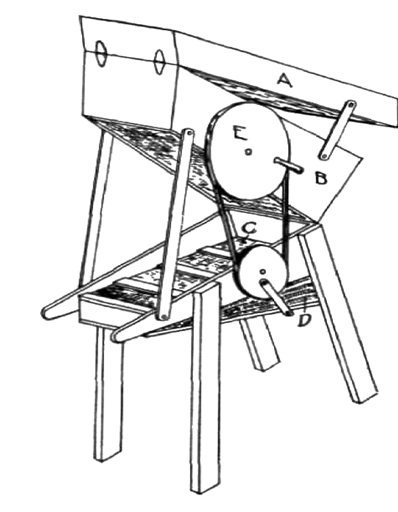
How A Bellows-Type Dry Washer Works
Gravel to be concentrated is shoveled onto screen (A), where the coarse material passes off the low end of the screen, and the fines go into the hopper (B). From the low end of the hopper, the sand falls to the riffles (C). Air from the bellows (D) lifts the lighter particles of sand over the riffles and off the low end of the washer, while the heavier particles of gold and black sands remain back of the riffles.The machine is operated by turning the crank (E) which is replaced with a small gasoline engine on some of the larger washers. The crankshaft is equipped with a cam to vibrate the screen, and a pulley wheel. The wheel transmits power by belt to an eccentric which operates the bellows.
To insure a flat surface and an even distribution of air in the gold recovery section, a riffle unit is built as follows: A well-braced heavy screen is covered with several layers of burlap and overtain by a piece of window screen, which is covered with handkerchief linen above which the riffles are placed from four to six inches apart. The riffles are made of half- to three-quarter-inch half-round moulding with the flat face on the upper side. If amalgamation of the flour gold is desired, pockets holding quicksilver are placed in front of the riffles. Some flour gold also passes through the handkerchief linen and is caught in the burlap.
—Text and drawing courtesy California State Division of Mines