Death Valley Wildflowers
Death Valley is famous for its dramatic spring wildflower displays, but those displays are never guaranteed. In some years, the desert floor and alluvial fans are bright with color; in other years, the bloom is sparse, though flowers are almost never entirely absent.A strong wildflower season usually depends on three conditions: well-spaced rainfall through winter and early spring, enough warmth from the sun, and the absence of drying winds. Rainfall is especially important. A single heavy storm in late October may not produce a strong bloom if the rest of the winter is dry. More reliable displays come when rain falls at intervals through the cool season, allowing annual seeds to germinate and continue growing.
Death Valley National Park supports more than 1,000 plant species, including 13 cactus species and 23 endemic plants found only in the Death Valley region. Many of the most noticeable wildflowers are desert annuals, also called ephemerals, because they live briefly, bloom, set seed, and disappear until favorable conditions return. Their colors range from white and yellow to purple, blue, red, and bright magenta.
Peak bloom varies by elevation. From mid-February to mid-April, flowers are most likely at lower elevations on the valley floor and alluvial fans, including areas near Jubilee Pass, Highway 190 near Furnace Creek, and the base of Daylight Pass. Common plants may include desert star, blazing star, desert gold, mimulus, encelia, poppies, verbena, evening primrose, phacelia, and several cactus species.
From early April to early May, blooms often move upward into the 2,000- to 4,000-foot elevations, especially in the Panamint Mountains. Paintbrush, Mojave desert rue, lupine, Joshua tree, bear poppy, cacti, and Panamint daisies may be seen there. From late April to early June, the highest blooms occur above 4,000 feet in the High Panamints, where Mojave wildrose, rabbitbrush, Panamint daisies, mariposa lilies, and lupine are among the characteristic plants.
Wildflowers in Death Valley are part of a protected desert ecosystem. Visitors should enjoy them where they grow and remember that National Park regulations prohibit picking wildflowers, so they remain for others to see and for the desert to reseed itself.
Wildflower Lists
-
White Blossoms
Orange and Red Blossoms
Yellow Blossoms
Pink and Lavender Blossoms
Blue and Purple Blossoms
Green and Brown Blossoms
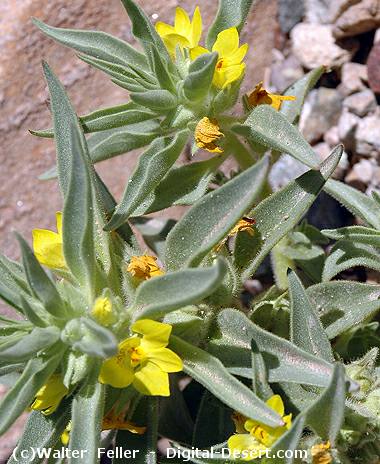
Lesser Mojavea Mohavea breviflora
Wildflower Slideshow
The wildflowers in this slideshow are an up-close look of the details of wildflower ...