Bitter Springs

Bitter Springs, Camp Cady, and the Fighting in the Mojave
Water formed the Mojave Desert roads. Long before pack trains, freight wagons, and soldiers came, the native people were familiar with the springs and places where rivers crossed. Ever since then, travelers have used those same water sources, which caused a growing amount of traffic to move into areas that had already been home to desert communities.
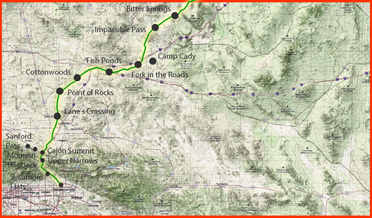
Bitter Springs was used as a place where people and animals could get water and graze on the Old Spanish Trail and later on the wagon road running between Salt Lake City and Southern California; the water was described by traveller Solomon Nunes Carvalho as brackish, not bitter. Nevertheless, both people and their animals needed the water.
The springs were located north of the Mojave River as part of the Salt Lake route. Near the river at the Fork of the Roads, this route branched off from the Mojave Road, which went east towards Fort Mohave. Camp Cady was established on the river some ten miles east of the fork.
In 1860 three killings led to calls for military intervention. Robert Wilburn, a cattleman, was killed close to the Mojave River in January, and in March Thomas S. Williams and Jackman, who were teamsters, were killed near Bitter Springs. The reports attributed the killings to the Paiutes, and the newspapers and businessmen in Los Angeles demanded that measures be taken to protect travellers and freight. However, those accusations did not prove that the Native people living around the springs had committed the murders.
General Newman S. Clarke directed Brevet Major James Henry Carleton to take action against the Indians in the area, and his orders did not call for Carleton to name the people who had actually committed the act. William and John Gorenfeld state that Lieutenant Colonel Benjamin Beall opposed the punishment of the local population in the situation where the guilty individuals may have come from elsewhere and had already left.
On April 12, 1860, Carleton left Fort Tejon with troops drawn from Companies B and K of the 1st Dragoons; he set up Camp Cady as his base camp and named it after Major Albemarle Cady, commander of Fort Yuma. The river provided water, and the site enabled patrols to operate along both roads.
At the Fish Ponds on the Mojave River, the soldiers came across two Native men, one of whom died during the fighting and the other of them was captured and said to have been killed when trying to escape; on April 22 their bodies were taken to Bitter Springs and hung from a scaffold as a warning.
On the 30th of April Lieutenant Milton T. Carr set out from Camp Cady with sixteen dragoons and a guide in order to scout towards Soda Springs and the Providence Mountains. As stated in the Gorenfeld account, his patrol attacked a small number of Native people near Old Dad Mountain on the 2nd of May, killing three individuals, wounding one and capturing an older woman; the soldiers had no casualties reported in that incident.
The heads of the three people who had been killed were removed and taken to Bitter Springs, where they were included in the display. After learning of the mutilations, Clarke ordered Carleton on May 28 to stop the practice and remove the remains from public view.
The patrols went on until June, and just before the expedition came to an end, representatives of the Native peoples went to Camp Cady to accept Carleton's peace proposals. On July 3rd the command started its journey back to Fort Tejon, leaving behind the defensive works at Camp Cady, Soda Springs, and Bitter Springs.
Camp Cady was used from time to time. It protected freight, travelers, and mail traveling along the Mojave Road. Around the mid-1860s, the road had become an important mail route linking Southern California with Prescott, Arizona.
On July 29, 1866, soldiers from Camp Cady fought a group identified as Paiutes near the post. The National Park Service says the commander believed the approaching group meant to attack and therefore opened fire first. It notes that three soldiers were killed and three were wounded.
Leonard Waitman, in The History of Camp Cady, offers an alternative account of the fight. He states that about twenty soldiers chased the Native fighters into thick undergrowth by the river, where they came upon an ambush. According to Waitman, five of the soldiers were killed, and several were wounded. The differences in the reported number of men engaged and the casualties still remain unexplained.
Waitman also states that a posse had set out from San Bernardino to reinforce the camp, but the Native fighters had already withdrawn before its arrival. The encounter, often called the Battle of Camp Cady, renewed calls for protection along the Mojave Road.
In 1868, the Army built better quarters about half a mile west of the first camp, including more space for a parade ground. Although some of the buildings at the older site continued to be used until the military left in 1871.
Bitter Springs and Camp Cady were part of a broader conflict over roads, water, and control of the desert. Travelers relied on scarce watering places, while Native people depended on the surrounding country for their livelihoods. The accounts examined do not show that the Native people who were killed during Carleton's campaign were responsible for the murders that prompted the campaign.
--
Today the site’s historic importance is preserved mostly in its name and in the old route logic it represents: a spring that held a route together.
Sheldon Stoddard
At Bitter Springs Lyman, Rich, Hopkins, Rollins and Captain Hunt started on ahead of the company on horseback, Stoddard accompanying them with a mule ...
Some Gang Members Elude Capture
Al Williams was the brother of Thomas Williams, the merchant killed by Indians and buried at Bitter Springs the year prior. It is somewhat ironic that Al Williams ...
A History of Zzyzx: 1860 - 1870 Army Outpost
The redoubt erected at Soda Springs is about the same size as that erected at Bitter Spring: it is called Hancock's Redoubt. (Named in honor of Army Quarter ...
Alvord Mine
This company owned the water rights for Paradise Springs, 9 miles north of the ... Wagon trail winds north and east from Alvord Summit toward Bitter Spring on ...
Bitter Springs
The Evolution of Bitter Springs - Fort Irwin Historical Review By Neil C. Morrison Museum Director NTC & 11TH ACR Museum ...
First Visitors to Bitter Springs
Father Francisco Garces. The first recorded contact with the local Native Americans was through Father Francisco Garces, ...
History in the Mojave Preserve
In 1860, two whites were murdered at Bitter Springs, on the Mormon wagon road, and the attacks were blamed on the "Pah-Utes," though contemporaries and ...
Man Dies at Lane's of Arrow Wounds
"Mr. Williams," the Los Angeles Star reported, "was buried at Bitter Springs, and Mr. Jackman was brought to Lane's ranch on the Mojave, where he receives ...
Mojave Desert Geomorphic Province
Goldstone Fault Blackwater Fault Bitter Springs Fault - Bicycle Lake Fault Gravel Hills - Harper Fault Zone Harper Lake Fault Lockhart and North Lockhart Faults
Vanyume Indians
First Inhabitants of Bitter Springs They were referred to by European travelers as Beneme, Vanyume, Paiute (Pah-Utah, Pai-Ute, Piute) and Serrano. They lived ...
Pioneer of the Mojave - Lane's Crossing
The Camel Express
In September of 1860, Aaron once again found himself in the center of activity when the camel "express" came by his ranch. Edward Beale had experimented with the capabilities of camels when he pioneered a wagon road through the Arizona desert in 1857, and had advocated the use of them.The Story of Bitter Springs
More about Bitter Springs
Paiute Campaign
Fort Irwin
Piute Campaign
Fort Irwin
Mojave Valley - Granite Mountains
Confederate forces acquired about eighty U.S. Army camels when they took over Camp Verde, Texas, in 1861. These animals belonged to the Army’s prewar camel experiment. Confederates used some for transportation, including hauling salt and carrying mail around San Antonio, but never developed a large camel service. Fort Lee, Virginia
A camel named Douglas, associated with the 43rd Mississippi Infantry, also carried supplies and served as a regimental mascot. nps.gov
There is an interesting connection: Jefferson Davis had supported the original U.S. Army camel experiment while serving as secretary of war, before becoming Confederate president.