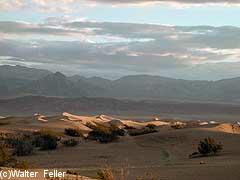
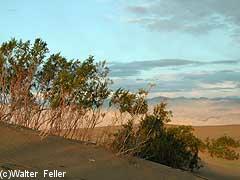
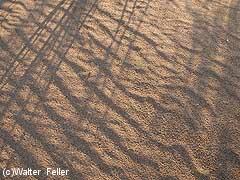
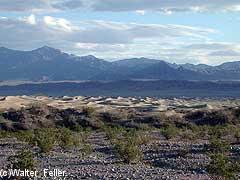
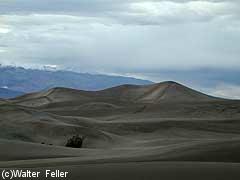
Mesquite Flats Dunes, Stovepipe Wells
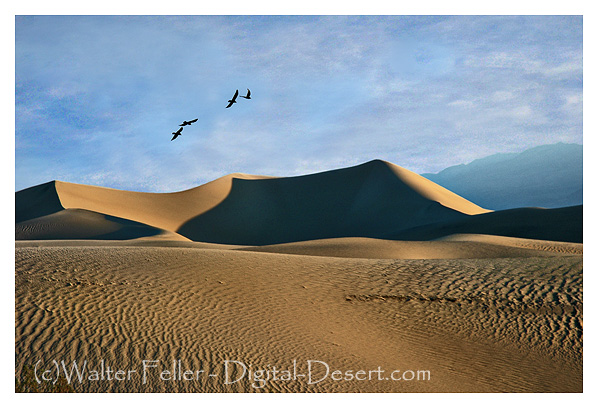
In Death Valley, sand dunes are less common than might be expected. Five widely separated dune fields exist in the national park--yet they account for only a fraction of the total acreage. Sand is scattered throughout the desert, but in only a few places is it gathered by the interaction of wind and mountains to form dunes.
Winds blowing through Death Valley are slowed here at the Mesquite Dunes by the changing shape of the valley and towering Tucki Mountain. The weakened winds cannot carry their cargo of sand any farther. Quartz grains, scoured from the surrounding mountains, compose the deposited sands. While winds constantly shape and reshape individual sand dunes, the dune field itself does not move.
Moderate winds blowing predominantly in one direction form transverse dunes. Winds blowing from several directions create non-migratory star dunes. The development of different dune types here indicate a complex wind flow pattern.
Related pages;
- Sand Dunes & Dust
The moving sand will stall and accumulate as dunes ...
- Desert Dune Habitat
Prevailing winds carry sands from dry lakes and ...
- Eureka Valley Dunes
Eureka Dunes rise nearly 680 feet above the valley floor in ...
- Saline Valley Dunes
Low and sweeping, the Saline Valley sand dunes ...
- Mojave Desert Sand Dunes
Sand dunes form wherever environmental conditions provide sand, steady wind and ...
- Mesquite Dunes Satellite Image