When will be the Next 'Big One?'
Along the Earth's plate boundaries, such as the San Andreas fault, segments
exist where no large earthquakes have occurred for long intervals of time.
Scientists term these segments "seismic gaps" and, in general, have been
successful in forecasting the time when some of the seismic gaps will produce
large earthquakes. Geologic studies show that over the past 1,400 to 1,500 years
large earthquakes have occurred at about 150-year intervals on the southern San
Andreas fault. As the last large earthquake on the southern San Andreas occurred
in 1857, that section of the fault is considered a likely location for an
earthquake within the next few decades. The San Francisco Bay area has a
slightly lower potential for a great earthquake, as less than 100 years have
passed since the great 1906 earthquake; however, moderate-sized, potentially
damaging earthquakes could occur in this area at any time.
A study completed in 2006 by Yuri Fialko, has produced the clearest evidence to date of the strain buildup
indicating that the San Andreas fault has been stressed to a level sufficient for the an earthquake of magnitude 7.0
or greater. The study also concluded that the risk of a large earthquake may be increasing faster than researchers had previously
believed. Fialko also emphasized in his study that, while the San Andreas Fault has experienced massive
earthquakes in 1857 at its central section and in 1906 at its northern segment (the great
San Francisco earthquake), the southern section of the fault has not seen a similar rupture in at least 300 years.
If such an earthquake were to occur, Fialko's study stated, it would result in substantial damage to
Palm Springs and a number of other cities in San Bernardino, Riverside and Imperial counties in California. Such
an event would be felt throughout much of Southern California, including densely populated areas of metropolitan
Los Angeles, Orange County and San Diego.
"The information available suggests that the fault is ready for the next big earthquake but
exactly when the triggering will happen and when the earthquake will occur we cannot tell," Fialko said.
"It could be tomorrow or it could be 10 years or more from now," he concluded.
A great earthquake very possibly will not occur unannounced. Such an
earthquake may be preceded by an increase in seismicity for several years,
possibly including several foreshocks of about magnitude 5 along the fault.
Before the next large earthquake, seismologists also expect to record changes in
the Earth's surface, such as a shortening of survey lines across the fault,
changes in elevation, and effects on strainmeters in wells. A key area for
research on methods of earthquake prediction is the section of the San Andreas
fault near Parkfield in central California, where a moderate-size earthquake has
occurred on the average of every 20-22 years for about the last 100 years. Since
the last sizeable earthquake occurred in 1966, Parkfield has a high probability
for a magnitude 5-6 earthquake before the end of this century and possibly one
may occur within a few years of 1988. The U.S. Geological Survey has placed an
array of instruments in the Parkfield area and is carefully studying the data
being collected, attempting to learn what changes might precede an earthquake of
about that size.
prev
-
next
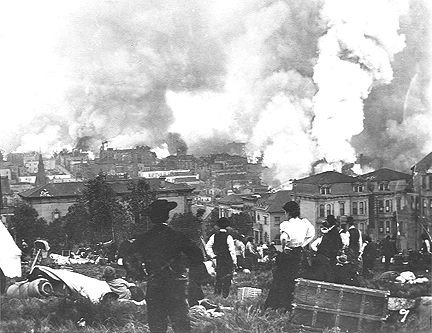
A devastating fire followed the 1906 earthquake in San Francisco
(photo from the P.E. Hotz Collection, USGS Library, Menlo Park, California)<
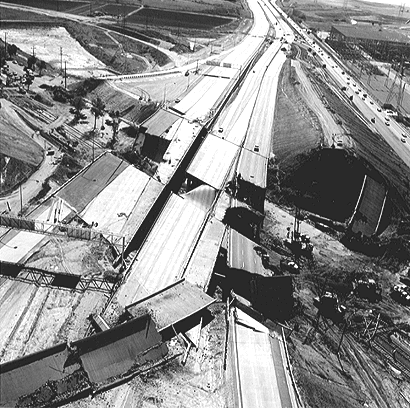
The San Fernando earthquake of 1971 collapsed freeway overpasses in southern California
(photo by Robert E. Wallace)