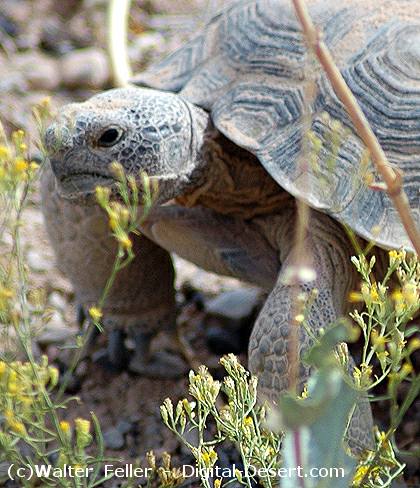
Desert Tortoise
The range of the desert tortoise includes the Mojave
and Sonoran deserts in southern California,
Arizona, southern Nevada, the southwestern tip of
Utah, and Sonora and northern Sinaloa, Mexico.
The Mojave population of the desert tortoise primarily
occupies valleys and bajadas characterized by
scattered shrubs. The soils range from sand to
sandy-gravel, though caliche soils, desert pavement,
and rocky, boulder terrain are occasionally used
(FWS 1994). Desert tortoises spend a large portion
of the year underground to avoid extreme temperatures
and, for younger tortoises, to avoid a variety
of predators, such as
coyotes,
foxes,
raptors, and
ravens
(BLM 1996). Tortoises generally are active during spring, early summer, and autumn when annual plants are most common and daily temperatures
are tolerable. Additional activity occasionally occurs during warm weather in winter months and after summer rainstorms (BLM 1996).
Desert tortoise habitat has been destroyed, degraded, and fragmented as a result of urbanization, agricultural
development, livestock grazing, mining and roads. The removal of tortoises by humans for pets
or for use as food or folk medicine is also a major factor in the decline of the desert tortoise population
(FWS 1994). A respiratory disease is an additional cause of desert tortoise mortality and population
decline, particularly in the western Mojave Desert (FWS 1994).
The Mojave population of the desert tortoise (an administrative designation for animals living north
and west of the Colorado River) is listed as a threatened species by the federal government since 1990
and the State of California. Critical habitat for this species was designated in 1994 (FWS 1994).
In June 1994, the U.S. Fish and Wildlife Service released the Desert Tortoise (Mojave Population)
Recovery Plan, which presented recommended prescriptions for population recovery and included
maps of the tortoise’s critical habitat and where recovery actions are recommended.
There are two areas of designated critical habitat in the Preserve. The northern area includes Ivanpah
Valley, south of Nipton Road, including the areas north, west and south of Cima Dome, extending up
to Interstate 15. This area totals approximately 492,360 acres (769 square miles) and is within the
Eastern Mojave Recovery Unit. The second area of the park that contains desert tortoise critical habitat
is the Fenner/Clipper Valley. This area contains 280,103 acres (438 square miles) of federal land. This
habitat is also within the Eastern Mojave Recovery Unit. Private, state and local agency lands were not
considered in this general management plan recovery effort and are not considered part of the recovery
effort unless the land is subsequently acquired by the adjacent managing agency. These two areas
of critical habitat combined total about 772,463 acres (48%) of the Preserve designated as critical
habitat for this species (FWS 1994). Critical habitat also extends north of the Preserve onto BLM lands in
the Shadow Valley area up to the southern slope of the Kingston Range and on adjoining BLM lands
north of Nipton Road up to Ivanpah Dry Lake. There are also large areas of critical habitat to the south
and east of the Fenner/Clipper valley area in California and Nevada.
source - NPS